protein powder ads
Protein powder ads that sell the taste and the label (with real examples)
Every tub promises grams of protein. What decides the sale is everything a buyer can't check from the feed: will it taste like chalk, will it clump, what's sweetening it, and is it really what the label says. Below are seven ads our engine made for Northvale Nutrition, a fictional whey isolate brand, each answering one of those doubts with a fact from its own page.
Updated · The sample ads are for a fictional brand, made by our engine.
In short
What makes a good protein powder ad?
A good protein powder ad answers the doubt that stops people buying: taste, mixing, sweeteners or trust. Print the macros straight from the label (protein, calories and sugar per scoop), show the real tub, quote a customer on taste, and name testing or certification exactly as your label states it. Leave out body-transformation promises.
Real sample ads
Seven protein powder ads for Northvale
Northvale Nutrition is a fictional brand. Its product page: grass-fed whey protein isolate, Vanilla Bean, flavored with real Madagascar vanilla and sweetened with monk fruit; per 30 g scoop, 25 g protein, 110 calories, 1 g sugar and 5.5 g BCAAs; 30 servings per 2 lb tub; third-party tested for heavy metals and banned substances; $54 (was $62), 4.7 from 2,986 reviews. Each ad tackles a different doubt.
Northvale Nutrition · Grass-Fed Whey Isolate, Vanilla Bean, 2 lb · $54 (was $62) · 4.7 from 2,986 reviews · fictional
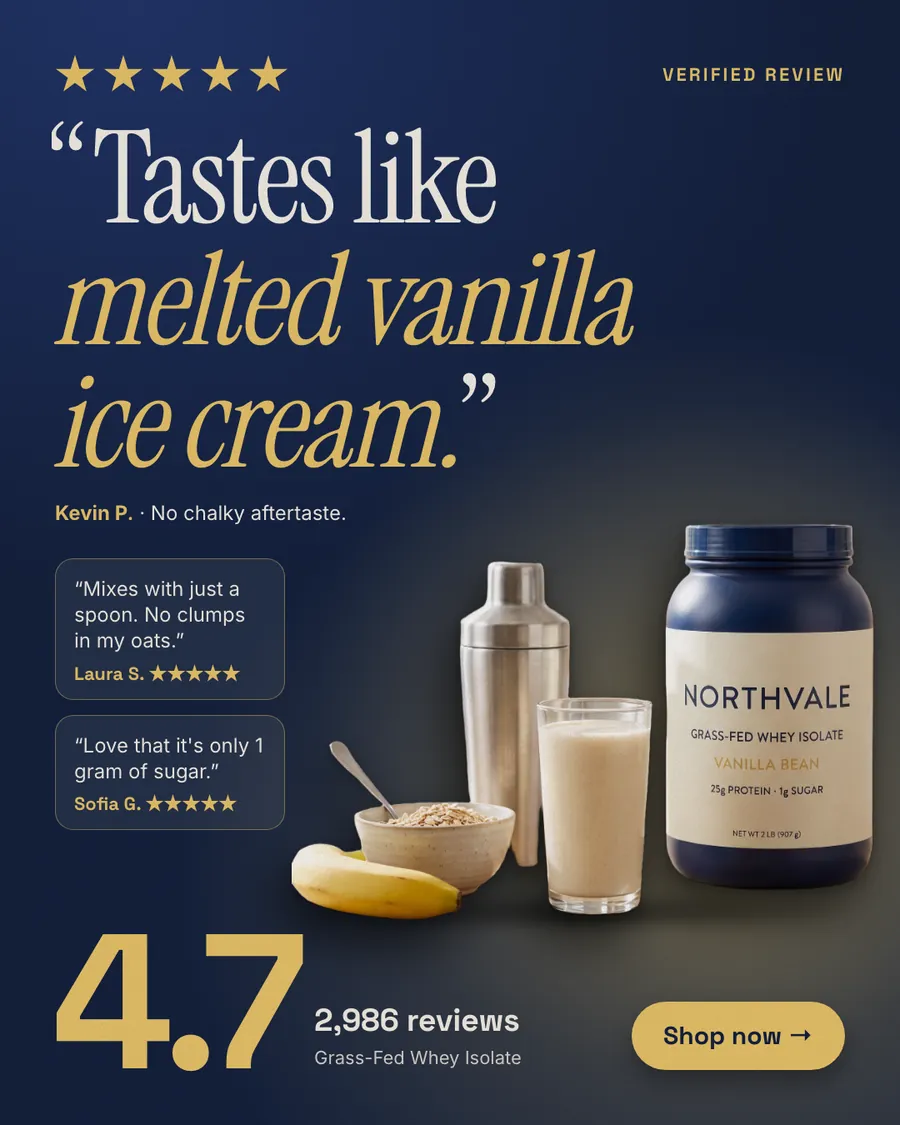
Review cardTaste
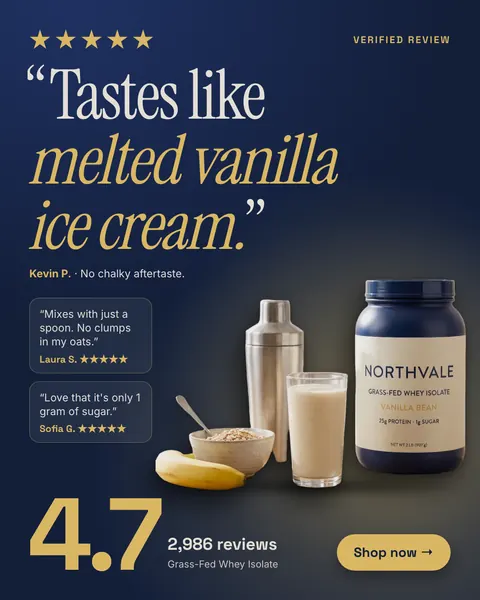
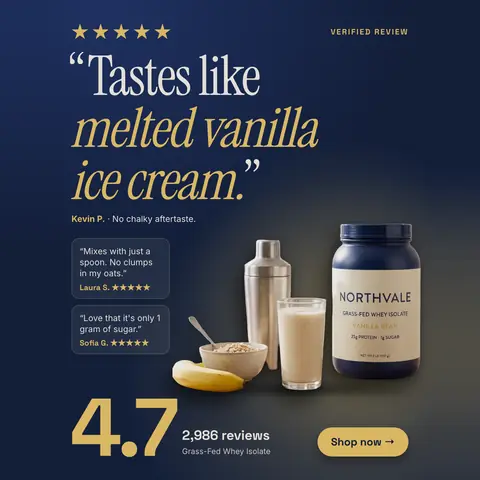
Northvale Nutrition: “Tastes like melted vanilla ice cream.”
Taste is the doubt every protein buyer brings from a bad tub, so a customer's taste line is the headline and the smaller quotes cover the next two worries: clumps and sugar. The 4.7 and the count keep it from reading as one lucky review.
Store facts used: Reviewer quotes (Kevin P., Laura S., Sofia G.), 4.7 rating, 2,986 reviews, 25g protein, 1g sugar, 2 lb tub
Matched by the fact check: 4.7 rating · 2,986 reviews · only 1 · 3 review quotes, word for word
The 2:3 Pinterest version
Fictional sample brand · made by our engine
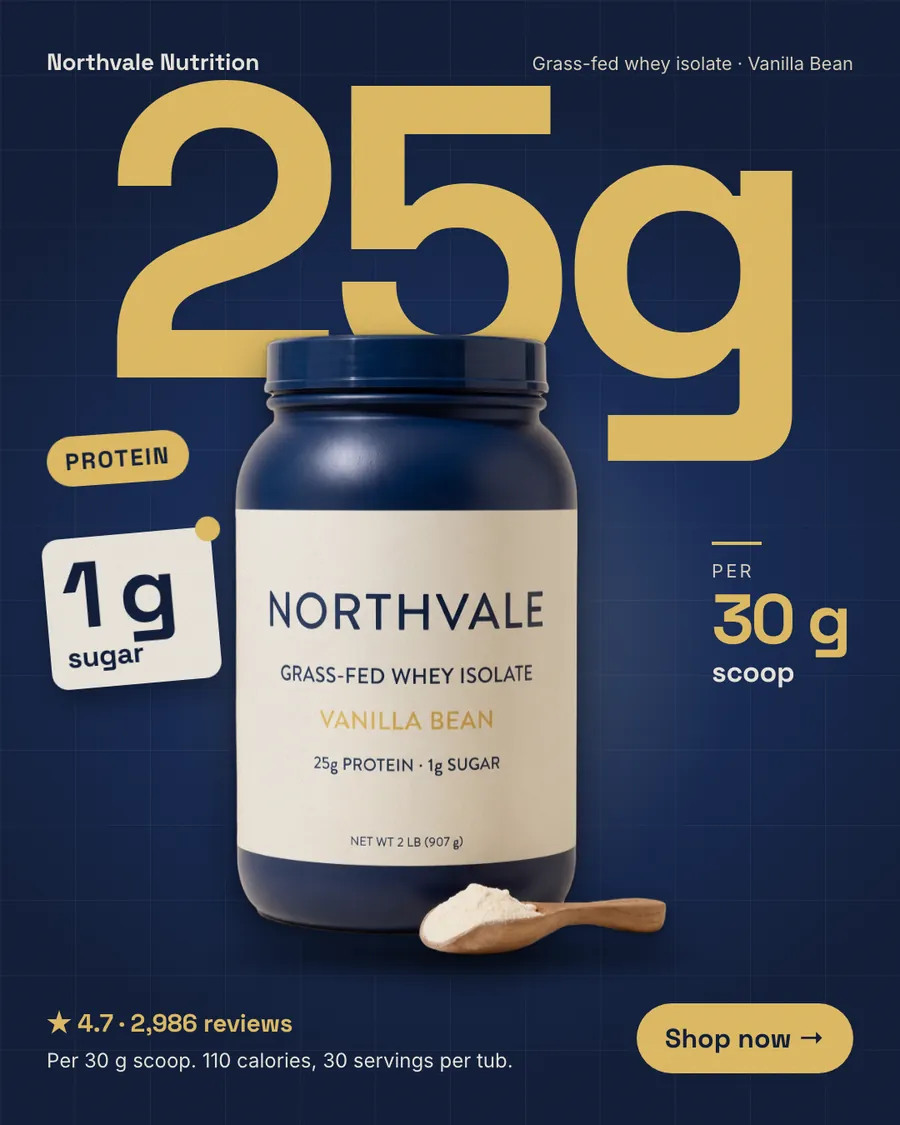
Big numberBenefit
Northvale Nutrition: 25g protein. 1 g sugar.
The 25g is the biggest thing on the ad and sits right behind the tub, so the number on the label gets read first. The 1 g sugar card and the small print on calories and servings back it up.
Store facts used: 25g protein, 1 g sugar, 30 g scoop, 110 calories, 30 servings per tub, 4.7 from 2,986 reviews, 2 lb tub
Matched by the fact check: 4.7 rating · 2,986 reviews · 1 g · 30 g · 110 calories · 30 servings
The 2:3 Pinterest version
Fictional sample brand · made by our engine
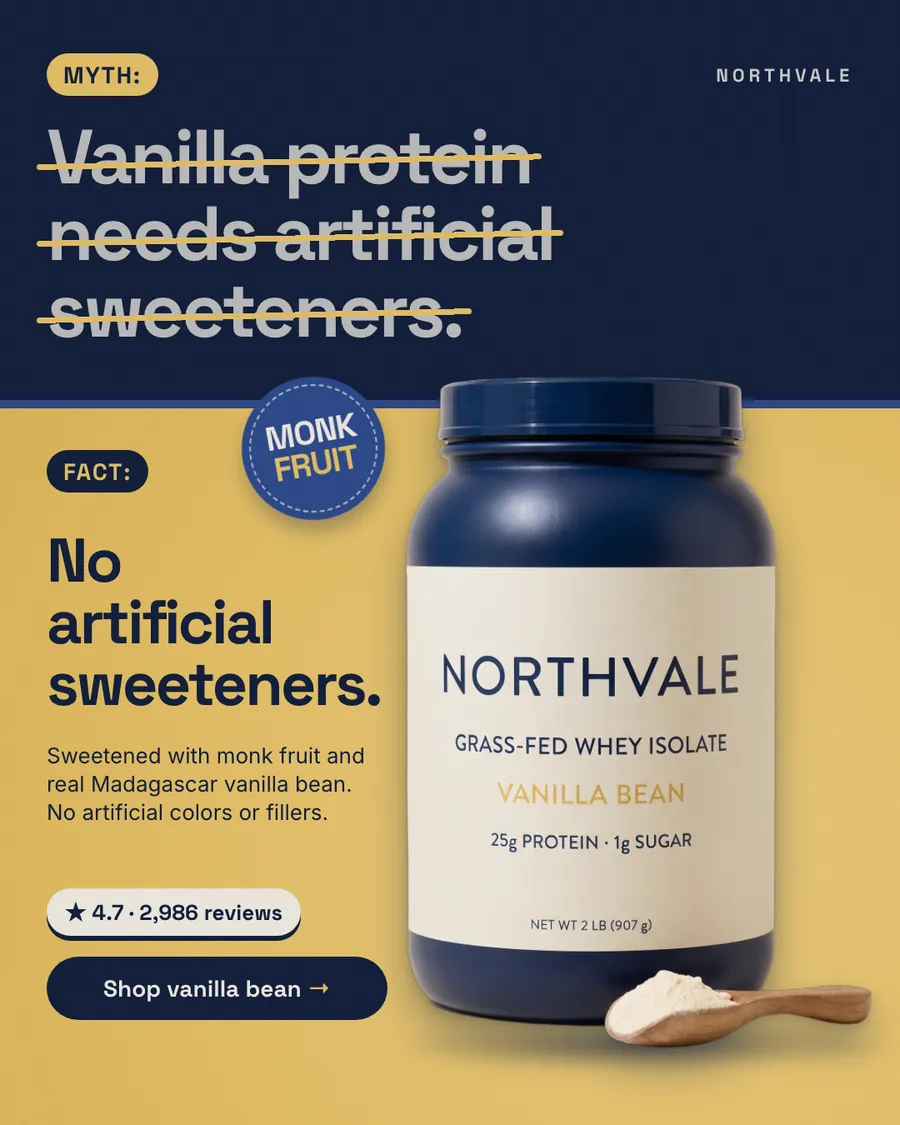
Myth vs factIngredients
Northvale Nutrition: MYTH: Vanilla protein needs artificial sweeteners.
Myth versus fact lets the ad make a comparison without naming anyone else's tub. The fact is checkable on the label (monk fruit, no artificial sweeteners), which is what makes the format honest rather than smug.
Store facts used: Monk fruit, real Madagascar vanilla bean, no artificial colors or fillers, 25g protein, 1g sugar, 2 lb, 4.7 from 2,986 reviews
Matched by the fact check: 4.7 rating · 2,986 reviews
The 2:3 Pinterest version
Fictional sample brand · made by our engine
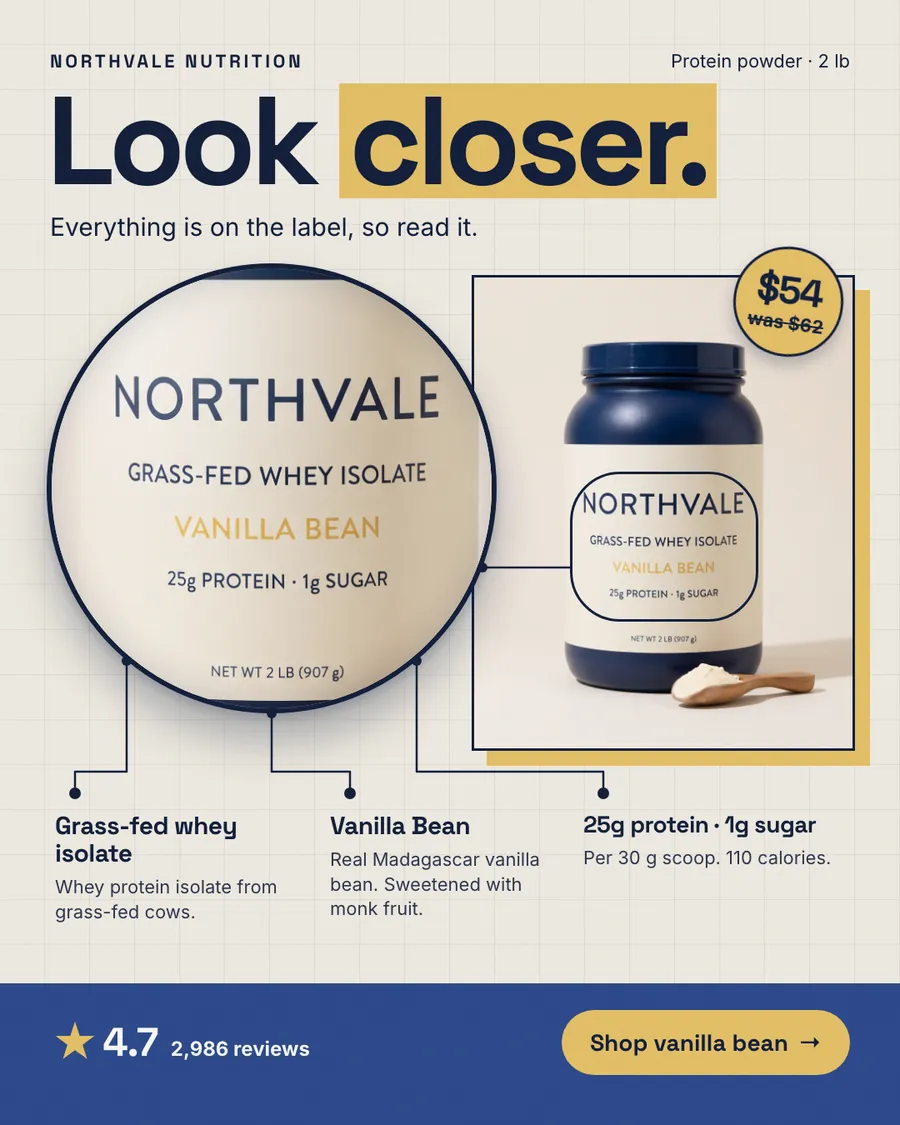
Look closerTransparency
Northvale Nutrition: Look closer.
The magnified label circle with lines to three short notes makes the ad feel like reading the label itself. Each claim sits next to the detail that backs it, so the proof is on the page.
Store facts used: Grass-fed whey isolate, monk fruit, 25g protein, 1g sugar, 30 g scoop, 110 calories, $54, was $62, 4.7 from 2,986 reviews
Matched by the fact check: $54 · $62 · 4.7 rating · 2,986 reviews · 25g · 1g · 30 g · 110 calories
The 2:3 Pinterest version
Fictional sample brand · made by our engine
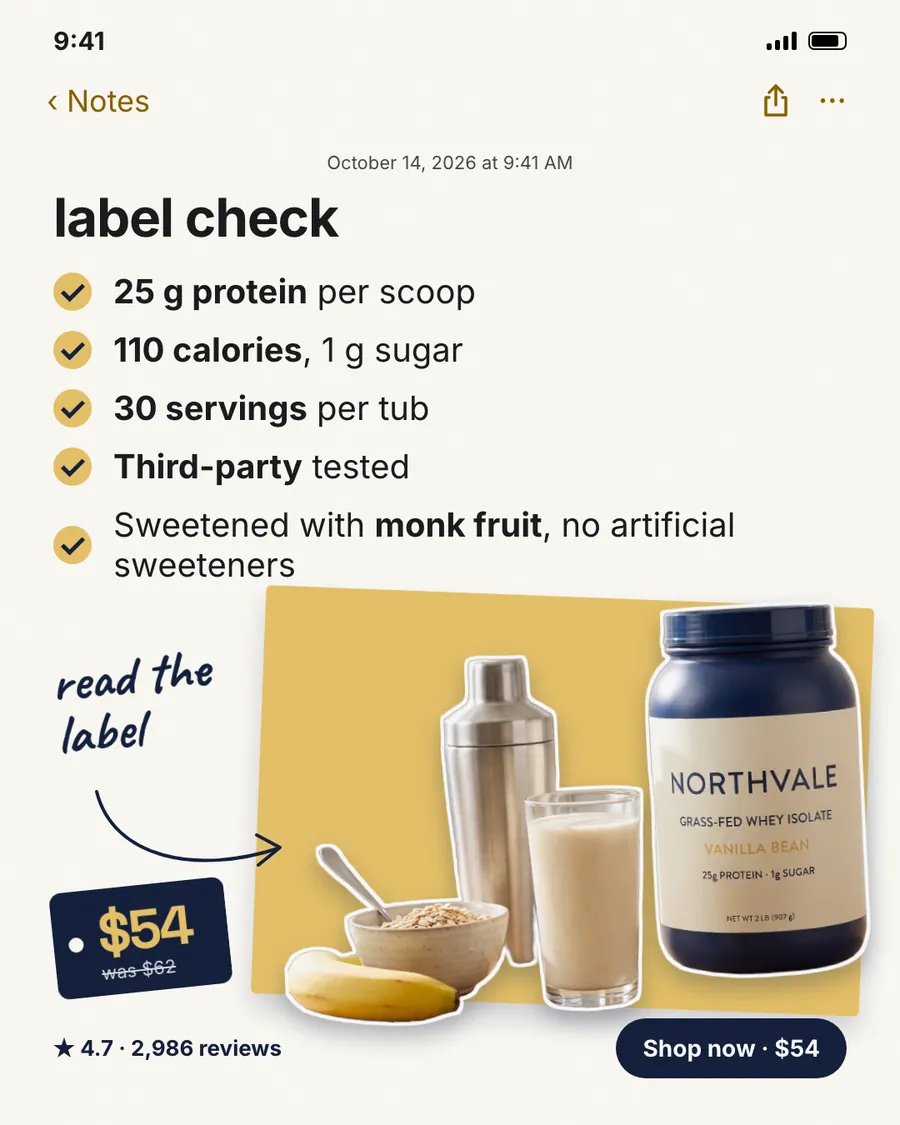
Notes-app listTransparency
Northvale Nutrition: label check
A label check in a notes app is how a careful buyer actually shops protein. Every ticked line is printed on the tub, and the arrow sends the eye to the real label to confirm it.
Store facts used: 25 g protein, 110 calories, 1 g sugar, 30 servings, $54, was $62, 4.7 from 2,986 reviews
Matched by the fact check: $54 · $62 · 4.7 rating · 2,986 reviews · 25 g · 110 calories · 1 g · 30 servings
The 2:3 Pinterest version
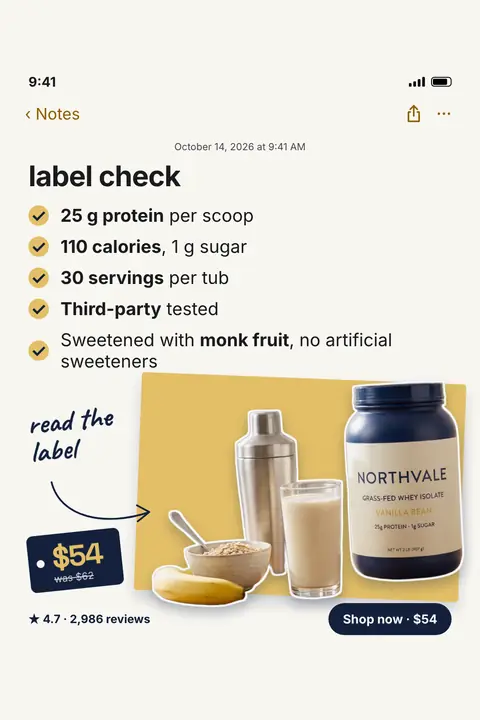
Fictional sample brand · made by our engine
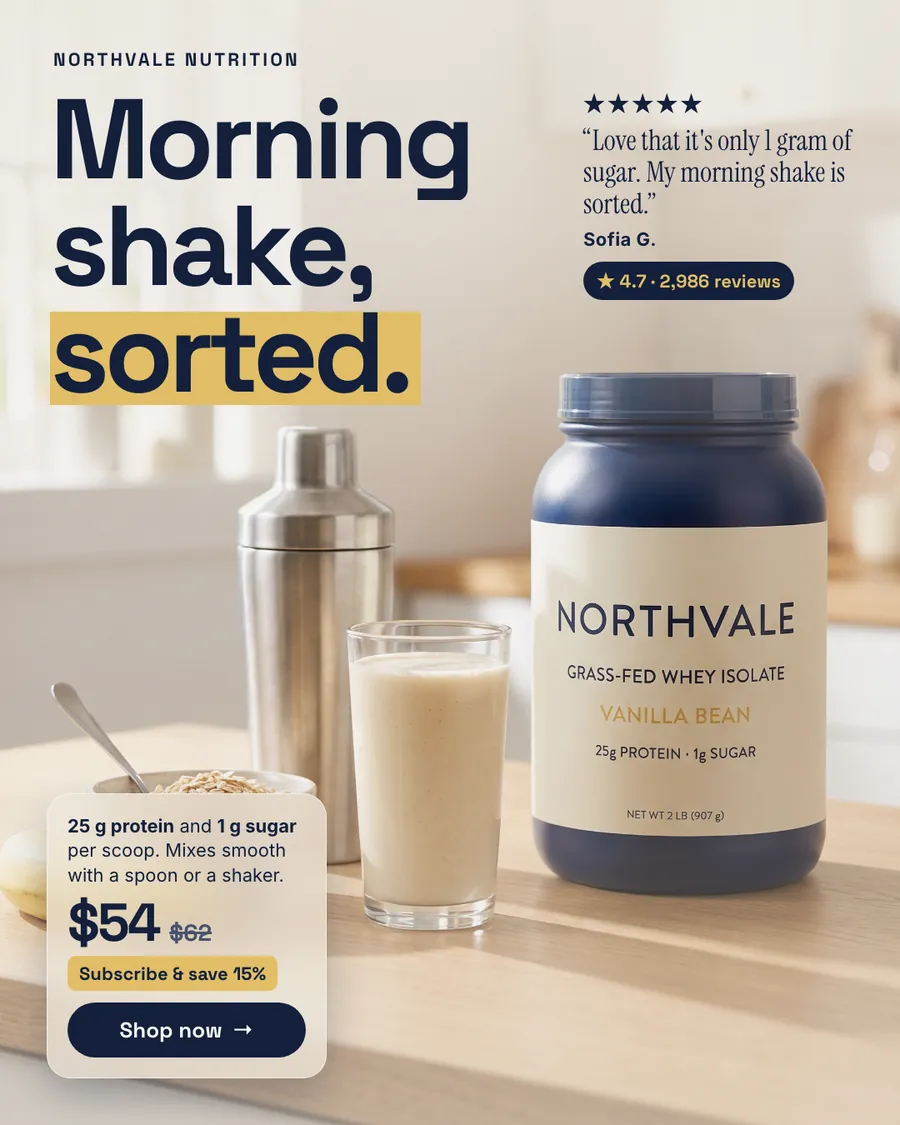
Lifestyle typeRitual
Northvale Nutrition: Morning shake, sorted.
The kitchen counter scene shows the whole routine at a glance: tub, shaker, finished shake. The reviewer's quote about 1 gram of sugar backs the headline, and the price sits next to the button.
Store facts used: 25 g protein, 1 g sugar, $54, was $62, subscribe and save 15%, 4.7 from 2,986 reviews, Sofia G. quote
Matched by the fact check: $54 · $62 · save 15% · 4.7 rating · 2,986 reviews · 25 g · 1 g · 1 review quote, word for word
The 2:3 Pinterest version
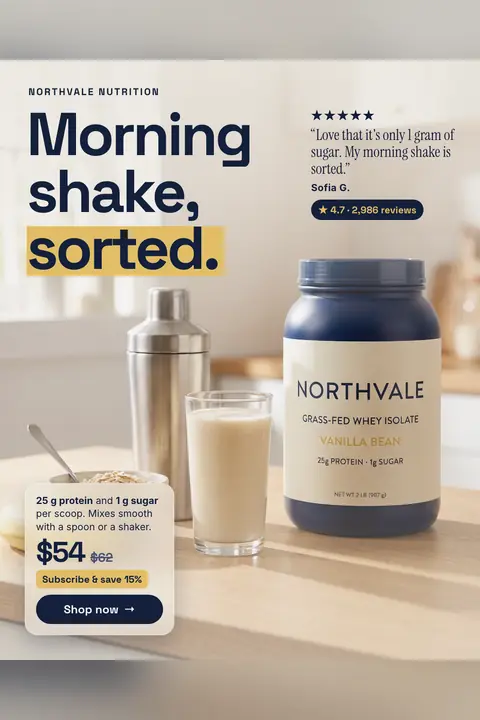
Fictional sample brand · made by our engine
Price dropOffer
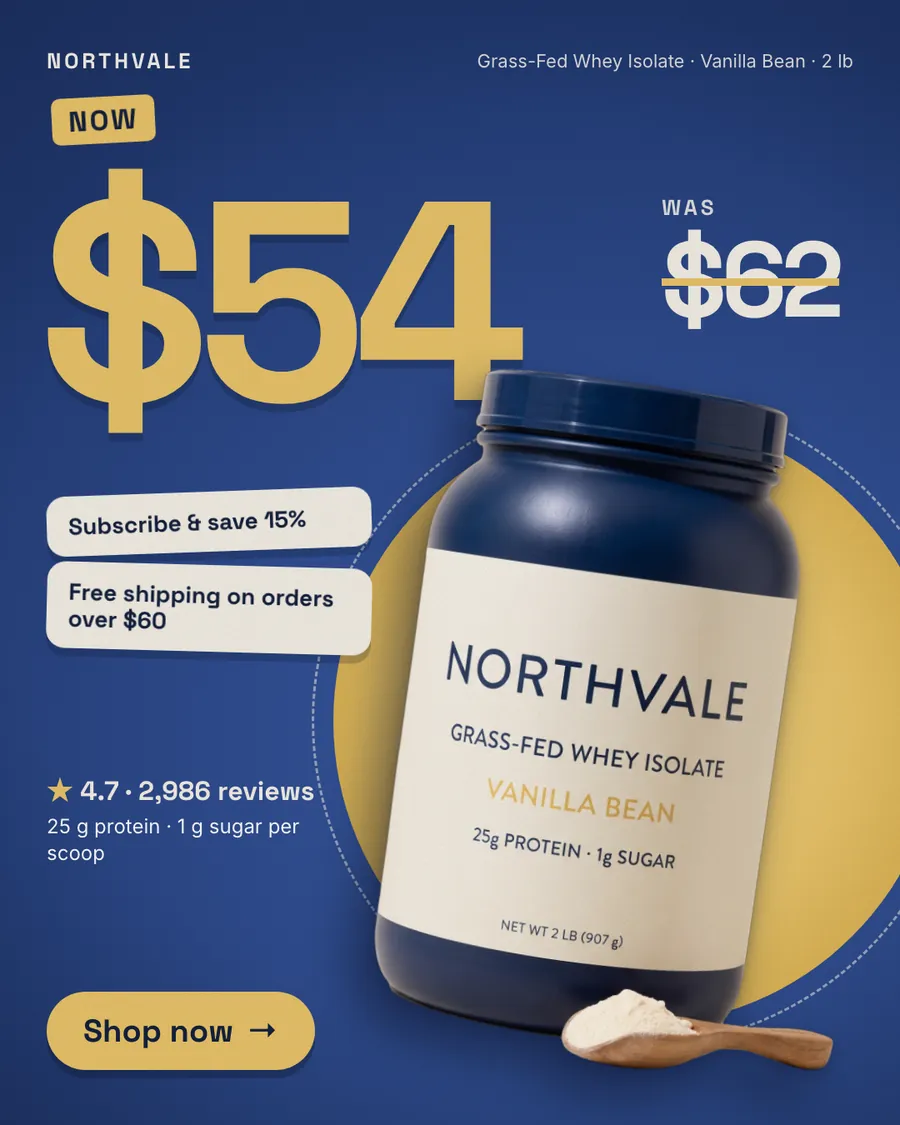
Northvale Nutrition: Now $54. Was $62.
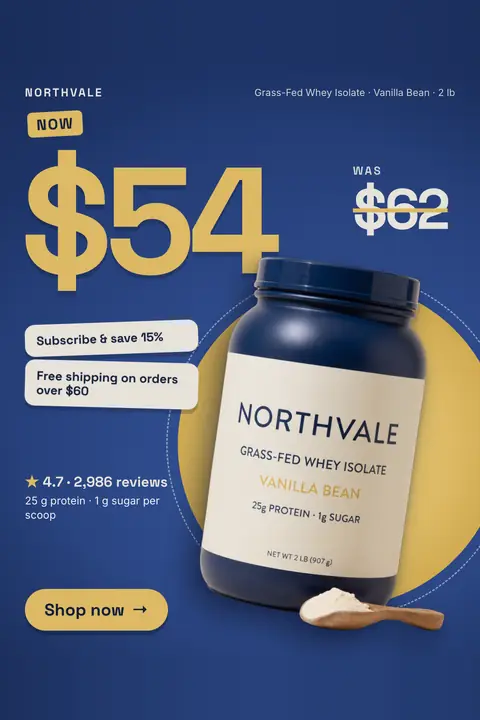
The new $54 is the biggest thing on the ad, and the crossed-out $62 sits beside it, so the drop reads at a glance. The tub photo and the rating sit below, so price and product are seen together.
Store facts used: $54, was $62, subscribe and save 15%, free shipping over $60, 4.7 from 2,986 reviews, 25 g protein, 1 g sugar
Matched by the fact check: $62 · $60 · save 15% · 4.7 rating · 2,986 reviews · 15% · 25 g · 1 g
The 2:3 Pinterest version
Fictional sample brand · made by our engine
The same ad in all five sizes
4:5 · Facebook and Instagram feeds
1:1 · Square placements
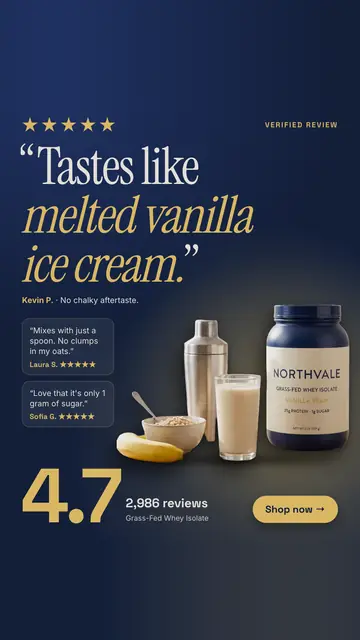
9:16 · Stories, Reels, TikTok
2:3 · Pinterest
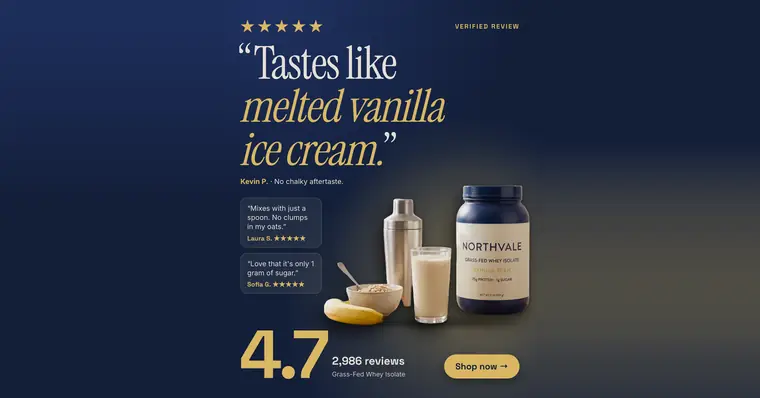
1.91:1 · Google Display
What makes a protein powder ad work: four doubts to answer
Protein buyers rarely need convincing that they want protein. They need convincing about this tub. Four doubts cover most of it.
- 01
Will it taste good?
Most buyers have already finished, or given up on, a chalky tub. Taste is the first thing to prove and the hardest to prove in a picture.
See it in the ad "“Tastes like melted vanilla ice cream.”"Proof the ad needs
A customer's taste description quoted word for word ("Tastes like melted vanilla ice cream"), the flavor source as the label names it (real vanilla bean) and the sweetener.
- 02
Are the numbers good?
Lifters and label readers compare grams of protein per scoop, calories, sugar and cost per serving before they compare anything else.
See it in the ad "25g protein. 1 g sugar."Proof the ad needs
Protein, calories and sugar per scoop exactly as the Nutrition Facts panel lists them, with the scoop size: 25 g protein, 110 calories, 1 g sugar per 30 g scoop. Servings per tub turn price into cost per serving: $54 for 30 servings is $1.80.
- 03
What's sweetening it?
Sweeteners split protein buyers more than flavors do. People who avoid artificial ones read the ingredient list to check.
See it in the ad "MYTH: Vanilla protein needs artificial sweeteners."Proof the ad needs
The sweetener named as on the label (monk fruit) and what's left out (no artificial sweeteners, colors or fillers), shown next to the real tub so the claim can be checked.
- 04
Is it what the label says?
Athletes who are drug tested, and careful buyers generally, look for outside testing before they trust a powder.
See it in the ad "Look closer."Proof the ad needs
What was tested, in the page's words (third-party tested for heavy metals and banned substances). A certification mark is a bigger claim than testing, and only belongs on the ad if the product holds it.
Read the label the way a buyer does
Protein ads that win usually just print the label better than the label does. These are the lines buyers check, and how each one turns into ad copy.
| Label line | What buyers work out | In the ad |
|---|---|---|
| Serving size and protein per serving | How much of the scoop is protein: 25 g in a 30 g scoop is about 83% | "25 g protein in every 30 g scoop" |
| Calories and sugar | Whether it fits what they track | "110 calories. 1 g sugar." |
| Ingredients and sweetener | Artificial or not, and what else is in the tub | "Sweetened with monk fruit. Nothing artificial." |
| Servings per container and price | Cost per serving | "$1.80 a serving" ($54 / 30) |
| Testing or certification | Whether anyone outside checked it | "Third-party tested for heavy metals and banned substances" |
Words like "high protein" or "excellent source of protein" are FDA-defined: the food has to provide at least 20% of the Daily Value per serving (21 CFR 101.54). A plain number such as "25 g protein" says the same thing more clearly and needs no definition.
Photo checklist for protein powder ads
Protein photos have to prove two things a still image struggles with: texture and taste. Mixing shots do the first; customers' words do the second.
The tub straight on, flavor and grams readable. Buyers look for the flavor name and the protein number first. If either is blurry, the ad is selling a generic tub.
A level scoop of powder. Shows the color and fineness and makes the 30 g serving real. Northvale's ads put a scoop of powder beside the tub for this.
The finished shake, no clumps. Mixability is the second doubt after taste. A smooth glass, or a spoon in a bowl of oats if it mixes that way, answers it.
The Nutrition Facts panel, flat and sharp. The source of every number in the copy. Shoot it separately for label-check and look-closer layouts.
A real morning counter. Shaker, tub, banana, oats: the routine the product joins. Northvale's lifestyle ad is built on one.
The shaker and the tub together. If you sell a shaker, show it beside the tub; it lifts order value without a discount.
Skip the transformation physique. A shredded torso next to the tub reads as a promise of that result, which brings weight and endorsement rules into play.
Protein powder ad copy lines you can adapt
Use your own label numbers and reviews. Lines built on numbers and taste are easier to believe than lines about effort and motivation, which most gym brands already use.
25 g protein. 1 g sugar. 110 calories.
Straight from the panel, per scoop.
"Tastes like melted vanilla ice cream."
A real review, word for word, with the name.
Sweetened with monk fruit. Nothing artificial.
Only if the ingredient list agrees.
$1.80 a serving.
Price divided by servings per tub.
Mixes with a spoon.
Northvale's page says so; a customer says it too.
Real Madagascar vanilla bean.
Third-party tested for heavy metals and banned substances.
Morning shake, sorted.
The routine, not the body.
Lines to leave out of protein powder ads
| Avoid | Why | Say instead |
|---|---|---|
| "Build muscle fast" | A body-composition result is a health claim that needs evidence, and it depends on training and diet more than on the tub. | "25 g protein per scoop." |
| "Get shredded" over a before-and-after physique | Weight and body-shape promises move the ad into Meta's weight loss rules (adults only, no statements attacking appearance), and the FTC treats a customer's results as what buyers can generally expect. | "Morning shake, sorted." |
| "Excellent source of protein" without checking | It's an FDA-defined term: at least 20% of the Daily Value per serving, and it has to match your label. | The plain number: "25 g protein per scoop." |
| "Certified clean" when it's only lab tested | A certification mark tells buyers an independent body tested it and audits the maker. Testing you commissioned is a smaller, different claim. | "Third-party tested for heavy metals and banned substances." |
| "Won't upset your stomach" | Turns one customer's experience into a promise about the viewer's digestion. | "The first protein that doesn't upset my stomach." (Mike D., a customer) |
Protein powder claims: what Meta, the FDA and the FTC allow
Good news first: Meta's Health and Wellness policy lists general food products, including protein products, among the things its adults-only targeting rule doesn't cover. That changes the moment an ad is about weight.
- Weight loss and weight gain. Ads for weight loss or weight gain products must target people 18 or older, can't make statements of inferiority about someone's appearance and can't show close-ups pinching fat. A "bulk up" ad for a mass gainer is a weight gain ad.
- Nutrient words. "High", "rich in" and "excellent source of" mean 20% or more of the Daily Value per serving under 21 CFR 101.54. "Good source" means 10 to 19%.
- Certification marks. NSF says its Certified for Sport mark means the product was tested for 290 substances banned in sport, its contents match the label and the facility is audited. Use a mark only if your product carries it.
- Transformations and testimonials. The FTC's Endorsement Guides say an ad that features a customer's results will be read as what others can expect, so a best-case physique needs evidence that it's typical.
A protein powder labeled as a dietary supplement (a Supplement Facts panel rather than Nutrition Facts) may be treated as a supplement, and Meta does require adults-only targeting for those. If in doubt, target 18+.
The protein powder calendar, 2026 to 2027
Protein follows training seasons and the tub itself: a 30-serving tub used daily lasts about a month, which makes reorder timing as important as any holiday.
| When | Moment | What to run |
|---|---|---|
| Nov 27 to 30, 2026 | Black Friday to Cyber Monday | Two-tub bundles and subscribe-and-save, with the price per serving in the ad. |
| Dec 1 to 17 | Gifts for people who train | Tub plus shaker as a set; order-by dates for heavy parcels (USPS Ground Advantage recommends Dec 17 for Christmas). |
| Jan 1 to mid-February, 2027 | New training plans | New buyers who have never found a protein they like: lead with taste and the label, not with bodies. |
| About day 25 after an order | The tub runs low | A reorder ad to recent buyers: flavor, subscription price, nothing new to explain. |
| March to June | Outdoor and race season | On-the-go shakes and the shaker bottle; recipes with the tub in frame. |
| July and August | Shakes as breakfast | Cold shakes and smoothie bowls, 1 g sugar in the headline. |
| Late August to Sep 6, 2027 | Back to the gym | Routine and subscription ads to lapsed buyers. |
What people ask about protein powder ads
What is a catchy slogan for protein?
A number or a taste beats effort talk: "25 g protein. 1 g sugar.", "Tastes like dessert, reads like a label", "Morning shake, sorted." Gym clichés about grinding and gains blend into every other protein ad in the feed.
How do I advertise protein powder on Facebook and Instagram?
Run four or five ads that each answer one doubt: taste (a review), numbers (macros per scoop), sweeteners (myth versus fact), trust (testing) and price. Make 4:5 versions for feeds and 9:16 for Stories and Reels, and keep body-transformation promises out so the ads stay out of Meta's weight rules.
How do I promote protein powder?
Lead with what people can't tell from the tub: how it tastes and mixes. Customer quotes, mixing shots and a clear label do most of the work. Then make reordering easy with a subscription and time a reminder for when the tub runs low.
What should protein powder ad copy say?
One doubt per ad, answered with a checkable fact: grams per scoop, calories, sugar, the sweetener, testing or a customer's taste quote. Use the exact numbers on your panel and the exact testing wording on your page.
Are protein powder ads restricted on Facebook?
Less than supplements. Meta's Health and Wellness policy exempts general food products, including protein products, from its adults-only rule. Ads about weight loss or weight gain do need 18+ targeting and can't attack anyone's appearance, and a powder labeled as a dietary supplement may be held to the supplement rule.
Are funny protein powder ads a good idea?
Humor works when the joke is about a shared experience, like a chalky shake or a clumpy spoon, and the ad still ends on a fact. Jokes about bodies risk Meta's rules on appearance and can put off the very people you want to buy.
How do I advertise protein powder on TikTok?
TikTok runs 9:16, so make the vertical version with the tub and one big number in the middle of the frame, away from the edges where the app's buttons sit. Taste and mixing are the stories that suit short video: a spoon stirring the powder smooth does more than a speech.
What makes a good protein powder poster?
One number or one quote set large, the real tub big enough to read the flavor, and the price per serving small at the bottom. Northvale's "25g protein. 1 g sugar." ad is built exactly that way.
Should protein ads mention third-party testing?
Yes, if it's true, and in exactly the words your page uses: what was tested (heavy metals, banned substances) and by whom if you can say. Don't upgrade testing to certification; a certification mark is a separate claim.
Make ads like these for your protein powder
Paste your store link and get 3 free ads of your own protein powder: we read your products, prices and reviews, design around your real product photo and check every fact against your store.
Where to go next
- Supplement ad ideasSeven sample ads for a magnesium brand that sell the label, not a cure, plus Meta's 18+ rule and FDA claim limits.
- Fitness product ad ideasEight sample ads for a resistance band brand that sell the gear, not a body, with specs to print and Meta's rules.
- Food product ad ideasSeven sample ads for a small-batch hot sauce: appetite, heat level, ingredients, and the food words the FDA defines.
- SupplementsSupplement ads that say only what the label says: dose, ingredients, certifications and real reviews.
- Fitness productsAds for fitness gear and nutrition that lead with one proof point and keep claims to your label.
- ReviewReview card ads: your star rating, your review count and one customer quote, word for word.
- PricingFree preview, Starter $49/month, weekly plans from $99/month with a 7-day free trial, 30-day money-back guarantee.
Sources
Rules and dates on this page were checked on against:
- 3 free ads when your spot opens
- Starter $49/month
- Growth $99/month, 7-day free trial
- Pro $149 · Scale $199
- 30-day money-back guarantee