supplement ad ideas
Supplement ad ideas that sell without promising a cure
Supplements run in a narrower lane than most products: the claims that would sell fastest are the ones the FDA and Meta rule out first. What's left is still plenty. A short label, outside testing, the price per serving, a habit people keep and customers' own words. Below are seven ads our engine made for Morrowleaf, a fictional magnesium brand, built only from those.
Updated · The sample ads are for a fictional brand, made by our engine.
In short
What makes a good supplement ad?
A good supplement ad sells what a buyer can check: the dose per serving, what is in the capsule and what isn't, outside testing, the price per serving and real reviews. It never promises to treat, cure or prevent a disease, keeps any body-function claim to what the brand can substantiate, and runs only to adults on Meta.
Real sample ads
Seven supplement ads for Morrowleaf
Morrowleaf is a fictional brand. Its product page: magnesium glycinate in vegan capsules, 200 mg of elemental magnesium per 2-capsule serving (48% of the Daily Value), 120 capsules or 60 servings, third-party tested for purity and potency, no fillers, artificial colors, gluten, dairy or soy, an amber glass bottle, $28 (was $34), 4.8 from 2,141 reviews. Its brand rules say no health promises, so every ad leads with the label, the habit or a customer.
Morrowleaf · Magnesium Glycinate, 120 Capsules · $28 (was $34) · 4.8 from 2,141 reviews · fictional
Annotated heroTransparency
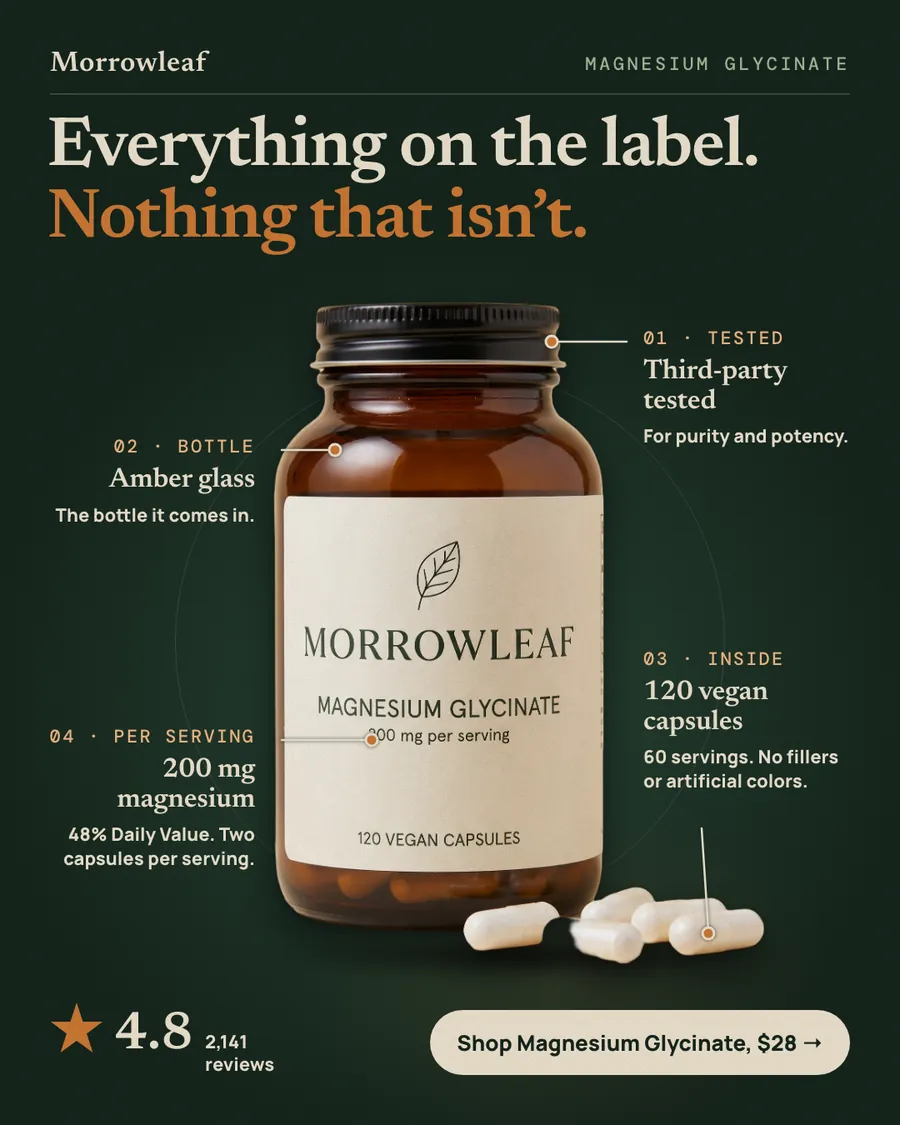
Morrowleaf: Everything on the label. Nothing that isn't.
This is the Supplement Facts panel turned into an ad: dose, Daily Value, count, testing and the bottle, each with a line to where it sits. Nothing on it says what magnesium does, and it doesn't need to; label readers buy on the numbers.
Store facts used: $28, 4.8 from 2,141 reviews, 200 mg magnesium, 48% Daily Value, 120 vegan capsules, 60 servings, third-party tested, amber glass
Matched by the fact check: $28 · 4.8 rating · 2,141 reviews · 60 servings · 200 mg · 48% · vegan
The 2:3 Pinterest version
Fictional sample brand · made by our engine
Myth vs factTransparency
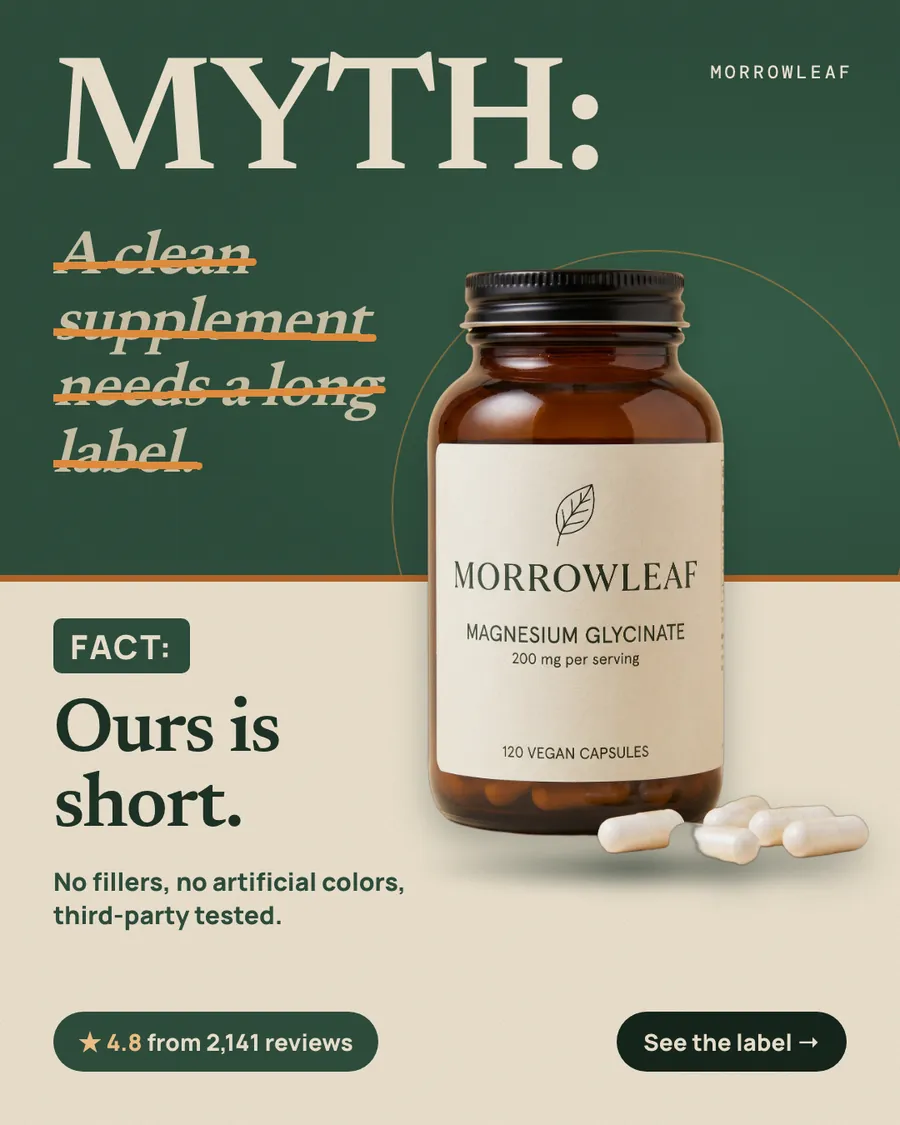
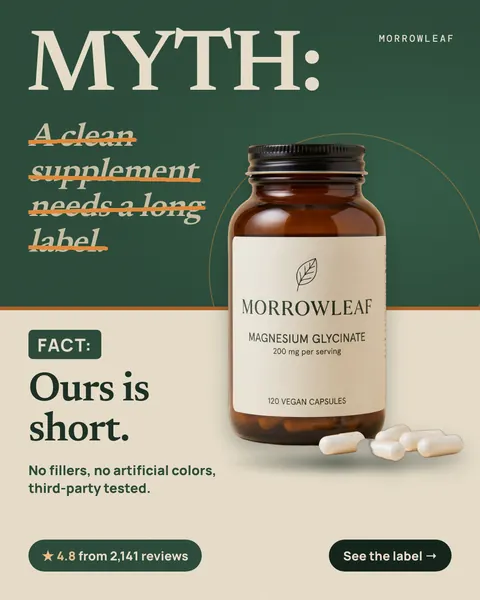
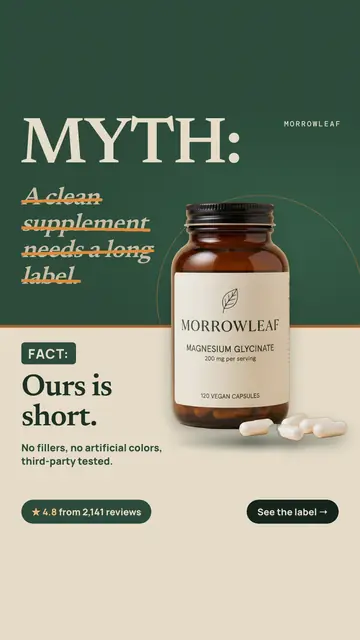
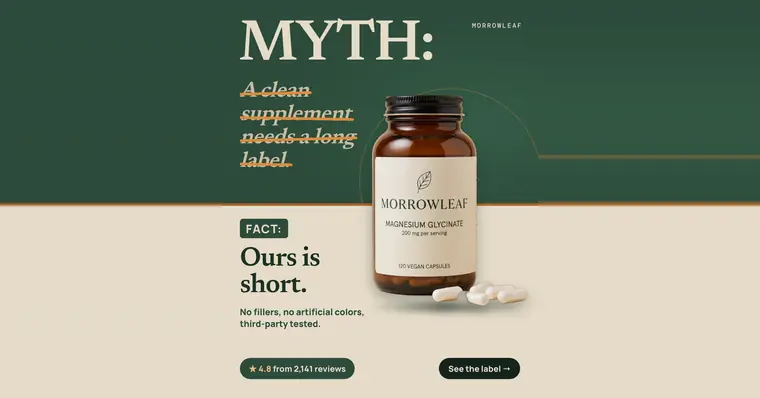
Morrowleaf: MYTH: A clean supplement needs a long label.
Crossing out the myth line and answering it with 'Ours is short.' makes the point in two glances. The bottle label sits right beside it, so the claim can be checked on the photo.
Store facts used: Magnesium Glycinate, 200 mg per serving, 120 vegan capsules, no fillers, no artificial colors, third-party tested, 4.8 from 2,141 reviews
Matched by the fact check: 4.8 rating · 2,141 reviews
The 2:3 Pinterest version
Fictional sample brand · made by our engine
Review wallSocial proof
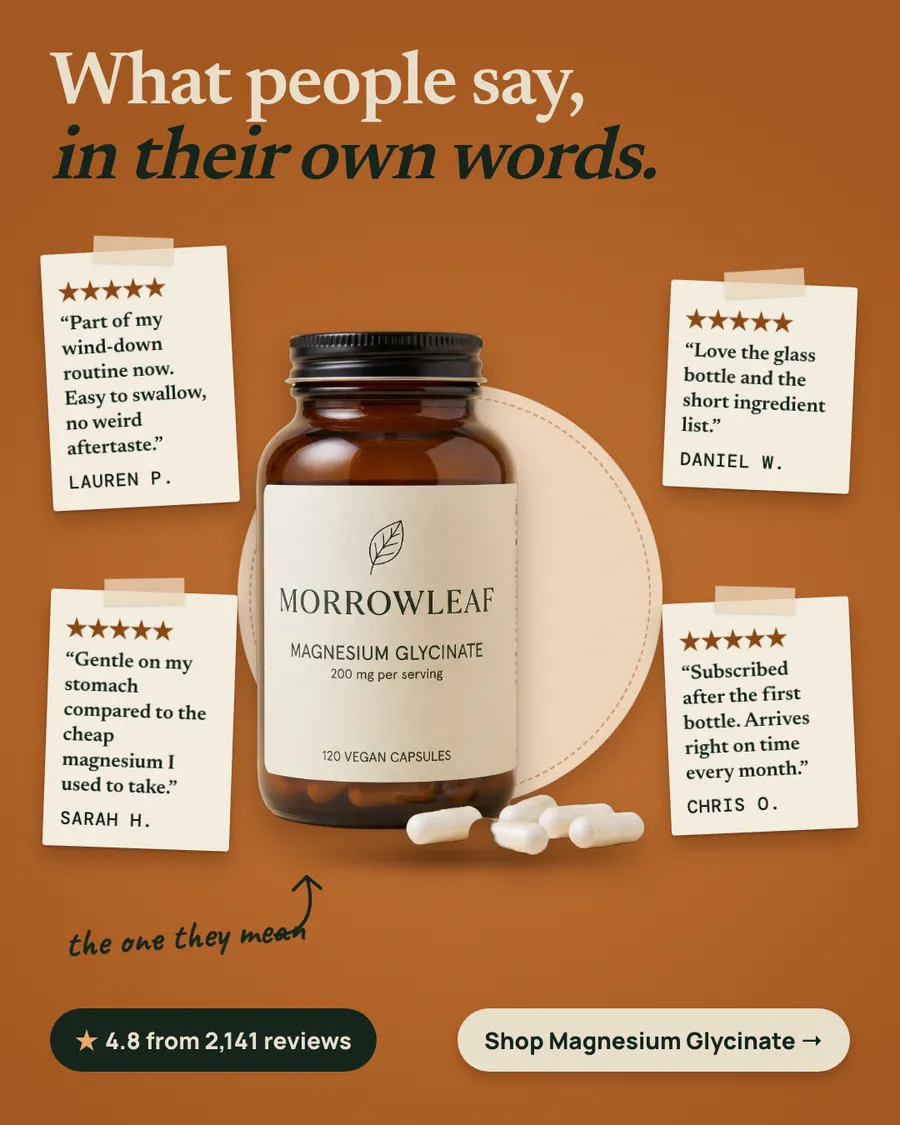
Morrowleaf: What people say, in their own words.
Four short quotes each give a different, calm reason to keep buying, so the wall reads like real feedback. The handwritten 'the one they mean' arrow ties the quotes to the bottle.
Store facts used: 4.8 from 2,141 reviews, four customer quotes, 200 mg per serving, 120 vegan capsules, glass bottle, subscription
Matched by the fact check: 4.8 rating · 2,141 reviews · 4 review quotes, word for word
The 2:3 Pinterest version
Fictional sample brand · made by our engine
Notes-app listRitual
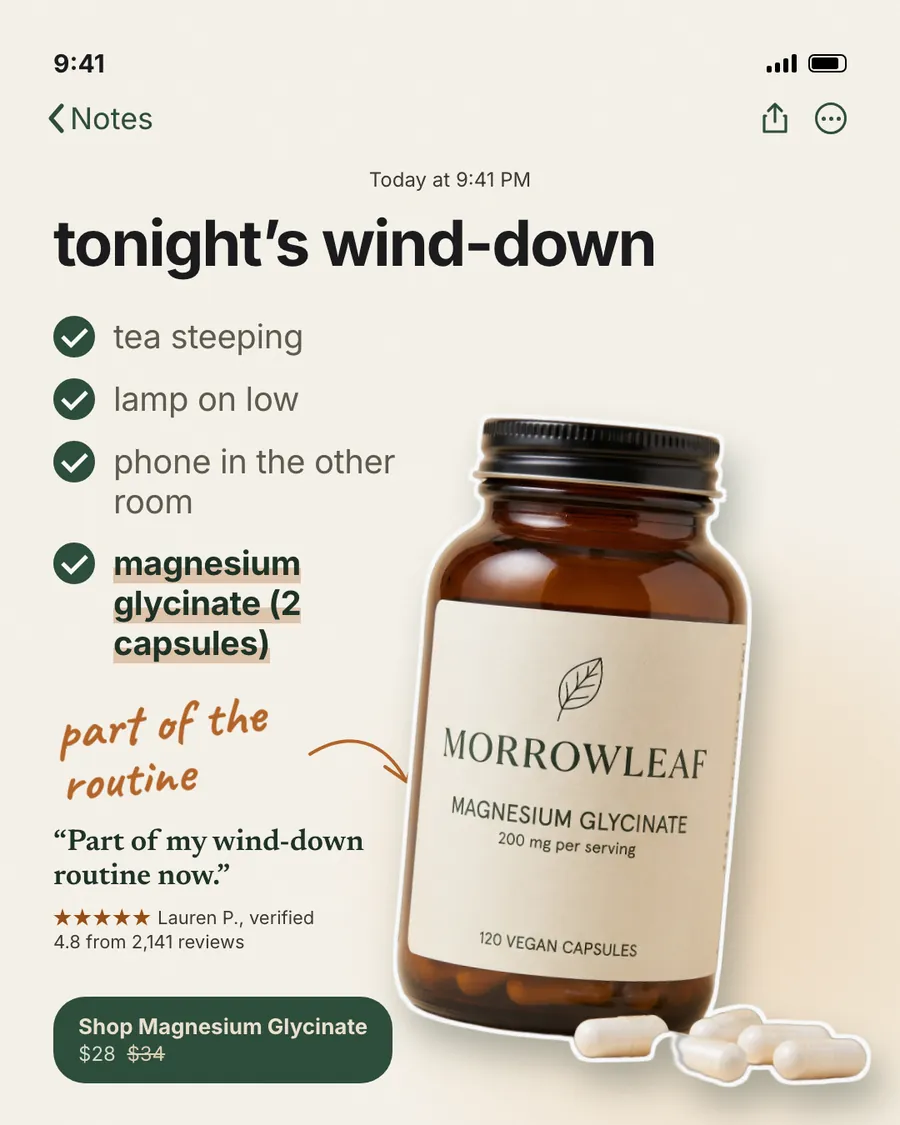
Morrowleaf: tonight's wind-down
The wind-down list puts two capsules beside tea and a low lamp and stops there. It describes a routine the customer chose, in her words on the card, and makes no claim about sleep, which would need evidence the page doesn't have.
Store facts used: Magnesium glycinate, 2 capsules, 200 mg per serving, 120 vegan capsules, $28, was $34, 4.8 from 2,141 reviews, Lauren P. quote
Matched by the fact check: $28 · $34 · 4.8 rating · 2,141 reviews · 1 review quote, word for word
The 2:3 Pinterest version
Fictional sample brand · made by our engine
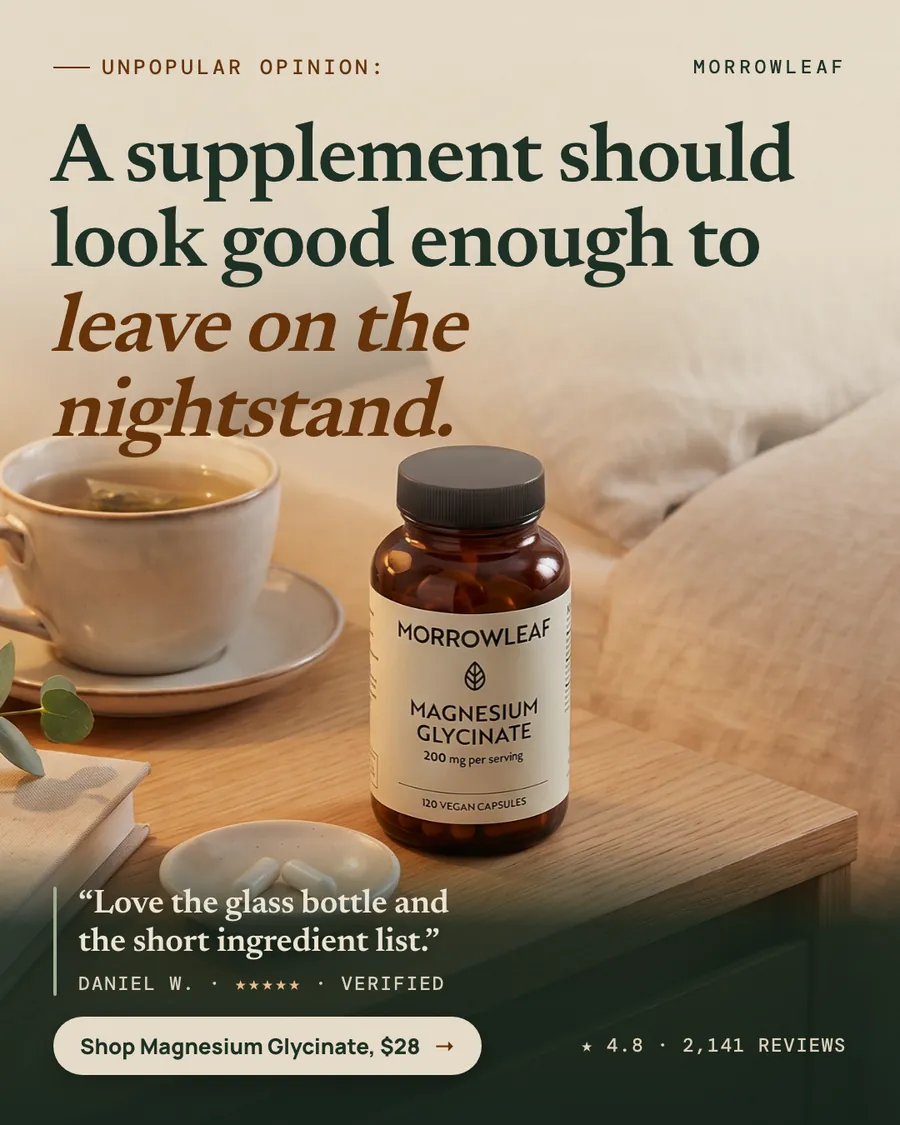
Unpopular opinionRitual
Morrowleaf: A supplement should look good enough to leave on the nightstand.
The photo proves the headline: the bottle sits on a real nightstand next to tea and a book, so the claim is shown, not just said. The short review quote backs up the glass bottle and simple ingredient list.
Store facts used: Magnesium Glycinate, 200 mg per serving, 120 vegan capsules, $28, 4.8 from 2,141 reviews, Daniel W. verified quote
Matched by the fact check: $28 · 4.8 rating · 2,141 reviews · 1 review quote, word for word
The 2:3 Pinterest version
Fictional sample brand · made by our engine
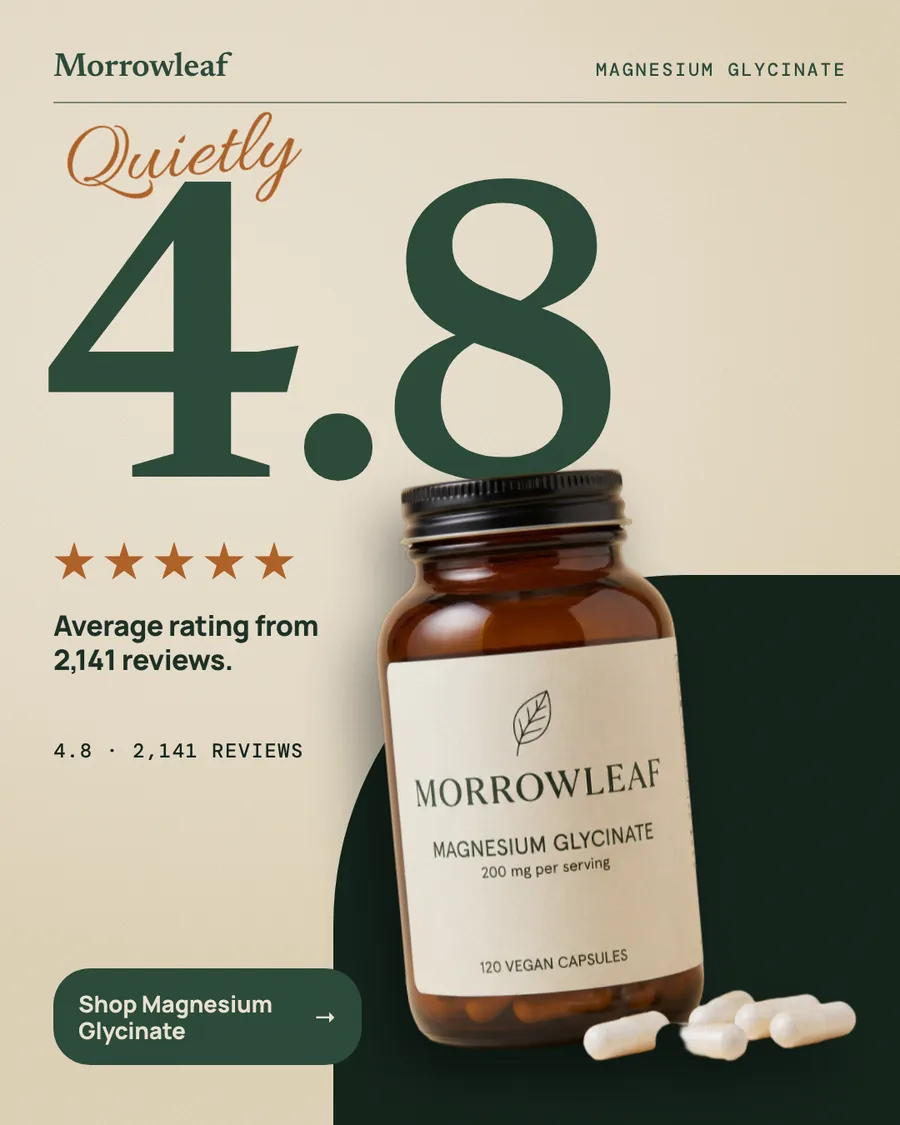
Big numberSocial proof
Morrowleaf: Quietly 4.8.
The 4.8 is the biggest thing on the ad, so the proof is read first. The small word 'Quietly' in script keeps the claim calm, and the review count under the stars backs it up.
Store facts used: 4.8 rating, 2,141 reviews, Magnesium Glycinate 200 mg per serving, 120 vegan capsules
Matched by the fact check: 4.8 rating · 2,141 reviews
The 2:3 Pinterest version
Fictional sample brand · made by our engine
Price dropOffer
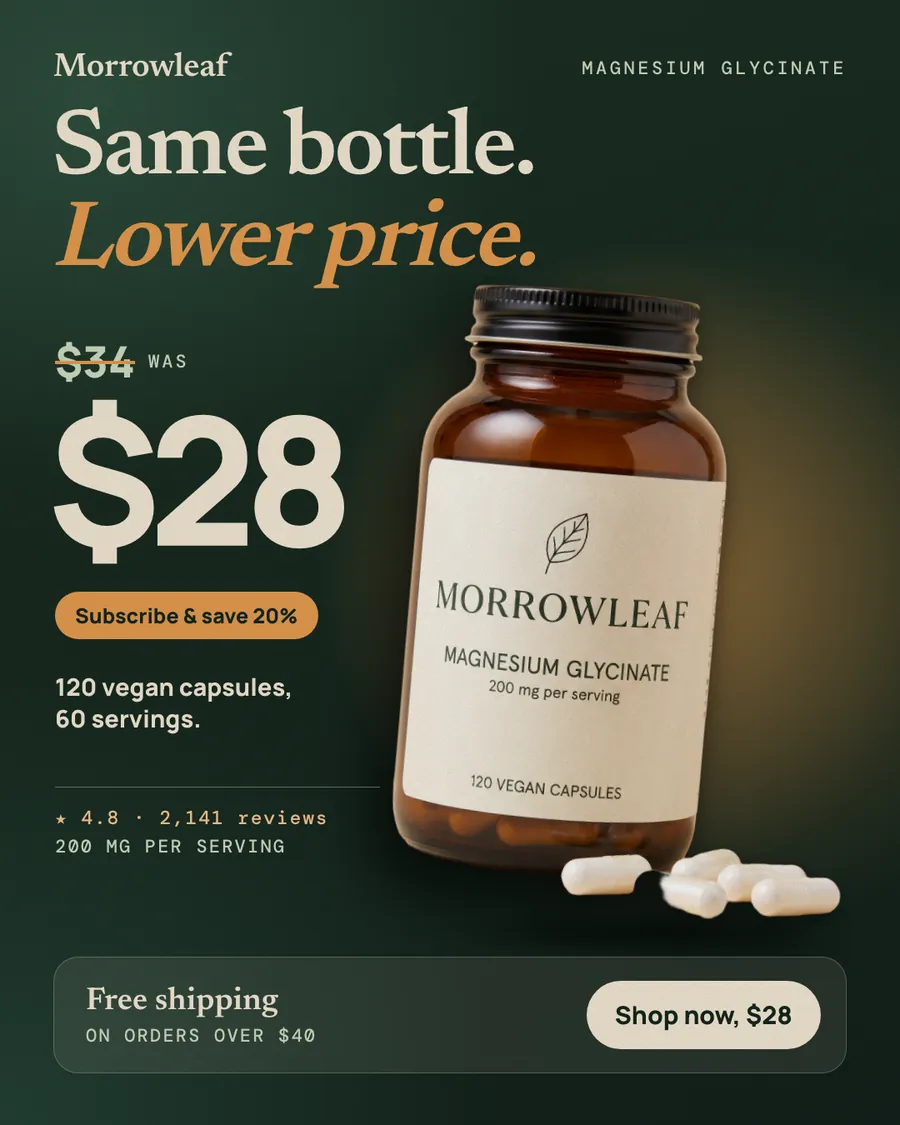
Morrowleaf: Same bottle. Lower price.
A plain price drop works well for something people take every day, because the saving repeats every refill. The subscription pill sits lower so the $28 stays the headline. Divided by 60 servings, that's about 47 cents a day, a line worth testing.
Store facts used: $28, was $34, save 20% subscribing, 60 servings, 4.8 from 2,141 reviews, free shipping over $40
Matched by the fact check: $34 · $40 · $28 · save 20% · 4.8 rating · 2,141 reviews · 20% · 60 servings
The 2:3 Pinterest version
Fictional sample brand · made by our engine
The same ad in all five sizes
4:5 · Facebook and Instagram feeds
1:1 · Square placements
9:16 · Stories, Reels, TikTok
2:3 · Pinterest
1.91:1 · Google Display
What makes a supplement ad work: four reasons to buy
Strip away the outcome promises and supplement buyers are left weighing four things. Each has proof you can print, and none of it needs a health claim.
- 01
The dose, in numbers
People shopping a nutrient they already know (magnesium, vitamin D, omega-3) compare form and dose before anything else. A precise number reads as honest; a vague benefit reads as a pitch.
See it in the ad "Everything on the label. Nothing that isn't."Proof the ad needs
The form, the dose per serving and the %DV exactly as the Supplement Facts panel prints them (magnesium glycinate, 200 mg, 48% DV), plus the serving size and servings per bottle.
- 02
A short label, tested
Clean-label shoppers read the other-ingredients line first. Fillers, dyes and allergens lose the sale, and outside testing is how a small brand earns the benefit of the doubt.
See it in the ad "MYTH: A clean supplement needs a long label."Proof the ad needs
The free-from list from your page, the real label visible in the photo so it can be checked, and the testing named the way your page names it ("third-party tested for purity and potency").
- 03
People who take it every day
A supplement is a repeat purchase, so the reviews that persuade are about living with it: easy to swallow, no aftertaste, gentle on the stomach, arrives on time.
See it in the ad "What people say, in their own words."Proof the ad needs
Verbatim quotes with first names, chosen for experience rather than results, next to the rating and review count. Leave out any review that claims a medical effect.
- 04
A habit, at a fair daily price
Daily products are judged per day, not per bottle, and the routine itself is the reason people reorder.
See it in the ad "tonight's wind-down"Proof the ad needs
Price per serving worked out from your own numbers ($28 for 60 servings is about 47 cents), the subscription terms your store states, and the product shown where the routine happens.
Photo checklist for supplement ads
Supplement photos carry more of the proof than in most categories, because the label is the evidence. Shoot these and every ad on this page can be rebuilt for your bottle.
The bottle straight on, label sharp. Buyers zoom in on the name, form and dose. A label they can read does half the trust work before any headline.
The Supplement Facts panel, flat and evenly lit. It proves dose, serving size and %DV in one image. Shoot it on its own so it can be cropped into a label-check ad.
Two or three capsules beside the bottle. People want to know what they'll swallow: size, color, capsule or tablet. Morrowleaf's ads spill a few beside the bottle for exactly this.
The bottle where the routine happens. A nightstand, a kitchen shelf, a gym bag. Place it, don't promise with it: the setting sells the habit, not an outcome.
Glass without glare. If the bottle is part of your pitch (amber glass, no plastic), angle the light so reflections don't hide the label.
The monthly delivery. If you sell subscriptions, a parcel arriving on the doormat shows the refill without a word about results.
No white coats, no before and after. A model in a lab coat implies an expert stands behind the product. Unless a real, qualified expert does, skip the costume.
Supplement ad copy lines you can adapt
Each line can be checked against a label, a price or a real review. Swap in your own numbers; if a line needs a footnote to be true, it doesn't belong in a supplement ad.
200 mg magnesium per serving. 48% of the Daily Value.
Straight from the Supplement Facts panel.
A short label, on purpose.
Pairs with the real label in the photo.
Third-party tested for purity and potency.
Use your test wording exactly, no stronger.
60 servings. About 47 cents a day.
Price per serving from your own price and count.
"Gentle on my stomach compared to the cheap magnesium I used to take."
A customer's experience, quoted word for word, not a promise about the viewer.
Two capsules, after the tea.
A routine, with no outcome attached.
Glass bottle. Vegan capsules. No fillers.
Subscribe and save 20%.
Only with the terms your store actually offers.
Lines to leave out of supplement ads
| Avoid | Why | Say instead |
|---|---|---|
| "Finally beat insomnia" | Insomnia is a disorder, so this is a disease claim. The FDA reserves claims to diagnose, treat, cure or prevent a disease for drugs. | A customer on the habit: "Part of my wind-down routine now." |
| "Can't sleep?" | Meta's Advertising Standards don't allow ads that assert or imply a person's health condition, and a question aimed at the viewer does exactly that. | "tonight's wind-down" as a list, with the capsules as one step. |
| "Calmer in 7 days" | Meta's Health and Wellness policy bans health clickbait, including specific outcomes in a set time without qualifiers, and the result itself would need scientific evidence. | "200 mg per serving. 60 servings a bottle." |
| "Doctor recommended" | An expert endorsement has to come from real experts who actually evaluated and recommend the product (FTC Endorsement Guides). | "Third-party tested for purity and potency." |
| "Clinically proven" | It tells buyers the product itself was studied and worked. The FTC's health products guidance generally expects well-designed human clinical trials behind health benefit claims. | The plain dose and form, which need only the label. |
Where the claim line sits for supplements
Most rejected or risky supplement ads cross one line: from describing the product, or what a nutrient does in a healthy body, to saying it fixes a disease. The FDA's own example of a structure/function claim is "calcium builds strong bones".
| Kind of line | Example | What it needs |
|---|---|---|
| Label fact | "200 mg per serving. 60 servings." | Only an accurate Supplement Facts panel. The safest line in the category. |
| Structure/function claim | "Calcium builds strong bones" (the FDA's example) | Substantiation that it's truthful, an FDA notification within 30 days of marketing, and the label disclaimer. In ads, the FTC expects competent and reliable scientific evidence. |
| Disease claim | "Treats insomnia", "lowers blood pressure", "prevents migraines" | Not available to supplements: only a drug can claim to diagnose, treat, cure or prevent a disease. |
| A customer's words | "Gentle on my stomach compared to the cheap magnesium I used to take." | A real review, quoted exactly. A review can't carry a claim the brand couldn't make itself. |
One more trap: the disclaimer ("not intended to diagnose, treat, cure or prevent any disease") doesn't rescue a disease claim made elsewhere in the ad. The FTC's guidance says so directly.
Supplement ad rules on Meta, and the US law behind them
Supplements are one of the categories Meta restricts, and its rules stack on top of what the FDA and FTC already require. Five things decide whether an ad runs and stays safe.
- Adults only. Meta's Health and Wellness policy says ads for dietary and health supplements must be targeted to people 18 or older. Set the age in every ad set, including retargeting.
- No cure claims. Meta bans claims to cure, heal or eliminate a listed set of incurable diseases (diabetes, cancer, Alzheimer's and others), even from health professionals. US law goes further: no disease claims at all for supplements.
- No clickbait. The same policy rules out sensational, exaggerated health claims and promises of a specific result in a set time without qualifiers.
- Nothing about the viewer's health. Meta's personal attributes rule bans lines that assert or imply a health condition, such as "Do you have trouble sleeping?"
- Evidence for every benefit, reviews included. The FTC's Health Products Compliance Guidance expects competent and reliable scientific evidence for health claims, whether you say them or a customer quote does.
What the fact check can and can't do: StoreToAds checks every price, rating, review quote and number in an ad against your store, and flags marketing claims it can't find there. It can't tell you whether a claim on your store is legal. Put words you can't back up, like "sleep", "anxiety" or "immunity", in Never say in Your brief and they stay out of every ad.
The supplement calendar, winter 2026 to autumn 2027
Supplement demand follows routines more than holidays: new years, new seasons, new schedules. Time reorder ads to the bottle running out, too.
| When | Moment | What to run |
|---|---|---|
| Nov 27 to 30, 2026 | Black Friday to Cyber Monday | Subscription offers suit daily products: state the discount and when it ends. More offer types in Black Friday ad ideas. |
| December | Stock-up and gifting | Two- and three-bottle bundles with the price per serving. Health claims stay out of gift copy too. |
| Jan 1 to mid-February, 2027 | New routines | When many people start new habits. Sell the routine and the label, not resolutions about weight or energy, which bring Meta's weight rules and the FTC's evidence bar into play. |
| About 60 days after a first order | The bottle runs out | A 60-serving bottle taken daily lasts two months: retarget January buyers in early March with a review-led reorder ad. |
| Apr 18 to Jun 20, 2027 | Mother's Day (May 9) and Father's Day (Jun 20) | Gift bundles, wrapped and priced; keep them to adults' audiences like every supplement ad. |
| Late August to Sep 6, 2027 | Back to schedules | Work and school routines restart: habit and subscription ads. |
What people ask about supplement ads
What is a good slogan for a supplement brand?
One that a shopper can check: "A short label, on purpose", "Tested by a lab we don't own", "Two capsules, 200 mg, that's the routine". Slogans that promise a body result ("Sleep better tonight") turn into health claims that need evidence and draw Meta's scrutiny.
How can I effectively advertise my supplements on Facebook?
Target adults only, which Meta requires for supplements, and run four or five ads with different reasons to buy: the label, outside testing, reviews about daily use, the price per serving, a routine. Keep every line to label facts or real quotes, and judge the ads on purchases, not clicks.
Can you run supplement ads on Instagram and Facebook?
Yes. Meta allows them with limits: target people 18 or older, make no claims to cure incurable diseases, avoid clickbait results in a set time, and never imply the viewer has a health condition. US law adds that supplements can't make disease claims at all.
What is the supplement ads Facebook policy?
It's Meta's Health and Wellness policy plus its personal attributes rule: adults-only targeting for dietary and health supplements, no cure claims for a listed set of incurable diseases, no sensational claims or timed results without qualifiers, and no lines that assert or imply someone's health. The policy page was last changed in July 2026.
What should supplement ad copy say?
Facts from the label (form, dose, %DV, servings), what isn't in it, how it's tested, and the price per serving, plus customers' own words about using it. If a line describes what the product does to the body, make sure you can substantiate it or leave it out.
What vitamin companies are legit?
Shoppers asking this usually check three things: a complete Supplement Facts panel, outside testing or a certification mark they can look up, and a brand that doesn't promise cures. Label-led ads that show all three answer the question before it's asked.
How do I advertise gummy vitamins?
The same way as capsules, with two extra facts buyers look for: sugar per serving and how many gummies make a serving. Show the real gummies next to the jar, and keep flavor and texture talk in customers' words. Ads for gummies follow the same adults-only and claims rules on Meta.
What are good supplement ad ideas for athletes?
Athletes who are drug tested care about banned substances. If your product holds a certification such as NSF Certified for Sport, which tests for 290 banned substances and checks the label matches the contents, lead with it. If it's only lab tested, say exactly what was tested.
Do static ads work for supplements?
They suit the category, because the proof is in the label, and a still image lets people read it. Label callouts, myth-versus-fact layouts, review walls and notes-app routines are all statics. Make several with different reasons to buy and let results decide.
Should supplement ads show the price?
Usually, and as a price per serving when it helps: a daily product judged at about 47 cents a day reads differently from $28 a bottle. If you sell subscriptions, show the subscriber price with its terms.
Make ads like these for your supplements
Paste your store link and get 3 free ads of your own supplements: we read your products, prices and reviews, design around your real product photo and check every fact against your store.
Where to go next
- Supplement ad generatorSupplement ads that say only what the label says: dose, ingredients, certifications and real reviews.
- Protein powder ad ideasSeven sample ads for a whey isolate brand that answer taste, sweeteners and trust, with the macros and claims rules.
- Skincare ad ideasSeven sample ads for a vitamin C serum, the proof each reason to buy needs, and the claims Meta and the FDA watch.
- Fitness product ad ideasEight sample ads for a resistance band brand that sell the gear, not a body, with specs to print and Meta's rules.
- ReviewReview card ads: your star rating, your review count and one customer quote, word for word.
- Static ad examples18 static ads for four fictional product brands, each with its format, reason to buy and what makes it work.
- PricingFree preview, Starter $49/month, weekly plans from $99/month with a 7-day free trial, 30-day money-back guarantee.
Sources
Rules and dates on this page were checked on against:
- Meta Advertising Standards: Health and Wellness
- Meta Advertising Standards: Privacy Violations and Personal Attributes
- FDA: Structure/Function Claims (dietary supplements)
- FTC Health Products Compliance Guidance (December 2022)
- FTC Endorsement Guides, 16 CFR 255
- NSF Certified for Sport: what the mark means
- 3 free ads when your spot opens
- Starter $49/month
- Growth $99/month, 7-day free trial
- Pro $149 · Scale $199
- 30-day money-back guarantee