food product ad ideas
Food product ad ideas that make people hungry (with real examples)
Food ads have one job before any other: make someone hungry enough to stop scrolling. Then they have to earn trust, because people put this product in their mouth. Below are seven ads our engine made for Pepperwick, a fictional small-batch hot sauce, plus the photos, claims and dates that matter for sauces, snacks and other pantry products.
Updated · The sample ads are for a fictional brand, made by our engine.
In short
What makes a food product ad work?
Food sells on appetite and trust. Show the product on real food people eat, close enough to see texture, and pair it with one fact a shopper can check: a flavor note, a heat level, an ingredient, how it's made. Customer quotes about what they put it on often do more than any adjective.
Real sample ads
Seven food ads for Pepperwick
Pepperwick is a fictional brand. Its product page: Smoked Habanero Hot Sauce, habaneros fermented for 30 days, then blended with smoked red peppers, roasted garlic, carrot and apple cider vinegar; medium-hot heat (6/10) with a smoky, fruity finish; 5 oz glass bottle; vegan, gluten-free, no added sugar; $12, rated 4.9 from 1,537 reviews. Free shipping over $40.
Pepperwick · Smoked Habanero Hot Sauce, 5 oz · $12 · 4.9 from 1,537 reviews · fictional
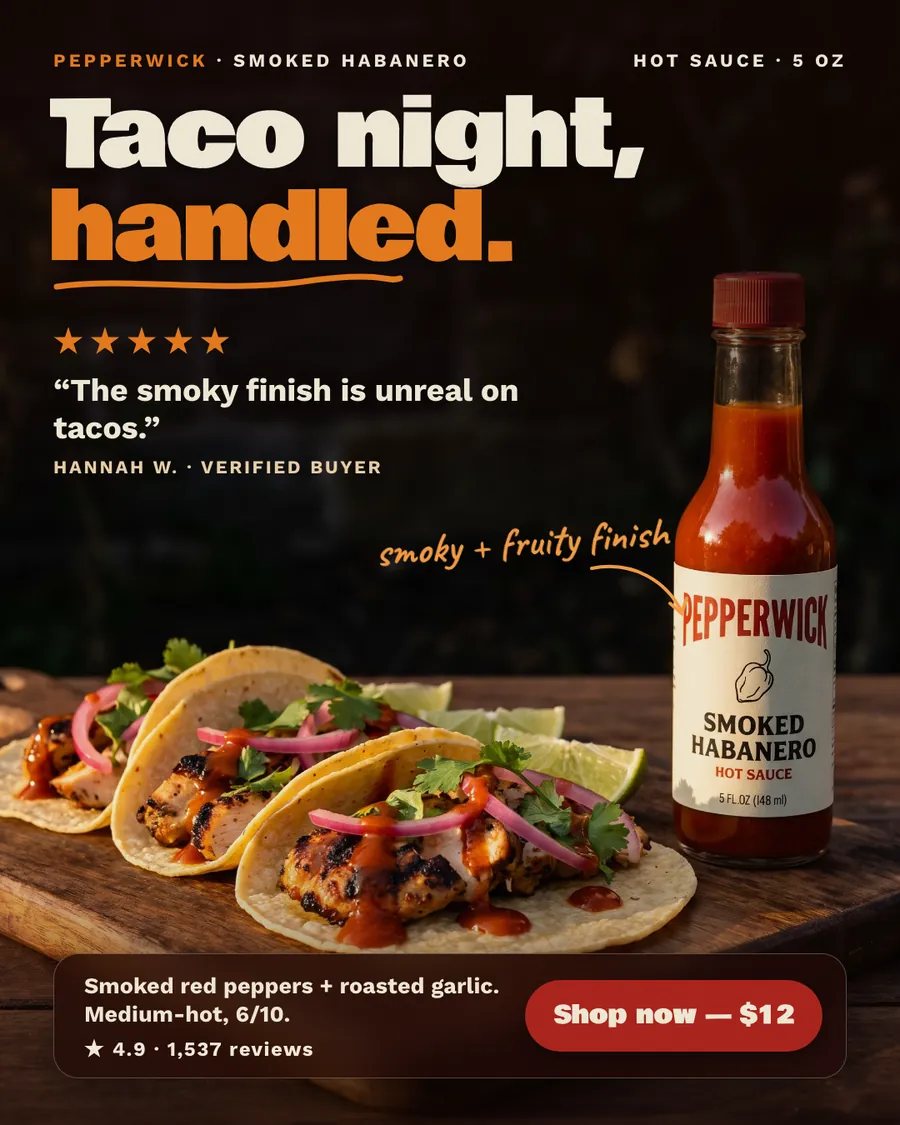
Lifestyle typeRitual
Pepperwick: Taco night, handled.
The headline ties the sauce to a night people already plan, and the photo shows it on tacos beside the bottle. The review quote repeats the same taco idea, so the message stays on one thing.
Store facts used: Smoked Habanero Hot Sauce, 5 oz, $12, 4.9 from 1,537 reviews, Hannah W. quote, smoked red peppers and roasted garlic, medium-hot 6/10
Matched by the fact check: $12 · 4.9 rating · 1,537 reviews · 5 oz · 1 review quote, word for word
The 2:3 Pinterest version
Fictional sample brand · made by our engine
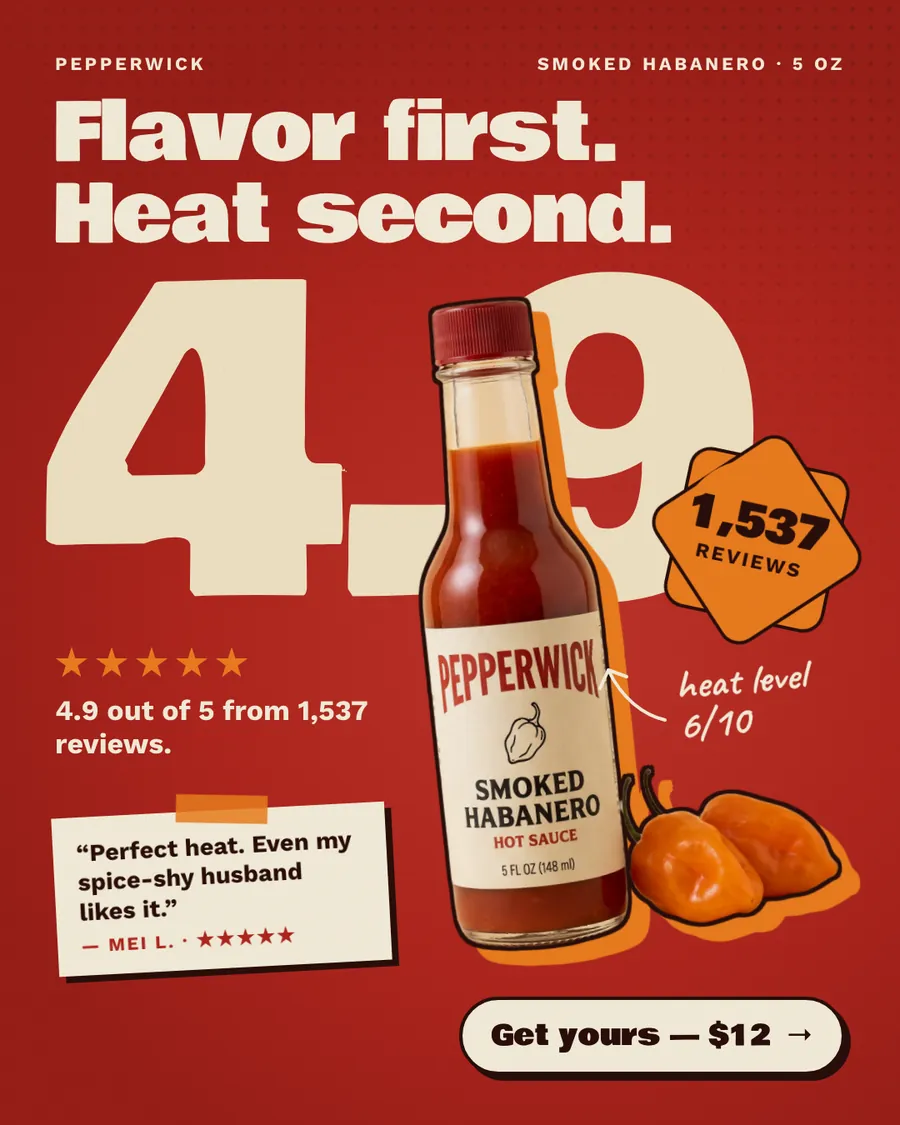
Big numberSocial proof
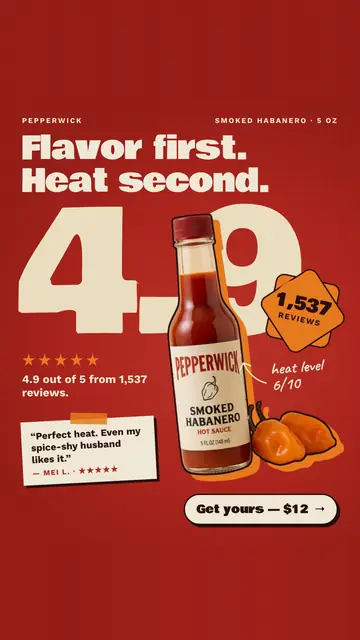
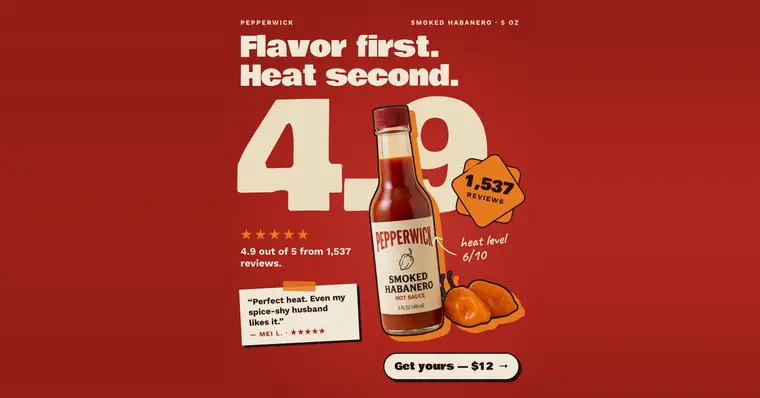
Pepperwick: Flavor first. Heat second.
The giant 4.9 is the first thing you see, and the bottle sits on top of it. The short review quote and the '6/10' heat note speak to buyers who worry the sauce will be too hot.
Store facts used: 4.9 from 1,537 reviews, quote from Mei L., heat level 6/10, $12, 5 oz bottle
Matched by the fact check: $12 · 4.9 rating · 1,537 reviews · 5 oz · 1 review quote, word for word
The 2:3 Pinterest version
Fictional sample brand · made by our engine
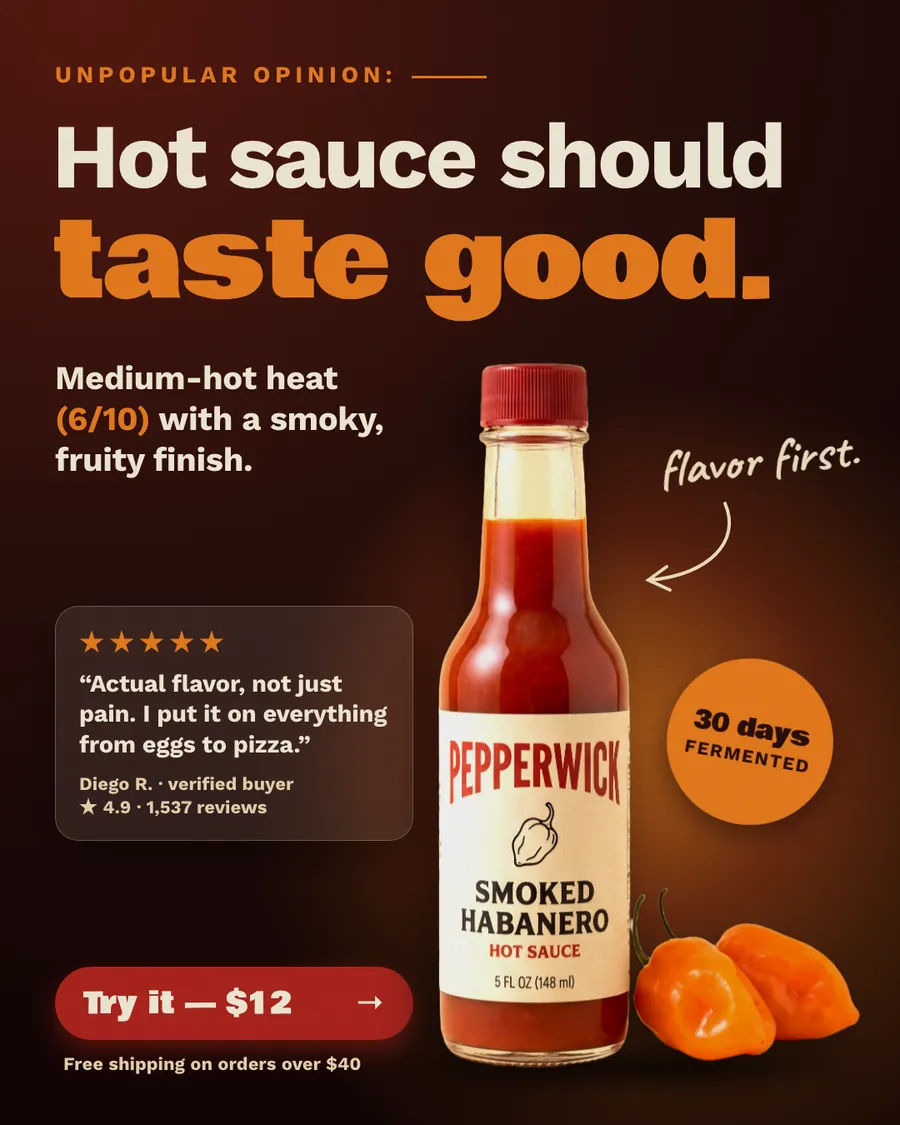
Unpopular opinionTaste
Pepperwick: Unpopular opinion: Hot sauce should taste good.
The headline takes a mild stance that makes you smile, and 'taste good' in big orange type is the promise. The heat rating of 6/10 and the review about eggs and pizza make flavor feel believable.
Store facts used: $12, free shipping over $40, 6/10 heat, 30 days fermented, 4.9 from 1,537 reviews, Diego R. quote
Matched by the fact check: $12 · $40 · 4.9 rating · 1,537 reviews · 30 days · free shipping · 1 review quote, word for word
The 2:3 Pinterest version
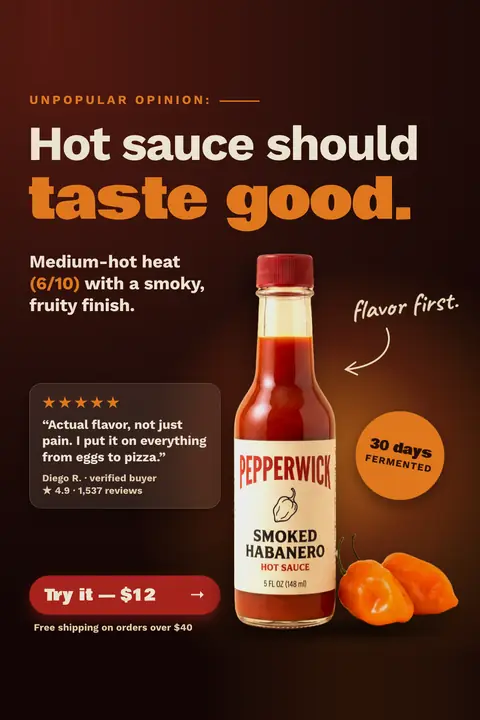
Fictional sample brand · made by our engine
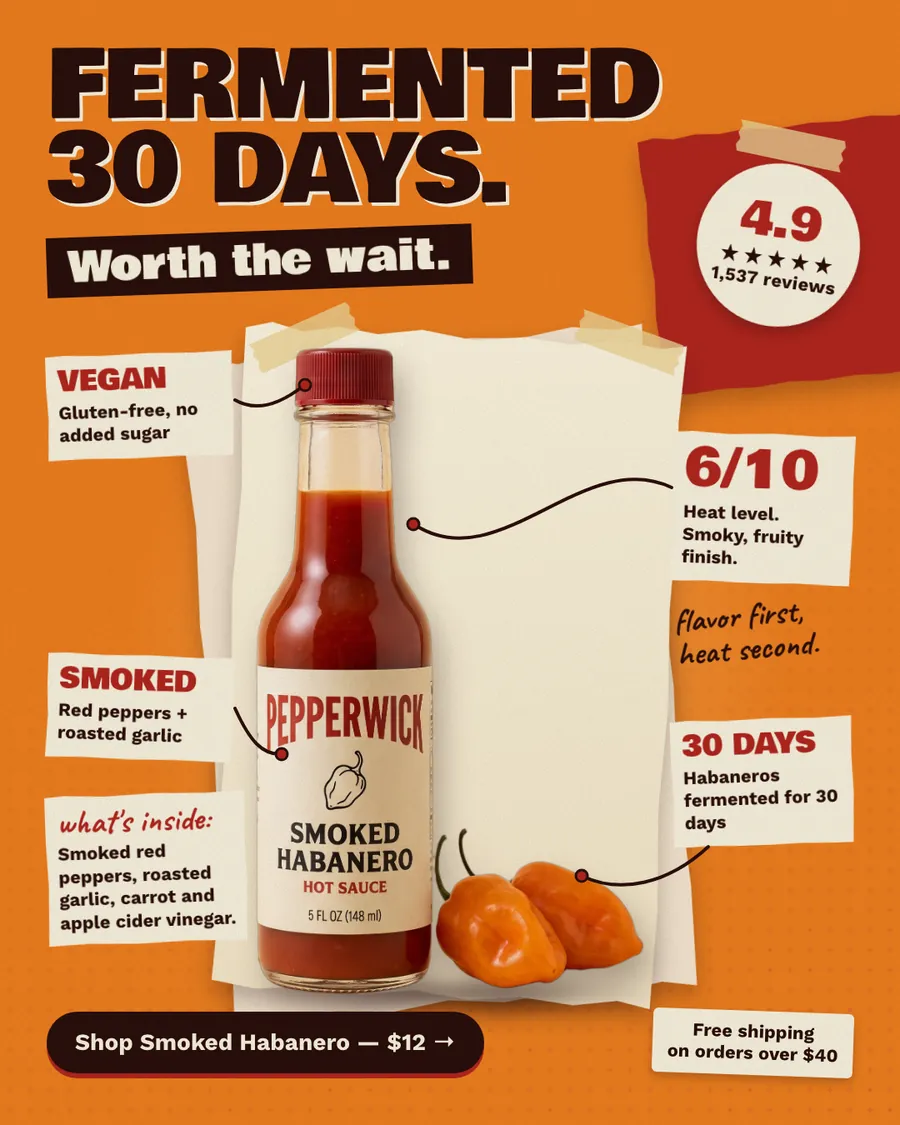
Annotated heroTransparency
Pepperwick: FERMENTED 30 DAYS.
Short notes with lines pointing at the bottle explain the sauce part by part, so the 30-day wait reads as a real step. The ingredient list sits in plain view, and the 6/10 heat score sets expectations.
Store facts used: 30 days fermented, vegan, gluten-free, no added sugar, ingredients, 6/10 heat, 4.9 from 1,537 reviews, $12, free shipping over $40
Matched by the fact check: $12 · $40 · 4.9 rating · 1,537 reviews · 30 days · vegan · gluten-free
The 2:3 Pinterest version
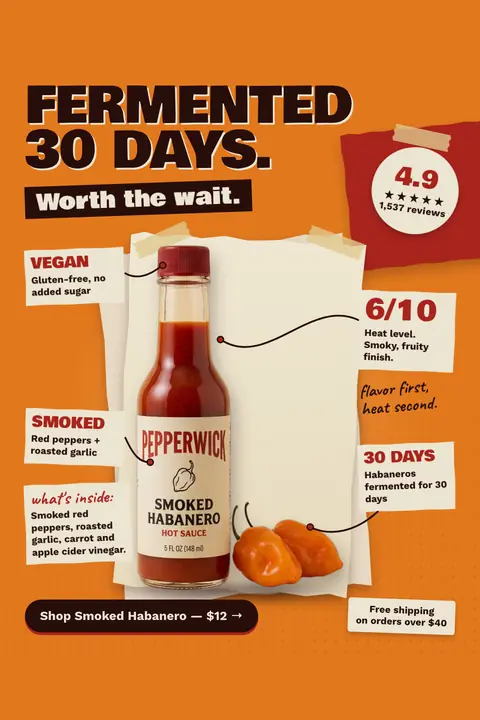
Fictional sample brand · made by our engine
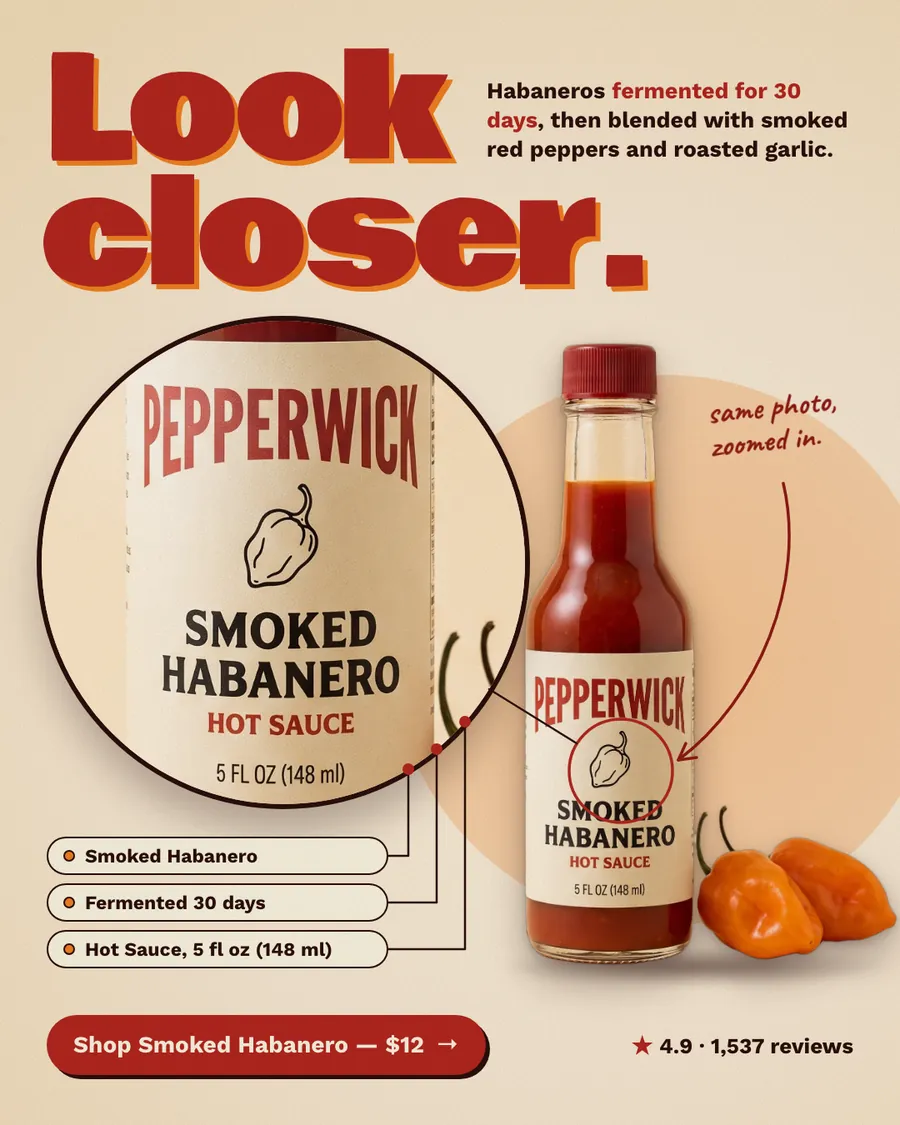
Look closerTransparency
Pepperwick: Look closer.
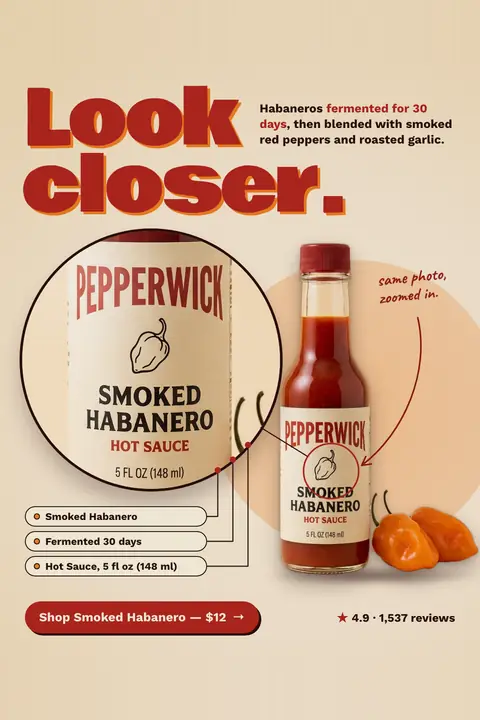
The zoom circle lets you read the label up close, and three lines point to the exact facts on it. The bottle photo stays beside it, so you see the zoom is the same photo.
Store facts used: Smoked habanero, fermented 30 days, 5 fl oz (148 ml), $12, 4.9 from 1,537 reviews
Matched by the fact check: $12 · 4.9 rating · 1,537 reviews · 30 days
The 2:3 Pinterest version
Fictional sample brand · made by our engine
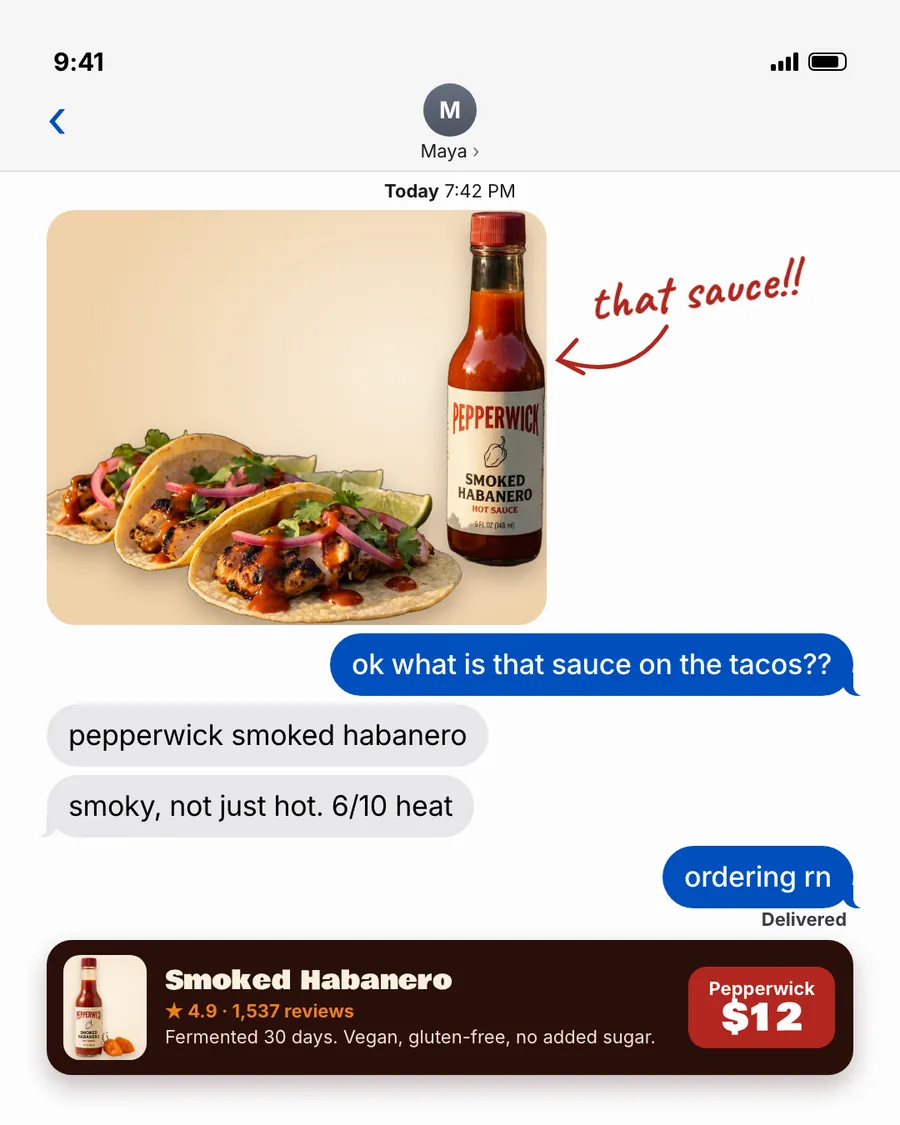
Text threadWord of mouth
Pepperwick: ok what is that sauce on the tacos??
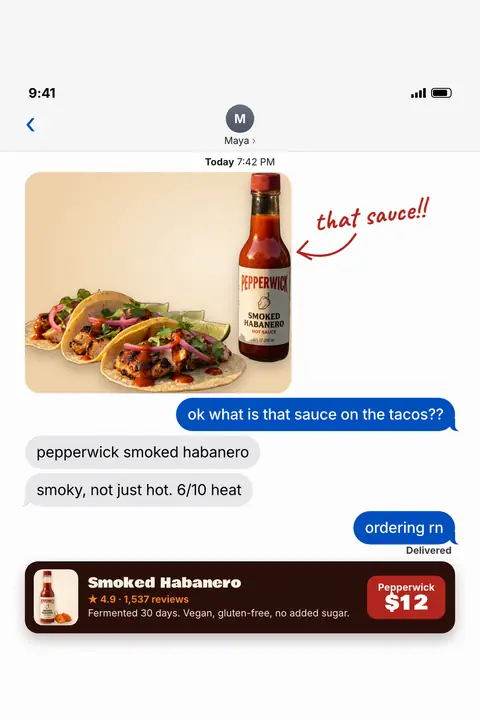
It reads like a real text between friends, so the recommendation feels unprompted. Maya's reply gives the name and the heat level, and the price and rating card sits right under the chat.
Store facts used: $12, 4.9 from 1,537 reviews, fermented 30 days, vegan, gluten-free, 6/10 heat, smoky flavor
Matched by the fact check: $12 · 4.9 rating · 1,537 reviews · 30 days · vegan · gluten-free
The 2:3 Pinterest version
Fictional sample brand · made by our engine
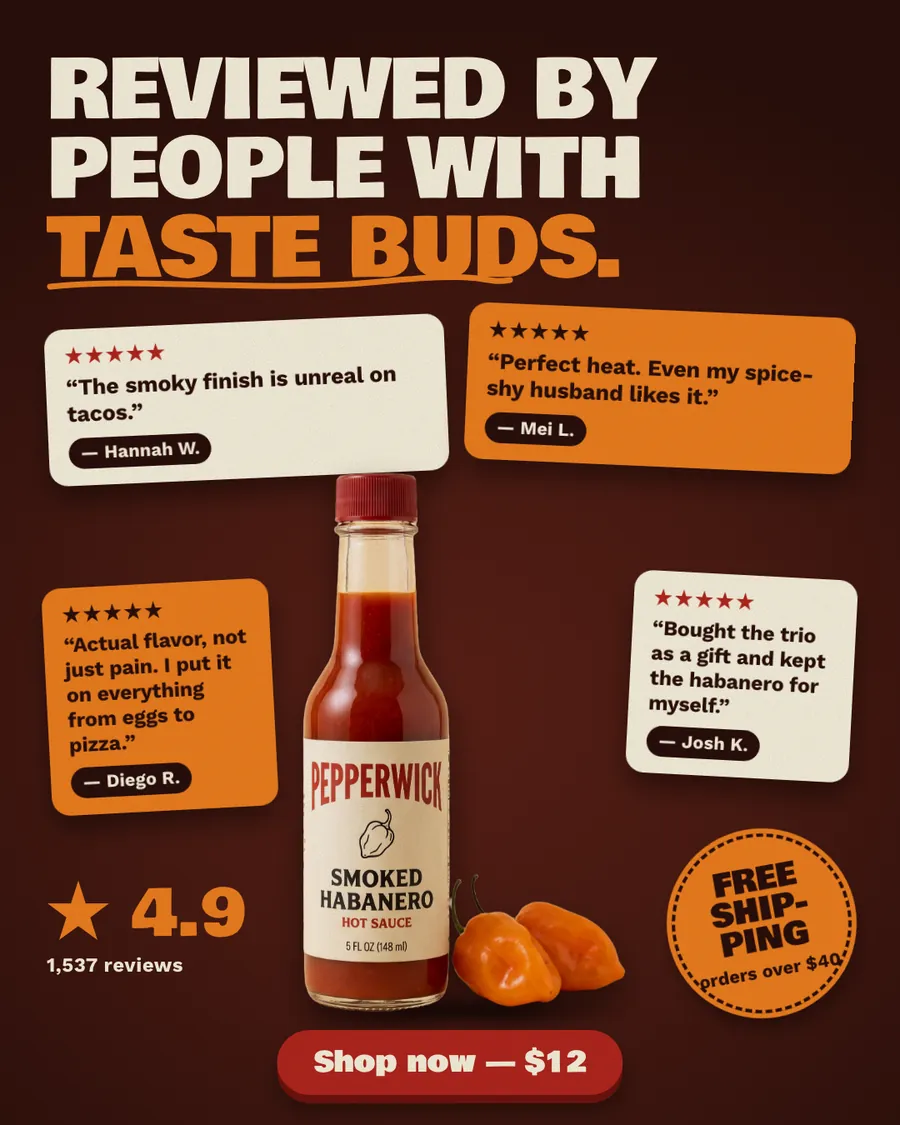
Review wallSocial proof
Pepperwick: Reviewed by people with taste buds.
Four short quotes each cover a different use or person: tacos, a spice-shy husband, eggs to pizza, a gift. The cards alternate cream and orange so they are easy to scan, and the bottle sits between them.
Store facts used: Four customer quotes, 4.9 rating, 1,537 reviews, $12, free shipping on orders over $40, Smoked Habanero, 5 fl oz
Matched by the fact check: $40 · $12 · 4.9 rating · 1,537 reviews · 4 review quotes, word for word
The 2:3 Pinterest version
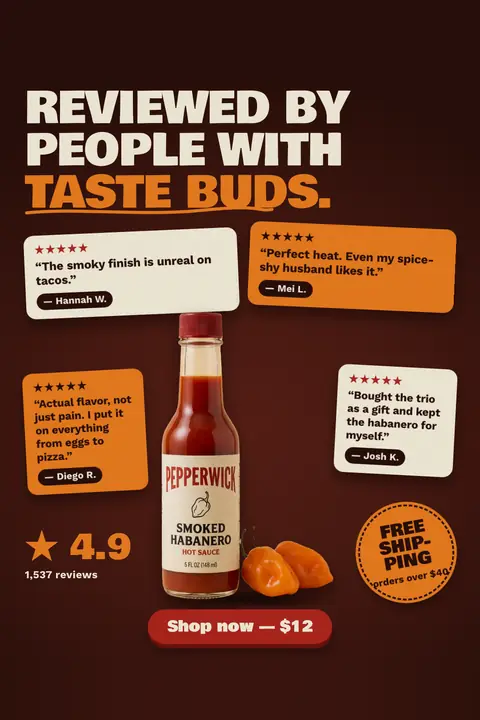
Fictional sample brand · made by our engine
The same ad in all five sizes
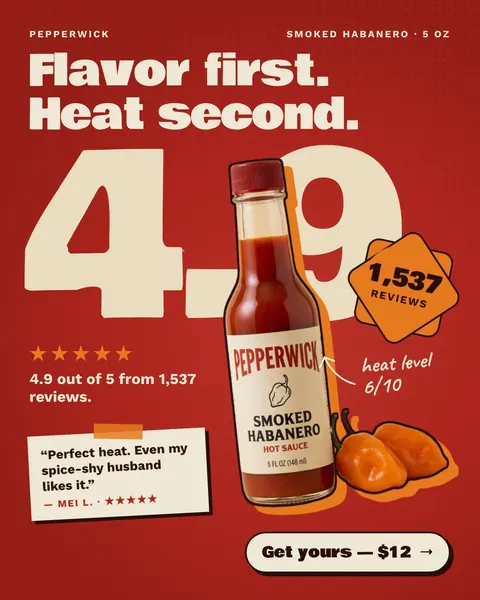
4:5 · Facebook and Instagram feeds
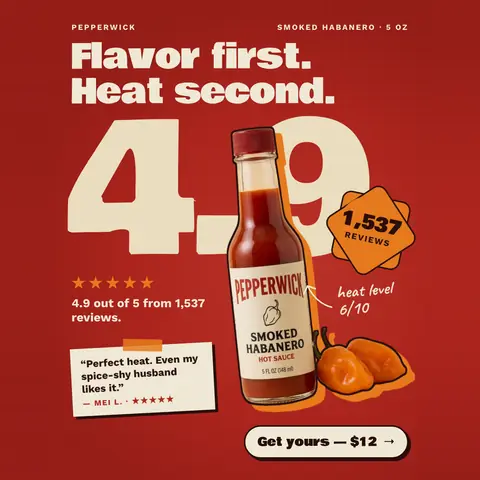
1:1 · Square placements
9:16 · Stories, Reels, TikTok
2:3 · Pinterest
1.91:1 · Google Display
Why people buy a food product they've never tasted
Trying a new sauce or snack is a small risk, but it's still a risk: money, a wasted bottle, a meal that's too hot. These four reasons lower it, and each needs proof from your store.
- 01
It tastes of something
In crowded aisles like hot sauce, the complaint is products that are all heat or all sugar. A specific flavor promise stands out.
See it in the ad "Unpopular opinion: Hot sauce should taste good."Proof the ad needs
Flavor words from your product page (smoky, fruity finish) and a customer who says it better: "Actual flavor, not just pain."
- 02
They know what they're getting into
Heat, sweetness, spice, texture: shoppers want to know how intense it is before they risk a meal on it.
See it in the ad "Flavor first. Heat second."Proof the ad needs
Your own scale or descriptor as the page states it (6/10, medium-hot), and a review from someone who usually avoids it: "Even my spice-shy husband likes it."
- 03
It goes on food they already eat
Nobody needs a new condiment; they need tonight's tacos to be better. Usage ideas turn a bottle into a meal.
See it in the ad "Taco night, handled."Proof the ad needs
The product on real food in the photo, and reviews that name dishes (tacos, eggs, pizza). The bottle should still be readable next to the plate.
- 04
They trust how it's made
Small brands win on process and short ingredient lists, the things big brands rarely put in a headline.
See it in the ad "FERMENTED 30 DAYS."Proof the ad needs
The full ingredient list, the process in plain numbers (fermented 30 days), and dietary facts exactly as your label states them.
Food ad formats that suit a pantry product
A sauce, spread or snack doesn't get a big launch film. These static formats carry the four reasons above, and each needs only the bottle photo and your product page.
| Format | When it works | Pepperwick's version |
|---|---|---|
| Plated lifestyle | New audiences who need a use idea | "Taco night, handled." with the bottle beside three tacos |
| Big number | People who know you but haven't bought | A huge 4.9 with the heat note under it |
| Label zoom | Ingredient readers and skeptics | "Look closer." with a magnified label |
| Process callouts | Craft and small-batch stories | "Fermented 30 days." with labelled ingredients |
| Text thread | Word of mouth, younger audiences | "ok what is that sauce on the tacos??" |
| Review wall | Retargeting before a sale or gift season | Four quotes, four uses |
Gift sets are a fifth format for Q4: Pepperwick's trio is $32 (usually $36), and a gift ad leads with the box, not the heat.
Appetite photo checklist for food ads
Food photos fail when they look like stock or like a lab. Aim for real food, real light and a product you can still read.
The bottle or pack straight on, label readable, plain background. The cutout for spec, review and label-zoom ads. Wipe drips off the neck first; they show at every size.
On the dish it's best on, in daylight. Tacos, eggs, a bowl of noodles: the appetite shot. Shoot within a few minutes of plating, before sauces dull and garnishes wilt.
The pour or drizzle, mid-motion. Shows texture and color. A sauce that looks watery in the photo will be judged watery.
Raw ingredients beside the product. Habaneros, garlic and carrot laid next to the bottle back up the ingredient story. Only show what's actually in it.
A hand holding the product. Gives scale. A 5 oz bottle is smaller than most people picture.
The back label, sharp. For ingredient and allergen questions, and for label-zoom ads that let shoppers read the facts themselves.
A shared table. Several dishes, several hands, one bottle in the middle: the social version of the appetite shot, useful for party seasons.
Food ad copy lines to adapt
Short, concrete and checkable. Swap in your flavors, numbers and dishes; every claim word has to match your label.
Flavor first. Heat second.
Positioning in four words, for any sauce that isn't only about heat.
Fermented 30 days. Worth the wait.
Process as a number. Use your real time.
6/10 heat. Smoky, fruity finish.
Intensity plus flavor, for shoppers deciding if they can handle it.
"Even my spice-shy husband likes it."
A review that removes the biggest worry. Quote it word for word.
Habaneros, smoked red peppers, roasted garlic, carrot, cider vinegar.
The whole ingredient list, if it's this short.
Taco night, handled.
A meal people already plan.
Vegan, gluten-free, no added sugar.
Only the dietary words your label carries, and they must meet the definitions.
Three sauces, one gift box: $32 (usually $36).
The trio's real compare-at price.
Lines to keep off food ads
| Avoid | Why | Say instead |
|---|---|---|
| "Healthy" | Since December 2024 the FDA's "healthy" claim requires a minimum amount from a food group plus limits on added sugars, sodium and saturated fat per serving. | State the specific facts: "No added sugar. Vegan." |
| "All natural" | The FDA has no formal definition, and its long-standing policy reads "natural" as nothing artificial or synthetic, including any color additive, added that wouldn't normally be expected. | List the ingredients and let shoppers judge. |
| "Gluten-free" without testing | FDA rules say a food labeled gluten-free must contain less than 20 parts per million of gluten. | Use it only when your label can, and the product meets the limit. |
| "Burns fat" or "boosts metabolism" | Health claims need competent and reliable scientific evidence under FTC law, and weight-loss framing brings Meta's Health and Wellness rules into play. | Sell the meal: "The smoky finish is unreal on tacos." (a customer) |
| "The hottest sauce you'll ever taste" | Unprovable, and for a 6/10 sauce it scares off the shoppers most likely to buy. | "6/10 heat", with a review about the flavor. |
Food claims: the words the FDA defines
Food isn't a restricted category on Meta, but many of the words food brands put in ads are defined by US labeling rules. An ad should never say more than your label is allowed to.
| Word on the ad | What it has to mean | Rule |
|---|---|---|
| Gluten-free | Less than 20 ppm gluten | FDA, 21 CFR 101.91 |
| No added sugar | No sugars or sugar-containing ingredients added during processing, plus label conditions | FDA, 21 CFR 101.60(c)(2) |
| Healthy | Food-group minimum and limits on added sugars, sodium and saturated fat | FDA final rule, December 2024 |
| Natural | No formal definition; FDA policy: nothing artificial or synthetic added | FDA policy |
| Organic | At least 95% certified organic content for the word "organic" | USDA organic regulations |
- Allergens. The FDA recognizes nine major food allergens: milk, egg, fish, crustacean shellfish, tree nuts, wheat, peanuts, soybeans and sesame (added January 1, 2023). An ad that says "nut-free" or "allergen-free" has to be true for your whole production, not just the recipe.
- Health. Claims that a food helps a condition or the body need scientific evidence under the FTC's health products guidance, and Meta's personal attributes rule bars lines that assume the viewer has a condition ("Watching your blood pressure?").
The food calendar, autumn 2026 to autumn 2027
Pantry products follow how people eat: game days, holidays, grilling. Hot sauce adds two gift peaks, the holidays and Father's Day.
| When | Moment | What to run |
|---|---|---|
| Now to January | Football weekends | Wings, dips and nachos: plated ads with the sauce on game-day food. |
| Nov 26, 2026 | Thanksgiving | Leftover ideas the day after: the sauce on a turkey sandwich. |
| Nov 27 to 30, 2026 | Black Friday to Cyber Monday | Gift sets and bundles at a real price. Glass is heavy: set a free-shipping threshold that still leaves margin. |
| Dec 1 to your order-by date | Stocking stuffers and gift sets | Order-by dates in every gift ad (USPS recommends Ground Advantage by Dec 17 for delivery before Christmas, minus your packing time). |
| Late January to early February | Playoff and championship watch parties | The shared-table photo, party-size bundles. |
| May 5, 2027 | Cinco de Mayo | Taco and salsa ads; keep them about the food, not stereotypes. |
| May 31 to July 4, 2027 | Grilling season opens | Marinade and burger ideas, the sauce beside the grill. |
| June 1 to 20, 2027 | Father's Day (Sun, June 20) | Hot sauce gift sets, with the order-by date. |
What people ask about food ads
What are some good food ads?
The ones that make you hungry first and give you a reason second: the product on real food, a specific flavor promise, and one fact you can check. For small brands, a plated photo plus a customer's line about what they put it on usually beats a clever headline.
What are some creative ideas for food ads?
A label zoom ("Look closer.") for ingredient readers, a text thread where a friend asks what's on the tacos, an unpopular opinion ("Hot sauce should taste good."), process callouts with a real number. Pepperwick's ads above use every one of them.
What are some good slogans for a hot sauce?
Ones that promise flavor as well as fire: "Flavor first. Heat second.", "Fermented 30 days. Worth the wait.", "6/10 heat. Smoky, fruity finish." Hot sauce is crowded with lines about pain, so taste stands out.
Is the food in ads real?
In TV and print, food is often styled and sometimes faked. For your own ads, show your real product as sold; an ad that makes the product look different from what arrives sets up returns and bad reviews. Plating and good light are fine.
How do you promote a food product online?
Pick the reasons people buy it (flavor, intensity, uses, how it's made) and give each its own ad, built on a real photo and a fact from your page. Run them to the same audience, keep what sells, and add seasonal ads around the meals your product suits.
What should food ad captions say?
One idea per caption: a dish to try it on, a flavor note, or a short review. Put the most important words first, because feeds cut captions after a line or two, and keep dietary words identical to your label.
How do you photograph food products for ads?
Shoot the pack straight on against a plain background for cutouts, then the product on real food in daylight, a pour or drizzle for texture, and the ingredients beside it. Plate quickly; food loses its gloss within minutes.
Do hot sauce ads work on Facebook?
They can. Hot sauce is visual, giftable and easy to explain in a feed. What decides it is the creative: the bottle readable, a clear heat level, food in the photo, and reviews that talk about flavor. Test several reasons to buy against each other.
Can I call my food product healthy in an ad?
Only if it meets the FDA's definition, updated in December 2024: a minimum amount from a food group and limits on added sugars, sodium and saturated fat. Most sauces and snacks are better served by specific facts such as "no added sugar".
What are good ad hooks for food?
A dish people already plan ("Taco night, handled."), a number that shows craft ("Fermented 30 days."), a question shoppers ask ("How hot is it?") answered on the ad, or a customer's surprised line. The hook has to lead straight to the product.
Make ads like these for your food products
Paste your store link and get 3 free ads of your own food products: we read your products, prices and reviews, design around your real product photo and check every fact against your store.
Where to go next
- Food product ad generatorSauce, snack and pantry ads built on appetite, ingredient facts and the bundle that makes the order worth it.
- Chocolate ad ideasSeven sample ads for a bean-to-bar maker: tasting notes, short ingredient lists, craft, gifting, and the health and organic claims to avoid.
- Coffee ad ideasSeven sample ads for a specialty roaster: tasting notes, roast dates, origin, subscriptions, and the claims to keep off a coffee ad.
- Beverage ad ideasSeven sample ads for a sparkling water brand: taste, label claims, price per can, habits, and what the FDA's zero-sugar words mean.
- ReviewReview card ads: your star rating, your review count and one customer quote, word for word.
- Static ad examples18 static ads for four fictional product brands, each with its format, reason to buy and what makes it work.
- PricingFree preview, Starter $49/month, weekly plans from $99/month with a 7-day free trial, 30-day money-back guarantee.
Sources
Rules and dates on this page were checked on against:
- FDA: Gluten and food labeling
- FDA: Use of the "healthy" claim on food labeling
- FDA: Use of the term natural on food labeling
- FDA: Sesame added as a major food allergen
- eCFR: 21 CFR 101.60, nutrient content claims for the calorie content of foods
- USDA Agricultural Marketing Service: Labeling organic products
- FTC Health Products Compliance Guidance (December 2022)
- Meta Advertising Standards: Privacy Violations and Personal Attributes
- Meta Advertising Standards: Health and Wellness
- USPS 2026 Holiday Shipping Deadlines
- 3 free ads when your spot opens
- Starter $49/month
- Growth $99/month, 7-day free trial
- Pro $149 · Scale $199
- 30-day money-back guarantee