how to advertise wall art
How to advertise wall art and art prints online
Art is the slowest impulse buy there is. People fall for a print in a second, then take days to decide: will it fit the wall, will the colors match the sofa, is $89 right for something they can't touch. A plan for wall art has to work across that gap, with ads that find people while they plan a room and ads that bring them back when they're ready. Linnet & Line, a fictional print studio, supplies the numbers.
Updated · Budgets and examples use a fictional brand's numbers. Use yours.
In short
How do you advertise wall art online?
Start on Pinterest and Instagram, where people plan rooms, with the print hanging on a real wall at its true size. Bring back people who viewed a print with a second ad that answers size, paper and frame. Sell pairs to raise order value, and leave deciding time before judging results.
At a glance
- How people buy
- They fall for it fast and decide slowly
- Where to start
- Pinterest and Instagram, with the print on a real wall
- What wins the second look
- Size, paper and frame, answered in a follow-up ad
- Order value lever
- Pairs and sets of three
- The rule that bites
- A print is never described as "an original"
Which channels fit wall art, in the order to try them
Art gets bought when a wall changes: a move, a new sofa, a bare spot after the holidays. The channels below reach people while they plan that wall, then again when they're ready to choose.
- 01
Pinterest
Start hereWhy it fits
Living rooms, gallery walls and bedroom refreshes are planned there, pin by pin. A 2:3 pin of your print hanging above a desk or sofa looks like the boards people are already building.
The trade-off
Pinners save long before they buy, so judge results over weeks. Conversion-optimized Pinterest ads need the Pinterest tag on your store.
- 02
Meta (Instagram first)
Start hereWhy it fits
Instagram is where people follow artists and print studios. Room shots find new buyers; close-ups of the frame and paper bring back the ones who looked.
The trade-off
A higher price means fewer purchases, which makes Meta's learning phase hard to finish at first (see the budget section).
- 03
Google Shopping
Add nextWhy it fits
Searches such as "desert wildflower print" or "botanical print 12x16 framed" carry clear intent, and Shopping shows the framed piece and price on them.
The trade-off
Big decor retailers are on the same searches, and your feed titles need the subject, size and frame to show up at all.
- 04
Interior stylists and home creators
Add laterWhy it fits
A print in a styled room on a home account is exactly the proof buyers want: how it looks in a real space, next to real furniture.
The trade-off
Gifting framed pieces is expensive to ship and to lose, and you need permission before running their photos as ads.
- 05
Etsy
Only if it fitsWhy it fits
Many shoppers search Etsy for art prints, especially unframed and digital ones.
The trade-off
On a framed $89 order, Etsy's transaction fee and a 15% Offsite Ads fee (capped at $100) take a real share; see how to advertise an Etsy shop.
- 06
TikTok
Skip for nowWhy it fits
Studio process videos can build an artist's following.
The trade-off
The audience is quick and the decision is slow; unless you already enjoy painting on camera, Pinterest and Instagram pay back sooner.
Your first 30 days advertising wall art
The first month sorts your prints by appeal and sets up the follow-up that slow buyers need. Expect the first purchases later than you would for a cheaper product.
Days 1 to 4
Shoot your best prints in rooms
Photograph three or four prints hanging on real walls at natural height, with furniture underneath for scale, in daylight. Check every photo against the real print so the colors match, and add the size to each image.
Days 5 to 8
Launch room ads on Pinterest and Meta
Put up 2:3 pins of each print in its room, linked to the product page, and run one broad Meta campaign with the same room shots in 4:5 and 9:16. Install the Pinterest tag and the Meta pixel first, so the visitors build audiences for later.
Days 9 to 16
Let people look
Leave the campaigns alone. Note which prints get saves, product page views and add to carts; with art, a print that collects saves early is often the one that sells later.
Days 17 to 23
Start the follow-up ads
Build a retargeting ad set for people who viewed a print or added one to the cart, with close-ups of the frame corner, the paper and the size line. Move budget from the prints nobody saved to the ones people did.
Days 24 to 30
Introduce the pair
For the leading print, make ads that show it with its companion piece, hung as a pair. Start a small Google Shopping campaign with titles that name subject, size and frame.
Follow-up ads for slow deciders
Most art buyers need a second and third look. Once your Meta pixel and Pinterest tag have collected visitors, these audiences give each look a different job.
| Who | Where they are | What the next ad shows |
|---|---|---|
| Viewed a print in the last 7 days | Liked it, not sure yet | The same print in a different room, with its size on the image |
| Added to cart, didn't buy (last 14 days) | Nearly decided | A corner close-up of the frame and paper, and the free shipping on framed prints |
| Viewed two or more prints (last 30 days) | Comparing | Two prints that hang together as a pair |
| Bought in the last 60 days | A customer | The matching print, or the mini set for a smaller wall |
With little traffic, combine these into one retargeting ad set instead of four: Meta's guidance is that many small ad sets each learn less than one larger one. The tiers become different ads inside it.
How to size a starting budget for wall art ads
Linnet & Line's framed Desert Bloom print sells for $89, down from $110, with free shipping on framed prints. Framing and shipping a glazed frame take a large share of each order, which is why the margin below is lower than the price suggests.
| Order value | $89.00 |
|---|---|
| Margin after product cost, shipping and fees | 40% |
| Most a first order can cost to break even | $35.60 |
| 50 purchases a week at that cost | $1,780 a week |
| The same budget per day | about $254 |
Meta says an ad set usually leaves its learning phase after about 50 results in the week after its last significant edit, and recommends a budget large enough to get enough results. Meta Business Help Center: About the learning phase
Each sale can carry more ad cost than a cheap product's ($35.60 here), but a print shop selling $89 pieces rarely sees 50 sales a week in its first month, so finishing Meta's learning phase on purchases is hard. What works for a slow, higher-priced buy:
- Optimize for add to cart until purchases build up. Meta's own fix for an ad set stuck short of results is a more frequent event, with add to cart as its example.
- Judge on weeks, not days. A print bought five days after the first click still came from the ad; compare whole weeks of spend and sales.
- Sell the pair. Desert Bloom and Coastal Dunes together make a $178 order that can carry twice the ad cost of one print.
- Keep unframed prints as a second door. The $34 unframed print suits smaller budgets, but don't let its margin set the budget for framed ads.
Offers that work for wall art
Art buyers hesitate over size, shipping and commitment more than over price. The offers that work answer those, and the pair raises the order at the same time.
Pairs and sets
Prints that belong together sell each other: a matching pair over a sofa, or a set of three minis for a narrow wall. Linnet & Line's mini set of three is $48.
Free shipping on framed prints
Shipping a glazed frame sounds expensive and fragile; free shipping removes that question from the decision.
Framed or unframed, side by side
Two prices give two budgets a way in, and the unframed option suits buyers who already own a frame.
A genuine sale price
A real reduction, like $110 to $89, gives a slow decider a reason to act this week.
Watch: The higher price must be one you actually charged for a reasonable time, and on Pinterest a promotion must match the landing page and end when it expires.
Angles to test for wall art ads
Every wall art ad answers one doubt a phone screen creates. The full set of sample ads, the size-on-wall guide and the photo checklist are on Wall art ad ideas.
Size in a real room
Shown at 12 x 16 in, over a real desk.
What it's printed on
Pigment inks on cotton-rag paper you can feel.
Painted first
Painted in gouache first. Printed second.
Colors in person
Guests ask about the colors before anything else.
The pair
Desert Bloom has a sister print.
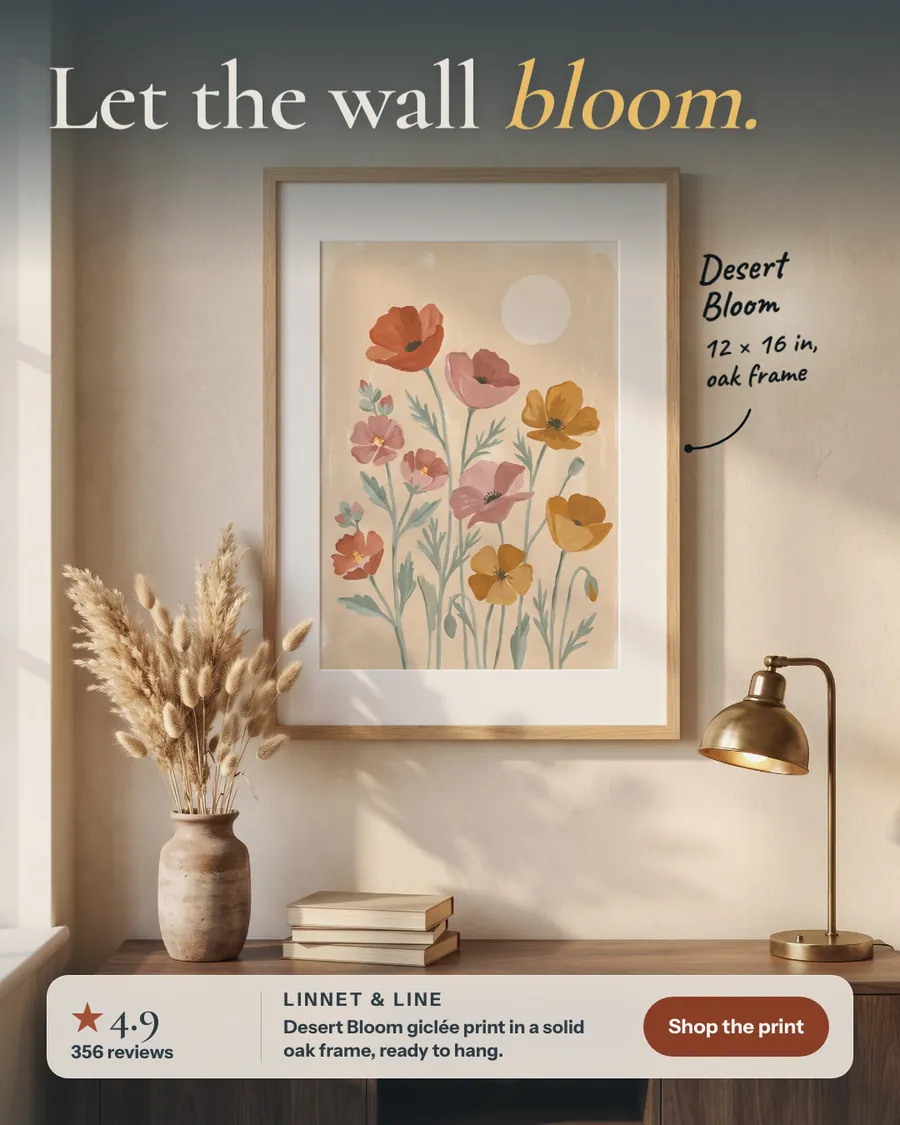
Lifestyle typeBenefit
Linnet & Line: Let the wall bloom.
Fictional sample brand · made by our engine
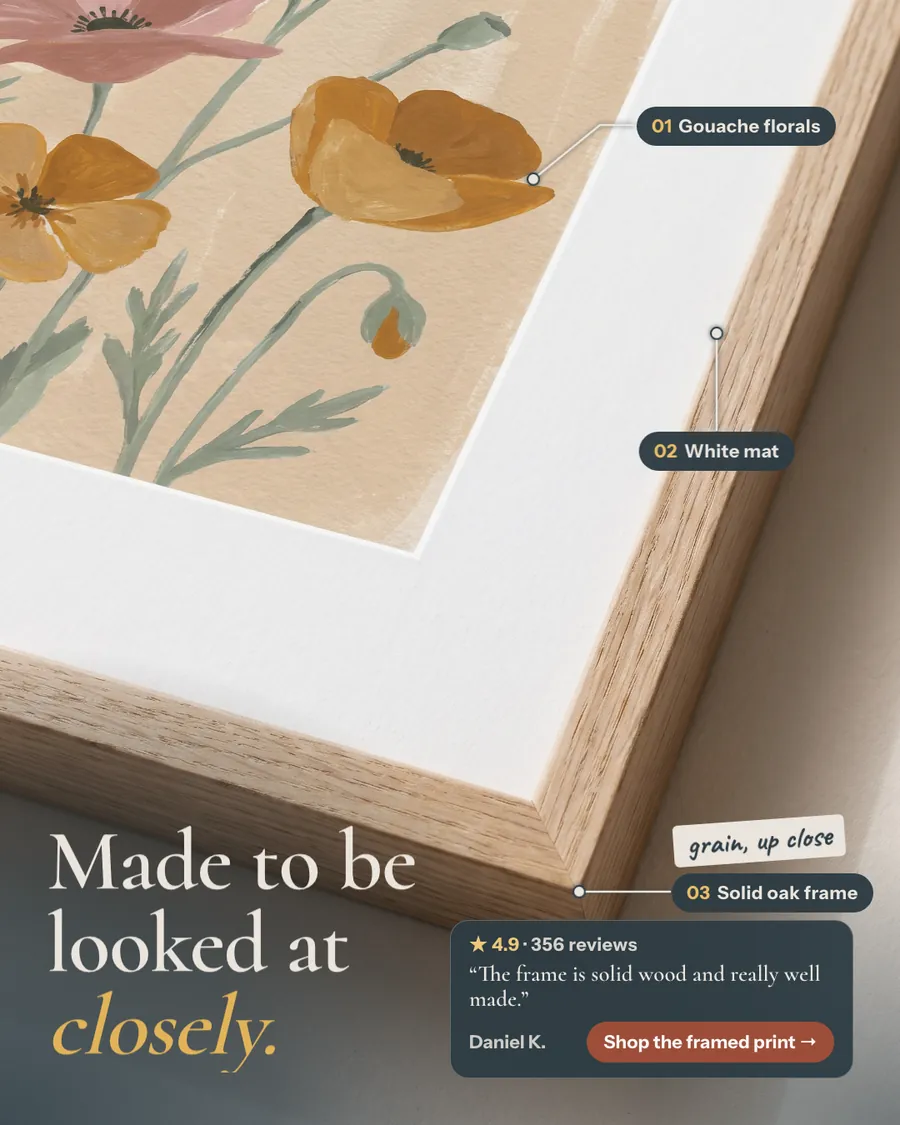
Annotated heroCraft
Linnet & Line: Made to be looked at closely.
Fictional sample brand · made by our engine
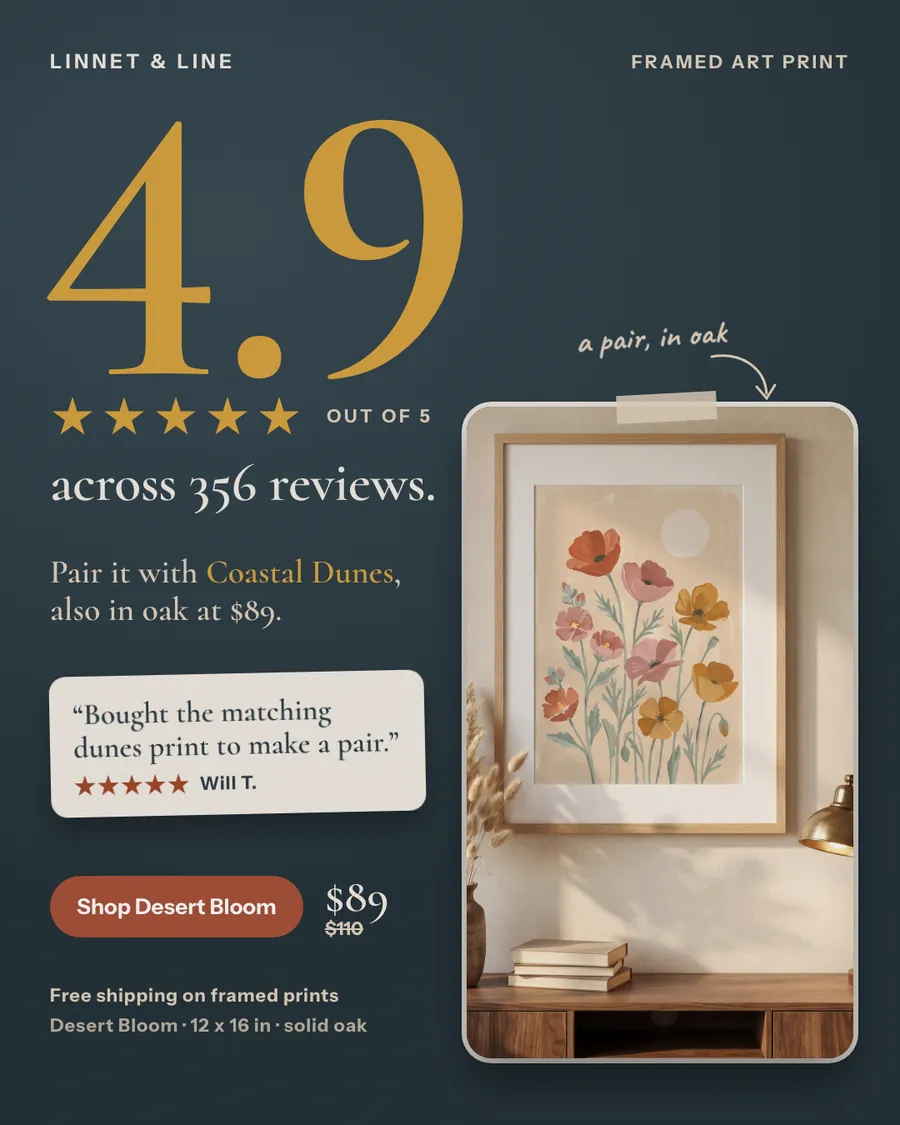
Big numberSocial proof
Linnet & Line: 4.9 across 356 reviews.
Fictional sample brand · made by our engine
Policy flags for wall art ads
Wall art isn't a restricted category, but art has honesty rules of its own, and higher prices draw closer attention to sale and origin claims.
Print or original
Describe a reproduction as a reproduction. California's fine prints law sets out disclosures, such as the medium and whether a piece is a reproduction, for prints sold as signed, numbered or limited editions.
Source: California Civil Code section 1742 (sale of fine prints: disclosure)
Was-and-now prices
Under the FTC's pricing guides, a former price in an ad has to be one you offered in good faith for a reasonably substantial period, not a number set high to make the sale look bigger.
Source: FTC Guides Against Deceptive Pricing, 16 CFR 233.1 (former price comparisons)
Made in USA
An unqualified Made in USA claim means all or virtually all of the product, frame and paper included. If only the printing and framing happen here, say exactly that.
Art you don't hold the rights to
Reproductions of someone else's work, famous characters or a living artist's recognizable style lead to reports, and Meta removes ads that infringe copyright.
Source: Meta Advertising Standards: Third-Party Intellectual Property Infringement
Promotions on Pinterest
Pinterest requires promotion conditions to be visible, the discount to match the landing page and checkout, and the promotional message to end when the offer does.
Source: Pinterest Advertising Guidelines
How often to refresh wall art ads, and what to measure
For art, a new room is a new ad. Refresh the setting before you change the print or the words.
Bring in new room shots of your leading prints every 3 to 4 weeks, and swap palettes with the seasons: warm landscapes in autumn, bare-wall prompts in January, botanicals in spring. A new piece or a new pair is the biggest refresh you have, so launch it with its own room ads.
On Pinterest, add fresh pins of the same print instead of editing old ones. On Meta, watch for "Creative limited", which means an ad costs more per result than your past ads, and answer it with a materially different photo.
What to measure
- Days from first click to purchase
- Tells you how long to wait before judging an ad, and how long your retargeting windows should be.
- Saves on Pinterest
- The earliest sign of which prints people are planning around, weeks before they buy.
- Prints per order
- Shows whether pairs and sets are working; it lifts what each first order can afford.
- Return reasons
- "Smaller than I thought" or "colors looked different" point straight at which photos to reshoot.
Questions about advertising wall art
How do I advertise wall art online?
Show each print on a real wall at its true size, with furniture for scale, on Pinterest and Instagram first. Then follow up with people who looked, using close-ups of the paper and frame, and give the decision a week or two before judging results.
How do I advertise art prints on Instagram?
Run room shots as 4:5 feed ads and 9:16 Stories from your Meta account, with the size on the image and the words kept off the art. Retarget visitors with a frame close-up and a pair, since most buyers need more than one look.
How do I advertise wall art on Facebook Marketplace?
Marketplace listings suit selling originals or a few pieces locally. For an online print shop, Marketplace is also one of the placements Meta ads can use, so a campaign with automatic placements already reaches people browsing it.
How do I advertise wall art on Etsy?
List prints with room photos and the size in the title, turn on Etsy Ads for the listings that already sell, and check what Etsy's 6.5% transaction fee and any 15% Offsite Ads fee leave on a framed order before you raise the budget.
What is the best website to sell wall art?
There isn't one answer. Your own store keeps the margin and lets Meta and Pinterest track sales; Etsy brings shoppers already searching for prints but takes fees; marketplaces suit volume. Many print shops run their own store and add Etsy for discovery.
How much should I spend to advertise wall art?
Work from what an order leaves you after printing, framing, shipping and fees: that's the most a sale can cost. Art sells in smaller numbers, so most shops start below Meta's 50-a-week learning level, optimize for add to cart and judge results over weeks.
How long do wall art ads take to work?
Longer than for impulse products: people often buy art days after the first click. Give a campaign at least two weeks before judging it, and measure the time from first click to purchase so you know your own buyers' pace.
Should I use Pinterest ads for art prints?
Pinterest is a strong fit, because people plan rooms and gallery walls there. Start with organic pins to see which prints get saved, then promote those with the Pinterest tag on your store so the ads can optimize for checkouts.
How do I advertise my art as an artist with no budget?
Post the work in progress and the finished piece in real rooms on Instagram and Pinterest, ask buyers for photos of the art on their walls, and offer prints alongside originals. When you add a small budget, put it behind the posts that already get saves.
Do wall art ads need the size in them?
Yes. On a phone every print looks the same size, and size is a common surprise when art arrives. Put the dimensions on the image and show the piece next to furniture people know the size of.
Get the ads for this plan
Paste your store link and get 3 free ads of your own art prints: we read your products, prices and reviews, design around your real product photo and check every fact against your store.
Where to go next
- Wall art ad ideasSeven sample ads for a framed giclée print, size-on-wall advice, print and edition wording, photos and the art calendar.
- Art printsWall art ads that answer size, frame and quality questions, built on your own room and detail photos.
- How to advertise home decorPinterest and Meta side by side for a small decor brand, a 30-day plan, a budget for slow deciders and the free-shipping line as your best offer.
- How to advertise print on demand productsStart from what an order leaves after the supplier's cut, test designs on Meta, push sets over single tees, then add Pinterest and Etsy.
- How to advertise furnitureA plan for a small furniture brand: Google Shopping and Meta first, a budget built on add to cart, and ads for buyers who measure and come back.
- Pinterest ads2:3 Pinterest pins (1000x1500) in every batch, built from your real product photos.
- PricingFree preview, Starter $49/month, weekly plans from $99/month with a 7-day free trial, 30-day money-back guarantee.
Sources
Platform rules on this page were checked on against:
- Meta Business Help Center: About the learning phase
- Meta Business Help Center: About learning limited
- California Civil Code section 1742 (sale of fine prints: disclosure)
- FTC Guides Against Deceptive Pricing, 16 CFR 233.1 (former price comparisons)
- FTC: Complying with the Made in USA Standard
- Meta Advertising Standards: Third-Party Intellectual Property Infringement
- Pinterest Advertising Guidelines
- 3 free ads when your spot opens
- Starter $49/month
- Growth $99/month, 7-day free trial
- Pro $149 · Scale $199
- 30-day money-back guarantee