how to advertise furniture
How to advertise furniture online when buyers take weeks to decide
Nobody buys a $245 solid oak table from one ad. They see it, measure the space, show someone, read the reviews and come back a week or three later. A furniture ad plan is mostly about that second and third visit, and about a budget that doesn't wait for purchases that arrive slowly. Here it is with Tallgrove, a fictional made-to-order furniture workshop.
Updated · Budgets and examples use a fictional brand's numbers. Use yours.
In short
How should a small brand advertise furniture online?
Use Google Shopping for people already searching for the piece and Meta to find people who aren't yet. Optimize for add to cart until purchases come often enough, show returning visitors the reviews, warranty and lead time, and judge results over a month. Furniture buyers measure, compare and come back before they order.
At a glance
- How long buyers take
- Days to weeks: they measure, compare and come back
- Where to start
- Google Shopping and Meta together
- What to optimize for
- Add to cart until purchases come weekly in volume
- What closes the sale
- Reviews, warranty, delivery and lead time, shown on the second visit
- The rule to know
- State a lead time you can keep (FTC Mail Order Rule)
Which channels fit furniture, in the order to try them
Furniture sits between search and discovery. Some buyers already know they want a solid oak side table; others need to see one in a room first. Start with one channel for each.
- 01
Google Shopping
Start hereWhy it fits
Searches like "solid white oak side table" or "round side table with shelf" are as close to a buying decision as furniture gets. Shopping shows your photo, price and free delivery on that exact search.
The trade-off
You appear next to large retailers with lower prices, so the title and photo have to make the material and build obvious. A thin feed (vague titles, no dimensions) wastes clicks.
- 02
Meta (Facebook and Instagram)
Start hereWhy it fits
A beautiful room shot reaches people who weren't searching but are furnishing a home. Meta also shows a second ad to people who visited the product page, which matters more in furniture than almost anywhere.
The trade-off
Few first clicks become same-week orders, and purchases are too rare for Meta's learning phase at first (see the budget below).
- 03
Pinterest
Add nextWhy it fits
People build whole rooms on Pinterest boards before buying anything, and a side table styled next to a sofa fits that planning. The 2:3 format shows the piece with the room around it.
The trade-off
It's the slowest channel here to turn a save into an order. Treat it as the top of a long funnel, not a sales channel you judge weekly.
- 04
Email
Add nextWhy it fits
A buyer comparing three tables wants something to come back to: a care guide, a wood finish sample, the lead time for their order. Email is how a long decision stays with you.
The trade-off
It needs a reason to sign up that isn't a discount, and someone to write it.
- 05
Home creators
Only if it fitsWhy it fits
A renovation or apartment account showing your table in a finished room is strong proof.
The trade-off
Shipping a free piece of solid furniture is expensive, so it works for your entry pieces, not the coffee table. Disclosure and usage rights apply.
- 06
Facebook Marketplace listings
Skip for nowWhy it fits
Marketplace is full of people furnishing on a budget.
The trade-off
Its listings are mostly local, secondhand sales between people. A new made-to-order piece belongs in normal Meta ads, which can still appear in the Marketplace placement.
How to size a starting budget for furniture ads
Furniture has the opposite problem to cheap products: each order is worth a lot, but there are few of them. Tallgrove's side table is $245 with free delivery in the contiguous US, made to order in 3 to 4 weeks.
| Order value | $245.00 |
|---|---|
| Margin after product cost, shipping and fees | 40% |
| Most a first order can cost to break even | $98.00 |
| 50 purchases a week at that cost | $4,900 a week |
| The same budget per day | about $700 |
Meta says an ad set usually leaves its learning phase after about 50 results in the week after its last significant edit, and recommends a budget large enough to get enough results. Meta Business Help Center: About the learning phase
Fifty $245 orders a week is a substantial furniture business, so almost no small workshop can optimize for purchases from the first day. That's normal, and Meta's own guidance points to the fix:
- Optimize for a step that happens more often. Meta suggests a more frequent optimization event, such as add to cart, when an ad set can't get enough results. A side table might collect many add to carts for every order.
- Budget from the add to cart, not the order. If roughly a fixed share of add to carts become orders in your shop, the most an add to cart can cost is that share of the break-even above. Use your own numbers once you have a month of them.
- Sell the pair. Buyers often put a side table on each side of the sofa. An ad that shows two raises the order value the whole calculation starts from.
Google's automated bidding learns from conversions too, so the same patience applies there: one Shopping campaign, enough budget to collect data, and no daily changes.
Your first 30 days advertising furniture
The month is built around two kinds of ad: ones that introduce the piece, and ones for people who already looked at it. Start with your entry piece, the one most people can say yes to.
Days 1 to 4
Feed, tracking and the entry piece
Sync your products to Google Merchant Center with titles that name the wood, the piece and the size. Check that add to cart and purchase events reach Meta and Google. Lead with your most affordable hero piece; for Tallgrove that's the $245 side table, not the $595 coffee table.
Days 5 to 10
Launch Shopping and a discovery campaign
Start a Shopping campaign on your hero pieces. On Meta, run 5 or 6 ads in one ad set: two room shots, two close-ups of the joinery or grain, one with the warranty, one with a review. Optimize for add to cart.
Days 11 to 18
Add the second-visit ads
Make three ads for people who viewed a product page in the last 30 days: the reviews, the warranty and free delivery, and the lead time stated plainly. Keep them in their own small ad set so the discovery ad set stays steady.
Days 19 to 24
Prune the search terms
In Google Ads, read the search terms that triggered your Shopping ads and add negatives for the ones that will never buy, like used, cheap or kids. Pause the Meta discovery ad with the fewest add to carts per dollar.
Days 25 to 30
Count orders over the whole month
Furniture orders arrive late, so compare channels on 30 days, not 7. If add to carts are coming steadily and orders follow, switch Meta to purchases once you see about 50 a week, or keep adding to cart as the goal until then.
What each visitor should see next
A furniture buyer meets your brand several times before ordering. Plan an ad for each stage instead of showing everyone the same room shot:
| Who | What they still doubt | What the ad shows |
|---|---|---|
| Hasn't seen you yet | Whether the piece suits their room | The piece in a real room, the price, free delivery |
| Viewed the product page | Whether it's worth the price | Joinery and grain close up, the 10-year warranty, a review |
| Added to cart, didn't buy | Delivery, lead time, returns | Ships assembled, made in 3 to 4 weeks, the return policy |
| Bought one | Whether to complete the room | The matching pieces, shown together |
Keep the second-visit ads few and plain. Someone deciding on a $245 table wants facts, not another mood shot.
Offers that work for furniture
Furniture buyers are paying for confidence. The offers that move them reduce risk or answer logistics, rather than knock a few dollars off.
Free delivery, said in the ad
Shipping a heavy piece is the hidden cost buyers fear most. Tallgrove's free delivery in the contiguous US belongs on the ad, not just the checkout.
A long warranty
A 10-year warranty says what the oak and the joinery are worth better than adjectives can.
Watch: Advertise only what the written warranty covers, and link to its terms.
A finish or wood sample
For made-to-order pieces, a small sample of the oak and oil finish lets a slow decider hold the real thing. It also gives you their address and email.
A real sale on a sale weekend
US furniture buyers expect sales on long holiday weekends. A genuine markdown then, like $245 from $295, meets that expectation.
Watch: The former price must be one you actually charged for a reasonable period.
Angles to test for furniture ads
Each angle answers a doubt that stops a furniture order. Tallgrove's annotated sample ads, photo checklist and copy lines are on Furniture ad ideas; the angles below are the ones the plan tests first.
How it's built
Mortise and tenon. No particle board, no veneer.
How long it lasts
A side table with a 10-year warranty.
What owners say
"Heavy, solid and beautifully finished."
Arrives ready
Ships fully assembled. Free delivery.
The pair
One for each side of the sofa.
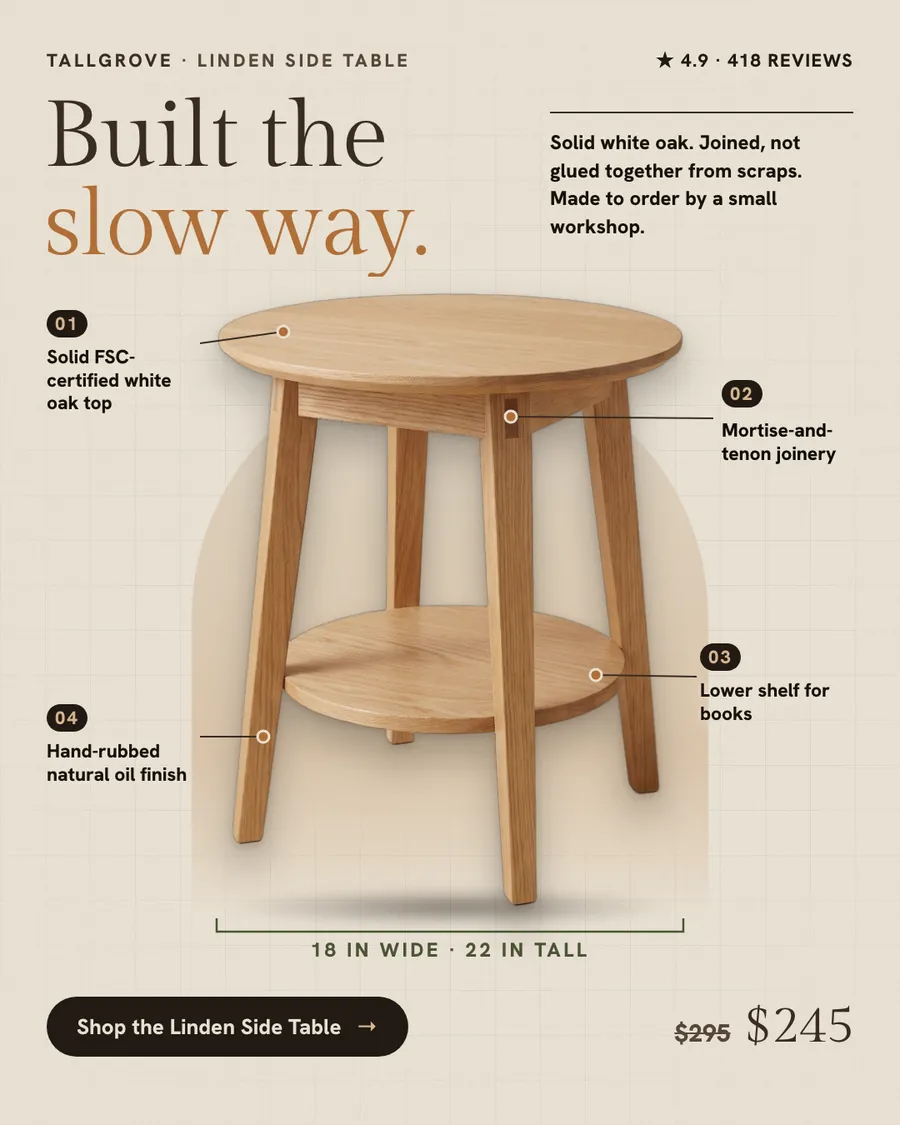
Annotated heroCraft
Tallgrove: Built the slow way.
Fictional sample brand · made by our engine
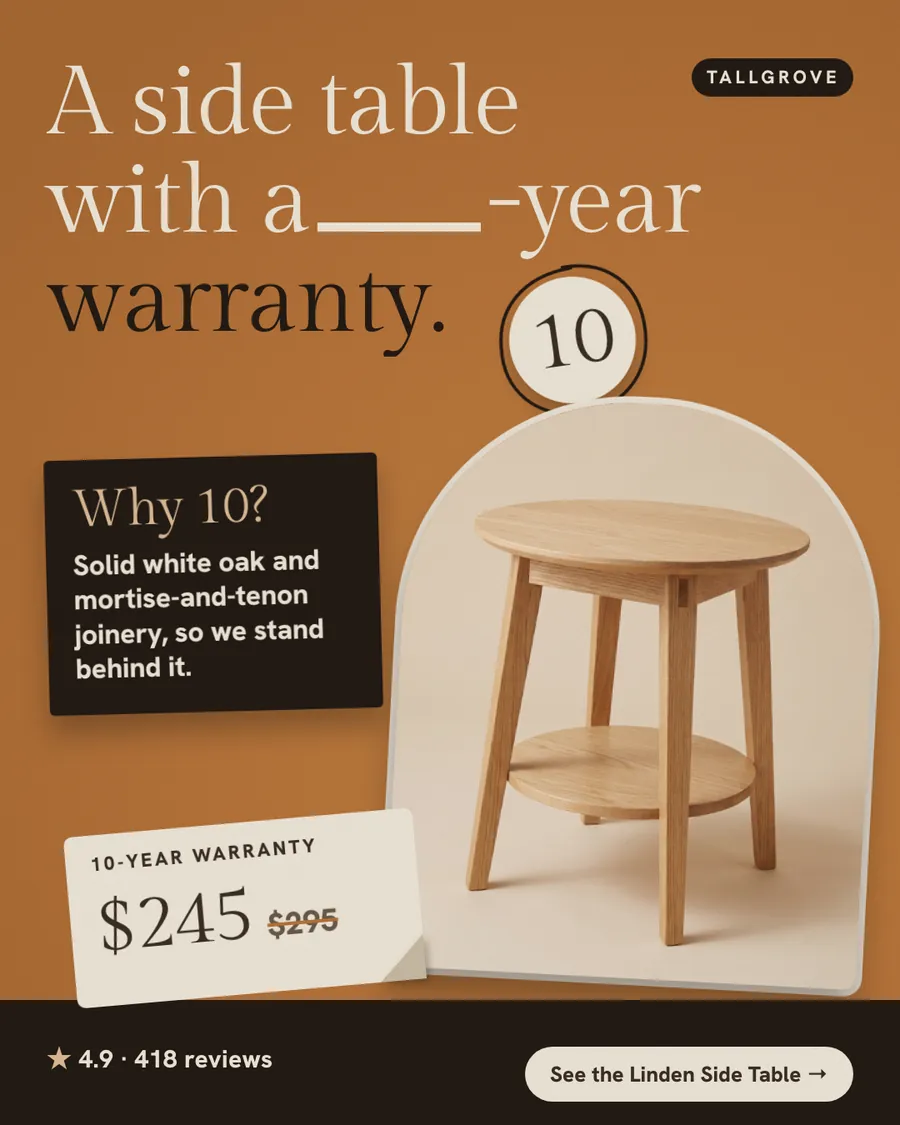
Fill in the blankDurability
Tallgrove: A side table with a ____-year warranty.
Fictional sample brand · made by our engine

Review cardSocial proof
Tallgrove: “Heavy, solid and beautifully finished. You can feel the quality.”
Fictional sample brand · made by our engine
Policy flags for furniture ads
Furniture isn't restricted on the ad platforms. The rules that matter are the FTC's, applied to the claims furniture brands make most: materials, lead times, origin and prices.
Lead times and delivery dates
Under the Mail Order Rule you need a reasonable basis for any shipping time you state, and if you can't meet it you must offer the buyer the choice to wait or cancel for a refund. Made-to-order pieces need an honest lead time in the ad or on the page.
Source: FTC: Business Guide to the Mail, Internet, or Telephone Order Merchandise Rule
Materials
"Solid oak" means the parts you name are solid oak. The FTC's guidance for small business: ads must be truthful and not deceptive, and you need evidence behind each claim.
FSC logos and certified wood
FSC's US office explains that promoting finished products as FSC-certified requires sourcing through certified companies and a licence to use the FSC trademarks. Check before the logo goes in an ad.
"Made in USA"
The FTC's standard is all or virtually all of the product, including wood, hardware and finish. If only the building happens here, say where your workshop is instead.
Was prices
A crossed-out price has to be one you really charged for a reasonable time, not a number set up to make the sale look bigger.
Source: FTC Guides Against Deceptive Pricing, 16 CFR 233.1 (former price comparisons)
How often to refresh furniture ads, and what to measure
Furniture ads reach fewer, more considered people, and the second-visit ads keep hitting the same small audience, so those tire first.
Refresh the discovery ads every three to four weeks with a new room or a new detail. Refresh the second-visit ads more often, every two weeks, because the same people see them repeatedly while they decide.
If Meta marks an ad "Creative limited" (costlier per result than your past ads) or "Creative fatigue" (about twice as costly), replace the image with a materially different one, such as a new room or the piece from another angle, and keep the original running if it still delivers.
What to measure
- Cost per add to cart
- Your working target until purchases come often enough to optimize for.
- Days from first click to order
- Tells you how long to wait before judging a channel, and how long your second-visit audience should be.
- Order value and pieces per order
- Pairs and sets change the whole budget calculation; watch whether the pair ads move them.
- Search terms in Shopping
- Shows which words real buyers use for your piece, which feeds better product titles and better ads.
Questions about advertising furniture
How do I advertise furniture online as a small brand?
Run Google Shopping for people searching for your type of piece and Meta for people furnishing a home who haven't searched yet. Lead with your most affordable hero piece, optimize Meta for add to cart at first, and show returning visitors your reviews, warranty and lead time.
How do I advertise furniture on Facebook Marketplace?
Marketplace listings are mostly people selling locally, often secondhand. A furniture brand gets further with a normal Meta campaign, whose ads can appear in the Marketplace placement along with the feed, Stories and Reels when placements are automatic.
Why don't my furniture ads get purchases in the first week?
Because furniture buyers rarely order on the first visit. They measure, compare and come back days or weeks later. Judge channels on a month of orders, track add to carts in the meantime, and show second-visit ads to people who viewed the product page.
Should I optimize furniture ads for add to cart?
Usually yes at the start. Meta's learning phase wants about 50 results a week after the last significant edit, and few small furniture brands sell that many pieces. Meta suggests a more frequent event in that case. Switch to purchases once orders come in that volume.
Are Google Shopping ads good for furniture?
They suit furniture because buyers search with specific words: the wood, the type of piece, the size. Clear product titles with the material and dimensions, good photos and a visible delivery promise matter more than bids. Read the search terms report and exclude words like used or cheap.
How do I advertise made-to-order furniture with a long lead time?
Say the lead time plainly in the ad or on the product page, and keep it accurate. The FTC's Mail Order Rule requires a reasonable basis for stated shipping times. A buyer of a made-to-order piece expects some wait; what loses the sale or the review is finding out after the order.
How much does it cost to advertise furniture?
It depends on your margin, not on a standard figure. Multiply your order value by the share left after making, delivery and fees: that's the most one order can cost. Since few small brands get 50 furniture orders a week, most budget from add to carts instead and grow from there.
Is Pinterest worth it for furniture brands?
It can be, as the top of a long decision: people build room boards there before buying. Expect saves well before orders and judge it over months, not weeks. Start it after Shopping and Meta are running, using the same room photos in the tall 2:3 format.
How do I advertise furniture for sale?
Show the piece in a real room and on its own, give the dimensions, the material and the price, and say how it arrives. For a brand, add the warranty and reviews. For a one-off secondhand sale, a local Marketplace listing with clear photos and measurements is usually enough.
Get the ads for this plan
Paste your store link and get 3 free ads of your own furniture: we read your products, prices and reviews, design around your real product photo and check every fact against your store.
Where to go next
- Furniture ad ideasSeven sample ads for a solid oak side table, how to prove size, wood and build, delivery facts and the sale weekends.
- FurnitureFurniture ads that show scale, materials and real rooms, with dimensions and delivery facts from your pages.
- How to advertise home decorPinterest and Meta side by side for a small decor brand, a 30-day plan, a budget for slow deciders and the free-shipping line as your best offer.
- How to advertise wall artPinterest and Instagram first, retargeting for people who take days to decide, pairs to lift order value, and print and edition rules.
- How to advertise kitchen productsCookware is bought by spec: Google Shopping and Meta demos first, a budget that leans on sets, and the coating claims to word carefully.
- How to make Facebook ads for your Shopify store, start to launchA practical playbook for solo Shopify owners: the setup you do once, the product and angles you pick, three honest ways to make the ads, and the weekly loop that keeps them working.
- PricingFree preview, Starter $49/month, weekly plans from $99/month with a 7-day free trial, 30-day money-back guarantee.
Sources
Platform rules on this page were checked on against:
- Meta Business Help Center: About the learning phase
- Meta Business Help Center: About learning limited
- Meta Business Help Center: About creative fatigue recommendations in Ads Manager
- FTC: Business Guide to the Mail, Internet, or Telephone Order Merchandise Rule
- FTC: Complying with the Made in USA Standard
- FTC Guides Against Deceptive Pricing, 16 CFR 233.1 (former price comparisons)
- 3 free ads when your spot opens
- Starter $49/month
- Growth $99/month, 7-day free trial
- Pro $149 · Scale $199
- 30-day money-back guarantee