how to advertise print on demand products
How to advertise print on demand products when the margin is thin
Print on demand removes inventory and adds a cost most ad plans ignore: every order pays the supplier for the blank, the print and often the shipping, so a $32 tee can leave well under half its price to spend on winning the sale. This plan starts from that number, uses Mossworth Press, a fictional illustrated-tee shop, as the worked example, and only spends seriously on designs that prove themselves.
Updated · Budgets and examples use a fictional brand's numbers. Use yours.
In short
How do you advertise print on demand products?
Start from what an order leaves after the supplier's base cost, shipping and fees, then advertise only designs with a clear audience. Test three or four designs with real sample photos on Meta, keep the one that earns add to carts, raise order value with bundles, and add Pinterest and Etsy once a design proves itself.
At a glance
- The number that decides it
- What's left after base cost, shipping and fees
- Where to start
- Meta, testing designs against each other
- What sells
- A design with a named audience, shown as a real printed sample
- Order value lever
- Free shipping on two items turns one tee into a set
- The rule that bites
- Other people's logos, lyrics and characters
Which channels fit print on demand, in the order to try them
A POD shop doesn't sell a product so much as a design for a group of people. The right channels let you find out cheaply which design has a group, then go where that group gathers.
- 01
Meta (Facebook and Instagram)
Start hereWhy it fits
Broad targeting with clearly niche creative finds the people a design is for: a mushroom illustration sorts out the foragers on its own. A carousel or a few ads per design shows within a week which one has an audience.
The trade-off
A thin margin makes the learning phase expensive, and mockup-only ads tend to bring returns when the printed colors arrive flatter than the screen showed.
- 02
Pinterest
Add nextWhy it fits
Hobby boards and gift searches for a niche ("gifts for birders", "cottagecore outfits") are where illustrated designs get discovered and saved. A 2:3 pin of the design worn fits right in.
The trade-off
Pins build slowly; judge Pinterest over months, not the first two weeks.
- 03
Creators in the niche
Add nextWhy it fits
A forager, a birder or a trail runner with a few thousand followers wearing your design reaches exactly its audience, and costs one sample.
The trade-off
Gifted posts need a clear disclosure, and their clips need written permission before you run them as ads.
- 04
Etsy
Only if it fitsWhy it fits
Many shoppers look for niche designs inside Etsy search, and Etsy Ads start at $1 a day. See how to advertise an Etsy shop.
The trade-off
Etsy's 6.5% transaction fee and, on orders from its Offsite Ads, a 15% fee come out of a margin that's already thin.
- 05
Google Shopping
Add laterWhy it fits
Searches like "mushroom t-shirt" carry intent, and your feed can show the design next to them.
The trade-off
Generic apparel searches are price-compared, and every click costs against a small margin. Wait until you know which designs convert.
- 06
TikTok
Add laterWhy it fits
Drawing-process clips and "how this design was made" videos give a POD shop a story the mass-market tees don't have.
The trade-off
It needs a steady supply of video, which is a second job on top of designing.
How to size a starting budget for print on demand ads
Mossworth Press sells the Mushroom Club tee at $32 and the matching tote at $24, with free shipping on two or more items, so the order this plan aims for is the $56 set. The table after this section shows where the other 62% goes.
| Order value | $56.00 |
|---|---|
| Margin after product cost, shipping and fees | 38% |
| Most a first order can cost to break even | $21.28 |
| 50 purchases a week at that cost | $1,064 a week |
| The same budget per day | about $152 |
Meta says an ad set usually leaves its learning phase after about 50 results in the week after its last significant edit, and recommends a budget large enough to get enough results. Meta Business Help Center: About the learning phase
Thirty-eight percent is lower than most product shops work with, because the supplier's base price and the free shipping come out of every order. For a POD shop that means:
- Test designs before you scale anything. Three or four designs in one ad set, with the same headline pattern, so the design is the only thing that changes.
- Sell the set, not the single tee. The bundle leaves more dollars per order to spend on winning it, even at a lower percentage.
- Optimize for add to cart until purchases add up. Meta's guidance for an ad set that can't get enough results is to pick a more frequent event, such as add to cart.
- Never scale a mockup. Order a sample of the design that wins and reshoot before you raise the budget.
Print on demand margin math: one tee against the set
Here's what Mossworth Press keeps from a single tee and from the tee-and-tote set. The supplier costs are made up for this page; put your own supplier's price list and your payment provider's rates in their place.
| Per order | One tee | Tee + tote (free shipping) |
|---|---|---|
| The buyer pays | $32.00 + $5.50 shipping | $56.00 |
| Supplier base cost (blank and print) | $14.50 | $24.00 |
| Shipping the shop pays the supplier | $5.50 (covered by the buyer) | $8.70 |
| Payment fees | $1.39 | $2.02 |
| Left for ads and profit | $16.11 (50% of the tee price) | $21.28 (38%) |
The set's percentage is lower, yet it leaves about $5 more per order to spend on getting that order. That's the reason to build ads around the set and the free-shipping rule rather than around a single shirt, and the reason a percent-off code hurts a POD shop more than most: it comes straight out of a margin the supplier has already cut.
Your first 30 days advertising print on demand products
The first month answers one question: which design has an audience big enough to pay for its ads. Everything else waits for that answer.
Days 1 to 5
Order samples of three or four designs
Pick the designs with the clearest audience, order a printed sample of each, and photograph them worn where that audience spends time. Compare the printed colors with your mockups and fix the listing images if they differ.
Days 6 to 9
Run a design test
One Sales campaign, one broadly targeted ad set, two ads per design built on the same layout and headline pattern, in 4:5 and 9:16. Keep the offer identical across designs so the drawing is the only variable.
Days 10 to 16
Hands off while the designs compete
Don't edit the ad set. Compare add to carts and purchases per design, not likes: a design people comment on and a design people buy are often different designs.
Days 17 to 23
Back the winner with the set
Turn off the designs that spent your break-even twice without an add to cart. Make new ads for the winner as the tee-and-tote set with the free-shipping rule on the image, and ask your first buyers for photo reviews.
Days 24 to 30
Take the winner to its audience
Pin the winning design at 2:3 on Pinterest, send samples to five creators in its niche, and list it on Etsy if that suits your shop. Start the next round of design tests with what you learned.
Offers that work for print on demand
With a supplier taking the first cut, good POD offers raise the order rather than lower the price.
Free shipping on two or more items
Mossworth's rule. It turns a single tee into a set and moves the shipping cost onto an order that can carry it.
The matching set
The same design on a tee and a tote sells the second item visually, without a discount at all.
An order-by date for gifts
Gift buyers want certainty more than savings, and POD production days make the date more valuable.
Watch: Work the date back from your supplier's peak-season production time plus the carrier; the FTC's Mail Order Rule requires a reasonable basis for any shipping promise.
A launch price for a new design
Gives followers a reason to buy in the first week, which is also when you learn whether the design works.
Watch: Only call a price reduced if you actually charged the higher price before.
Angles to test for print on demand ads
In POD the design is the product, so every angle is a different way into the same drawing. The full set of sample ads, photo checklist and mockup advice is on Print on demand ad ideas.
Who it's for
Mushroom people will know.
Made after you order
Printed for you, not pulled off a warehouse shelf.
The set
Tee and tote, and the shipping's free.
Holds up in the wash
Twelve washes in. Still sharp.
The drawing itself
Drawn by hand, line by line, before it was a shirt.

Lifestyle typeSocial proof
Mossworth Press: Market day, but make it mushrooms.
Fictional sample brand · made by our engine
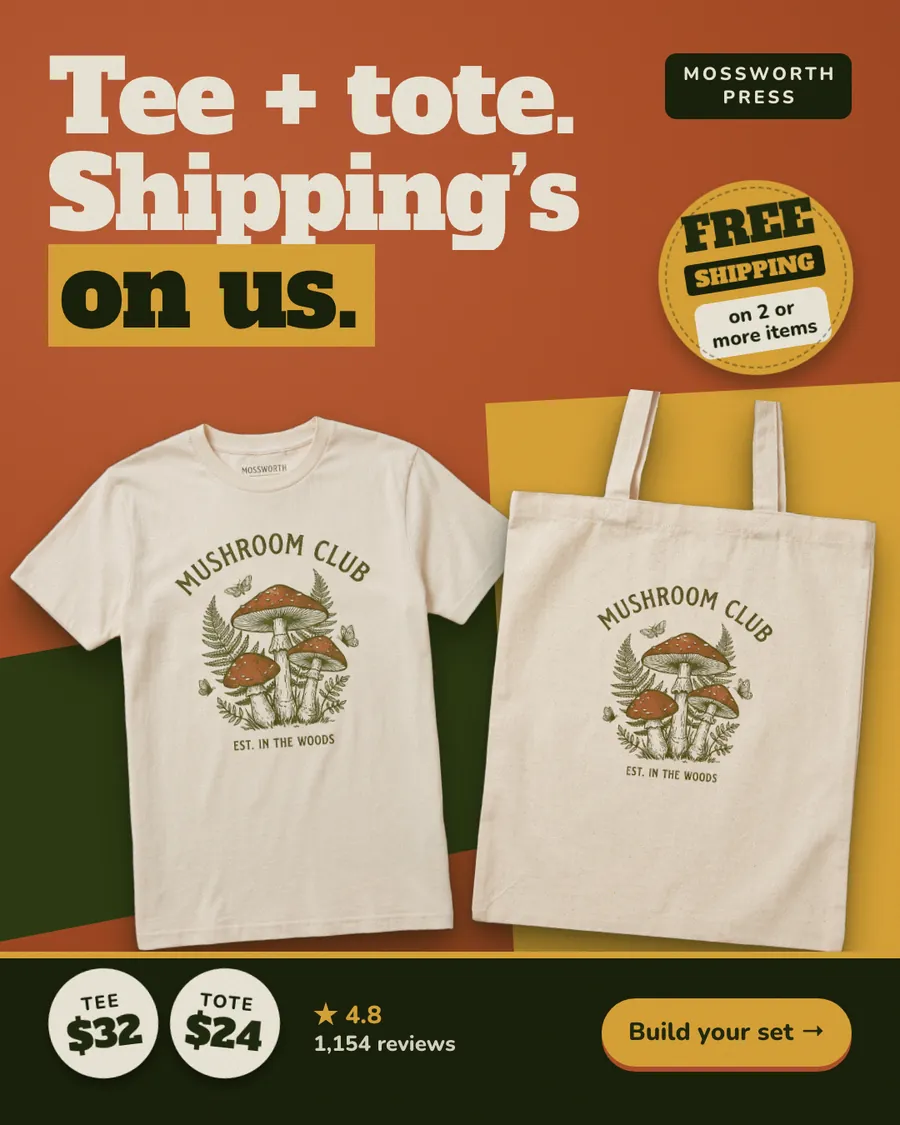
Bold posterOffer
Mossworth Press: Tee + tote. Shipping's on us.
Fictional sample brand · made by our engine
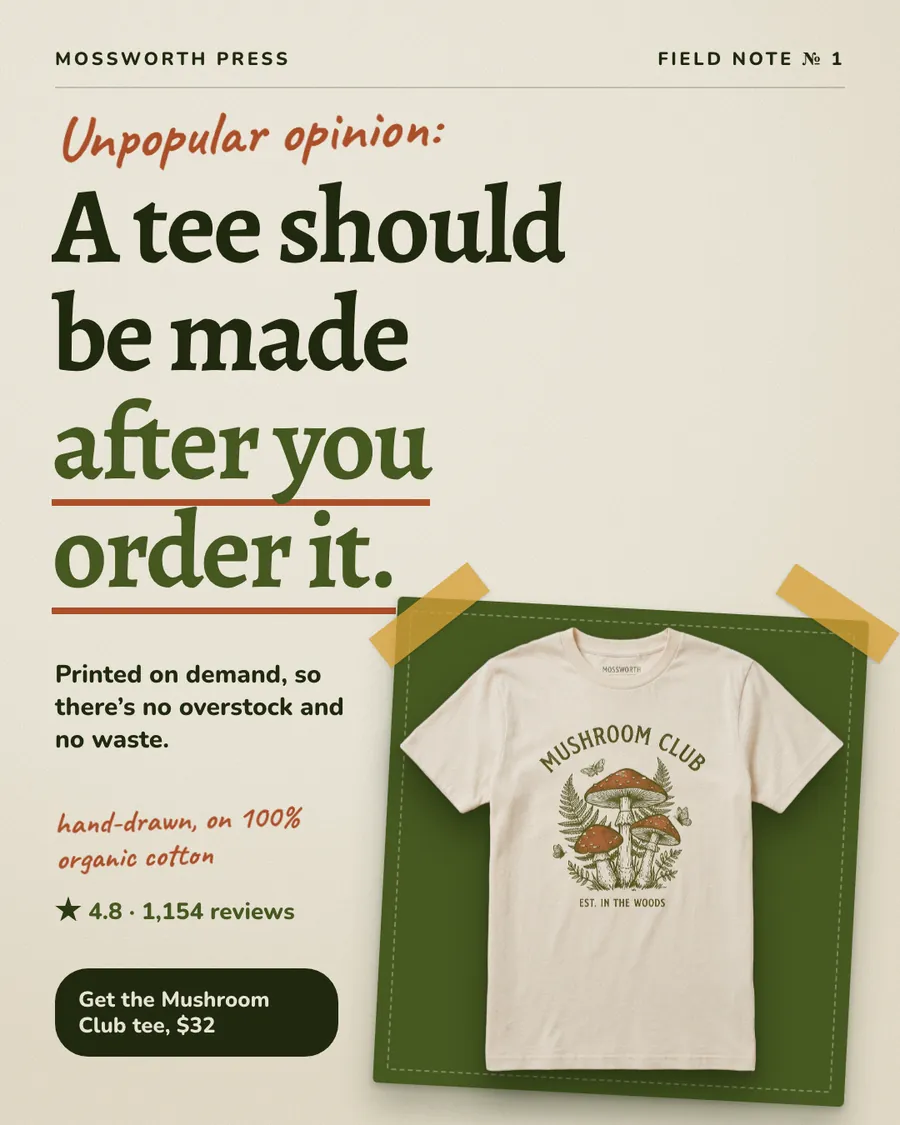
Unpopular opinionTransparency
Mossworth Press: Unpopular opinion: A tee should be made after you order it.
Fictional sample brand · made by our engine
Policy flags for print on demand ads
POD ads aren't a restricted category, but the business model walks into a few rules that cost shops their ad accounts or their margins.
Designs that borrow
Fan art, band names, film lines and team logos are the usual reason POD ads get removed: Meta takes down ads that infringe copyright or trademarks once a rights holder reports them.
Source: Meta Advertising Standards: Third-Party Intellectual Property Infringement
Delivery times
Your advertised shipping time has to include the supplier's production days. Under the FTC's Mail Order Rule you need a reasonable basis for it, and if you can't ship in time you must offer the buyer a delay or a refund.
Source: FTC: Business Guide to the Mail, Internet, or Telephone Order Merchandise Rule
Personalized products
Meta's personal attributes policy rules out ads that address the viewer by name or assert things about them. Describe what the buyer can customize instead.
Source: Meta Advertising Standards: Privacy Violations and Personal Attributes
"Zero waste" and "organic"
Printing to order avoids unsold stock, but "zero waste" is a broad environmental claim the Green Guides expect you to prove. Call cotton organic only when the fiber is certified.
Source: USDA Agricultural Marketing Service: Organic textiles
How often to refresh print on demand ads, and what to measure
A new design costs a POD shop almost nothing to list, which changes what refreshing means.
Run a small design test every two to three weeks, so there's always a challenger ready when the current winner tires. For the winner itself, refresh the photos and the setting before you touch the design: the same tee at a market, on a trail and on a sofa are three ads.
Watch for Meta's "Creative limited" status, which means an ad's cost per result has climbed above your past ads. With a margin this thin, act on it sooner than a higher-margin shop would.
What to measure
- What's left per order
- Price minus base cost, shipping and fees, per order. It moves every time a supplier changes prices, and it caps what each sale may cost in ads.
- Add to cart rate per design
- Picks your winners. Likes and comments don't.
- Share of orders that are sets
- Tells you whether the bundle offer is doing its job of raising what each order is worth.
- Reprint and return requests
- Print faults and color complaints show up here first, and they cost you twice: the refund and the reprint.
Questions about advertising print on demand products
How do I advertise a print on demand t-shirt business?
Treat each design as its own small test: order a sample, photograph it worn by the kind of person it's for, and run a few ads per design in one ad set. Keep the designs that earn add to carts, and sell them as sets so each order can pay for its ad.
How do I advertise t-shirts on Facebook?
Use real photos of the printed shirt in 4:5, name the audience in the headline, and state the fabric and shipping time in the text. One broad Sales ad set with three or four designs tells you more than separate campaigns per design.
How do I advertise t-shirts on Instagram?
The same ads run there from your Meta account; add 9:16 versions for Stories and Reels with the shirt worn and the design filling the frame. A short clip of the design being drawn often works as a second angle.
How do I advertise hoodies?
Hoodies cost more to produce, so the margin in dollars is often better than on a tee even if the percentage isn't. Advertise them from early autumn, show the fabric weight and fit on two body types, and offer them as a set with a matching tee.
How do I advertise print on demand products on Etsy?
List your strongest designs with clear photos of real samples, turn on Etsy Ads for those listings from a small daily budget, and check what Etsy's transaction fee and any Offsite Ads fee leave you before raising it.
How do I advertise mugs on Etsy?
Mugs sell as gifts, so lead with who it's for and an order-by date, show the mug in a hand for scale, and photograph both sides if the design wraps around. Etsy Ads on your best mug listings are the low-cost place to start.
How do I run a print on demand business profitably?
Know what each order leaves after base cost, shipping and fees, and never let ads cost more than that per sale. Niche designs with a clear audience, real sample photos, sets that raise order value and quick cuts of designs that don't sell are what keep the margin intact.
How much should I spend on print on demand ads?
Work from what an order leaves you: that is the most a sale can cost in ads. About 50 purchases a week at that cost is what Meta says an ad set usually needs to leave learning, so most POD shops start lower and optimize for add to cart while they test designs.
Which print on demand designs should I advertise?
The ones with a specific audience you can picture and reach, and that already show some organic interest, such as saves, shares or a few sales. Generic slogans compete with every other shop using the same blanks; a design for a defined group doesn't.
Can I advertise print on demand without a big budget?
Yes, by testing small: a few dollars a day on one ad set with three designs, optimized for add to cart, tells you which design to back. Add free channels alongside it: Pinterest pins, posts in hobby groups where self-promotion is allowed, and samples sent to niche creators.
Get the ads for this plan
Paste your store link and get 3 free ads of your own print on demand products: we read your products, prices and reviews, design around your real product photo and check every fact against your store.
Where to go next
- Print on demand ad ideasSeven sample ads for an illustrated print on demand tee, real photos vs mockups, shipping-time and design rules, and dates.
- T-shirtsTee ads where the print reads at phone size, plus fabric-weight and fit ads for blanks.
- How to advertise a clothing brandOne hero product, fit proof on real bodies, returns counted before the budget: a first-month ad plan for a small clothing brand.
- How to advertise an Etsy shopWhen Etsy Ads pay, what Offsite Ads really cost per order, and how Pinterest and video bring outside shoppers to your listings.
- How to advertise wall artPinterest and Instagram first, retargeting for people who take days to decide, pairs to lift order value, and print and edition rules.
- Bundle offerBundle and set ads that show what is in the box and the real saving against buying separately.
- PricingFree preview, Starter $49/month, weekly plans from $99/month with a 7-day free trial, 30-day money-back guarantee.
Sources
Platform rules on this page were checked on against:
- Meta Business Help Center: About the learning phase
- Meta Business Help Center: About learning limited
- Meta Business Help Center: About creative fatigue recommendations in Ads Manager
- Meta Advertising Standards: Third-Party Intellectual Property Infringement
- Meta Advertising Standards: Privacy Violations and Personal Attributes
- FTC: Business Guide to the Mail, Internet, or Telephone Order Merchandise Rule
- FTC Green Guides, 16 CFR 260 (environmental marketing claims)
- USDA Agricultural Marketing Service: Organic textiles
- Etsy Help: What are the Fees and Taxes for Selling on Etsy?
- 3 free ads when your spot opens
- Starter $49/month
- Growth $99/month, 7-day free trial
- Pro $149 · Scale $199
- 30-day money-back guarantee