how to advertise home decor
How to advertise home decor when people save first and buy later
Decor buyers rarely see a vase and check out. They save it, picture it on the shelf, come back on a Sunday and buy it with something else. A decor ad plan has to work with that delay instead of judging every ad on its first week. This one uses Hollowfern, a fictional ceramics and textiles brand, and its numbers.
Updated · Budgets and examples use a fictional brand's numbers. Use yours.
In short
How do you advertise home decor online?
Run Pinterest and Meta together: Pinterest catches people planning a room, Meta reaches people who weren't looking yet. Show every piece styled in a real room and on its own, give the size, and use a free-shipping line to build orders. Judge results over two to four weeks, because decor buyers save before they buy.
At a glance
- How people buy
- Save it, picture it, come back later, add a second piece
- Where to start
- Pinterest and Meta at the same time, with the same room photos
- The number that decides
- Size, given in inches next to something familiar
- Your best offer
- A free-shipping line just above your bestseller's price
- How long to judge
- Two to four weeks, not seven days
Which channels fit home decor, in the order to try them
Decor is visual, planned and often bought in pairs or sets. Two channels share the starting line here because they catch different moments: planning a room and stumbling on a piece.
- 01
Pinterest
Start hereWhy it fits
People open Pinterest to plan a room, so a vase on a styled console reaches someone already deciding what goes on theirs. Pins keep getting found through search and boards long after a feed ad would be stale.
The trade-off
Saves come quickly, sales slowly. The Pinterest tag has to be installed and checkout events firing before the campaign can optimize for sales.
- 02
Meta (Facebook and Instagram)
Start hereWhy it fits
Instagram is where people find the small studio they didn't know existed. A single striking piece in soft light, with the price, does well in the feed, and Meta's reach finds buyers Pinterest won't.
The trade-off
Feed scrollers are less ready to buy than pinners who were planning, so expect more clicks per sale. Purchases also arrive days after the click, which makes the first week look worse than it is.
- 03
Email
Add nextWhy it fits
One-of-a-kind glazes and small batches give you real news: a new color, a restock, the last few pieces. That's a reason to email that doesn't need a discount.
The trade-off
You need a list first, so pair it with a signup on the site and a note in every order.
- 04
Creators and stylists
Add nextWhy it fits
Home accounts on Instagram and TikTok show a piece in a lived-in room, which is exactly the proof decor buyers want. Small stylists often swap a post for a piece.
The trade-off
Each post needs a clear #ad disclosure if they got the piece free, and running their photo as your ad needs their permission.
- 05
Google Shopping
Add laterWhy it fits
Searches like "speckled ceramic vase" or "large textured vase" show real intent, and Shopping puts your photo and price on them.
The trade-off
Generic decor searches are full of big home retailers on price. It works best once you have a few pieces with clear, searchable names.
- 06
Facebook Marketplace listings
Skip for nowWhy it fits
Marketplace is busy with local, secondhand decor sales.
The trade-off
Its listings are mostly people selling locally, not brands shipping nationwide. A normal Meta campaign can still show ads in the Marketplace placement.
Pinterest or Meta first? A quick way to choose
Running both is the default above. If budget forces a choice, let the product decide:
| If your decor is | Lean toward | Why |
|---|---|---|
| Styled into rooms (vases, throws, baskets, mirrors) | People plan those rooms there, and the tall format shows the whole corner. | |
| A striking single piece with a story (a studio, a maker) | Meta | Instagram is where people discover small makers and follow them. |
| Seasonal (holiday tables, autumn textures) | Pinterest first, then Meta | Pins need weeks to collect saves; feed ads can follow closer to the date. |
| Searched by name or material (a linen pillow cover, a rattan lamp) | Google Shopping soon after | The search already says what they want; Shopping shows yours with a price. |
Your first 30 days advertising home decor
The plan runs Pinterest and Meta from the same photos, so you learn which room and which piece sell, then puts more behind them.
Days 1 to 3
Tags, sizes and two kinds of photo
Install the Pinterest tag and the Meta pixel and check a test checkout on both. For your two or three hero pieces, get one styled shot in a real room and one plain shot, and put the measurements on the product page in inches.
Days 4 to 10
Launch on both channels
On Pinterest, run 5 or 6 pins in 2:3, each a different room or styling of the hero pieces. On Meta, run 6 ads in 4:5 and 9:16: two room shots, two close-ups of the glaze or weave, two with a customer review. One campaign and one ad set on each platform.
Days 11 to 20
Read saves and clicks, not just sales
Leave both campaigns alone. Note which room and which piece get the most saves on Pinterest and the most add to carts on Meta. In decor, those usually point to the same winner a week before purchases do.
Days 21 to 26
Build the second piece into the ad
Make new ads that show the winning piece next to a natural partner (the large vase with the small one, a pillow with a throw) and the free-shipping line. Pause the room styling nobody saved.
Days 27 to 30
Look back over the whole month
Count sales against both channels over the full 30 days, including orders that came days after the click. Then decide: put more on the channel with the better cost per order, and start a small Shopping campaign for the piece with the clearest searchable name.
How to size a starting budget for home decor ads
Decor orders are bigger than most impulse buys, which helps, but breakage and double boxing cost more than people think. Hollowfern's numbers: the large vase is $64, and most orders add a second piece to clear free shipping at $75.
| Order value | $90.00 |
|---|---|
| Margin after product cost, shipping and fees | 45% |
| Most a first order can cost to break even | $40.50 |
| 50 purchases a week at that cost | $2,025 a week |
| The same budget per day | about $289 |
Meta says an ad set usually leaves its learning phase after about 50 results in the week after its last significant edit, and recommends a budget large enough to get enough results. Meta Business Help Center: About the learning phase
Fifty purchases a week of $90 decor orders is a real business, and two channels would split that number between them. Most small decor brands can't hit it on day one, and there are honest ways around that:
- Pick one optimization goal you can feed. If purchases are too rare for the learning phase, Meta suggests a more frequent event such as add to cart. On Pinterest, optimize for checkouts only once the tag reports enough of them.
- Give each platform one campaign. Two campaigns per channel halves the data each one learns from.
- Judge on a longer window. A decor buyer who saves today and buys in ten days is a sale your first-week report misses. Compare channels on the month.
A budget well under the break-even line still teaches you which piece and which room people want; just don't call a channel a failure in its first week.
Offers that work for home decor
Decor buyers rarely need a discount to buy a piece they love. They need a reason to buy two, and confidence it will arrive in one piece.
A free-shipping line just above the bestseller
Hollowfern's large vase is $64 and free shipping starts at $75, so the small vase or a basket goes into the cart instead of a shipping fee.
Pairs and sets
Vases in two sizes, a pillow cover and a throw, three baskets that nest: decor looks better in groups, and an ad that shows the group sells it.
Breakage cover, said out loud
The first doubt about mail-order ceramics is whether it arrives intact. A line on replacing anything broken in transit answers it.
Watch: Only promise what you'll do, and keep the claims process simple.
First access to new glazes
For one-of-a-kind or small-batch pieces, early access for email subscribers is an offer that costs nothing and builds the list.
Angles to test for home decor ads
Each angle answers one question a decor buyer has before saving or buying. Hollowfern's full set of annotated sample ads and photo notes is on Home decor ad ideas; these are the angles worth testing first.
The room it finishes
Let the room exhale.
How it's made
Thrown by hand in a small studio in Portugal.
Size, made real
10 inches tall. Big enough for branches.
Arrives safely
"Arrived double-boxed and perfectly safe."
A gentle opinion
A vase doesn't need flowers.

Lifestyle typeBenefit
Hollowfern: Let the room exhale.
Fictional sample brand · made by our engine
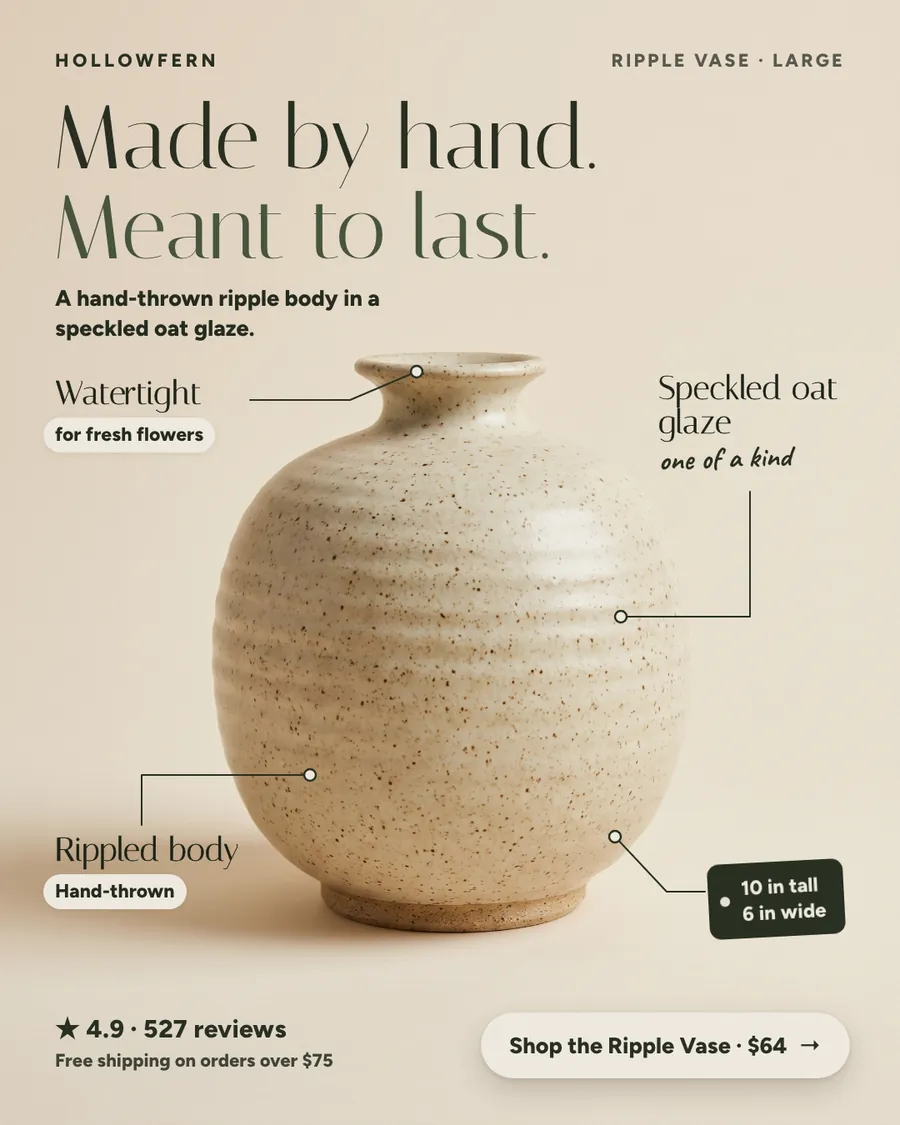
Annotated heroCraft
Hollowfern: Made by hand. Meant to last.
Fictional sample brand · made by our engine

Unpopular opinionRitual
Hollowfern: A vase doesn't need flowers.
Fictional sample brand · made by our engine
Policy flags for home decor ads
Decor isn't a restricted category on Meta, Pinterest or Google. The flags that catch decor ads are about truthfulness, Pinterest's editorial standards and ceramics near food.
"Handmade" and "one of a kind"
These words carry price, so they have to be true, and if pieces vary the ad should say so. The FTC's guidance for small businesses: ads must be truthful and not deceptive, with evidence behind the claims.
Pinterest's editorial standards
Pinterest rejects pins packed with text overlay (it suggests no more than 4 frames and 2 font styles or colors), blurry images and low-quality screenshots or selfies. A clean room shot with a short line passes.
Source: Pinterest Advertising Guidelines
Decorative ceramics near food
Under 21 CFR 109.16, a decorative piece that looks suitable for food is treated as food ware unless it carries a "Not for Food Use" label or has a hole through the food-contact surface. Keep fruit out of decorative bowls in the photos unless they are food-safe.
Source: FDA: Ornamental and decorative ceramicware, 21 CFR 109.16
"Sustainable" and "natural"
The FTC's Green Guides ask for the specific benefit instead of a broad green word: a named material, a recycled-content share you can prove.
Source: FTC Green Guides, 16 CFR 260 (environmental marketing claims)
How often to refresh home decor ads, and what to measure
Decor ads tire slower on Pinterest than on Meta, because pins live in search and boards while feed ads keep hitting the same people.
A workable rhythm: new Meta ads every two to three weeks on a small budget, with a new room or a new piece each time; new pins monthly, plus seasonal rooms (autumn textures, the hosting table, spring light) a few weeks before each season, since people save ahead.
On Meta, an ad marked "Creative limited" costs more per result than your past ads, and "Creative fatigue" means about twice as much. Meta's advice is a materially different image, which in decor usually means a different room, not a different crop.
What to measure
- Cost per purchase over 30 days, per channel
- Decor sales lag the click, so a monthly view is the fair comparison between Pinterest and Meta.
- Items per order
- Tells you whether the pairing ads and the free-shipping line are working.
- Pin saves and outbound clicks
- The early sign of which piece and which room will sell, before purchases are numerous enough to judge.
- Breakage and return rate
- Each broken vase comes out of the margin your budget math assumes; packaging is part of ad efficiency.
Questions about advertising home decor
How do I advertise home decor on Facebook Marketplace?
Marketplace listings are mostly people selling locally, so a brand that ships nationwide does better with a normal Meta campaign. With automatic placements, those ads can still appear in the Marketplace placement alongside the feed, Stories and Reels.
How do I advertise a home decor store online?
Start with Pinterest and Meta using the same styled room photos, two or three hero pieces and their sizes in every ad. Add a free-shipping line just above your bestseller's price, give it two to four weeks, then put more budget behind the room and the piece that sold.
Should a home decor brand start on Pinterest or Instagram?
If your pieces are styled into rooms, Pinterest, because people plan rooms there. If you sell striking single pieces with a maker's story, Instagram, because that's where people discover small studios. With enough budget for both, run them side by side from the same photos.
How much should I spend on home decor ads?
Take your typical order value and multiply by the margin left after product cost, packing, shipping and fees: that's the most a first order can cost. About 50 purchases a week at that cost is what Meta's learning phase looks for. Most small decor brands start lower and optimize for add to cart first.
What type of home decor sells the most online?
There's no single answer that holds for every shop, and trend lists change. For advertising, pieces that are easy to ship, photograph well in a real room and sit near a free-shipping line are the easiest to sell from an ad. Check which of yours already get saved and reordered.
How do I advertise handmade home decor?
Show the hand in the process: the studio, the glaze up close, the small variations between pieces. Say plainly that each piece differs, give the size, and add a buyer's review about seeing it in person. Handmade is a reason to buy, but only if the photos prove it.
Do I need professional photos to advertise home decor?
You need good light and a real room more than an expensive shoot. One styled shot in daylight with space above it for a headline, plus one plain shot on a simple background, covers most ads. Avoid busy staging that hides the piece you are selling.
How do I advertise fragile decor without scaring buyers?
Answer the worry instead of hiding it. Show the packaging, quote a buyer who says it arrived safe, and state your replacement policy for anything broken in transit. A line like that often does more than a discount for ceramics and glass.
When is the best time to advertise home decor?
Decor follows the seasons and the guests: autumn refreshes, the hosting weeks before the holidays, a January reset, spring light and summer moves. Put pins up a few weeks before each moment, since people save ahead, and bring feed ads in closer to the date.
Can I advertise one-of-a-kind pieces when each one sells once?
Yes, but advertise the line rather than the single piece: a glaze, a shape or a collection with several pieces in stock. Say that each piece varies and show a few of them, so a buyer isn't disappointed when the one in the ad has already sold.
Get the ads for this plan
Paste your store link and get 3 free ads of your own home decor: we read your products, prices and reviews, design around your real product photo and check every fact against your store.
Where to go next
- Home decor ad ideasSeven sample ads for a hand-thrown vase, styling and Pinterest advice, honest handmade wording and a decor calendar.
- Home decorHome decor ads that show the finish, the scale and the room, using your own product and lifestyle photos.
- How to advertise wall artPinterest and Instagram first, retargeting for people who take days to decide, pairs to lift order value, and print and edition rules.
- How to advertise candlesA candle brand's ad plan: Meta all year, Pinterest from October, a reorder email timed to the burn, and a budget that peaks for gifts.
- How to advertise furnitureA plan for a small furniture brand: Google Shopping and Meta first, a budget built on add to cart, and ads for buyers who measure and come back.
- Product photos that sell: the shots every ad needsAds ask more of a photo than a product page does. Here is how to shoot, with a phone and a window, the handful of photos that can carry months of ads.
- PricingFree preview, Starter $49/month, weekly plans from $99/month with a 7-day free trial, 30-day money-back guarantee.
Sources
Platform rules on this page were checked on against:
- 3 free ads when your spot opens
- Starter $49/month
- Growth $99/month, 7-day free trial
- Pro $149 · Scale $199
- 30-day money-back guarantee