how to advertise supplements
How to advertise supplements without getting your ads rejected
With most products, the plan starts with where the buyers are. With supplements it starts with what you're allowed to say, because every channel has its own list and the claims that would sell fastest are on all of them. Below is a plan that clears those rules first, built on Morrowleaf, a fictional magnesium brand, and its numbers.
Updated · Budgets and examples use a fictional brand's numbers. Use yours.
In short
How do you advertise supplements as a small brand?
Start on Meta with adults-only targeting and ads built from the label: dose, form, testing and price per serving, never a cure. Put buyers into a reorder email timed to the bottle running out. Add Google Shopping once your feed is clean, and check each channel's supplement rules before you spend there.
At a glance
- First job
- A claims audit of your own product page, before any ad
- Where to start
- Meta, targeted to adults 18 and over
- What sells
- The label: dose, form, testing, price per day
- Where the margin is
- The second and third bottle, often on subscription
- Off the table
- Disease claims anywhere, weight claims on Pinterest
Which channels fit supplements, in the order to try them
A supplement is a considered first purchase and a habit after that. You need one channel that will run label-led ads to new adults, one that brings buyers back every 60 days, and patience with the channels that gatekeep.
- 01
Meta (Facebook and Instagram)
Start hereWhy it fits
It reaches a broad adult audience with room to explain a product, and a still ad can hold a whole Supplement Facts panel. Label readers stop for numbers they recognize, like 200 mg and 48% DV.
The trade-off
Supplement ads must be targeted to people 18 or older, and health wording gets reviewed closely, so expect the odd rejection while you learn where the line sits.
- 02
Email and SMS
Start hereWhy it fits
A 60-serving bottle taken daily runs out in about two months. A reminder a week before that, with the subscription price, is the cheapest order you'll ever get.
The trade-off
It only reaches people who already bought or signed up. SMS needs explicit opt-in, and the same claims rules apply in an inbox as in a feed.
- 03
Google Shopping
Add nextWhy it fits
Supplement shoppers often search the exact form and dose, like "magnesium glycinate 200 mg". A Shopping ad answers that search with your bottle and price.
The trade-off
Healthcare products go through Google's restricted-content checks, and some unapproved supplements can't be listed anywhere. Titles need the form, dose and count to earn the click.
- 04
Amazon
Only if it fitsWhy it fits
Plenty of people buy vitamins where they buy paper towels, and Sponsored Products catch searches for your exact nutrient.
The trade-off
Amazon requires each supplement to be verified through a third-party testing, inspection and certification provider it authorizes before it can be sold, and fees plus price comparisons squeeze the margin.
- 05
TikTok
Add laterWhy it fits
Routine videos (what's on my nightstand, what I take with breakfast) suit supplements and travel well.
The trade-off
Weight and muscle claims must be limited to adults and can't suggest the product works alone. Creator videos drift into claims fast, and the brand answers for them.
- 06
Creators and gifting
Add laterWhy it fits
A real person's routine is more believable than a studio bottle shot.
The trade-off
A creator who says your magnesium fixed their sleep has made a health claim you'd need evidence for. Brief in writing, review before posting, and require a clear #ad.
- 07
Pinterest
Only if it fitsWhy it fits
Wellness routines and morning setups get saved and planned on Pinterest.
The trade-off
Pinterest doesn't allow weight loss supplements or any weight loss language in ads, and treats disease prevention or cure claims as off limits. Fine for a plain vitamin, closed for anything sold on weight.
Supplement ad rules, channel by channel
Read this before you write a headline. These are the rules small supplement brands actually trip over, and each one changes what the plan below is allowed to test.
Adults only on Meta
Meta's Health and Wellness policy says ads for dietary and health supplements must be targeted to people 18 or older. Set the age in every ad set, retargeting included.
Disease claims
Only a drug can claim to diagnose, treat, cure or prevent a disease. A structure/function claim ("calcium builds strong bones" is the FDA's example) needs substantiation, an FDA notification within 30 days of marketing, and the label disclaimer that the FDA hasn't evaluated it.
Source: FDA: Structure/Function Claims (dietary supplements)
Lines about the viewer's health
Meta's personal attributes rule bans ads that assert or imply a health condition, so "Can't sleep?" fails even when the product is legal to sell.
Source: Meta Advertising Standards: Privacy Violations and Personal Attributes
Evidence for every benefit, reviews included
The FTC's Health Products Compliance Guidance expects competent and reliable scientific evidence behind health claims, whether you write them or a customer quote carries them.
Source: FTC Health Products Compliance Guidance (December 2022)
Weight and muscle claims
TikTok limits weight loss and muscle gain claims to audiences 18 and over and bans claims that the product alone, without diet or exercise, gets results. Pinterest bans weight loss supplements and weight loss language outright.
Source: TikTok Advertising Policies: Weight Management and Body Image
Restricted listings
Google Shopping restricts unapproved pharmaceuticals and supplements, and some can't be listed anywhere. Check your ingredient list against Google's restrictions before you build a feed.
Source: Google Merchant Center: Healthcare and medicines (Shopping)
One supplement, five channels: what each will run
The same magnesium bottle meets a different gate on each channel. Plan your first ads to pass the strictest one you intend to use, so they can move between channels unchanged.
| Channel | Who can see it | What it won't run | What to check first |
|---|---|---|---|
| Meta | Adults 18 and over | Cure claims for listed diseases, timed results, lines about the viewer's health | Age set in every ad set |
| Google Shopping | Varies by product and country | Unapproved supplements; misleading listings | Ingredients against the restricted list, a feed with form, dose and count |
| TikTok | Adults only for weight or muscle claims | Product-alone results, easy or guaranteed results, body shaming | Creator scripts before they film |
| Its normal audience | Weight loss supplements and language, disease prevention or cure | Whether your product is sold on weight at all | |
| Amazon | Its shoppers | Supplements not verified by an authorized testing provider | Testing documents for each product |
Your first 30 days advertising supplements
The plan is slower at the start than for most products, on purpose: an ad account with a run of rejections is a worse place to be than a week's delay.
Days 1 to 3
Audit your own claims
Read your product page and label the way a reviewer would. Remove disease words, timed results and "clinically proven" unless the product itself was studied. Write a never-say list (sleep, anxiety, immunity, weight) and set 18+ on the ad set before you build anything else.
Days 4 to 7
Launch 6 ads on 3 label angles
Two ads each for the dose and form, the short tested label, and the price per serving. Use one Sales campaign with one adult ad set, broad interests, automatic placements, 4:5 and 9:16. Check the pixel records purchases first.
Days 8 to 14
Fix rejections by rewriting, not resubmitting
If an ad is rejected, read the reason and change the line it points at. Uploading the same claim with new words wastes review time and edits restart learning. Otherwise leave the ad set alone.
Days 15 to 21
Add proof from customers
Add two review ads that quote experience, like easy to swallow or no aftertaste, never results. Switch on a reorder email about 50 days after a first order, with the subscription terms spelled out.
Days 22 to 30
Open a second channel
If cost per first order sits under your break-even, raise the budget in small steps. Then build a Shopping feed with form, dose and count in every title, or start Amazon only if your testing documents are ready.
How to size a starting budget for supplement ads
Supplements look high-margin, but the first order has to carry the whole cost of finding a careful buyer. Here's the math with Morrowleaf's numbers: a typical order pairs the $28 magnesium with the $22 D3 and K2 to clear the $40 free shipping line.
| Order value | $50.00 |
|---|---|
| Margin after product cost, shipping and fees | 55% |
| Most a first order can cost to break even | $27.50 |
| 50 purchases a week at that cost | $1,375 a week |
| The same budget per day | about $196 |
Meta says an ad set usually leaves its learning phase after about 50 results in the week after its last significant edit, and recommends a budget large enough to get enough results. Meta Business Help Center: About the learning phase
Fifty first orders a week at that cost is a big commitment for a new brand, and the adults-only audience doesn't make it cheaper. What changes the math is the bottle running out:
- Price the second bottle in, from your own data. If your records show a share of buyers reorder within 70 days, a first order can cost more than its margin. Until you have those records, don't assume it.
- Watch what the subscription does to margin. Morrowleaf's 20% subscriber discount cuts each repeat order's margin, so it pays only if subscribers stay longer than one-off buyers.
- Start with add to cart if purchases are too few. Meta suggests a more frequent optimization event when an ad set can't get enough results, then switch to purchases once the volume is there.
- One adult ad set, not one per angle. Splitting a small budget across ad sets gives each too little data to learn from.
Angles to test for supplement ads
Every angle below can be proved from the label, the price or a real review, which is what keeps it through review. The annotated sample ads, photo checklist and copy lines are on Supplement ad ideas.
The dose and form
Magnesium glycinate. 200 mg a serving. 48% DV.
Tested and short
Third-party tested. Nothing on the label you can't pronounce.
Price per day
60 servings for $28. About 47 cents a day.
Living with it
"Easy to swallow, no weird aftertaste."
The bottle, not the outcome
Amber glass. Vegan capsules. Two a night.
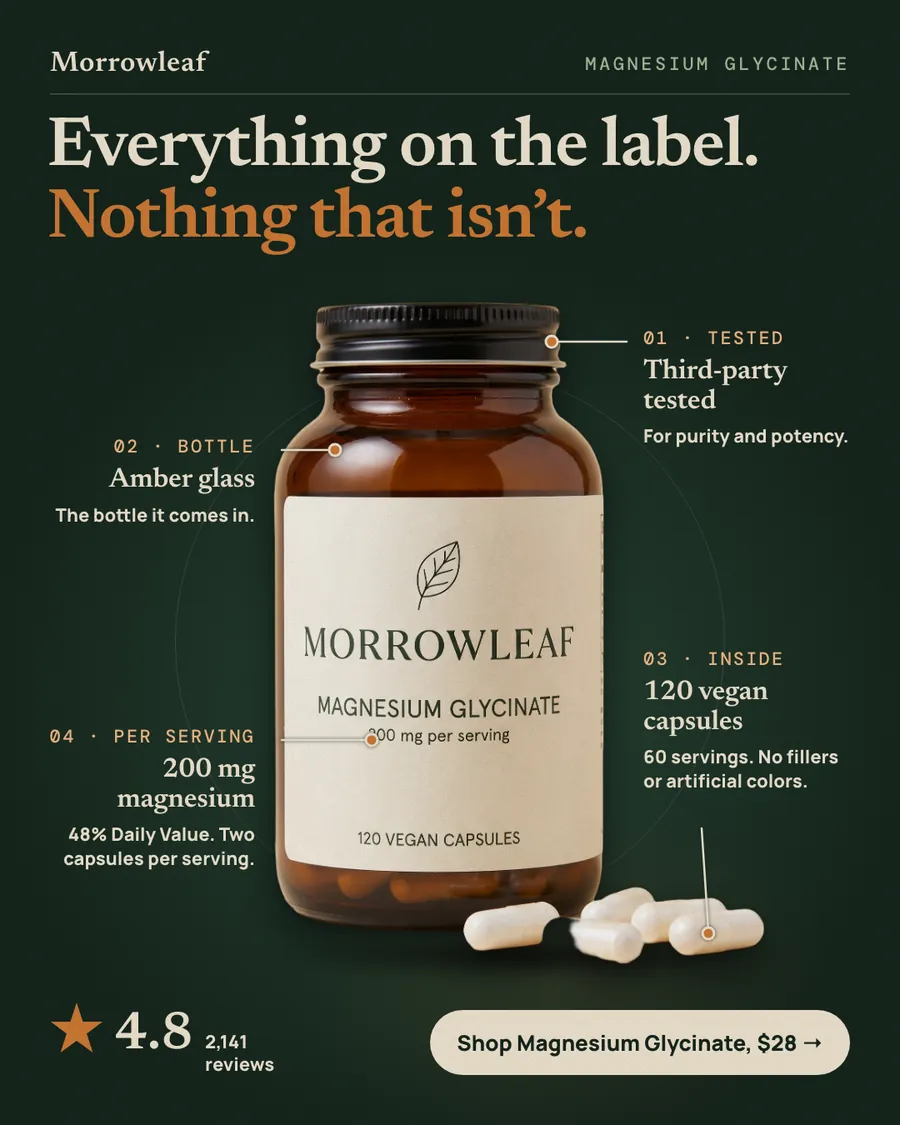
Annotated heroTransparency
Morrowleaf: Everything on the label. Nothing that isn't.
Fictional sample brand · made by our engine
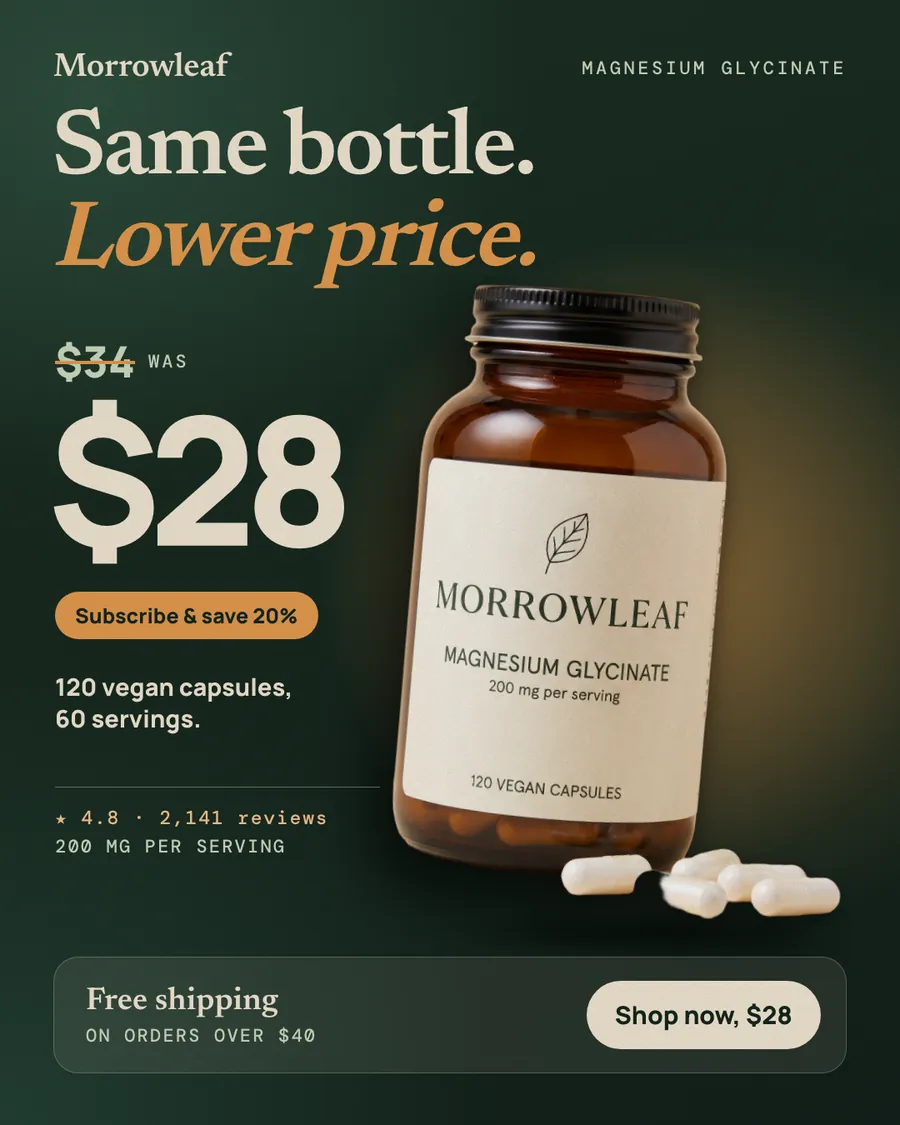
Price dropOffer
Morrowleaf: Same bottle. Lower price.
Fictional sample brand · made by our engine
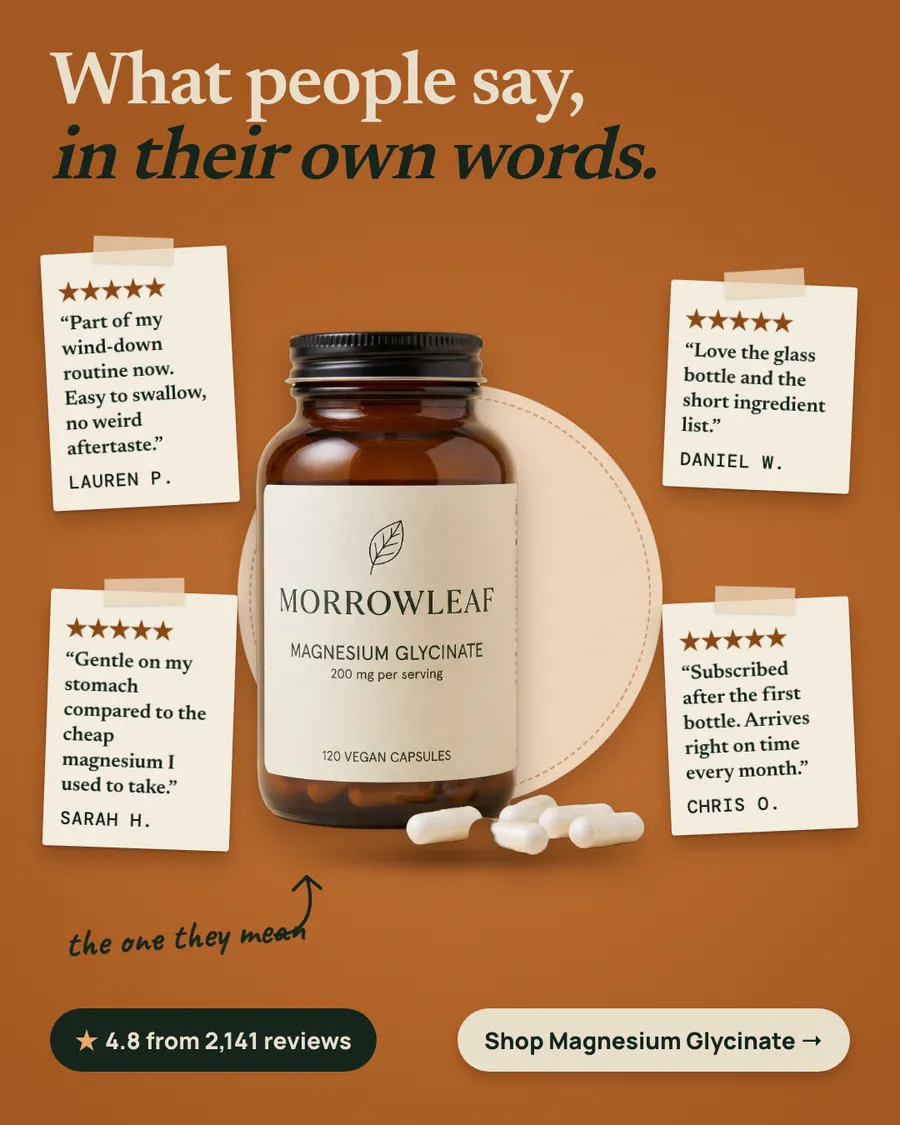
Review wallSocial proof
Morrowleaf: What people say, in their own words.
Fictional sample brand · made by our engine
Offers that work for supplements
Supplement offers should reward staying, not a one-time bargain hunt. The strongest offer is often a better price for the habit people already have.
Subscribe and save
A daily product suits a standing order, and a subscriber is worth more than a one-off buyer if they stay. Morrowleaf takes 20% off.
Watch: US law on online subscriptions (ROSCA) requires clear terms before billing, the buyer's express consent and a simple way to cancel. Put the terms next to the price.
A pairing that clears free shipping
Magnesium plus D3 and K2 at $50 passes the $40 line and lifts the order value your budget math starts from.
A real price drop
$28, was $34, repeats its saving every refill, which matters more for a daily product than a one-time gadget.
Watch: Only quote a former price you actually charged for a reasonable time (FTC pricing guides).
Two bottles for the routine
Four months of supply for people who don't want a subscription, priced per serving.
How often to refresh supplement ads, and what to measure
Label-led ads age slowly because the facts don't change, but each new ad also goes back through review. Refresh with intent rather than on a timer.
A sensible rhythm for a small supplement brand: one or two new ads every 3 to 4 weeks, each a new angle rather than a new color, plus seasonal versions for January routines and the holidays. Keep a library of approved wording so new ads reuse lines that already passed.
When Meta marks an ad "Creative fatigue" (cost per result at twice your past ads), make a materially different image, such as the label ad turned into a review ad, and keep the original running alongside it.
What to measure
- Cost per first order vs break-even
- The number from the budget section, measured on new customers only so reorders don't flatter it.
- Reorder rate at 70 days
- A 60-serving bottle should be gone by then. This decides how much a new customer may cost.
- Subscription take rate
- The share of first orders that subscribe. If it's low, test the subscription line in the ad, not just on the page.
- Rejected and limited ads
- A rising count means your wording is drifting toward claims. Fix the template before the account's history suffers.
Questions about advertising supplements
How do I advertise supplements on Facebook?
Target people 18 and over, which Meta requires for supplements, and build each ad on something checkable: dose and form, outside testing, the price per serving or a customer's experience. Run one Sales campaign with one adult ad set and five or six ads, and leave it alone for the first week.
Can you promote supplements on TikTok?
Yes, with care. TikTok limits weight loss and muscle gain claims to adults and bans saying the product works without diet or exercise or that results are easy or guaranteed. Routine videos without health promises are the safest format, and creator scripts should be agreed before filming.
How do I advertise vitamins online?
Lead with the nutrient, form and dose people already search for, show the real bottle and Supplement Facts panel, and give the price per day. Start on Meta for reach and Google Shopping for searches by name, and keep every line to what the label proves.
How do I advertise gummies on Instagram?
Show the real gummies next to the jar and state what gummy buyers check: how many gummies make a serving, sugar per serving and the dose. Instagram ads run from Meta's ad account, so the same adults-only rule for supplements applies.
Do supplement ads need a disclaimer?
The FDA requires the disclaimer on the label of a supplement that makes a structure/function claim. The disclaimer does not make a disease claim acceptable anywhere, so it never rescues an ad that promises to treat or prevent something.
Why do supplement ads get rejected on Facebook?
The usual reasons are a line that implies the viewer has a health condition, a promised result in a set time, a cure claim, or an ad set not limited to adults. Read the rejection reason, change the specific line, and keep a list of wording that has already passed.
Can I sell supplements on Amazon as a small brand?
You can, but Amazon requires each dietary supplement to be verified through a testing, inspection and certification provider it authorizes before it can be listed. Budget for that testing and for marketplace fees before you count Amazon as a channel.
How much should I spend to advertise supplements?
Multiply your typical order value by the margin left after product cost, shipping and fees to get the most a first order can cost. About 50 orders a week at that cost is what Meta's learning phase needs, so many new brands start lower and optimize for add to cart first.
Can I advertise a weight loss supplement on Pinterest?
No. Pinterest doesn't allow weight loss supplements, weight loss language or imagery, before and after weight pictures, or references to BMI in ads. A supplement sold on other grounds can run there as long as weight never comes into it.
What should I never say in a supplement ad?
Anything that treats, cures or prevents a disease, a result in a set number of days, a question about the viewer's health, clinically proven without a study of your own product, and expert endorsements you can't document. Swap them for label facts and real customer experience.
Get the ads for this plan
Paste your store link and get 3 free ads of your own supplements: we read your products, prices and reviews, design around your real product photo and check every fact against your store.
Where to go next
- Supplement ad ideasSeven sample ads for a magnesium brand that sell the label, not a cure, plus Meta's 18+ rule and FDA claim limits.
- SupplementsSupplement ads that say only what the label says: dose, ingredients, certifications and real reviews.
- How to advertise protein powderA plan for a small protein brand: Meta and short video first, a taste trial to beat the chalky-tub doubt, and the muscle-claim rules.
- How to advertise fitness productsA plan for a small fitness gear brand: Meta demos first, then Shopping and short video, with the order-value math a one-time purchase needs.
- How to advertise skincare productsA plan for a one-hero skincare brand: claims written before the first ad, Meta and a routine email first, then creators and Shopping.
- Ad creative testing on a small budget: an honest guideOne ad is a bet; fifty ads is a spray. Here is the middle path for small budgets: a few angles that disagree with each other, enough spend to read them, and a weekly loop that builds on what works.
- PricingFree preview, Starter $49/month, weekly plans from $99/month with a 7-day free trial, 30-day money-back guarantee.
Sources
Platform rules on this page were checked on against:
- Meta Advertising Standards: Health and Wellness
- Meta Advertising Standards: Privacy Violations and Personal Attributes
- FDA: Structure/Function Claims (dietary supplements)
- FTC Health Products Compliance Guidance (December 2022)
- FTC Guides Against Deceptive Pricing, 16 CFR 233.1 (former price comparisons)
- TikTok Advertising Policies: Weight Management and Body Image
- Pinterest Advertising Guidelines
- Google Merchant Center: Healthcare and medicines (Shopping)
- Amazon Seller Central: Dietary supplements
- Meta Business Help Center: About learning limited
- Meta Business Help Center: About creative fatigue recommendations in Ads Manager
- 3 free ads when your spot opens
- Starter $49/month
- Growth $99/month, 7-day free trial
- Pro $149 · Scale $199
- 30-day money-back guarantee