how to advertise skincare products
How to advertise skincare products when every claim gets read twice
Skincare is one of the easier categories to find buyers for and one of the easier ones to get rejected in. The plan below is built for a small brand with one hero product: settle the claims before the first dollar, find out which reason to buy sells it, then earn the margin on the second product in the routine. The numbers are Mira's, a fictional vitamin C serum brand.
Updated · Budgets and examples use a fictional brand's numbers. Use yours.
In short
How do you advertise skincare products as a small brand?
Pick one hero product and advertise it on Meta with six to eight ads that each lead with something checkable: the active and its percentage, the texture, reviews, the routine. Write every claim about the product, never the viewer's skin. Then sell the next step in the routine by email, and add creators and Google Shopping.
At a glance
- The hard part
- Getting claims through review, not finding buyers
- Where to start
- Meta, one hero product, every claim about the bottle
- Where the margin is
- The second product in the routine, and the refill
- The rule that bites
- No promises about the viewer's skin, and no results by a date
- New ads
- Two or three every few weeks while testing
Which channels fit skincare, in the order to try them
Skincare is bought on trust in a formula, then kept on habit. You need one channel that puts a label and a stranger's review in front of new people, and one that sells the rest of the routine to people who already use it.
- 01
Meta (Facebook and Instagram)
Start hereWhy it fits
People scroll past a dozen serums a day and still stop for a readable label and a real review. Broad delivery finds buyers without you guessing at interests, as long as each ad says who the formula is made for.
The trade-off
Skincare ads get reviewed closely, and a rejected ad costs you days. Meta also says costs per result usually run higher while an ad set is learning, so the first week reads worst.
- 02
Email and SMS
Start hereWhy it fits
A serum runs out, and the cleanser and moisturizer are the obvious second order. A short sequence after the first purchase usually earns more margin than another ad set.
The trade-off
It only reaches people who bought or signed up. Result claims in emails follow the same rules as ads, and SMS needs explicit opt-in consent.
- 03
Creators and seeded product
Add nextWhy it fits
Texture and feel sell skincare, and a creator's hands show both better than a studio shot. Product sent to ten or twenty small creators gives you real footage to test as ads.
The trade-off
Once you pay or gift, what a creator says about results is your claim too. Brief them on the words to avoid, and expect some to post nothing.
- 04
Google Shopping
Add nextWhy it fits
People search by ingredient and format: "vitamin c serum", "fragrance-free moisturizer". A Shopping ad puts your bottle and price on exactly that search.
The trade-off
Ingredient searches are crowded with big brands and marketplaces. Titles need the active, the percentage and the size before they can compete.
- 05
TikTok
Add laterWhy it fits
Routine videos and texture close-ups are native there, and a good creator clip can carry a small brand.
The trade-off
It wants new video every week, and TikTok doesn't allow cosmetic ads to claim they clear acne or remove wrinkles.
- 06
Amazon
Only if it fitsWhy it fits
Plenty of shoppers buy skincare where they buy everything else, and they compare ingredients and reviews right in the search results.
The trade-off
You sit beside hundreds of serums on price, and those buyers stay Amazon's customers, so your routine emails can't reach them.
- 07
Pinterest
Skip for nowWhy it fits
Routine and shelf pins get saved, and Pinterest suits gift sets later.
The trade-off
A save is a long way from buying one serum. Come back to it once you have a routine set or a gift box.
Read this before the first skincare ad
Most skincare ads that fail never run at all. These are the rules that decide it, written for a brand selling creams, serums and cleansers, not treatments.
The viewer's skin
Meta's personal attributes policy covers physical health, including medical conditions, and rejects ads that assert or imply them. Its own rejected example is "Ready to upgrade your skin to look younger?". Describe the product and who it is formulated for instead.
Source: Meta Advertising Standards: Privacy Violations and Personal Attributes
Results by a date
Meta's health and wellness rules bar cosmetic ads that attack someone's appearance or promise specific outcomes within a set time frame without disclaimers or qualifiers.
Treat, heal, regenerate
The FDA decides cosmetic or drug by intended use, and the claims in your ads count. Its examples of drug claims include changing melanin production and regenerating cells.
Source: FDA: Is It a Cosmetic, a Drug, or Both? (Or Is It Soap?)
Creator and review results
A paid or gifted creator's result statement counts as your claim, needs a clear disclosure, and should match what buyers generally experience (FTC Endorsement Guides).
TikTok's beauty rules
TikTok doesn't allow medical claims in cosmetic ads, including claims to remove or cure acne or remove wrinkles, or promises of permanent change.
Source: TikTok Advertising Policies: Healthcare and Pharmaceuticals
Before-and-after photos
Meta lets cosmetic before-and-after transformations run only in ads targeted to people 18 and over. Ordinary ads for creams and serums don't need that age limit.
Your first 30 days advertising skincare
One hero product, one ad set, four reasons to buy, and the claims settled first. The steps assume an online store and a Meta ad account.
Before day 1
Write the claims list first
List what your label and product page can prove: the active and its percentage, texture, skin types, size, reviews. Cross out anything about the viewer's face or a result by a date. Every ad gets built from what's left, which saves days of rejections.
Days 1 to 3
Check tracking and the landing page
Make sure purchases reach Events Manager through the pixel and Conversions API. The product page should answer what the ads raise: the full ingredient list, how to use it, who it suits and real reviews.
Days 4 to 7
Launch 6 to 8 ads on one hero product
Four angles, two versions each: the active, the texture, a review wall and the routine. One Sales campaign, one ad set, broad audience, feed and Stories sizes. Keep it to one product, so you learn which reason sells it.
Days 8 to 18
Hands off, notebook open
Let the ad set learn without edits. Record cost per add to cart by angle and read the comments: skincare commenters tell you which doubt the ad left open, like sting, smell or pilling.
Days 19 to 30
Feed the winner, start the routine email
Replace the weakest angle with a new version of the strongest. Send first-time buyers a sequence that introduces the next step in the routine around the time a bottle runs out, then choose between seeding creators and a small Shopping campaign.
How to size a starting budget for skincare ads
A serum looks like a high-margin product until shipping, samples and payment fees come out. Mira's typical first order is the $38 serum plus the $24 cleanser, which clears its free shipping line.
| Order value | $62.00 |
|---|---|
| Margin after product cost, shipping and fees | 60% |
| Most a first order can cost to break even | $37.20 |
| 50 purchases a week at that cost | $1,860 a week |
| The same budget per day | about $266 |
Meta says an ad set usually leaves its learning phase after about 50 results in the week after its last significant edit, and recommends a budget large enough to get enough results. Meta Business Help Center: About the learning phase
That daily figure is a real budget for a brand with three products. The skincare levers that bring it within reach:
- Price the routine, not the bottle. The serum earns the click; the cleanser and moisturizer raise the order value your break-even is built on. A set at a clear price lifts the first order without discounting the hero.
- Let the second purchase pay for the first, if your data says so. Use your own rate of buyers who come back within 60 days. Only then let a first order cost more than its margin.
- Use add to cart while volume is low. Meta's learning limited guidance suggests a more frequent optimization event when an ad set can't get enough purchases. Move back to purchases once you can.
- Don't split by skin type. Separate ad sets for dry, oily and sensitive skin cut a small budget into pieces too small to learn. Put the skin type in the copy instead.
Offers that work for skincare
Skincare offers work best when they introduce the next product or make the reorder automatic. A permanent discount on the hero does neither.
A routine set at one price
Serum, cleanser and moisturizer together answer "what else do I need?" and raise the order value. Show each item's own price so the saving can be checked.
Watch: Compare only against prices you really charge.
A deluxe sample of the next step
A sample of the moisturizer in every serum order is how the second product gets tried without spending on an ad.
Watch: Put the sample's cost into your margin before you promise it.
Subscribe and save on the hero
A daily serum runs out on a schedule, and a standing order removes the reorder decision.
Watch: Make skipping and cancelling easy, and say so near the button.
A real compare-at price, used sparingly
Mira's $48 to $38 works because $48 was a real price. A sale that never ends trains buyers to wait and empties the word "was".
Which skincare product to show to whom
Show cold audiences the hero and nothing else; show the rest of the routine to people who already know you. Retargeting audiences are small, so give each row a couple of ads, not a campaign of its own.
| Who | What to advertise | What the ad leads with |
|---|---|---|
| People who've never heard of you | The hero serum only | One checkable reason: the active, the texture or a review |
| Visitors who didn't buy | The same serum | The likely doubt: who it suits, the full ingredient list, your returns policy |
| First-time buyers, a few weeks later | The next step in the routine | How it pairs with what they already use |
| Repeat buyers | The refill or the routine set | Convenience: subscribe, or the set price |
Angles to test for skincare ads
One reason per ad, each taken from the claims list. The full sample gallery, photo checklist and copy lines are on Skincare ad ideas.
The active, with its percentage
15% vitamin C. Ferulic acid. Vitamin E.
How it feels
Lightweight. Fragrance-free. Made for sensitive skin.
A stranger's words
"Lightweight, no smell, and my skin looks brighter in the morning."
The step in a routine
Cleanse. Serum. Moisturize. Don't skip the middle one.
Why the bottle is amber
Vitamin C doesn't like light. The glass is amber for a reason.
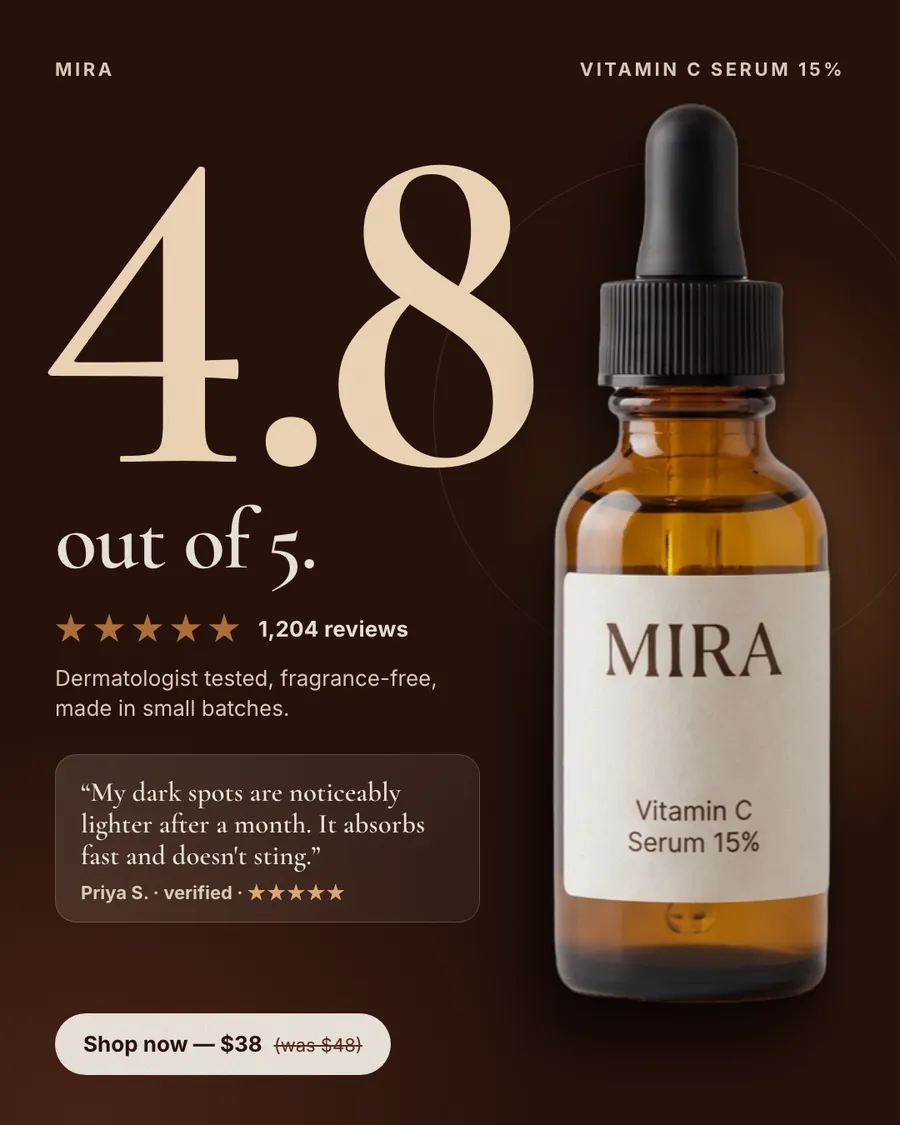
Big numberSocial proof
Mira: 4.8 out of 5.
Fictional sample brand · made by our engine
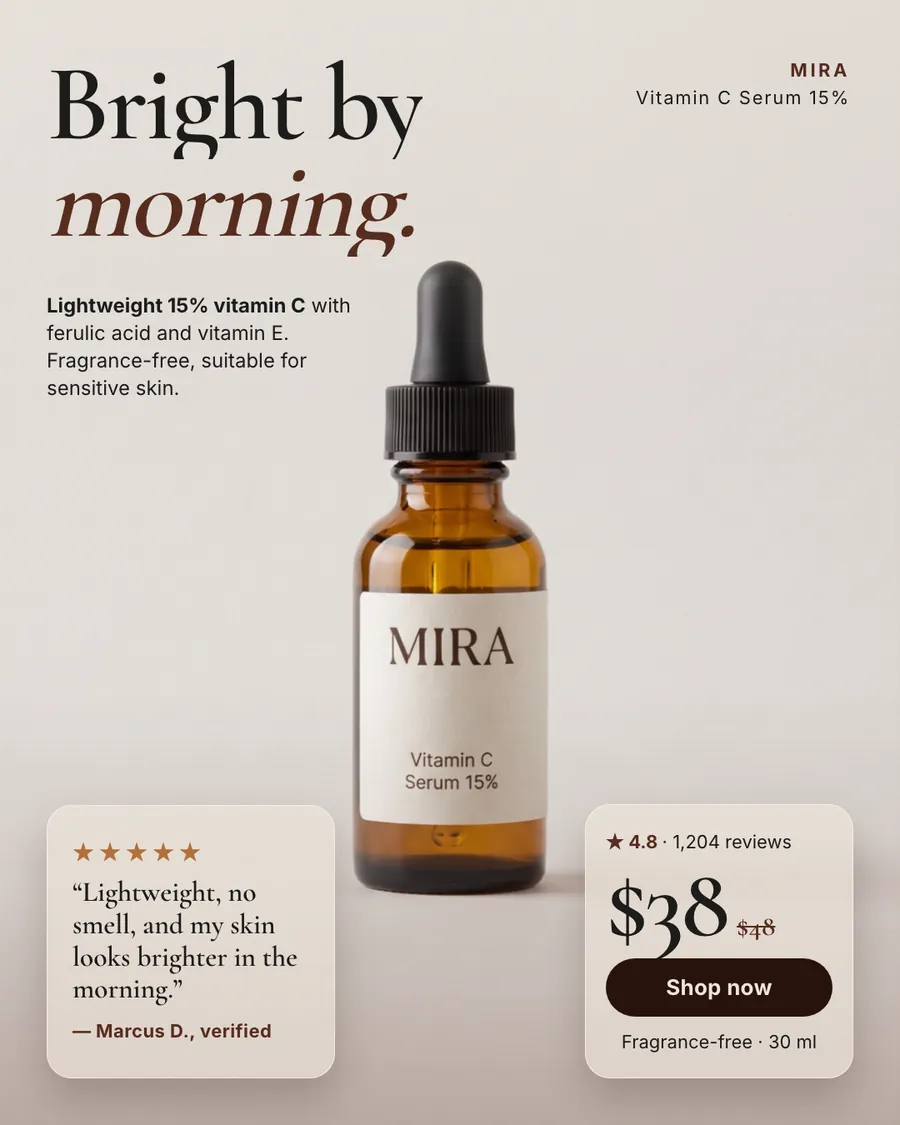
Lifestyle typeRitual
Mira: Bright by morning.
Fictional sample brand · made by our engine
How often to refresh skincare ads, and what to measure
A skincare ad can keep working for weeks on a small budget, because the audience is large and each person sees it less often. Watch the signs rather than the calendar.
A rhythm that suits a one-hero brand: two or three new ads every two to three weeks, each a new version of the best-selling angle or a fresh angle from the claims list. Swap textures with the weather: richer creams in late autumn, lighter formulas in spring.
Meta shows "Creative limited" when an ad's cost per result climbs above your past ads, and "Creative fatigue" at twice their cost. Its advice is a materially different image or video, not a recolored copy, and it suggests keeping the original running.
What to measure
- Cost per purchase against break-even
- The number from the budget section, read per angle. Under it, add budget slowly; over it, change the ad first.
- Rejected and limited ads
- In skincare an ad that never runs costs more than one that runs badly. Note which claim caused each rejection and strike it from the list.
- Second-product rate at 60 days
- How many serum buyers come back for the moisturizer or a refill. It sets how much a first order may cost.
- Click-through rate by angle
- Shows which reason stops people long before purchases are numerous enough to judge.
Questions about advertising skincare
How do you advertise your skin care products?
Start with one hero product and six to eight Meta ads that each lead with one fact a buyer can check, such as the active and its percentage, the texture or a review. Keep every claim about the product, track purchases properly, and sell the rest of the routine by email to people who bought.
How do I advertise skincare on Instagram?
Instagram ads run from the Meta ad account, so build each ad in 4:5 for the feed and 9:16 for Stories and Reels. Texture videos and real hands applying the product fit the platform, and the copy should name who the formula is for rather than ask about the viewer's skin.
How do I advertise a serum?
Make the active and its percentage the headline, show the dropper bottle with a readable label, and test it against a texture ad and a review ad. Send people to a product page with the full ingredient list and directions, then offer the moisturizer as the next step.
How do I promote a new skincare brand with no reviews yet?
Lead with the formula and the label until reviews arrive, seed product to a handful of creators for honest first impressions, and ask early buyers for reviews with a follow-up email. Avoid inventing urgency or results; a clear ingredient story is enough to test with.
Why do skincare ads get rejected on Facebook?
Usually for one of three reasons: the copy implies something about the viewer's skin or health, it promises a result within a set time, or it claims to treat a condition. Rewrite the line to describe the product and who it is made for, and keep results in customers' own words.
How much should a skincare brand spend on ads at first?
Multiply a typical order by the share you keep after product, shipping and fees: that's the most a new customer can cost. Meta says ad sets usually settle after about 50 results in a week, so the full budget is 50 of those. Many skincare brands test with less first, optimizing for add to cart.
Should a skincare brand work with influencers?
Yes, once the claims list exists. Gift product to small creators who use similar products, ask for honest texture and routine videos, and brief them on words to avoid. Paid or gifted posts need a clear disclosure, and you need permission before running their videos as ads.
Is TikTok good for advertising skincare?
It suits routine and texture videos well, but it asks for new clips every week and its policy bars medical claims in cosmetic ads, such as clearing acne or removing wrinkles. Many small brands start on Meta, then use TikTok for creator content before running TikTok ads.
How long should a skincare ad run before I judge it?
Give the ad set at least a week without edits, since Meta says ad sets usually leave learning after about 50 results in the week after a significant edit. Judge angles on cost per add to cart early, then on cost per purchase once there are enough purchases to compare.
What should a skincare product page include for ad traffic?
The full ingredient list, the key active and its percentage, texture and scent, which skin types it suits, how to use it, the size, real reviews and your returns policy. The ad raises one question; the page should answer that one first.
Get the ads for this plan
Paste your store link and get 3 free ads of your own skincare: we read your products, prices and reviews, design around your real product photo and check every fact against your store.
Where to go next
- Skincare ad ideasSeven sample ads for a vitamin C serum, the proof each reason to buy needs, and the claims Meta and the FDA watch.
- SkincareSerum, cream and SPF ads built on your real bottle, your actives and your customers' own words.
- How to advertise makeupA shade-first plan for a small makeup brand: video swatches on Meta and TikTok, one shade per ad, add-ons that clear free shipping.
- How to advertise hair productsA plan for a small hair care brand: one hair type per ad, short demos on Meta and TikTok, the set and the refill, no growth claims.
- How to advertise men's grooming productsA plan for a beard and skin brand: plain Meta ads all year for the user, kit ads for the gift buyer in December and June.
- Black Friday skincare adsOffers, claims and lines for skincare on Black Friday, with four sample ads for Mira's 25% off sale.
- Ad creative testing on a small budget: an honest guideOne ad is a bet; fifty ads is a spray. Here is the middle path for small budgets: a few angles that disagree with each other, enough spend to read them, and a weekly loop that builds on what works.
- PricingFree preview, Starter $49/month, weekly plans from $99/month with a 7-day free trial, 30-day money-back guarantee.
Sources
Platform rules on this page were checked on against:
- Meta Advertising Standards: Privacy Violations and Personal Attributes
- Meta Advertising Standards: Health and Wellness
- FDA: Is It a Cosmetic, a Drug, or Both? (Or Is It Soap?)
- FTC Endorsement Guides, 16 CFR 255
- TikTok Advertising Policies: Healthcare and Pharmaceuticals
- Meta Business Help Center: About the learning phase
- Meta Business Help Center: About learning limited
- Meta Business Help Center: About creative fatigue recommendations in Ads Manager
- 3 free ads when your spot opens
- Starter $49/month
- Growth $99/month, 7-day free trial
- Pro $149 · Scale $199
- 30-day money-back guarantee