how to advertise fitness products
How to advertise fitness products when you sell gear, not a body
Fitness ads are full of promised bodies. A gear brand has a better story and fewer rules to fight: the annoyance the product removes. A band that stays put mid-squat, a set that fits in a carry-on, a mat that doesn't slide. This plan is built on Tidepull, a fictional resistance band brand, and it treats the first order as the one that has to pay.
Updated · Budgets and examples use a fictional brand's numbers. Use yours.
In short
How do you advertise fitness products as a small brand?
Show the gear solving one annoyance per ad, like a band that doesn't roll up, in short Meta demos and statics. Raise the order value with a bundle, since gear isn't reordered. Add Google Shopping for people searching by spec, then sell accessories to buyers by email, and keep weight promises out entirely.
At a glance
- What to sell
- The annoyance the gear removes, shown in use
- Where to start
- Meta, with demos and box-contents statics
- Repeat orders
- Rare: a band set lasts, so the first order must pay
- Where the margin is
- Bundles and the second product, not a refill
- The line not to cross
- Weight loss or body-shape promises
Which channels fit fitness products, in the order to try them
Gear is bought when someone decides to train at home, travel with a routine, or replace something that annoys them. The channels below catch those moments in the order that suits a small budget.
- 01
Meta (Facebook and Instagram)
Start hereWhy it fits
A six-second clip of a band staying put at the bottom of a squat, or a flat-lay of everything in the box, sells gear in the feed. Meta lists fitness equipment among the products its adults-only rule doesn't cover.
The trade-off
The moment an ad promises weight loss it becomes a weight loss ad, with adults-only targeting and appearance rules. And January, when routines restart, tends to be when the most fitness brands compete for the same people.
- 02
Google Shopping
Add nextWhy it fits
Gear buyers search by spec: "fabric resistance bands set", "6mm yoga mat". A Shopping ad puts your photo and price on that search when the decision is half made.
The trade-off
You're compared side by side on price, and titles have to carry the specs (resistance range, loop size, thickness) or the click goes elsewhere.
- 03
TikTok
Add nextWhy it fits
Home and hotel workout clips are native there, and the travel angle (a band set in a carry-on) suits a 10-second video.
The trade-off
It needs a steady supply of 9:16 clips, and TikTok's body image rules rule out anything suggesting there's an ideal body or that looking a certain way brings happiness.
- 04
Amazon
Only if it fitsWhy it fits
Some buyers start on Amazon for generic gear like bands and jump ropes.
The trade-off
It's a crowded, price-led shelf where a $32 set sits next to much cheaper ones, and Amazon keeps the customer you'd want to sell a mat to later.
- 05
Pinterest
Only if it fitsWhy it fits
Home workout plans and yoga setups get saved and planned, which suits mats and a home-gym corner more than bands.
The trade-off
Pinterest doesn't allow weight loss language, before and after weight imagery or body shaming in ads, and planners buy slower than searchers.
- 06
Trainers and creators
Add laterWhy it fits
A trainer using your bands in a real session is proof a studio shot can't fake, and their clips make strong ads.
The trade-off
Expect weeks of back and forth for a few usable videos. Posts need a clear #ad, and transformation talk is still your claim.
- 07
Email
Add laterWhy it fits
Nobody reorders a band set next month, but a band buyer may want the mat, roller or jump rope. Email is where the second product sells.
The trade-off
It earns nothing until you have buyers, so it can't carry the first month.
If you sell yoga mats instead of bands
Most of this plan carries over to mats, but a few things change: what buyers compare, how you prove it, and which channel moves up.
| Resistance bands | Yoga mats | |
|---|---|---|
| What buyers compare | Resistance range per band, loop size, fabric or latex | Thickness in mm, length and width, weight, grip when sweaty |
| The proof shot | The band at the hardest point of a squat | A palm pressed on a damp mat, a rolled mat under an arm |
| Channel that moves up | Meta and TikTok demos | Pinterest, where yoga corners and routines get planned |
| Order value | Low, so bundles do the lifting | Higher, but bulky to ship, so check margin after shipping |
| Claims to watch | Weight and body results | "Non-toxic" and "eco" lines, which fall under the FTC Green Guides |
Your first 30 days advertising fitness products
Gear sells on demonstration, so the first days go into shooting the product working. Then one campaign, a handful of annoyances to test, and a week of not touching anything.
Days 1 to 3
Shoot the gear at work
Film the band at the bottom of a squat, close enough to see the grip lining, lay out everything in the box, and take one shot in a hotel room or by a suitcase. Check that purchases show up in Events Manager.
Days 4 to 7
Launch 6 ads on 3 annoyances
Two ads each for bands that roll up, working out while traveling, and not knowing which level to grab, plus the sale price on one of each. One Sales campaign, one ad set, broad targeting, 4:5 and 9:16.
Days 8 to 14
Hold steady
No edits to budget, audience or ads while the ad set learns. Watch which annoyance gets the cheapest link clicks and add to carts; that's the story buyers recognize.
Days 15 to 21
Turn the winner into video and a feed
Make one 10 to 15 second demo of the winning annoyance, and build a Shopping feed with the resistance range, loop size and set count in every title. Cut ads that spent twice your break-even without an add to cart.
Days 22 to 30
Sell the second product
Send buyers a short email a week after delivery with the mat, roller or jump rope. Retarget people who watched the demo with the bundle, and raise the budget in small steps only if first orders cost less than your break-even.
How to size a starting budget for fitness product ads
A band set is bought once, so the first order has to cover its own ad cost. With Tidepull's numbers, the order that clears its $50 free shipping line is the $32 band set plus the $24 jump rope.
| Order value | $56.00 |
|---|---|
| Margin after product cost, shipping and fees | 55% |
| Most a first order can cost to break even | $30.80 |
| 50 purchases a week at that cost | $1,540 a week |
| The same budget per day | about $220 |
Meta says an ad set usually leaves its learning phase after about 50 results in the week after its last significant edit, and recommends a budget large enough to get enough results. Meta Business Help Center: About the learning phase
That math is unforgiving on a single $32 set, which is why order value matters more here than in consumables. Levers that fit gear:
- Bundle to lift the order. Bands plus a jump rope, or bands plus a mat, raise the most a first order can cost without a discount.
- Count the second product only when you see it. If your own data shows band buyers come back for a mat, the first order can cost more. Until then, assume they won't.
- Start with add to cart if purchases are scarce. Meta suggests a more frequent optimization event when an ad set can't get enough results.
- Don't run your first test in the New Year rush. Many fitness brands push hardest in early January; a test in a quieter week tells you more for the same money.
Offers that work for fitness products
Gear offers should make the first order bigger or less risky. A guarantee you'll honor often does more than a bigger discount.
A bundle over the free shipping line
Tidepull's $32 set alone sits under its $50 line; the jump rope at $24 clears it and the buyer sees free shipping, not an upsell.
The guarantee, stated in the ad
A 1-year guarantee answers the durability doubt behind every cheap band that snapped.
Watch: The FTC's guides say to state a guarantee's main conditions in the ad and to honor it promptly.
A real sale price
$32, usually $40, is concrete for gear, especially with everything in the box shown.
Watch: Only compare to a price you actually charged for a reasonable time.
A home-gym starter set
Bands, mat and roller together suit someone setting up a corner at home, and it's the natural December gift.
Angles to test for fitness product ads
Each angle names an annoyance and shows the gear fixing it. The full set of annotated sample ads, the specs table and photo checklist are on Fitness product ad ideas.
The problem it fixes
Why won't this band roll up mid-squat?
Training on the road
Hotel workouts. Three bands, one pouch.
Which level to grab
Light, medium, heavy. The range is printed on each band.
Built to last
"Six months of daily use and no fraying."
What's in the box
Three bands, a pouch, a 20-move guide. $32.
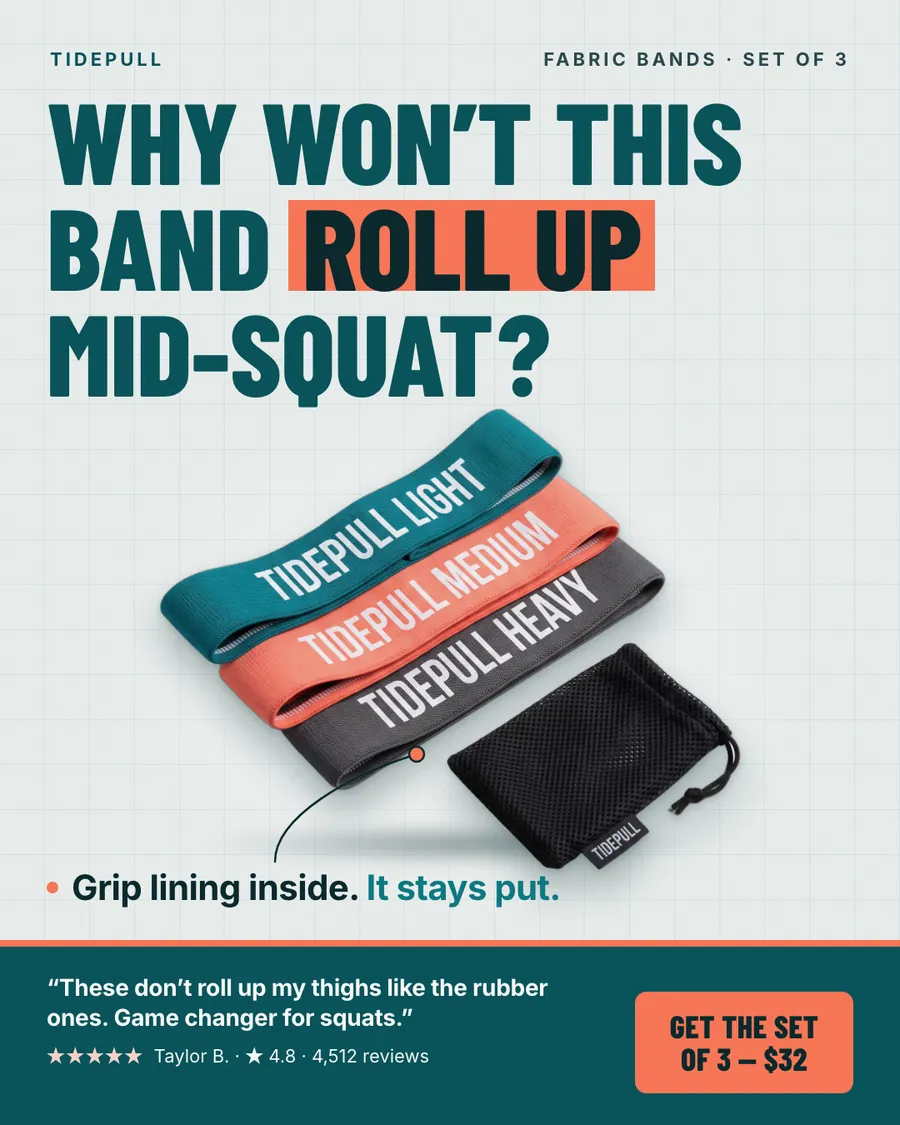
Question hookBenefit
Tidepull: Why won't this band roll up mid-squat?
Fictional sample brand · made by our engine
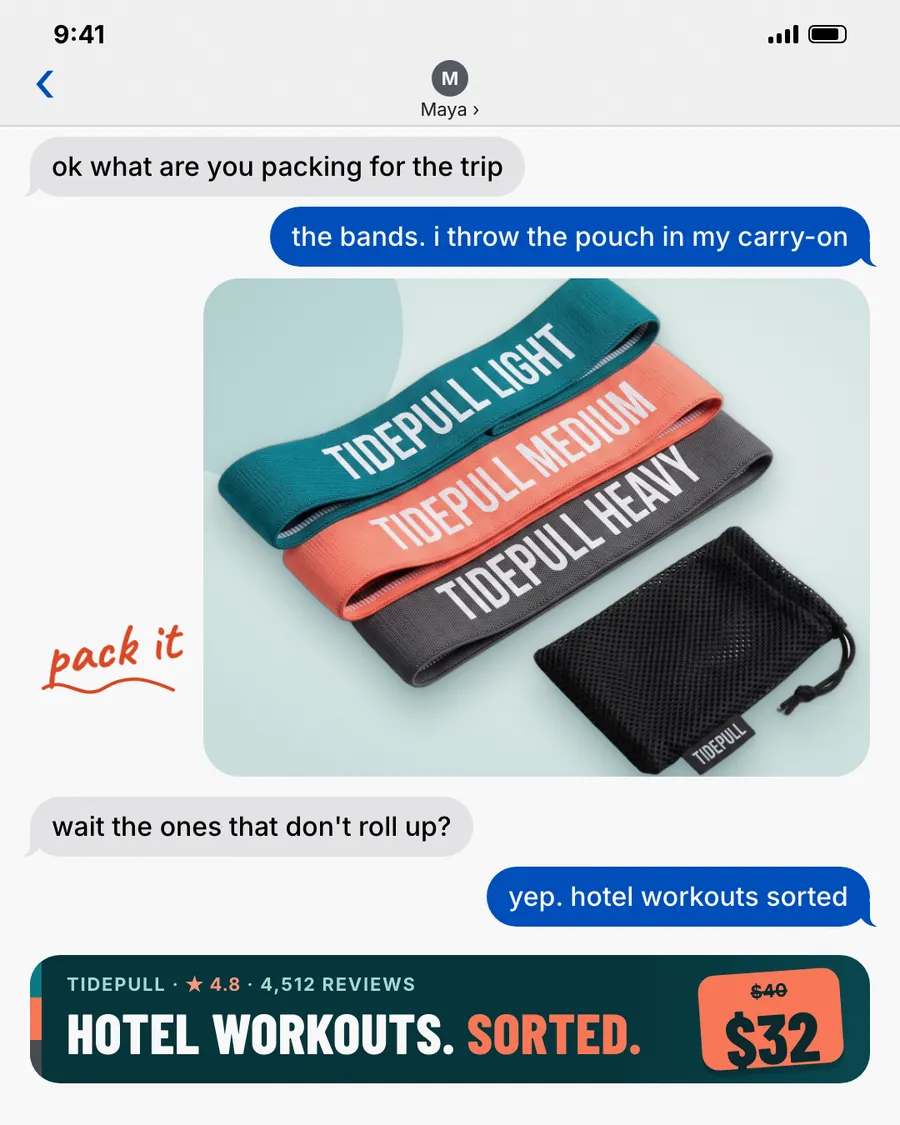
Text threadConvenience
Tidepull: Hotel workouts. Sorted.
Fictional sample brand · made by our engine
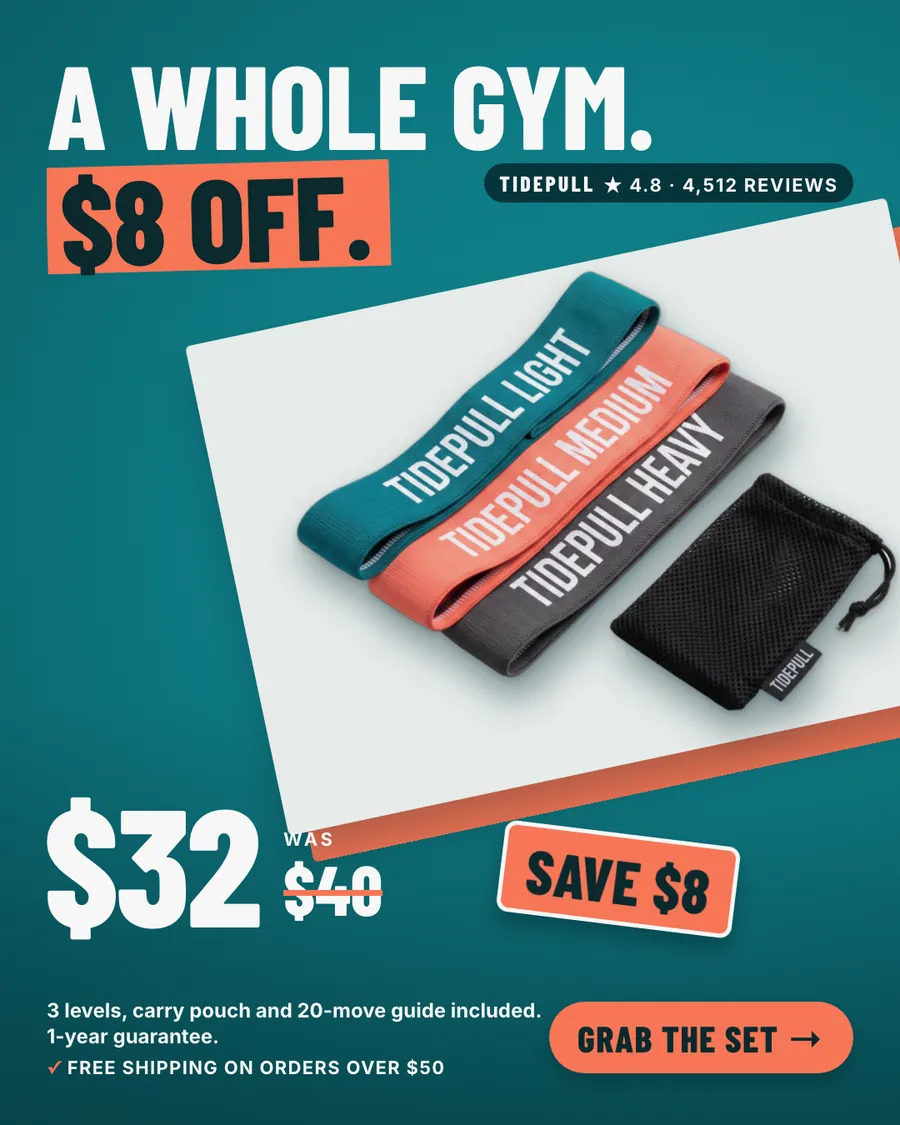
Price dropOffer
Tidepull: A WHOLE GYM.
Fictional sample brand · made by our engine
Policy flags for fitness product ads
Gear is in an easy lane on most platforms for exactly as long as the ad stays about the gear. These are the flags that move it out.
Weight loss promises
Meta treats an ad that promises weight loss as a weight loss ad: adults-only targeting, no statements of inferiority about appearance, no close-ups pinching fat.
Lines about the viewer's body
Meta's personal attributes rule bans ads that assert or imply something about a person's physical health. Describe what the product does, not what's wrong with the viewer.
Source: Meta Advertising Standards: Privacy Violations and Personal Attributes
Body image on TikTok
TikTok doesn't allow ads that shame bodies, suggest there's a right way to look, or promise that changing your body brings confidence or popularity.
Source: TikTok Advertising Policies: Weight Management and Body Image
Weight language on Pinterest
Pinterest bans weight loss language and imagery in ads, including before and after weight pictures and body shaming.
Source: Pinterest Advertising Guidelines
Guarantees
Advertise a guarantee only if you honor it promptly, and disclose its main conditions in the ad.
Source: FTC Guides for the Advertising of Warranties and Guarantees, 16 CFR 239
How often to refresh fitness product ads, and what to measure
Fitness ads tend to crowd the feed in January and thin out the rest of the year. Plan refreshes around that calendar, not only the clock.
Outside January, 2 to 3 new ads every 3 weeks on a small budget is plenty: a new annoyance, a new setting (the park, a hotel), or a new review. Before New Year, have a fresh batch ready so you're not relaunching tired ads into the busiest weeks.
Meta flags an ad as "Creative fatigue" when its cost per result reaches twice your past ads. It suggests a materially different image or video, and keeping the original running alongside it.
What to measure
- Cost per purchase vs break-even
- With no reorders to rescue it, this is the number that decides whether an ad stays.
- Average order value
- Every dollar of bundle lifts what a first order may cost. Watch it per ad, since some angles attract bundle buyers.
- Second-product rate at 60 days
- How many band buyers come back for a mat or roller. It tells you how much email and retargeting are worth.
- Video hold rate
- If people leave before the band hits the bottom of the squat, the demo starts too slowly.
Questions about advertising fitness products
How do I advertise fitness products on Instagram?
Show the gear working in Reels and Stories at 9:16 and in the feed at 4:5: a band at the bottom of a squat, a mat that grips. Each ad names one annoyance and shows it fixed, with the price. Instagram ads run from Meta's ad account, so one ad set covers both apps.
How do I advertise fitness products on Facebook?
Start with one Sales campaign and one broadly targeted ad set holding six ads, two each for three annoyances your gear fixes. Leave it alone for a week, keep the annoyance that earns add to carts, and turn it into a short demo video.
How do I advertise yoga mats?
Prove the two things mat buyers worry about: grip when sweaty and thickness for their knees. A hand on a damp mat and a side view of the thickness do that. Pinterest suits mats more than bands, and every spec belongs in your Shopping titles.
How do I advertise yoga mats on Facebook?
Make ads around the moment a mat fails, like sliding in downward dog, and show yours staying put. Give the thickness, size and material in the ad and the price on the image, and test a mat plus bands bundle against the mat alone.
How do I advertise a yoga mat business?
Pick one mat as the hero and one reason it's different, such as grip, thickness or travel weight, and build every first ad around that. Run Meta and Pinterest, add Shopping with full specs, and sell straps and blocks to buyers afterward.
How do I advertise fitness products online without big budgets?
Lift the order value with a bundle so each sale can afford more, test on Meta with a single ad set, and optimize for add to cart until purchases are steady. Post the same demos on your own TikTok and Instagram for free signals about which annoyance people recognize.
How do I advertise fitness products on TikTok?
Post short 9:16 clips of the gear in a real workout, a hotel room or a park, with the annoyance it fixes in the first two seconds. Run the clips that hold viewers as ads. TikTok bans body-shaming and ideal-body messages, so keep the camera on the gear, not on a physique.
Can fitness ads show before and after photos?
Avoid them for gear. Pinterest bans before and after weight imagery, TikTok bans body-shaming and ideal-body messages, and on Meta a weight loss promise turns the ad into a restricted weight loss ad. Show the product working instead.
Should I sell fitness gear on Amazon?
Only if you can compete on price or have something clearly different, because generic gear sits beside much cheaper versions. Amazon also keeps the customer, which makes it harder to sell them the next product.
When is the best time to advertise fitness products?
Many people start routines around New Year, and many brands advertise then too. Have fresh ads ready before January, run first tests in quieter weeks such as mid-February or early autumn, and use December for gift bundles.
Get the ads for this plan
Paste your store link and get 3 free ads of your own fitness products: we read your products, prices and reviews, design around your real product photo and check every fact against your store.
Where to go next
- Fitness product ad ideasEight sample ads for a resistance band brand that sell the gear, not a body, with specs to print and Meta's rules.
- Fitness productsAds for fitness gear and nutrition that lead with one proof point and keep claims to your label.
- How to advertise protein powderA plan for a small protein brand: Meta and short video first, a taste trial to beat the chalky-tub doubt, and the muscle-claim rules.
- How to advertise supplementsA rules-first plan for a small supplement brand: adults-only Meta, a reorder email, then Shopping, with the claims each channel accepts.
- How to advertise a clothing brandOne hero product, fit proof on real bodies, returns counted before the budget: a first-month ad plan for a small clothing brand.
- Problem-solutionName the everyday problem, then show your product as the fix, in one honest frame.
- PricingFree preview, Starter $49/month, weekly plans from $99/month with a 7-day free trial, 30-day money-back guarantee.
Sources
Platform rules on this page were checked on against:
- Meta Advertising Standards: Health and Wellness
- Meta Advertising Standards: Privacy Violations and Personal Attributes
- TikTok Advertising Policies: Weight Management and Body Image
- Pinterest Advertising Guidelines
- FTC Guides for the Advertising of Warranties and Guarantees, 16 CFR 239
- FTC Green Guides, 16 CFR 260 (environmental marketing claims)
- Meta Business Help Center: About learning limited
- Meta Business Help Center: About creative fatigue recommendations in Ads Manager
- 3 free ads when your spot opens
- Starter $49/month
- Growth $99/month, 7-day free trial
- Pro $149 · Scale $199
- 30-day money-back guarantee