how to advertise protein powder
How to advertise protein powder when every tub promises the same grams
Protein buyers don't need persuading that they want protein. They need persuading that this tub won't taste like chalk, clump in the shaker or hide something on the label. That shifts the plan toward short video, taste proof and a cheap way to try it. Here it is with Northvale Nutrition, a fictional whey isolate brand, and its numbers.
Updated · Budgets and examples use a fictional brand's numbers. Use yours.
In short
How do you advertise protein powder?
Answer the taste doubt first: run Meta ads that pair a customer's taste quote with the macros per scoop, then add short TikTok and creator videos of the powder mixing. Offer a low-risk way to try it, keep muscle and weight promises out, and send buyers a reorder reminder before the tub runs out.
At a glance
- The real objection
- Taste and texture, which a photo can't prove
- Where to start
- Meta statics plus a reorder email; video next
- Which label you're under
- Nutrition Facts or Supplement Facts changes the rules
- The claim that bites
- Muscle gain or weight change, on every platform
- Reorder clock
- A 30-serving tub used daily lasts about a month
Which channels fit protein powder, in the order to try them
Protein is bought on habit and switched on doubt. The channels that work show the product being used, and the one that keeps the margin is the reorder.
- 01
Meta (Facebook and Instagram)
Start hereWhy it fits
A still ad can put the macros, the sweetener and a taste quote in one frame, which is how protein buyers compare. Instagram's feed and Reels sit where training content already lives.
The trade-off
Any ad about weight loss or weight gain moves into Meta's weight rules and adults-only targeting. Keep the ads on taste and the label to stay out of that lane.
- 02
Email and SMS
Start hereWhy it fits
One scoop a day empties a 30-serving tub in about a month, so a reminder around day 22 with the subscription price is the most predictable sale you have.
The trade-off
It can't find new customers, and SMS needs explicit opt-in before the first text.
- 03
TikTok
Add nextWhy it fits
A spoon stirring powder smooth in five seconds answers the clumping doubt better than any headline, and gym and recipe videos are native there.
The trade-off
It needs fresh 9:16 video every week or two, and TikTok limits any muscle gain or weight loss claim to adults and bans results that come from the product alone.
- 04
Creators and gym coaches
Add nextWhy it fits
Coaches and lifters who post daily meals give you real taste reactions and recipes to run as partnership or Spark Ads.
The trade-off
A creator's transformation story becomes your claim. Brief them on taste, mixing and recipes, never "how I got shredded", and require a clear #ad.
- 05
Google Shopping
Add nextWhy it fits
Buyers search specifics like "grass-fed whey isolate vanilla" or "protein with monk fruit". A Shopping ad shows the tub and price on that exact search.
The trade-off
Price comparison is brutal for a commodity-looking tub, so the feed title has to carry what's different: the protein source, sweetener and servings.
- 06
Amazon
Only if it fitsWhy it fits
Repeat buyers often reorder protein wherever their other groceries come from.
The trade-off
Fees, price matching and reviews you can't reply to by email. If your tub carries a Supplement Facts panel, Amazon's dietary supplement testing rules apply too.
- 07
Pinterest
Add laterWhy it fits
Protein pancakes, overnight oats and smoothie bowls get saved and cooked, and a recipe pin shows the tub in use.
The trade-off
Pinterest bans weight loss language and imagery in ads, and recipe savers are slower to buy than people searching for a tub.
Protein powder ad rules to know before the first ad
Protein sits closer to food than to supplements, which makes it easier to advertise, right up to the moment an ad mentions a body. These flags decide what the plan below can test.
Muscle gain and weight claims
TikTok limits weight loss and muscle gain claims to audiences 18 and over, and doesn't allow claims that the product alone, without diet or exercise, builds muscle, or that results are easy or guaranteed.
Source: TikTok Advertising Policies: Weight Management and Body Image
Weight gain and weight loss on Meta
Meta lists protein products among general foods that don't need adults-only targeting, but ads for weight loss or weight gain products must target adults and can't make statements of inferiority about appearance. A "bulk up" angle is a weight gain ad.
"High protein" and similar words
"High", "rich in" and "excellent source of" are FDA-defined and mean at least 20% of the Daily Value per serving. A plain "25 g protein per scoop" needs no definition.
Source: 21 CFR 101.54: nutrient content claims for "good source" and "high"
Transformation testimonials
The FTC's Endorsement Guides treat a featured customer's results as what others can expect, so a best-case physique needs evidence that it's typical.
Weight language on Pinterest
Pinterest doesn't allow any weight loss language or imagery in ads, including before and after weight pictures, body shaming and references to BMI.
Source: Pinterest Advertising Guidelines
Nutrition Facts or Supplement Facts: which rules you're under
Look at the panel on your own tub before you plan anything. Many protein powders are sold as foods with a Nutrition Facts panel; some are sold as dietary supplements with a Supplement Facts panel. The same ad faces different rules depending on which one you print.
| Nutrition Facts (a food) | Supplement Facts (a dietary supplement) | |
|---|---|---|
| Meta targeting | Protein products are exempt from the adults-only rule, unless the ad is about weight | Supplements must be targeted to people 18 or older |
| Body-function claims | No FDA notification or label disclaimer required, but the claim still has to be true and supported | Needs substantiation, an FDA notification within 30 days and the label disclaimer |
| Nutrient words | "High protein" means 20% of the Daily Value or more per serving | The same FDA definitions apply |
| Amazon | Grocery listing rules | Each product must be verified by a testing provider Amazon authorizes |
Offers that work for protein powder
The best protein offer lowers the cost of finding out whether it tastes good. After that, it rewards the second tub.
A taste trial
A few single-serve packs, or a small tub, priced to cover your cost and credited toward the first full tub, takes the chalky-tub risk off the table.
Watch: Keep the trial price honest: if the sample is free, say exactly what the buyer pays, including shipping.
Tub plus shaker
Northvale's $54 tub sits under its $60 free shipping line; adding the $18 shaker clears it and lifts the order without a discount.
Subscribe and save
A monthly habit suits a standing order. Northvale takes 15% off for subscribers.
Watch: State the terms and how to cancel next to the price, and make cancelling simple.
A second flavor at the same price
Someone drinking the same shake every morning gets tired of one flavor. Chocolate next to vanilla at the same $54 gives them a reason to stay instead of shopping around.
Your first 30 days advertising protein powder
Statics prove the label, video proves the texture, and the first month gives you both without spreading a small budget thin.
Days 1 to 3
Check the label and the tracking
Confirm which panel your tub carries and set the age to match. Make sure the pixel records purchases. Put protein, calories and sugar per scoop, the sweetener and the servings per tub in the first screen of the product page.
Days 4 to 7
Launch 8 statics on 4 doubts
Two ads each for taste (a customer quote), the macros, the sweetener and testing. Run them in one Sales campaign and one ad set, 4:5 for feeds and 9:16 for Stories and Reels, with no body imagery anywhere.
Days 8 to 14
Send tubs to 10 to 15 creators
No edits to the campaign this week. Meanwhile pick people who already post meals and recipes. Ask for a mixing clip, a taste reaction and one recipe, give them the claims you can't use, and agree usage rights for ads in writing.
Days 15 to 24
Run the best clips as ads
Put the two strongest creator videos into the same ad set as partnership ads, and start a small TikTok test with the same clips as Spark Ads. Leave the statics running so you can compare cost per purchase.
Days 25 to 30
Set up the reorder and judge the month
Turn on a reminder around day 22 after each order with the subscription price. Keep the doubt that won, cut ads that spent your break-even twice without an add to cart, and test a second flavor.
How to size a starting budget for protein powder ads
Protein orders are bigger than most consumables, so the break-even per order is generous. The catch is how many of them the learning phase wants. With Northvale's numbers, a typical first order is the $54 tub plus the $18 shaker.
| Order value | $72.00 |
|---|---|
| Margin after product cost, shipping and fees | 42% |
| Most a first order can cost to break even | $30.24 |
| 50 purchases a week at that cost | $1,512 a week |
| The same budget per day | about $216 |
Meta says an ad set usually leaves its learning phase after about 50 results in the week after its last significant edit, and recommends a budget large enough to get enough results. Meta Business Help Center: About the learning phase
A 2 lb tub is heavy to ship and protein isn't cheap to make, so the margin is thinner than the order value suggests, and $216 a day is a lot for month one. Ways to make the first month affordable:
- Let the trial carry the first click. A taste trial costs less to sell than a full tub, then the tub sells by email to people who liked it. Judge the trial on how many trial buyers come back, not on its own margin.
- Optimize for add to cart first. Meta suggests a more frequent event when an ad set can't reach enough purchases. Switch to purchases once orders are steady.
- Count the second tub only once you've seen it. If your own data shows a share of buyers reorder within 35 days, the first order can cost more. Before that, budget as if it won't.
Angles to test for protein powder ads
Each angle answers one doubt with something the buyer can check. The full set of annotated sample ads, the label-reading table and copy lines are on Protein powder ad ideas.
Taste, in a customer's words
"Tastes like melted vanilla ice cream."
The macros, large
25 g protein. 110 calories. 1 g sugar.
The sweetener question
Sweetened with monk fruit. Nothing artificial.
Mixing
Stirs smooth with a spoon. No shaker required.
Cost per shake
30 shakes for $54. $1.80 each.
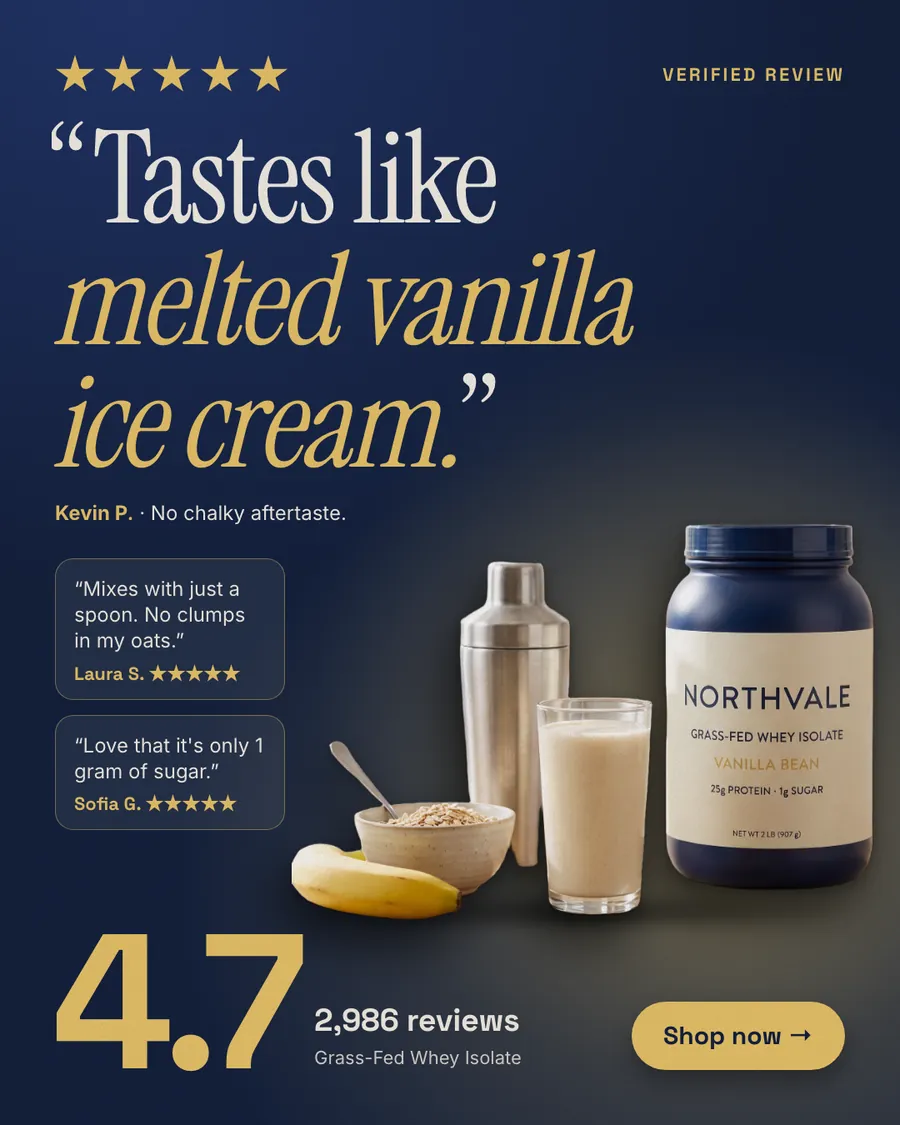
Review cardTaste
Northvale Nutrition: “Tastes like melted vanilla ice cream.”
Fictional sample brand · made by our engine
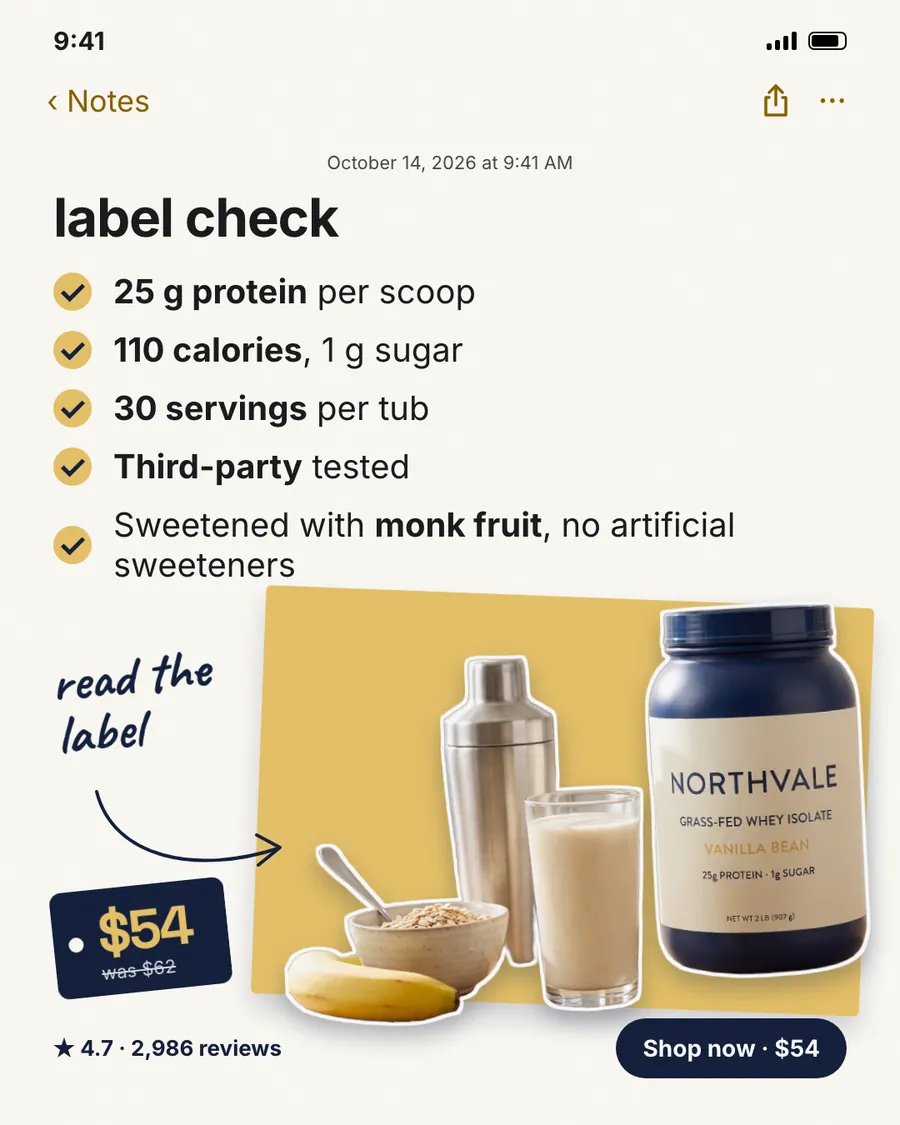
Notes-app listTransparency
Northvale Nutrition: label check
Fictional sample brand · made by our engine
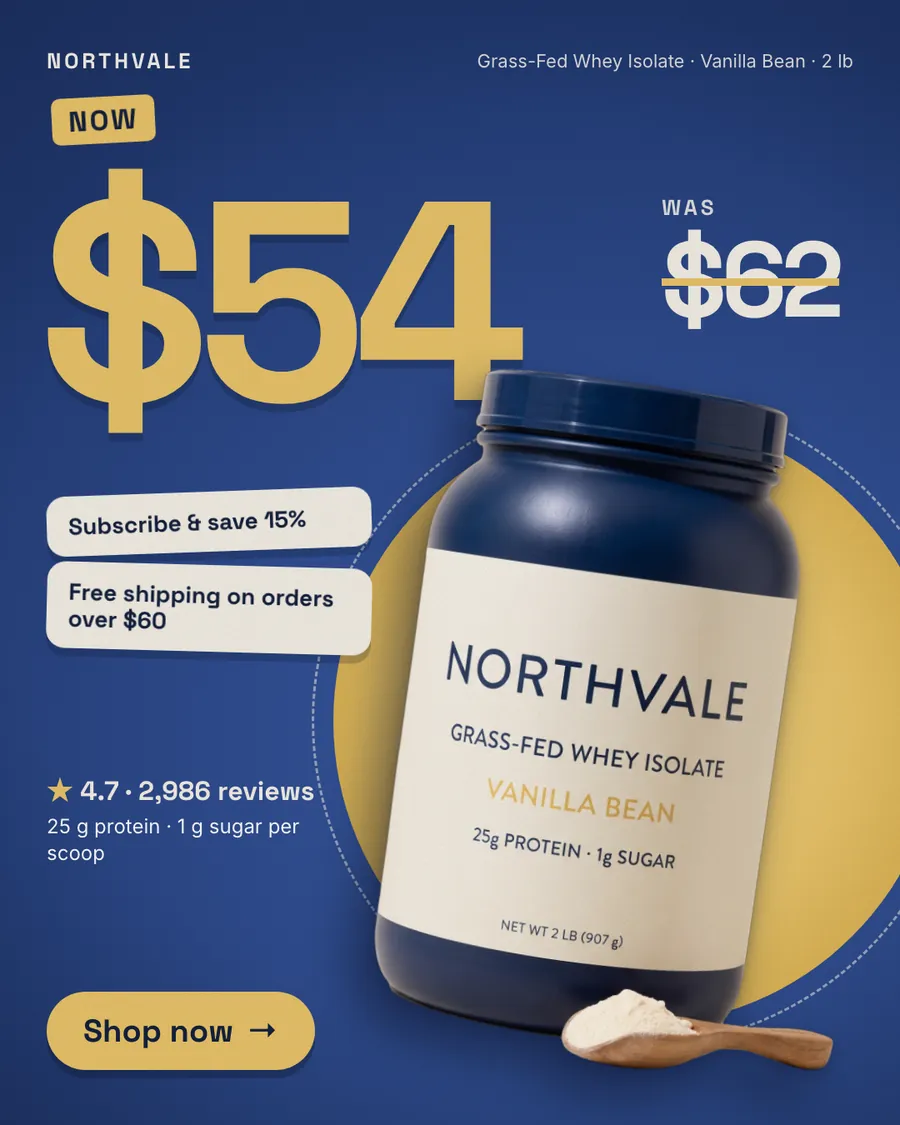
Price dropOffer
Northvale Nutrition: Now $54. Was $62.
Fictional sample brand · made by our engine
How often to refresh protein powder ads, and what to measure
Video wears out faster than a label static, because the same clip feels stale sooner than a page of facts, so plan two refresh speeds.
Refresh video every 2 to 3 weeks with new creator clips and recipes, and the label statics every 4 to 6 weeks or when results slip. Swap in seasonal versions for January training plans and summer smoothies.
Meta labels an ad "Creative limited" when its cost per result is above your past ads and "Creative fatigue" at twice their cost. It suggests a materially different image or video, so try a new doubt rather than a new background.
What to measure
- Cost per first purchase vs break-even
- Measured on new customers, since reorders arrive from email anyway.
- Trial to tub conversion
- If you run a taste trial, the share of trial buyers who buy a full tub within 30 days is the number that says whether the trial pays.
- Reorder rate at 35 days
- A tub used daily is gone in about a month; this shows whether taste is keeping people.
- Video hold rate
- How many viewers watch past the first few seconds. Low hold means the mixing or taste moment comes too late.
Questions about advertising protein powder
How do I advertise protein powder on Instagram?
Make each ad in 4:5 for the feed and 9:16 for Stories and Reels, lead with one doubt answered (a taste quote, the macros, the sweetener) and keep bodies out of the picture. Instagram ads run from Meta's ad account, so start with one ad set and a handful of ads, then add creator clips.
How do I advertise protein powder on Facebook?
Run one Sales campaign with one ad set and six to eight ads, each built on one checkable fact: grams per scoop, calories, sugar, the sweetener or a customer's taste line. Avoid weight gain or bulking language, which brings Meta's weight rules and adults-only targeting into play.
How do I advertise protein powder on TikTok?
Show the moment a still photo can't: the powder stirring smooth, the first sip, a recipe. Keep one big fact on screen away from the app's buttons. TikTok limits muscle and weight claims to adults and bans saying the product works without diet or exercise.
How do I promote protein powder on social media without paying for ads?
Post recipes and mixing clips from your own account, send tubs to creators who already post meals, and reply to taste questions in comments. Organic posts show you which doubts people care about, and the winners become your first paid ads.
What is a catchy slogan for protein?
Something a buyer can check beats effort talk: 25 grams, 1 gram of sugar; tastes like dessert, reads like a label; morning shake, sorted. Slogans about grinding and gains sound like every other tub in the feed.
Can protein powder ads say they build muscle?
Be careful. TikTok allows muscle gain claims only to adults and never as a result of the product alone, Meta treats weight gain ads as adults-only, and any body result needs evidence. A plain grams-per-scoop line sells the same thing without the risk.
Should I give away free samples of protein powder?
Samples answer the taste doubt directly, but free ones attract people who never buy. A small paid trial credited toward the first tub filters for real interest. Track how many trial buyers order a full tub to see whether it pays.
How much should I spend on protein powder ads?
Start from your margin: typical order value times the margin after product cost, shipping and fees is the most a first order can cost. About 50 of those a week is what Meta's learning phase needs. Below that, optimize for add to cart and keep one ad set.
Do protein powder ads have to target adults?
On Meta, protein products count as general food and are exempt from the adults-only rule, unless the ad is about weight loss or weight gain. A powder sold with a Supplement Facts panel may be held to the supplement rule, so target 18 and over if in doubt.
What should protein powder ads avoid?
Transformation photos, bulking and shredding promises, results tied to a number of days, high protein without meeting the FDA definition, and certification marks the product doesn't hold. Taste, mixing, the macros and the price per shake do the selling without them.
Get the ads for this plan
Paste your store link and get 3 free ads of your own protein powder: we read your products, prices and reviews, design around your real product photo and check every fact against your store.
Where to go next
- Protein powder ad ideasSeven sample ads for a whey isolate brand that answer taste, sweeteners and trust, with the macros and claims rules.
- How to advertise supplementsA rules-first plan for a small supplement brand: adults-only Meta, a reorder email, then Shopping, with the claims each channel accepts.
- How to advertise fitness productsA plan for a small fitness gear brand: Meta demos first, then Shopping and short video, with the order-value math a one-time purchase needs.
- How to advertise food productsA plan for sauces, snacks and pantry brands: sell the dish, answer how hot or how sweet, and build first orders that clear free shipping.
- Vertical 9:16 (1440x2560)1440 x 2560 vertical ads for Stories, Reels and Google's vertical image slots, with motion on demand.
- PricingFree preview, Starter $49/month, weekly plans from $99/month with a 7-day free trial, 30-day money-back guarantee.
Sources
Platform rules on this page were checked on against:
- TikTok Advertising Policies: Weight Management and Body Image
- Meta Advertising Standards: Health and Wellness
- 21 CFR 101.54: nutrient content claims for "good source" and "high"
- FDA: Structure/Function Claims (dietary supplements and conventional foods)
- FTC Endorsement Guides, 16 CFR 255
- Pinterest Advertising Guidelines
- Meta Business Help Center: About learning limited
- Meta Business Help Center: About creative fatigue recommendations in Ads Manager
- 3 free ads when your spot opens
- Starter $49/month
- Growth $99/month, 7-day free trial
- Pro $149 · Scale $199
- 30-day money-back guarantee