Playbooks
Ad creative testing on a small budget: an honest guide
One ad is a bet; fifty ads is a spray. Here is the middle path for small budgets: a few angles that disagree with each other, enough spend to read them, and a weekly loop that builds on what works.
By the StoreToAds team · · 4 min read
What counts as a different creative
A new color or a new button label is a tweak. A different reason to buy is a different creative. On a small budget, only the second kind is worth testing, because tweaks produce differences too small to see in a few hundred dollars of spend.
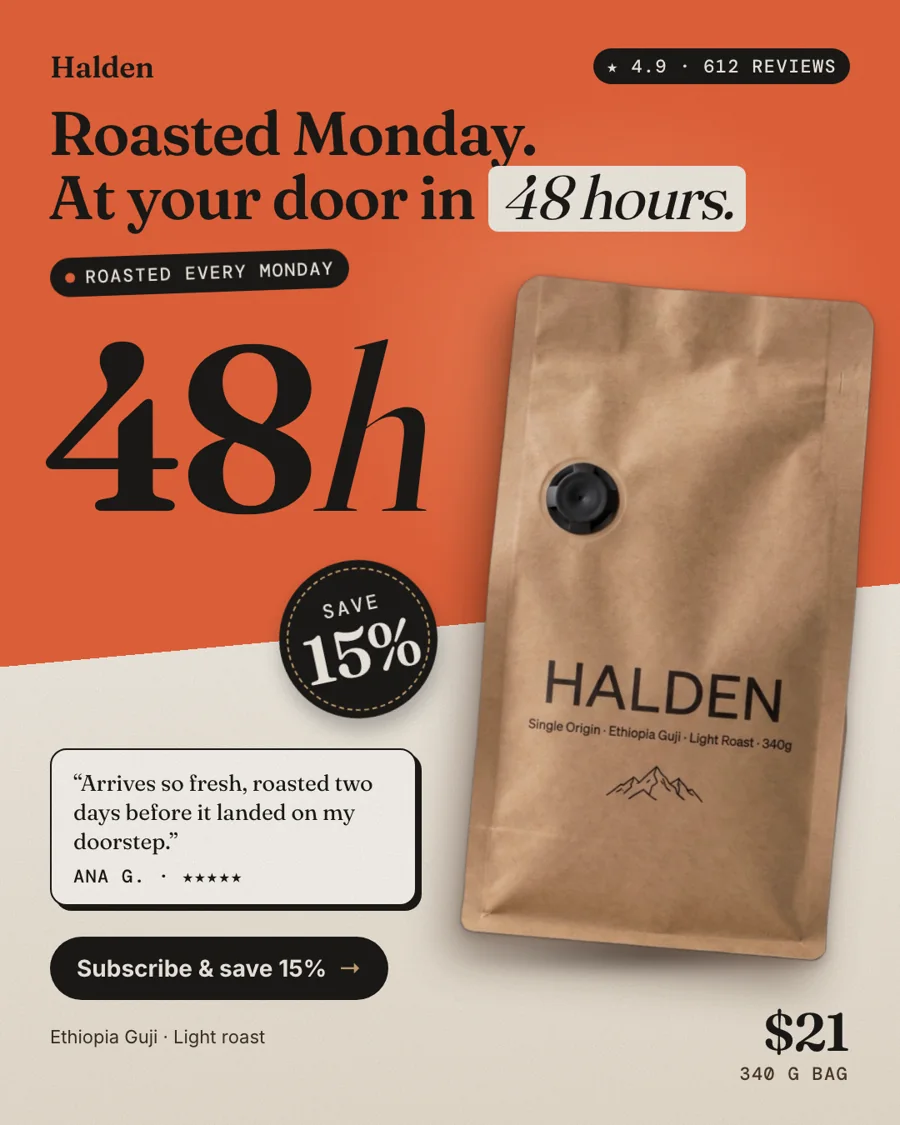
Take Halden, our fictional coffee brand. Four ads that really differ:
- Taste: the tasting notes, jasmine, peach and honey, around the bag.
- Freshness: roasted every Monday, at your door in 48 hours.
- Proof: "Like peach tea." with 4.9 stars from 612 reviews.
- Comparison: a table against a typical supermarket bag.
Same product, same price. If freshness wins clearly, you have learned something about your customers that will shape every ad you make next.
How many ads to test at once
Three to five. Fewer, and you have nothing to compare. More, and a small daily budget gets split so thin that most ads never get enough delivery to judge. Put them in one ad set and let Meta deliver; if you need an even split for a cleaner read, use Ads Manager's A/B test or give each angle its own ad set with the same budget.
How much spend before you judge
Most small stores make the same mistake: they judge an ad after a day and a handful of clicks. Early numbers swing wildly. Some rules of thumb that keep you honest:
- Wait at least three to four days, and ideally a full week, before turning anything off. Weekday and weekend shoppers behave differently.
- Before calling a loser on purchases, let it spend at least about your target cost per purchase. An ad with zero sales after spending a fraction of that has not failed yet.
- If purchases are too few to compare, use earlier signals: link click-through rate, cost per click and cost per add-to-cart. They move faster and usually point the same way.
These are rules of thumb, not statistics. With small budgets you are reading direction, not proving anything. That is fine, as long as you keep testing.
Reading results without fooling yourself
- Look for big gaps. If one ad's click-through rate is double another's, that is a signal. Ten percent apart is noise at this scale.
- Notice where Meta puts the money. Uneven spend across ads in one ad set reflects Meta's prediction of what will work. It is not proof, but it is information.
- Check the whole path. An ad with cheap clicks and no add-to-carts may be attracting the wrong people or promising something the product page doesn't deliver.
- Write down the result as a sentence: "Freshness beat taste on click-through rate, 2x, over 7 days." A testing log beats memory.
The winner loop
When an angle wins, don't stop and don't start over. Build on it:
- Keep the winning ad running.
- Make two or three new ads on the same reason to buy, each with a new headline, layout or photo.
- Turn off the clear losers.
- Add one or two brand-new angles, so you keep finding the next winner.
A useful split is roughly two-thirds of new ads building on proven angles and one-third trying something new. Ads wear out as the same people see them again. When frequency climbs and click-through rate falls week over week, the replacements you have been testing are already waiting.
A four-week starter plan
| Week | What you run | What you decide |
|---|---|---|
| 1 | 3 to 5 ads, each on a different angle | Nothing yet, unless an ad is clearly broken |
| 2 | The same ads | Which one or two angles lead |
| 3 | The leaders, plus 2 to 3 new versions of the best angle and 1 new angle | Whether the new versions beat the original |
| 4 | The best of everything so far, plus fresh versions | Your next month's main angles |
After a month you have a short list of angles your customers respond to, which is worth more than any single winning ad.
Four habits that ruin small tests
- Editing a live ad. Changing the image or text resets what Meta has learned about it. Make a new ad instead.
- Testing on a sale week, then judging on a normal week. Compare ads that ran at the same time.
- Copying the winner exactly in five colors. That repeats one idea; it does not test a new one.
- Stopping once something works. Every winner wears out, so the testing never really ends.
Where StoreToAds helps
The hard part of this loop is producing new, genuinely different ads every week. StoreToAds builds each batch on different reasons to buy from your store's real data. On weekly plans, Meta results per ad and per creative tag steer the next batch: it leans on what won and keeps about 30% for new angles. You still decide what runs; ads reach Meta as paused drafts. See the Meta ad creative generator for how it works.