how to advertise food products
How to advertise food products online, worked through with a hot sauce
A jar or a bottle has two problems in a feed: nobody can taste it, and one $12 item rarely justifies the shipping. So a food ad has to sell a meal the viewer already plans, and the store has to make the first basket big enough to send. Pepperwick, a fictional small-batch hot sauce, is the example throughout.
Updated · Budgets and examples use a fictional brand's numbers. Use yours.
In short
How do you advertise a food product online?
Show the product on a dish people already cook, answer the question that stops them (how hot, how sweet, what's in it) right on the ad, and sell a bundle that clears free shipping. Start on Meta, add food creators and Google Shopping, and follow every first order with recipes and the next flavor.
At a glance
- What sells it
- The dish, not the jar: tacos, eggs, wings
- The question to answer
- How hot is it, and what do I put it on?
- Where to start
- Meta ads, with a first order that clears free shipping
- The rule that bites
- Food words like gluten-free and healthy are defined by the FDA
- Plan around
- Game days, grilling season and gift sets
Which channels fit food products, in the order to try them
Pantry food is cheap, visual and bought for a use. The best channels show it being used, then make the second bottle as easy as the first.
- 01
Meta (Facebook and Instagram)
Start hereWhy it fits
Food on food stops a thumb. A bottle next to a plate of tacos, with the heat level printed on the ad, tells a stranger what it is and when they'd use it in one look.
The trade-off
A single $12 bottle can't carry much ad cost, so the store needs bundles and a free-shipping line before the ads can pay.
- 02
Email and the next flavor
Add nextWhy it fits
Someone who liked one sauce is the easiest person to sell the second. Recipes after delivery and a note when a new batch drops keep the bottle on the table.
The trade-off
It's only as big as your list of past buyers, which starts small.
- 03
Home cooks and food creators
Add nextWhy it fits
A creator splashing your sauce on their weeknight dinner shows the use and the real heat better than any studio shot, and gives you video to test in ads.
The trade-off
Results are uneven, gifted posts need a clear disclosure, and you need permission to run their clips as ads.
- 04
Google Shopping
Add nextWhy it fits
Fans search by style, like "smoked habanero hot sauce" or "fermented hot sauce", and Shopping shows your bottle and price on those searches.
The trade-off
Grocery brands sell for less, so a single-bottle listing struggles; list the bundles too and keep shipping costs honest in Merchant Center.
- 05
Pinterest
Add laterWhy it fits
Recipes are a big part of what people save there, and a wing or taco recipe pin can carry the sauce into a planned meal.
The trade-off
Pins get saved for later, so sales come slowly and seasonally.
- 06
Markets, tastings and pop-ups
Only if it fitsWhy it fits
A taste converts people no ad can, and a market table is where you collect reviews, email signups and the phrases customers use.
The trade-off
It eats weekends and doesn't scale, so treat it as research for the ads, not as the plan.
- 07
Amazon
Only if it fitsWhy it fits
Some sauce buyers only shop there, and a listing catches searches for your style.
The trade-off
Glass, fees and price comparison squeeze a small bottle hard, and those buyers never join your email list.
Your first 30 days advertising a food product
The aim of month one is to learn which dish makes people buy, and to make sure first orders are big enough to ship profitably.
Days 1 to 3
Answer the stop questions on the page
Put the heat level, three uses from your reviews, the ingredients and the allergens on the product page. Make the bundle that clears free shipping easy to pick, then place a test order to confirm the purchase reaches Ads Manager.
Days 4 to 7
Launch 6 to 8 ads built on dishes
Two ads each for four angles: the heat answered, a dish people already cook, a customer's line about flavor, and the process (Pepperwick's 30-day ferment). Point half at the single bottle and half at the gift trio, all inside a single Sales campaign with one broadly targeted ad set.
Days 8 to 14
Don't touch, just read
Give the learning phase the full week without edits. Note which dish gets the most add to carts and how many orders clear the shipping line.
Days 15 to 21
Recipes, samples and the second flavor
Send buyers three recipes after delivery and a link to your other sauces. Ship bottles to 10 to 20 home cooks or food creators, and add two new ads on the winning dish.
Days 22 to 30
Build the next food moment early
Make the ads for the next eating occasion (game days, grilling, holiday gift sets) now, so they finish learning before the rush instead of during it.
How to size a starting budget for food ads
Start from the basket you want, not the single item. For Pepperwick that's the gift trio plus one bottle, which clears the $40 free-shipping line.
| Order value | $44.00 |
|---|---|
| Margin after product cost, shipping and fees | 48% |
| Most a first order can cost to break even | $21.12 |
| 50 purchases a week at that cost | $1,056 a week |
| The same budget per day | about $151 |
Meta says an ad set usually leaves its learning phase after about 50 results in the week after its last significant edit, and recommends a budget large enough to get enough results. Meta Business Help Center: About the learning phase
If most orders are a single $12 bottle, the break-even cost per order falls to a few dollars and paid ads rarely work. That's why the basket comes first and the ad budget second.
- Make the bundle the hero. Ads that show three flavors as a tasting flight lift the order value without a discount on any bottle.
- Count the second flavor only if it happens. Check how many buyers come back for another sauce within two months before letting a first order cost more than its margin.
- Start with a more frequent goal. While purchases are too few for Meta's learning phase, optimizing for add to cart is Meta's own suggestion; move to purchases when orders are steady.
Glass, shipping and the free-shipping line
Three bottles cost little more to ship than one, which is why the threshold matters more for food than for most products. Pepperwick's baskets against its $40 line:
| Basket | Order value | Clears $40? | What it means for ads |
|---|---|---|---|
| One bottle | $12 | No | Shipping eats most of the margin; don't send ads here alone |
| Hot Sauce Trio Gift Set | $32 | No | $8 short: show a single bottle as the add-on |
| Trio plus one bottle | $44 | Yes | The natural first order to build ads around |
| Four single bottles | $48 | Yes | Works for fans of one flavor |
Offers that work for food products
Food offers should lower the risk of an unknown flavor and fill the box. Percent-off codes on a single jar do neither.
A tasting set
Pepperwick's trio is $32, compared with $36 for three bottles, and it answers the buyer's worry about picking the wrong heat.
Watch: The compare-at price has to be what the bottles really sell for.
Free shipping over a threshold
A line just above the bundle price nudges people to the basket that makes ads affordable.
A swap if it's too hot
Heat is the biggest worry with an unknown sauce. A promise to swap for a milder bottle removes it.
Watch: Only if you will actually do it, with the conditions written on the page.
Gift sets in gift season
Pepperwick's own reviews mention buying the trio as a gift, so a boxed set earns its own ads before December and Father's Day.
Angles to test for food product ads
Every food ad should lead with one dish or one answer. The full set of sample ads, photo tips and copy lines is on Food product ad ideas; the angles below are the ones the 30-day plan tests.
The heat, answered
Heat level 6 out of 10. Smoky, fruity, medium-hot.
A dish people already cook
Tuesday tacos just got a lot more interesting.
Flavor from a customer
"Actual flavor, not just pain."
The process, as a number
Habaneros, fermented for 30 days.
The spice-shy partner
"Even my spice-shy husband likes it."
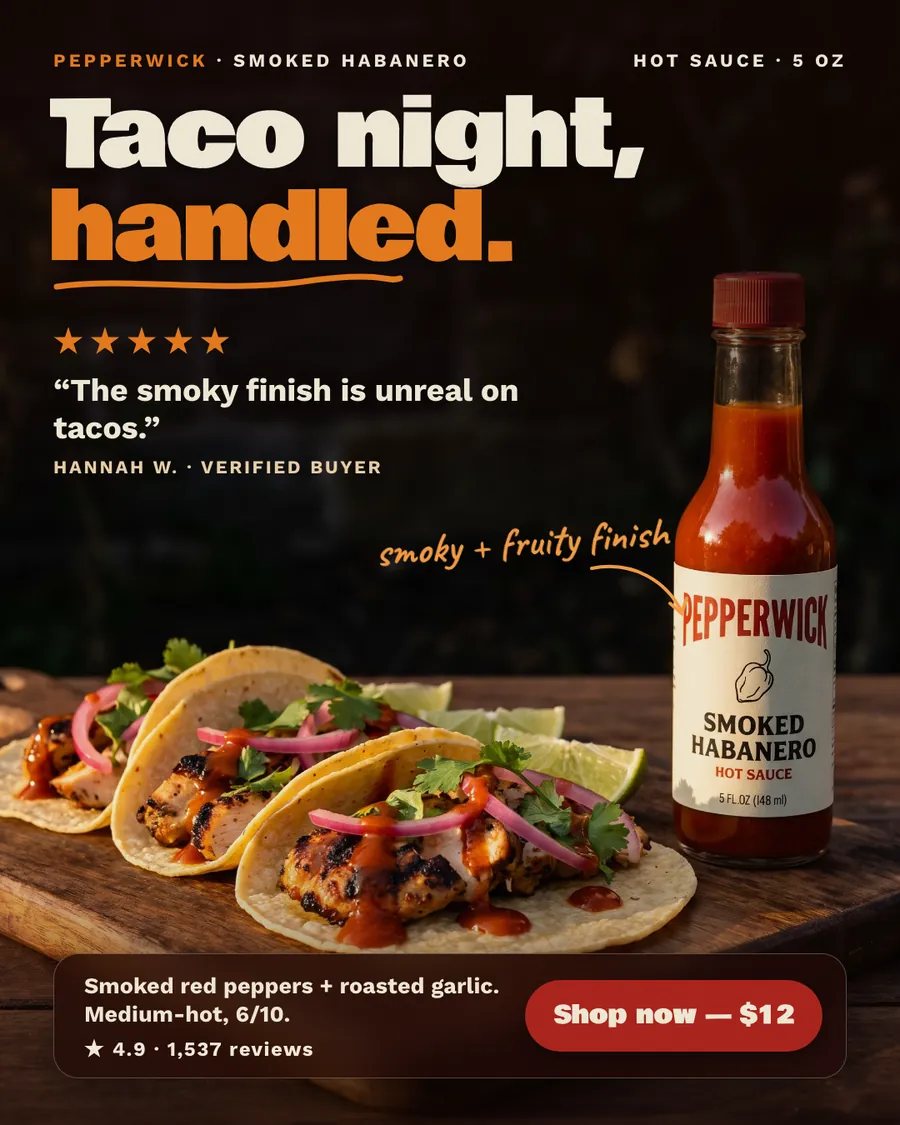
Lifestyle typeRitual
Pepperwick: Taco night, handled.
Fictional sample brand · made by our engine
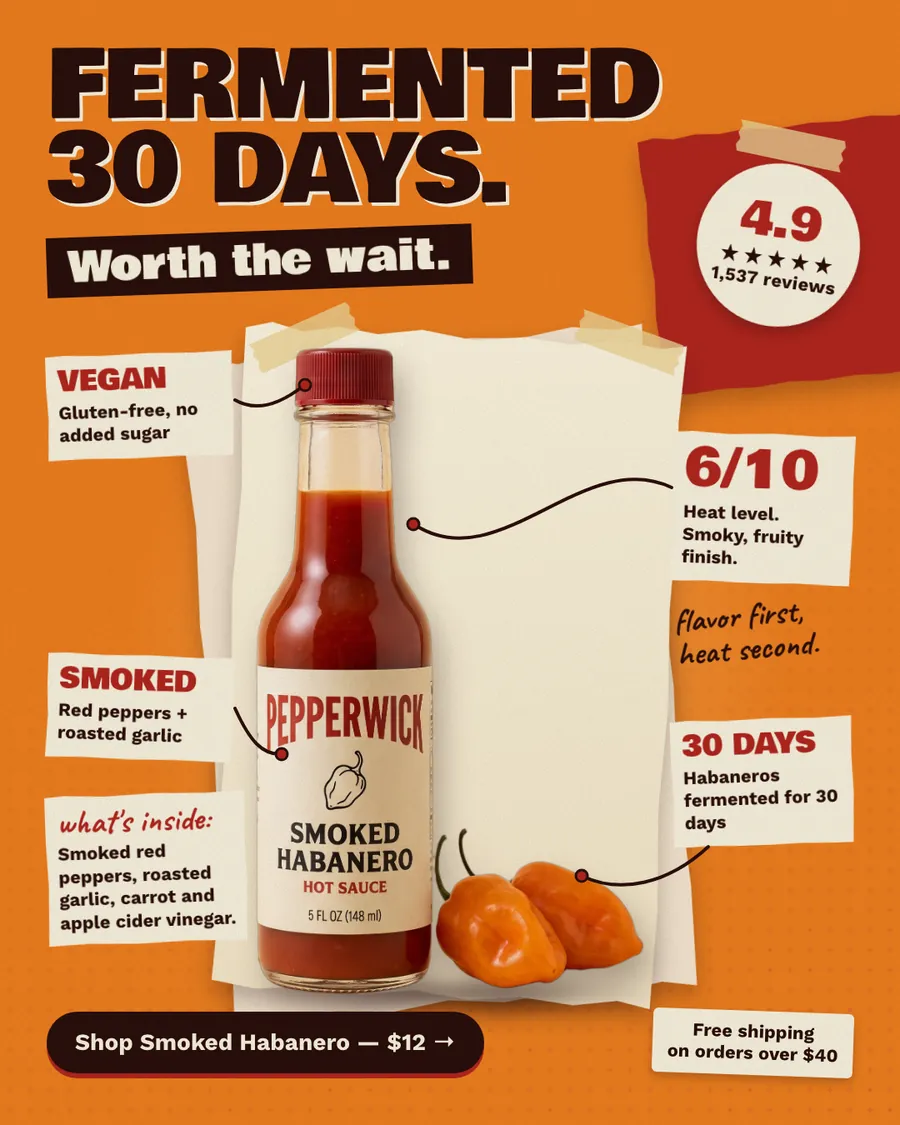
Annotated heroTransparency
Pepperwick: FERMENTED 30 DAYS.
Fictional sample brand · made by our engine
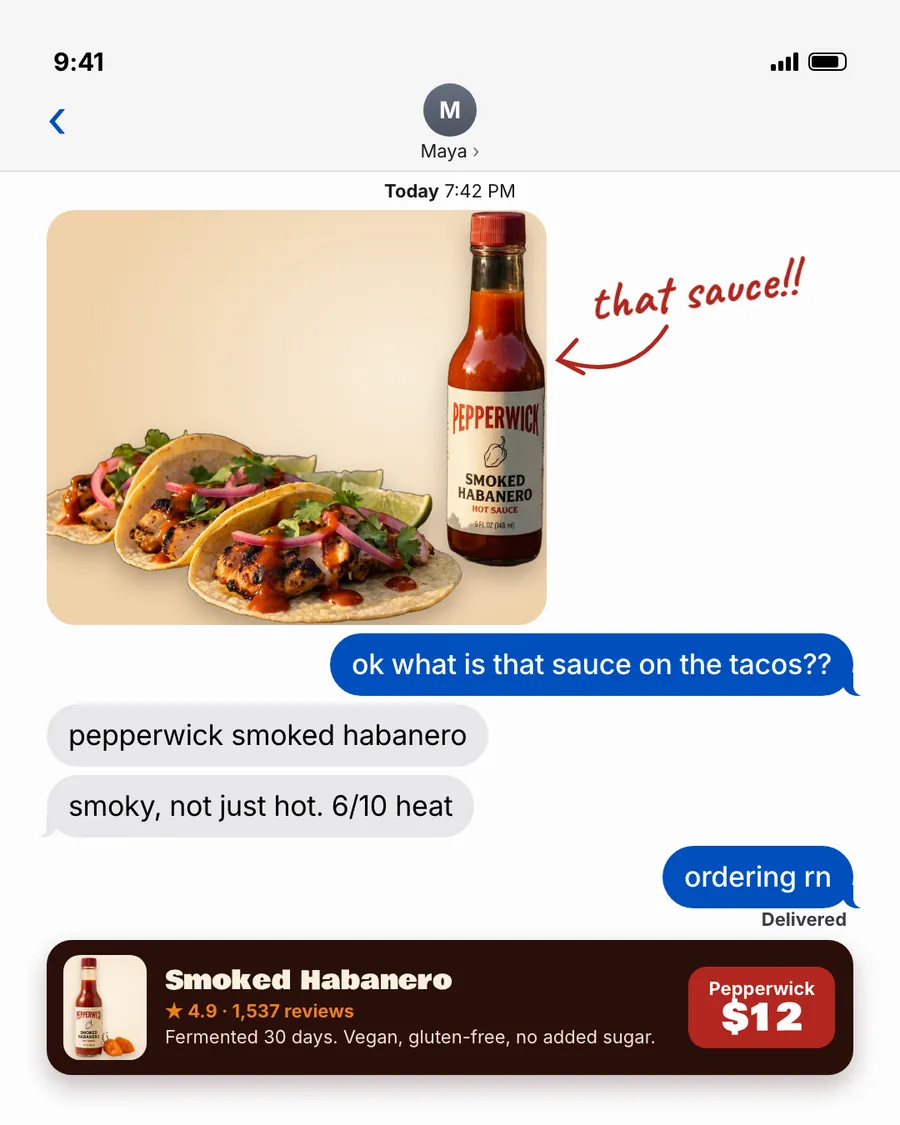
Text threadWord of mouth
Pepperwick: ok what is that sauce on the tacos??
Fictional sample brand · made by our engine
Policy flags for food product ads
Food isn't restricted on Meta or Google, but US labeling rules define many words food brands like to put in ads, and an ad shouldn't say more than the label may.
"Gluten-free"
Under FDA rules, food labeled gluten-free must contain less than 20 parts per million of gluten. The same word in an ad makes the same promise.
Source: FDA: Gluten and food labeling
"Healthy" and "no added sugar"
"Healthy" now requires a food-group minimum and limits on added sugars, sodium and saturated fat under the FDA's updated rule, and "no added sugar" has its own conditions. Most sauces are better off with a specific fact.
Chili and health promises
Lines like "boosts metabolism" are health claims, and the FTC expects competent and reliable scientific evidence for them.
Source: FTC Health Products Compliance Guidance (December 2022)
Allergens
The FDA recognizes nine major food allergens, sesame among them since 2023. Don't call a product allergen-free unless that holds for your whole production line.
How often to refresh food ads, and what to measure
Food ads change with what people are eating. Keep the reason to buy, change the dish around it.
Swap the plated scene with the eating calendar: wings and dips during football season, burgers and grills from late spring, gift sets before the holidays. Within a season, add two or three new ads every two to three weeks on the dish that's winning.
When Meta marks an ad "Creative limited" or "Creative fatigue", its cost per result has climbed above your past ads (fatigue is at twice the cost). Meta suggests a materially different image or video, so change the dish or the scene, not just the headline.
What to measure
- Share of orders that clear free shipping
- If most orders don't, the basket is the problem, not the ad.
- Cost per purchase by dish
- Tells you which meal to build the next ads and pins around.
- Second-flavor orders within 60 days
- The number that decides how much a first order can cost.
- Breakage and refund rate
- Glass that arrives broken turns a profitable order into a loss and a bad review.
Questions about advertising food products
How do I advertise food products online?
Show the product on a dish people already cook, answer the question that stops them on the ad itself, and send them to a bundle that clears free shipping. Start with a few Meta ads in one ad set, then add food creators, Google Shopping and recipe emails.
How do I promote a new food product nobody has heard of?
Lower the risk of tasting something new: a tasting set, customer quotes about flavor, and a clear answer to how hot, sweet or salty it is. Send samples to home cooks and creators for honest first reactions, and use their words in your ads.
How do I advertise a hot sauce business?
Lead with flavor and an honest heat level, show the sauce on real food, and sell a trio or gift set so orders are big enough to ship. Meta is the usual first channel; markets and tastings help you find the words customers use.
How do I advertise hot sauce on Facebook?
Run one Sales campaign with a single ad set and several ads, each built on one dish or one answer, like the heat level or a customer's line about flavor. Use 4:5 and 9:16 images with the bottle readable, and point at the bundle that clears free shipping.
How do I advertise hot sauce on Instagram?
Instagram ads come from the same Meta account, so the plan is the same. Short clips of a pour over eggs or tacos, and creator videos of a first taste, look natural there; keep the bottle and the heat level visible in every one.
How do I advertise my hot sauce locally?
Target a radius around your town in Meta ads, mention where you sell in person, and show up at markets and local shops with tastings. Local buyers also become your first reviews, which make the online ads more convincing.
How do I advertise snacks on social media?
Snacks sell on texture and a moment: the crunch, the desk drawer, the road trip. Show the bag open, give one fact from the label, and sell a multi-pack, because a single bag rarely covers the cost of the ad and the shipping.
How much should a small food brand spend on ads?
Multiply your typical order value by the margin left after ingredients, packaging, shipping and fees; that's the most a first order can cost. Meta's learning phase usually needs about 50 purchases a week at that cost, so many small brands start lower and optimize for add to cart.
How do I promote a food product with a small budget?
Put the money where it's cheapest first: a clear product page, a bundle that clears shipping, recipe emails to past buyers and samples to a few creators. Then run a handful of Meta ads and keep only the dish that sells.
Should I sell hot sauce on Amazon?
Only once your own store works. Glass bottles cost a lot to ship and store, fees take a large share of a $12 sale, and Amazon buyers don't join your email list, so the second flavor is harder to sell.
Get the ads for this plan
Paste your store link and get 3 free ads of your own food products: we read your products, prices and reviews, design around your real product photo and check every fact against your store.
Where to go next
- Food product ad ideasSeven sample ads for a small-batch hot sauce: appetite, heat level, ingredients, and the food words the FDA defines.
- FoodSauce, snack and pantry ads built on appetite, ingredient facts and the bundle that makes the order worth it.
- How to advertise chocolateA plan for a small chocolate maker: ads timed to gift dates, a sampler as the first order, and a summer plan for the heat.
- How to advertise drinksA plan for a drink brand selling cases online: a trial-sized first order, Meta and TikTok first, and a budget that survives shipping weight.
- How to advertise giftsA plan for gift boxes and personalized gifts: ads for the giver, built backwards from each order-by date, with a budget for gift peaks.
- Ad creative testing on a small budget: an honest guideOne ad is a bet; fifty ads is a spray. Here is the middle path for small budgets: a few angles that disagree with each other, enough spend to read them, and a weekly loop that builds on what works.
- PricingFree preview, Starter $49/month, weekly plans from $99/month with a 7-day free trial, 30-day money-back guarantee.
Sources
Platform rules on this page were checked on against:
- Meta Business Help Center: About the learning phase
- Meta Business Help Center: About learning limited
- Meta Business Help Center: About creative fatigue recommendations in Ads Manager
- FDA: Gluten and food labeling
- FDA: Use of the "healthy" claim on food labeling
- eCFR: 21 CFR 101.60, nutrient content claims for the calorie content of foods
- FDA: Sesame added as a major food allergen
- FTC Health Products Compliance Guidance (December 2022)
- FTC Guides Against Deceptive Pricing, 16 CFR 233.1 (former price comparisons)
- 3 free ads when your spot opens
- Starter $49/month
- Growth $99/month, 7-day free trial
- Pro $149 · Scale $199
- 30-day money-back guarantee