how to advertise lashes
How to advertise lashes when the buyer's first question is "can I do this myself?"
A lash kit is a small purchase with a big doubt attached: will I manage to put these on, and will they stay? Ads that answer that doubt on video sell; ads that only show a perfect eye get likes. This plan is for a brand selling lash products online, led by tutorials, built on refills, and careful with every word near the eye. The numbers are Lumiwisp's, a fictional DIY lash cluster brand.
Updated · Budgets and examples use a fictional brand's numbers. Use yours.
In short
How do you advertise lashes you sell online?
Lead with short tutorial videos that show a real person applying the lashes start to finish, run them as Meta ads in Stories and Reels, and add creators who use the kit on camera. Sell the kit with its remover past the free shipping line, then sell refills by email. Never claim lashes grow or strengthen.
StoreToAds makes ready-to-post ads from your product photo, free to try.
At a glance
- The doubt to answer
- Can I apply these myself, and will they stay on?
- Where to start
- Meta Stories and Reels, with real application videos
- The order to aim for
- The kit plus remover, just past the free shipping line
- Where the margin is
- Refill clusters and bond, bought again and again
- The claim to drop
- Anything about growing or strengthening natural lashes
Which channels fit lashes, in the order to try them
Lashes are bought on proof that the look is reachable at home. The channels below are ranked for a brand selling kits and refills from its own store, not for a salon.
- 01
Meta (Instagram first)
Start hereWhy it fits
Beauty buyers already watch application videos in Stories and Reels, and Meta's broad delivery finds them without interest targeting. A 20-second clip from bare lashes to finished look answers the main doubt better than any headline.
The trade-off
Close-up eye shots are judged closely, and comparison shots of a before and after need an 18+ audience. Early sales cost more until the ad set leaves learning.
- 02
Creators and tutorials
Add nextWhy it fits
A creator with a similar eye shape doing the kit on camera is the strongest proof a lash brand can get, and the footage can run as an ad with their permission.
The trade-off
Gifted kits are a material connection the creator must disclose clearly, and whatever they say about the product becomes your claim. Brief them before they film.
- 03
Email and SMS
Add nextWhy it fits
Clusters and bond get used up, and a buyer who learned the technique wants the same kit again. Refill reminders are where a lash brand's margin comes from.
The trade-off
Only past buyers and subscribers see it. SMS needs explicit permission to text.
- 04
TikTok
Add laterWhy it fits
DIY beauty tutorials and get-ready-with-me clips are native there, and the creator footage you already have can be trimmed for it.
The trade-off
TikTok bars medical claims and exaggerated performance promises in cosmetic ads, and it wants new video often. Start once you have a steady supply of clips.
- 05
Amazon
Only if it fitsWhy it fits
Many shoppers search for lash clusters where they buy everything else and compare reviews right there.
The trade-off
You sit beside many cheap kits on price, and the refill order, which is where the margin is, becomes Amazon's customer rather than yours.
- 06
Google Shopping
Skip for nowWhy it fits
Searches like "diy lash clusters kit" do happen, and a Shopping ad shows the kit and price.
The trade-off
Lash buyers decide on video, not on a product thumbnail. Come back once Meta (Facebook and Instagram) and email are working.
Selling lash products or lash appointments?
Some of the searches here, like "how to advertise lash extensions", come from lash techs selling appointments. That is a different plan, and it is worth being honest about which one you need:
| Question | A lash product brand | A lash tech or studio |
|---|---|---|
| What you sell | Kits, refills and tools, shipped anywhere | Appointments in one place |
| Who you reach | Anyone in the country who buys online | People within a short drive |
| Main channels | Meta, creators, email | Local search listing, Instagram, rebooking |
| The number to watch | Refill orders per buyer | Rebooking rate per client |
This page plans the first column. If you run a studio, the angles and claims sections still apply, but spend on local reach and on getting each client to book the next fill before they leave.
Your first 30 days advertising lashes
Spend the first days on footage. A lash ad without a real application video is guessing at the one thing buyers want to see.
Days 1 to 4
Film three real application videos
Film yourself or a friend applying the kit in natural light, start to finish, in one take if you can. Keep the time on screen honest. Add one clip of removal, since that's the second worry people have.
Days 5 to 7
Settle the claims and the product page
List what you can back: what's in the kit, the lengths, how long wear lasts, how many times a cluster can be reused, the adhesive's ingredients. Cut anything about lash growth or eye health. Put the ingredient list and removal steps on the product page.
Days 8 to 14
Launch 6 ads, video first
Three application videos, one kit contents ad, one ad on how long wear lasts, one built on a customer's words. One Sales campaign, broad audience, 9:16 first and 4:5 second, and no edits for a week.
Days 15 to 22
Seed five to ten creators
Send kits to small creators whose followers buy beauty online, ask for an honest tutorial, and agree up front that you may run the video as an ad. Remind them to disclose the gift clearly.
Days 23 to 30
Turn on refills and run the best creator clip
Set an email for when a kit should be running low, offering refill clusters and bond. Put the best creator video into the ad set alongside your winning clip, and pause the weakest ads.
How to size a starting budget for lash ads
Lash kits are light and cheap to ship, which helps, but a $24 kit still leaves only a modest amount. Lumiwisp's free shipping starts at $35, so its typical first order is the kit plus the $12 remover: $36.
| Order value | $36.00 |
|---|---|
| Margin after product cost, shipping and fees | 60% |
| Most a first order can cost to break even | $21.60 |
| 50 purchases a week at that cost | $1,080 a week |
| The same budget per day | about $154 |
Meta says an ad set usually leaves its learning phase after about 50 results in the week after its last significant edit, and recommends a budget large enough to get enough results. Meta Business Help Center: About the learning phase
Few new lash brands start at that level. The levers that matter for lashes:
- Bundle the remover or the bond. A kit on its own sits under the free shipping line. Adding the remover lifts the order and answers the removal worry at the same time.
- Let refills pay, once you can measure them. Refill clusters at $18 and the bond and seal duo at $16 are the repeat purchases. Use your own reorder rate before letting a first order cost more than its margin.
- Use add to cart as the event until sales build. A small budget may never reach 50 purchases a week; a more frequent event gives the ad set something to learn from until it can.
Offers that work for lashes
Lash offers work best when they remove a worry or set up the refill. A discount on the kit alone does neither.
Kit plus remover
It clears Lumiwisp's $35 free shipping line and answers the question new buyers ask right after "how do I put them on": how do I get them off?
Watch: Show what each item costs alone so the bundle price can be checked.
A refill reminder with the price in it
"Refill clusters, $18" in an email to a buyer who has learned the technique is the easiest sale the brand makes.
A party or wedding season push
Lashes are bought for events. A clear order-by date before a holiday party or wedding season gives the ad a deadline that isn't a fake countdown.
Watch: Use your real shipping times, and stop promising delivery once the date has passed.
A refill subscription
Regular wearers use clusters on a rhythm. A standing order with easy skipping keeps them from drifting back to a salon or a cheaper kit.
Watch: Let subscribers skip or cancel in a click, and tell them so before they sign up.
Angles to test for lash ads
Each angle answers one of the doubts that stop a lash purchase. The full set of sample ads, photo notes and copy lines is on Lash ad ideas; here are the angles the plan above tests.
It's doable
About 10 minutes, on your couch, with everything in the box.
It stays
Wear up to 5 days. Through the party and the morning after.
What's in the kit
120 clusters, bond, seal and an applicator. Nothing else to buy.
Value per wear
Reuse each cluster up to 3 times with care.
A customer's words
"Looks like I just got a lash fill, and I did it on my couch."
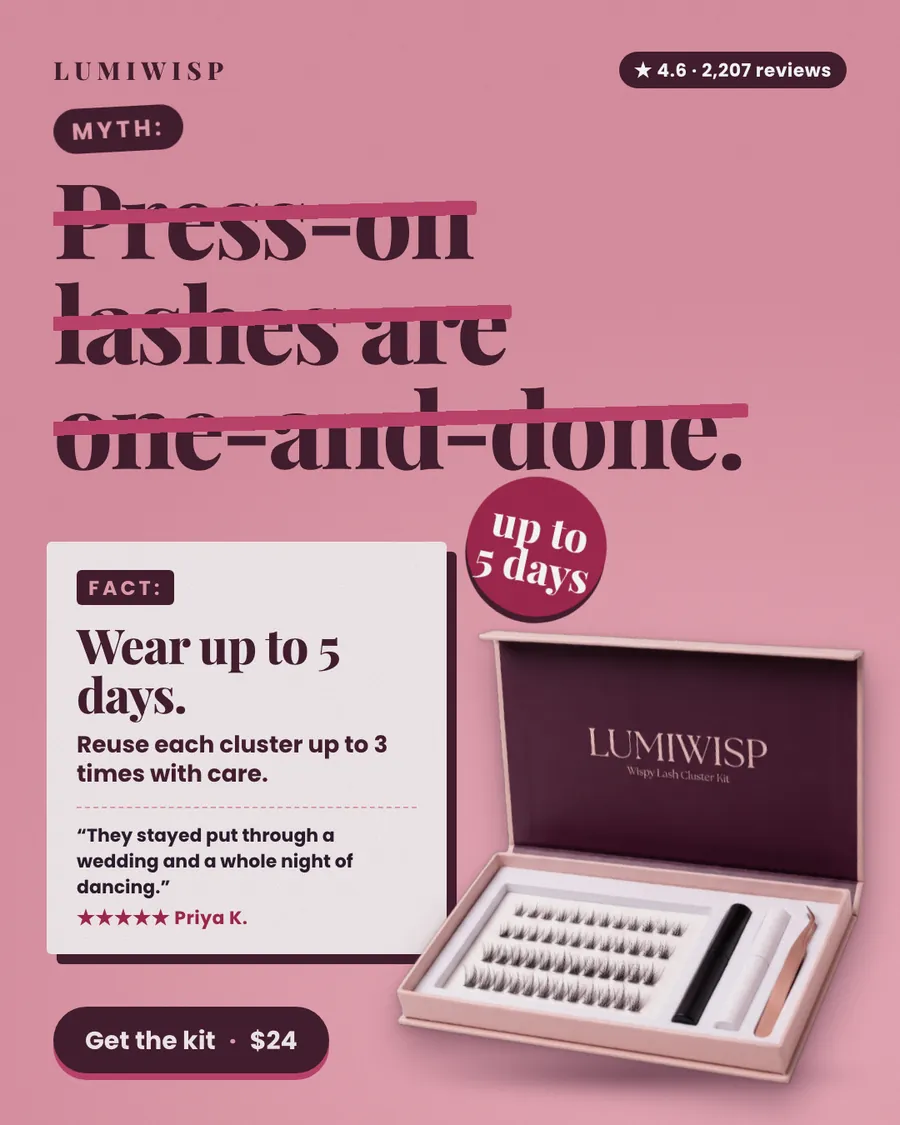
Myth vs factDurability
Lumiwisp: Press-on lashes are one-and-done.
Fictional sample brand · made by our engine
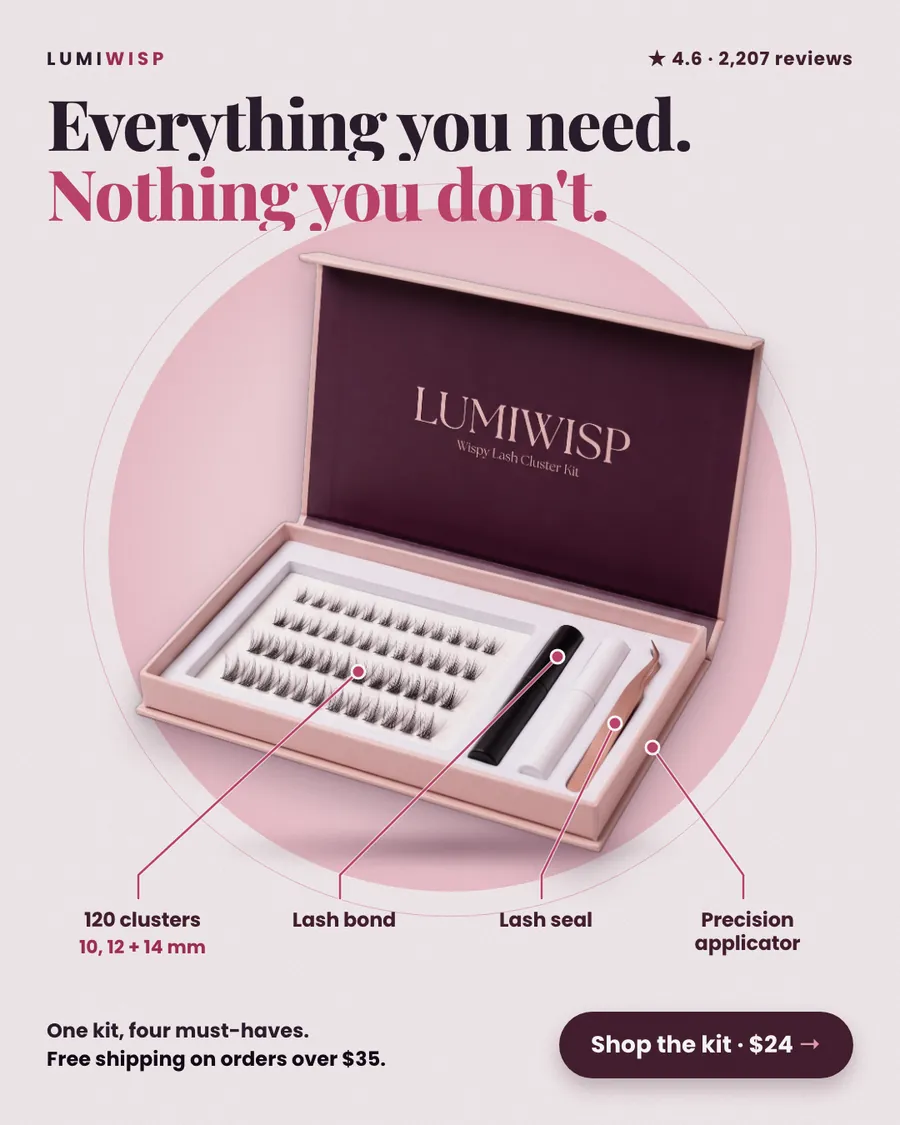
Annotated heroConvenience
Lumiwisp: Everything you need. Nothing you don't.
Fictional sample brand · made by our engine
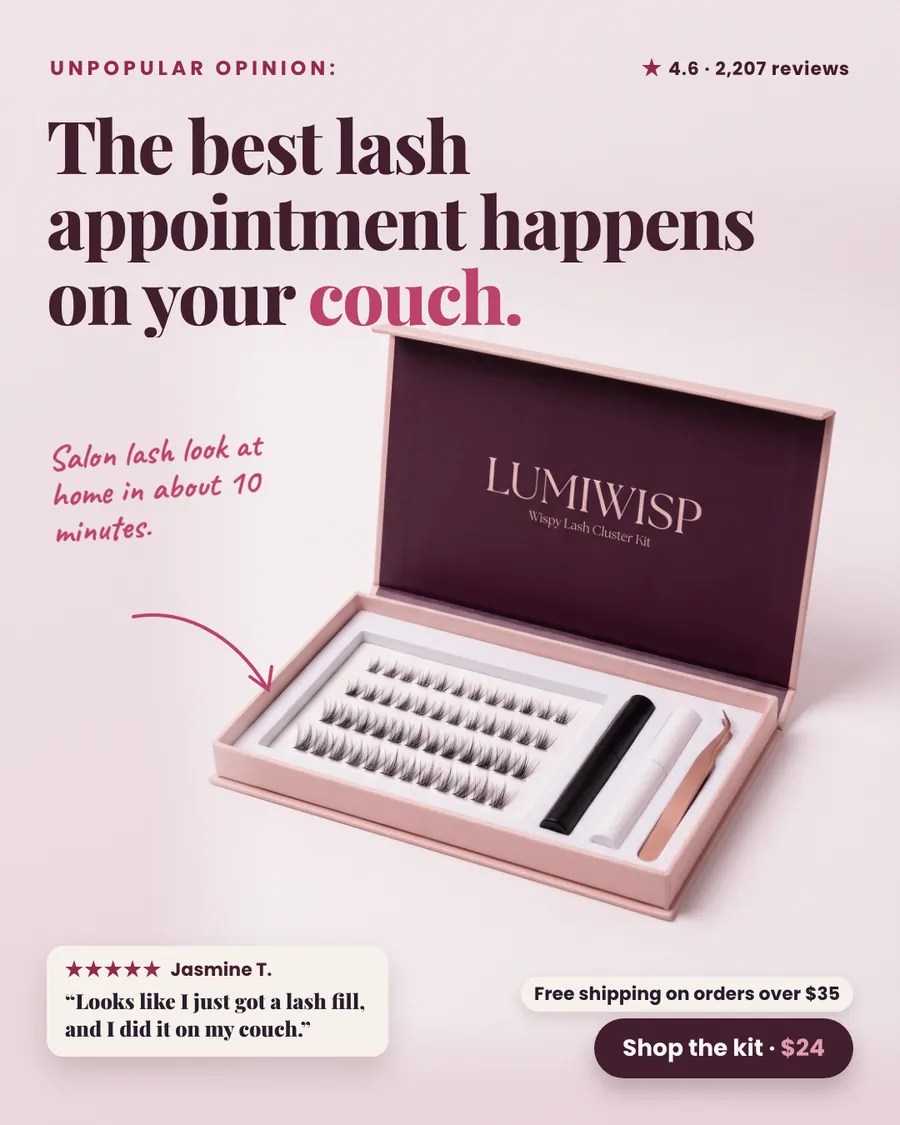
Unpopular opinionConvenience
Lumiwisp: The best lash appointment happens on your couch.
Fictional sample brand · made by our engine
Words to be careful with
Lash products are cosmetics, but they sit close to the eye and close to drug territory. These are the rules that decide how a lash ad can talk and what it can show.
Growing or strengthening natural lashes
The FDA defines drugs as products intended to affect the structure or function of the body, and it gives claims that a product restores hair growth as an example of a drug claim. A cluster kit sells a look; promising longer or stronger natural lashes belongs to drugs.
Source: FDA: Is It a Cosmetic, a Drug, or Both? (Or Is It Soap?)
Adhesives near the eye
The FDA treats false lashes, extensions and their adhesives as cosmetics that must meet safety and labeling rules, and it tells consumers to check adhesive ingredients and stop using a product that irritates. List the bond's ingredients on the page and show application the way your directions say.
Source: FDA: Eye Cosmetic Safety
Before-and-after shots
Meta allows cosmetic before-and-after transformations only in ads aimed at people 18 and over. Its exemption for non-permanent cosmetics names makeup and creams but not lashes, so set comparison ads to 18+.
Lines about the viewer's eyes
Meta bars terms or questions that attack someone's appearance or specific body parts, so "Sparse, thin lashes?" aimed at the viewer is the risky version. Describe the look the kit gives instead.
Wear time, reuse and minutes
Numbers like "up to 5 days", "reusable 3 times" and "about 10 minutes" are objective claims, and the FTC (the US consumer protection agency) expects a reasonable basis for them before the ad runs. Keep the testing or wear trials behind each one.
Source: FTC Policy Statement Regarding Advertising Substantiation
Gifted creators
A free kit is a connection that can affect how much people trust an endorsement, so it must be disclosed clearly and conspicuously in the creator's post and in any ad that uses it.
Source: 16 CFR 255.5: Disclosure of material connections (FTC Endorsement Guides)
Rules checked . The sources are linked at the end of this page.
How often to refresh lash ads, and what to measure
Video ads wear out faster than still images, and lash audiences see a lot of tutorials. A steady supply of new application clips matters more than clever editing.
Plan two or three new videos every two weeks while testing, ideally on different eye shapes and in different light. Creator clips count as new creative, which is one more reason to keep seeding kits.
Watch the Delivery column. Meta shows "Creative limited" when an ad costs more per result than your past ads and "Creative fatigue" at twice the cost or more. Its fix is a materially different image or video, so film a new person or a new event look rather than recutting the same clip.
What to measure
- Cost per purchase, by video
- Tells you which kind of tutorial sells: speed, staying power or the finished look.
- Share of orders with the remover or bond
- Shows whether the bundle is visible enough to lift first orders past the free shipping line.
- Refill orders per buyer at 60 and 90 days
- The number that sets how much you can afford to pay for a new customer.
- Questions in comments
- Lash commenters ask about removal, sensitivity and eye shapes. Each repeated question is the next ad to make.
Questions about advertising lashes
How do I start advertising lashes I sell online?
Film real application videos first, write a claims list without growth or eye-health promises, then run six Meta ads in Stories and Reels for a week without edits. Add creator tutorials next and a refill email once the first orders arrive.
How do I promote a lash business that sells products, not appointments?
Treat it like any online beauty brand: video proof that the look is doable at home, a kit priced past your free shipping line, and refills by email. Local tactics like salon listings don't help much when your buyers are spread across the country.
How should a lash tech advertise extensions?
Locally. Most clients come from nearby, so a local search listing, an Instagram feed of your own work and a habit of booking the next fill before each client leaves matter more than national ads. The claims rules on this page still apply to anything you post.
How much should a lash brand spend on ads?
Multiply a typical order by the margin left after product, packaging, shipping and fees. That figure is your ceiling for a new customer. About 50 purchases a week is what Meta's learning phase (Facebook's first days of testing who to show the ad to) looks for, so most lash brands start lower and grow spend as refills prove themselves.
Is Instagram or TikTok better for lash ads?
Start with Instagram through Meta's ad account, because Stories and Reels let you run application videos to buyers without much setup. Add TikTok once you have a steady stream of creator clips, since it wants new video often and bars medical claims in cosmetic ads.
Should I send free kits to beauty creators?
Yes, it's one of the best sources of proof for lashes. Pick small creators whose followers buy beauty online, ask for an honest tutorial, get permission to run it as an ad, and make sure they disclose the free kit clearly.
How do I get lash customers to reorder?
Make refills easy to find and state their price, send a reminder when a kit should be running low, and offer a subscription with simple skipping. Someone who has learned the technique is far more likely to buy again than a new visitor.
Can I run before-and-after lash ads?
On Meta, before-and-after cosmetic transformations can only be shown to people 18 and over. The comparison should show the lashes, not a promise about natural lash growth, and the photos should be real and unretouched on the lashes themselves.
When should a lash brand spend the most on ads?
Around events: holiday parties, New Year's Eve, wedding season and proms, plus Black Friday, November 27, 2026, for kit bundles. Put a real order-by date in event ads so buyers know it will arrive in time.
Do I need to sell lashes on Amazon?
No. Amazon adds reach, but it puts you beside many cheap kits and keeps the refill customer for itself. Most small lash brands do better building their own store and email list first, and adding Amazon later if it fits.
Get the ads for this plan
Paste your store link and get 3 free ads of your own lashes: we read your products, prices and reviews, design around your real product photo and check every fact against your store.
Where to go next
- Lash ad ideasSeven sample ads for a DIY lash cluster kit, the doubts each one answers, eye close-ups that pass, and claims to skip.
- Beauty productsAds for body care, beauty tools and gift sets that show the product and keep claims to your label.
- How to advertise makeupA shade-first plan for a small makeup brand: video swatches on Meta and TikTok, one shade per ad, add-ons that clear free shipping.
- How to advertise press-on nailsA plan for a small press-on nail brand: short video first, a sizing offer that removes the big worry, then paid ads on the clips that already work.
- How to advertise skincare productsA plan for a one-hero skincare brand: claims written before the first ad, Meta and a routine email first, then creators and Shopping.
- Instagram Reels (9:16)9:16 image ads and 7-second motion versions for Reels, laid out for its busy bottom edge.
- Black Friday ad ideasThe 2026 dates, six Black Friday offers and the products they suit, copy lines, and 16 sample ads for four stores.
- Ad creative testing on a small budget: an honest guideOne ad is a bet; fifty ads is a spray. Here is the middle path for small budgets: a few angles that disagree with each other, enough spend to read them, and a weekly loop that builds on what works.
- PricingFree preview, Lite $29/month for 9 designs a month (optional 2 weekly), Starter $49/month for 20. Meta and a 7-day trial from Growth.
Sources
Platform rules on this page were checked on against:
- FDA: Is It a Cosmetic, a Drug, or Both? (Or Is It Soap?)
- FDA: Eye Cosmetic Safety
- Meta Advertising Standards: Health and Wellness
- FTC Policy Statement Regarding Advertising Substantiation
- 16 CFR 255.5: Disclosure of material connections (FTC Endorsement Guides)
- TikTok Advertising Policies: Healthcare and Pharmaceuticals
- Meta Business Help Center: About the learning phase
- Meta Business Help Center: About creative fatigue recommendations in Ads Manager
- 3 free ads, no signup
- Lite $29/month · 9 designs a month · optional 2 weekly
- Starter $49/month · 20 designs
- Growth $99/month, 7-day free trial
- Pro $149 · Scale $199
- 30-day money-back guarantee