how to advertise makeup on social media
How to advertise makeup when the shade is the whole sale
Makeup has a problem skincare doesn't: the buyer chooses a color on a screen that changes colors. So a makeup ad plan is mostly a plan for showing shades honestly and helping people pick one. This one is built for a small brand with a lip product and a handful of shades, using the numbers of Rosequill, a fictional lip and cheek tint brand.
Updated · Budgets and examples use a fictional brand's numbers. Use yours.
In short
How do you advertise makeup as a small brand?
Start with short video and feed ads on Meta and TikTok that show one shade on real skin in daylight, named, with the finish and price. Test shades as separate ads, send buyers to a shade guide, and grow the order with a liner or second shade. Keep the copy about the product, never the face.
At a glance
- What decides it
- The shade, seen on skin like the buyer's
- Where to start
- Meta and TikTok video, one shade per ad
- Order value lever
- A matching liner or a second shade
- The rule that bites
- Nothing that implies the viewer's face needs fixing
- Hidden cost
- Wrong-shade returns, which honest swatches reduce
Which channels fit makeup, in the order to try them
Makeup sells on proof of color, and moving pictures prove color better than stills. That puts the short-video placements first and the search channels later, once people know your shade names.
- 01
Meta (Instagram Reels, Stories and feed)
Start hereWhy it fits
Instagram is where many makeup buyers compare swatches, and its Reels and Stories placements take the 9:16 swatch videos lip products sell with. Purchase tracking from a store is mature there, so Meta can optimize for sales early.
The trade-off
Still images flatten color, and a swatch photo looks different on every phone. Plan on video, or on several skin tones in each static ad.
- 02
TikTok
Start hereWhy it fits
Lip products fit a ten-second clip: one swipe, then two, then the coffee cup. Creator-style videos there often decide which shade someone orders.
The trade-off
It runs on fresh video, several clips a week. TikTok also bars medical claims in cosmetic ads, so a line like "heals dry lips" stays out.
- 03
Creators with different skin tones
Add nextWhy it fits
"Will this shade work on me?" is the question your own photos can't fully answer. Three creators wearing the same shade answer it better than any copy.
The trade-off
Gifted posts need a clear disclosure, running them as ads needs the creator's permission, and some creators never post.
- 04
Email and SMS
Add nextWhy it fits
A buyer who likes one shade is the likeliest buyer of the second. New shades should go to past buyers before they go to ads.
The trade-off
It needs a list first, and SMS needs explicit opt-in consent.
- 05
Google Shopping
Add laterWhy it fits
Searches like "matte lip tint" or a shade description catch people already shopping for the product type.
The trade-off
Generic makeup searches are full of big beauty retailers, and a new brand gets few searches for its own name at first.
- 06
Pinterest
Only if it fitsWhy it fits
Planned looks live there: wedding makeup, holiday looks, a palette for a trip.
The trade-off
Pinterest's guidelines reject low-quality user content such as selfies and screenshots, and images packed with fonts. Only polished pins get through.
Your first 30 days advertising makeup
Most of the month's work happens before the first ad: a consistent shade library. After that, the ads are simple and the decisions are about shades.
Week 0
Shoot every shade the same way
One daylight setup. Swatch every shade on paper and on at least three skin tones, and film a 5 to 10 second clip of one swipe and two. This library feeds every ad for the month, so finish it before launching anything.
Days 1 to 7
Launch shade by shade
Pick your three most-bought shades. Make two ads per shade (a video swatch and a static with the shade name and price) and one ad with the whole range. One campaign, one ad set, broad audience; let delivery decide who sees which shade.
Days 8 to 14
Read the comments as research
Makeup comments are a free survey: "what shade is she wearing?", "does it transfer?". Answer them, and note the questions that come up twice. They are next week's ads.
Days 15 to 21
Add the second shade and the add-on
Turn the most-asked question into an ad. Test a two-shade or tint-and-liner offer against the single tube, and send gifted product in the two leading shades to creators with different skin tones.
Days 22 to 30
Decide which shades get the budget
Keep advertising the shades whose cost per purchase sits under break-even, rest the others (in ads, not in the store), and move the strongest creator clip into an ad with permission.
One ad per shade, a range ad, or a shade finder?
How many shades to put in front of new people is the first structural decision in makeup advertising. A rough guide:
| Format | Use it when | Watch out for |
|---|---|---|
| One ad per shade | You have three to six shades and a clear best seller | Too many shade ads in one ad set spread a small budget thin |
| Range ad, every shade in one image | People haven't picked yet; it works as the catch-all | Each shade gets small, so name every one |
| Carousel, one shade per card | You want to see which shade draws the clicks | The first card does most of the work; lead with the best seller |
| Shade finder landing page | Your range is wider than six shades | The ad should still show a shade, not a quiz |
How to size a starting budget for makeup ads
Lip products are cheap, so the ad cost per order has very little room. Rosequill's free shipping starts at $35, which makes the common first order the $22 tint plus the $16 lip liner.
| Order value | $38.00 |
|---|---|
| Margin after product cost, shipping and fees | 58% |
| Most a first order can cost to break even | $22.04 |
| 50 purchases a week at that cost | $1,102 a week |
| The same budget per day | about $157 |
Meta says an ad set usually leaves its learning phase after about 50 results in the week after its last significant edit, and recommends a budget large enough to get enough results. Meta Business Help Center: About the learning phase
For a $22 product, that's the whole challenge: the first order leaves little for the ad. The makeup-specific ways through it:
- Build the basket around the shade. A liner in the matching shade, or a second shade at a set price, is an add-on buyers understand. It lifts the order value your break-even starts from without discounting the tint.
- Judge shades, not just ads. If one shade sells at half the cost of another, give its ads more of the budget and keep the rest inside the range ad.
- Start on add to cart if purchases are thin. Meta suggests a more frequent optimization event for ad sets that can't reach enough results; switch to purchases when they pick up.
- Count repeat shades from your own numbers. Use your real 90-day repeat rate before letting a first order cost more than its margin.
Wrong-shade returns eat margin quietly. Every ad that shows the shade on several skin tones is also working on that number.
Offers that work for makeup
The best makeup offers take the risk out of picking a color, or make the second item feel obvious. Sitewide percentage sales often just discount buyers who were going to buy anyway.
Tint and matching liner
It answers "what goes with it?" and clears the free shipping line in one click.
A shade duo at a set price
Undecided buyers pick two instead of none, and the duos people choose tell you which shades sell together.
A one-time shade exchange
Fear of the wrong shade is the main reason not to buy color online, and an exchange removes it.
Watch: Write the conditions plainly, and budget for units you can't resell.
The free shipping line, in the ad
"Free shipping over $35" next to a $22 price makes adding a liner feel like the smarter move.
Angles to test for makeup ads
Each ad should prove one thing about the color or the formula. The sample ads, the finish-word table and copy lines are on Makeup ad ideas.
One swipe, then two
A stain at 8 am. Full color by dinner.
The shade on three skin tones
Fig on fair, medium and deep skin.
The day test
On at breakfast. Still there after lunch.
Two jobs, one tube
Lips at 8:00. Cheeks at 8:01.
The matte worry
Matte that doesn't pull. Squalane is why.
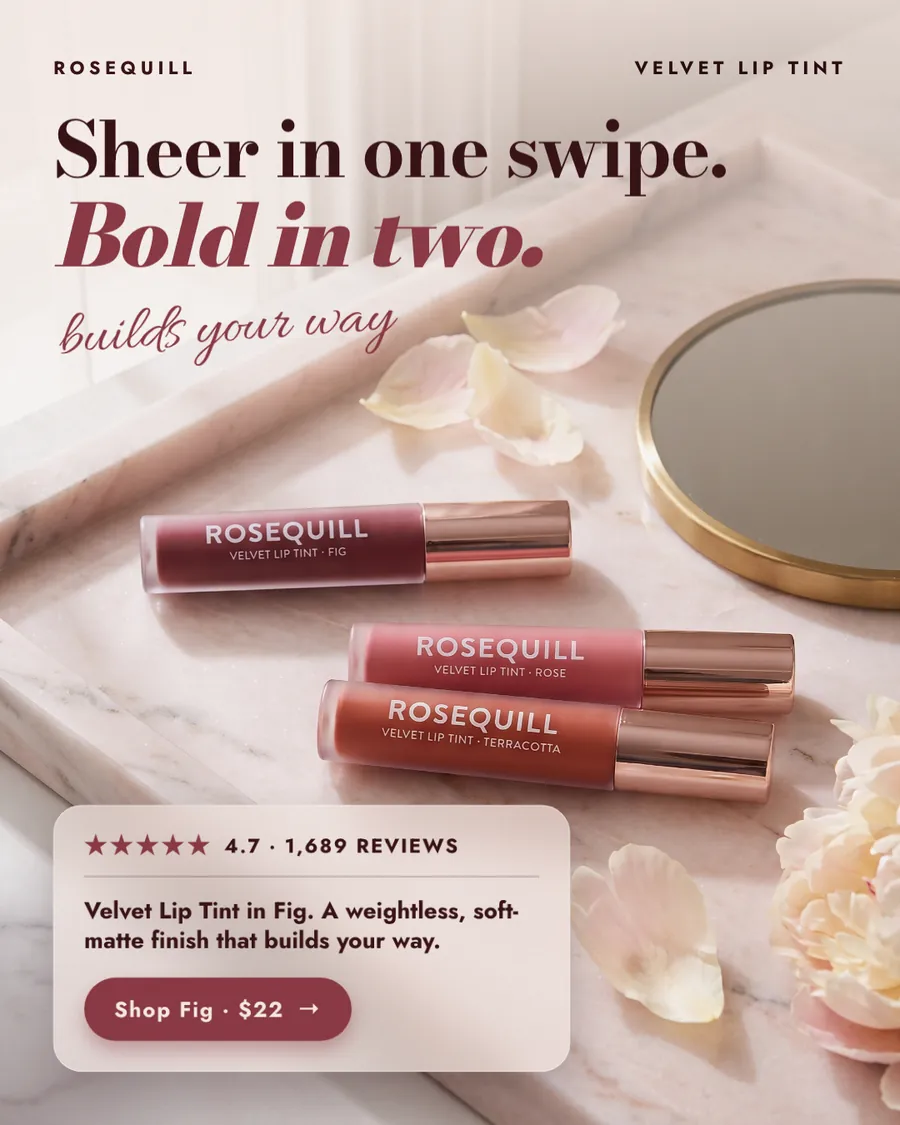
Lifestyle typeBenefit
Rosequill: Sheer in one swipe. Bold in two.
Fictional sample brand · made by our engine
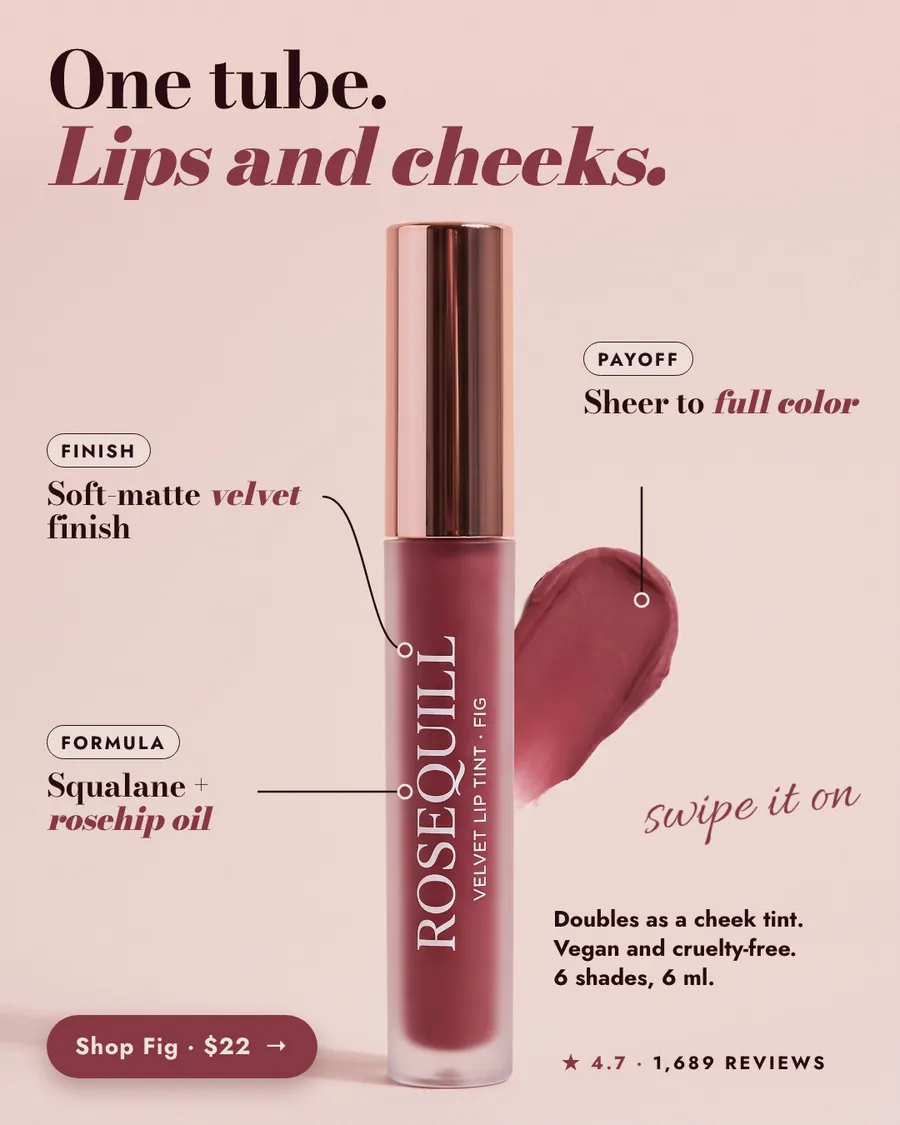
Annotated heroBenefit
Rosequill: One tube. Lips and cheeks.
Fictional sample brand · made by our engine
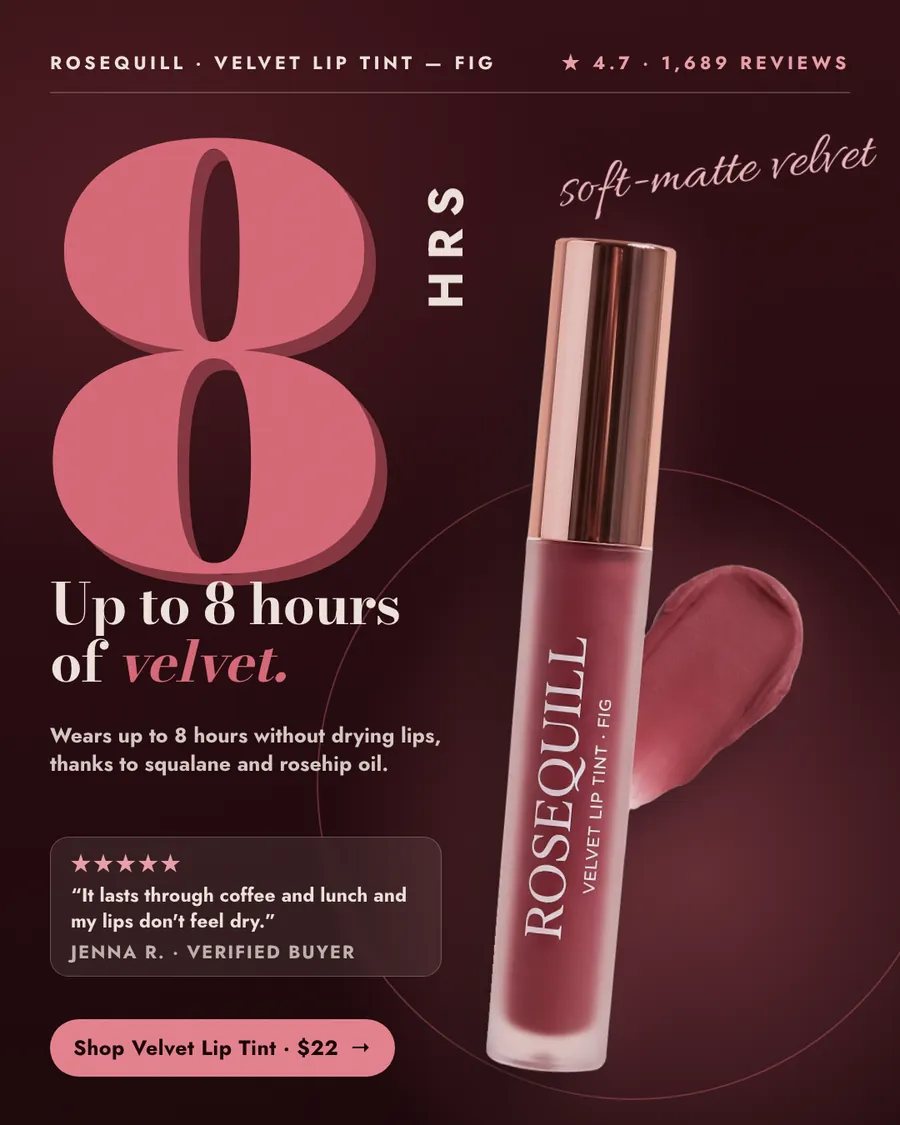
Big numberBenefit
Rosequill: Up to 8 hours of velvet.
Fictional sample brand · made by our engine
Policy flags for makeup ads
Makeup is a non-permanent cosmetic, so most of it runs freely. These are the lines that catch it, on the platforms and in the law.
Comments about the face
Meta bars cosmetic ads with negative statements about someone's appearance or body parts, and ads that imply personal attributes. "Thin lips?" does both; "Sheer to full in two swipes" does neither.
Eye-area use
The FDA lists which color additives are permitted near the eyes, and several common reds are not. Advertise only the uses your formula is made and permitted for.
Wear and transfer claims
"Up to 8 hours" and "transfer-proof" are objective claims, and the FTC expects a reasonable basis, such as your own testing, before the ad runs.
Source: FTC Policy Statement Regarding Advertising Substantiation
TikTok's cosmetics rule
TikTok doesn't allow medical claims or exaggerated performance promises in cosmetic and beauty ads.
Source: TikTok Advertising Policies: Healthcare and Pharmaceuticals
Gifted creator posts
A gifted post is an endorsement under the FTC Guides and needs a clear disclosure. Running it as your ad is a separate permission to get from the creator.
"Cruelty-free" and "vegan"
The FDA notes that "cruelty-free" has no legal definition, so back it with a certification or written supplier statements.
How often to refresh makeup ads, and what to measure
Makeup hands you fresh creative for free: every shade, every skin tone and every season is a new ad without a new concept.
Rotate before you reinvent. When a shade ad slows, the same layout with another shade or another skin tone is often enough of a change. Plan a genuinely new concept about once a month, and new shade or skin-tone versions every week or two.
Meta flags "Creative fatigue" when an ad costs twice as much per result as your past ads, and recommends a materially different image or video. Swapping a still for a video swatch is that kind of change; a new headline on the same photo isn't.
What to measure
- Cost per purchase by shade
- Tells you which shades deserve their own ads and which belong in the range ad.
- Wrong-shade return rate
- If it climbs, the swatches in your ads aren't matching what arrives. Check the lighting first.
- How long people watch
- The share of viewers who stay past the first swipe. If they leave before the color shows, the opening is too slow.
- Order value with add-ons
- Shows whether the liner and duo offers are doing their job for your break-even.
Questions about advertising makeup
How do I advertise makeup on social media?
Lead with short videos that show one shade on real skin in daylight, name it, and give the finish and price. Run them on Meta and TikTok in 9:16 and 4:5, test each shade as its own ad, and answer comment questions, since they show what the next ads should prove.
How do I advertise lipstick on Instagram?
Use Reels and Stories for swatch videos and the feed for a clear static with the shade name, finish and price. Keep beauty filters off so the color matches what arrives, show the shade on more than one skin tone, and send people to the exact shade page rather than the whole shop.
How do I advertise lipstick on TikTok?
Film the product in one take: bare lips, one swipe, two swipes, then a real-life test like a coffee cup. Gifting creators with different skin tones often gives better ad footage than producing your own, and TikTok's policy keeps medical claims out of cosmetic ads.
How do I advertise lipstick on Facebook?
Facebook ads run from the same Meta ad account as Instagram, so the same shade-led videos and statics work. The Facebook feed is a good place to test clear statics with the shade, the finish, a review and the price alongside the videos.
How do I start advertising a small makeup business?
Shoot a consistent shade library first, then launch two ads for each of your three most-bought shades in one Meta campaign. Track purchases, leave the ads alone for a week, and use the results to pick which shades get more budget and which become part of a range ad.
How do I promote a new lipstick shade?
Send it to past buyers by email before ads, with a swatch on several skin tones. Then add a new shade ad to your existing campaign rather than starting a new one, and pair it with a shade you already know sells, as a duo, to give it a familiar anchor.
How much should I spend on makeup ads?
Begin with the break-even cost of a first order: the tint plus whatever buyers add, times the margin you keep after costs. Fifty of those a week is roughly what Meta's learning phase asks for. Small lip brands usually begin below that, judge shades on add to cart, and raise spend as purchases come in.
Should makeup ads show models or just swatches?
Both, for different jobs. Swatches on paper and arms prove the true color; cropped lips and cheeks show how it wears. Full faces add little for a single lip product and can drift into appearance claims, so keep the focus on the product.
Do I need influencers to advertise makeup?
Not to start, but creators with different skin tones solve the shade question faster than anything else. Gifting product to a dozen small creators and asking to use their clips as ads is a common first step. Their posts need a clear disclosure.
How do I advertise myself as a makeup artist?
That is a local service, not a product, so it needs different proof: real photos of your work with clients' permission, what a booking includes, your area and your starting price. This page covers advertising makeup products sold online.
Get the ads for this plan
Paste your store link and get 3 free ads of your own makeup: we read your products, prices and reviews, design around your real product photo and check every fact against your store.
Where to go next
- Makeup ad ideasSeven sample ads for a lip and cheek tint, how to prove shade, finish and wear, and the color and "clean" claims to watch.
- MakeupLipstick, foundation and palette ads that lead with the shade, the finish and real reviews.
- How to advertise skincare productsA plan for a one-hero skincare brand: claims written before the first ad, Meta and a routine email first, then creators and Shopping.
- How to advertise press-on nailsA plan for a small press-on nail brand: short video first, a sizing offer that removes the big worry, then paid ads on the clips that already work.
- How to advertise perfumeA plan for a small fragrance brand: sell a sample or discovery set first, follow up by email, and size the budget from the full bottle.
- Instagram Reels (9:16)9:16 image ads and 7-second motion versions for Reels, laid out for its busy bottom edge.
- Static ads vs video ads: what to run firstThe honest answer isn't a winner. It's an order: use cheap static ads to find the reason people buy, then put video money behind the reasons that already work.
- PricingFree preview, Starter $49/month, weekly plans from $99/month with a 7-day free trial, 30-day money-back guarantee.
Sources
Platform rules on this page were checked on against:
- Meta Advertising Standards: Privacy Violations and Personal Attributes
- Meta Advertising Standards: Health and Wellness
- FDA: Color Additives Permitted for Use in Cosmetics
- FTC Policy Statement Regarding Advertising Substantiation
- TikTok Advertising Policies: Healthcare and Pharmaceuticals
- FTC Endorsement Guides, 16 CFR 255
- Pinterest Advertising Guidelines
- Meta Business Help Center: About learning limited
- Meta Business Help Center: About creative fatigue recommendations in Ads Manager
- 3 free ads when your spot opens
- Starter $49/month
- Growth $99/month, 7-day free trial
- Pro $149 · Scale $199
- 30-day money-back guarantee