how to advertise clothing brand
How to advertise a clothing brand without burning the budget on returns
Clothes are easy to make ads for and hard to sell through a screen. Everyone has a camera and a body to show the fit on, but the shopper still can't touch the fabric, and every wrong size comes back at your cost. This plan starts with one hero product, proves fit before style, and counts returns before it counts sales. The numbers are Oatfield Supply's, a fictional heavyweight tee brand.
Updated · Budgets and examples use a fictional brand's numbers. Use yours.
In short
How do you advertise a small clothing brand?
Pick one hero piece and run Meta ads that each settle one doubt: fit on a real body, fabric weight, how it washes, how easy returns are. Count returns in your margin before you set a budget, collect emails for drops and restocks, and add creators for try-on proof once a few ads earn sales.
At a glance
- The real doubt
- Will it fit me, and will it still look like this after a wash?
- Where to start
- Meta ads on one hero product, not the whole catalog
- Hidden cost
- Returns. Take them out of your margin before you set a budget.
- The rule that bites
- Fiber, origin and organic words have to match the label
- New ads
- With every drop or new color, and a fresh fit angle every few weeks
Which channels fit a clothing brand, in the order to try them
Clothing is bought on sight and returned on fit. The channels that work early are the ones where you can show the garment moving on a person, then bring the same people back when a new color drops.
- 01
Meta (Facebook and Instagram)
Start hereWhy it fits
A 4:5 feed ad and a 9:16 Reel can show the cut on a body, the fabric up close and the price in one scroll. Broad targeting is fine: a boxy heavyweight tee attracts the people who wear boxy heavyweight tees.
The trade-off
You share the feed with fashion brands that spend more in a day than you will in a month, so one polished photo won't carry it. Expect to need several ads, each answering a different doubt.
- 02
Email and SMS
Start hereWhy it fits
Clothing gives people reasons to come back that other products don't: new colors, restocks, a drop next Thursday. A "your size is back" email is one of the few messages shoppers ask to receive.
The trade-off
The list starts empty, so it grows only as fast as your ads and your site bring people in. Texts need opt-in consent.
- 03
Creators and try-on
Add nextWhy it fits
Fit proof is more convincing on several bodies than on one model. Ten creators of different heights and sizes wearing the same tee answer the question your size chart can't.
The trade-off
Gifted posts need a clear disclosure, and you need permission before running a creator's video as your ad. A creator whose build is nothing like your buyers' can mislead more than help.
- 04
Google Shopping
Add nextWhy it fits
Some shoppers search exactly: "heavyweight tee", "boxy white t-shirt", "organic cotton crew neck". Shopping ads put the photo, colors and price on that search.
The trade-off
Every color and size needs to be a clean variant in your product feed, and basics compete hard on price next to big retailers.
- 05
TikTok
Add laterWhy it fits
Try-on hauls and "how I style it" clips are native there, and a garment in motion sells better than a flat lay.
The trade-off
It wants new video every week. Start once you have a steady source of clips, such as the creators above.
- 06
Pinterest
Only if it fitsWhy it fits
Strong for styled outfits, occasion wear and anything people plan ahead, like wedding guest looks or a capsule wardrobe.
The trade-off
Slow to build, and plain basics get less out of it than styled looks do.
- 07
Amazon
Skip for nowWhy it fits
Some shoppers start every search there.
The trade-off
Fees and returns eat clothing margins, and your brand becomes one listing among thousands of near-identical ones.
Your first 30 days advertising a clothing brand
The plan assumes one hero product with good reviews and few returns. If you sell 40 styles, pick the one you'd be happy to sell 1,000 of and leave the rest out of the ads for now.
Days 1 to 3
Choose the hero and fix the size chart
Pick the piece with the best reviews and the lowest return rate. Give its page measurements in inches, the model's height and the size worn, the fabric weight and the care instructions, and check that purchases show up in Meta's Events Manager.
Days 4 to 7
Shoot fit proof and launch 6 ads
Film the hero on three people of different builds, shoot it flat with measurements, and hold it up to a window if it's opaque. Make six ads: two about fit, two about fabric, one review and one about free returns. Run them together in one ad set.
Days 8 to 14
Hold still while it learns
Resist adding the new sweatshirt or switching off yesterday's laggard. New ads and budget changes can restart learning. Watch which angle earns add to carts, and read the first return reasons as they come in.
Days 15 to 21
Fix the reason people return
If returns say "too small", the fit ad needs a size note; if they say "thinner than expected", lead with the fabric weight. Add two or three new ads on the best angle, and switch on a back-in-stock email for sizes that sell out.
Days 22 to 30
Add a second product or a second channel, not both
If the hero sells under your break-even after returns, test a small catalog ad with your three best sellers. If it doesn't, try a new angle first. Then send the hero to ten creators for try-on posts.
How to size a starting budget for clothing ads
In clothing the margin you plug in has to be after returns, not before. With Oatfield's numbers: a typical order is two tees at $42, since a third would clear the $100 free shipping line.
| Order value | $84.00 |
|---|---|
| Margin after product cost, shipping and fees | 50% |
| Most a first order can cost to break even | $42.00 |
| 50 purchases a week at that cost | $2,100 a week |
| The same budget per day | about $300 |
Meta says an ad set usually leaves its learning phase after about 50 results in the week after its last significant edit, and recommends a budget large enough to get enough results. Meta Business Help Center: About the learning phase
A refunded order costs you the ad, the shipping out and often the shipping back, so returns lower the real break-even. If one order in eight comes back, take that out of the margin before you trust the figure above.
The weekly number is too high for most new brands, and that's normal. Ways to work with it:
- Lift the order value. Oatfield's 3-pack at $108 clears the free shipping line and adds margin to every order the ad wins.
- Start with a more frequent event. When an ad set can't reach enough purchases, Meta suggests optimizing for something that happens more often, such as add to cart, until purchases pick up.
- Advertise one product in one ad set. Splitting a small budget across tees, sweatshirts and pocket tees leaves every ad set short of data.
A common question is whether $1,000 is enough. At about $33 a day it's enough to find out which angle earns clicks and carts, not enough to exit learning on purchases at this break-even.
Cut returns with the ad, not just the policy
Most return reasons in clothing are questions the ad or the product page left open. Each one has a fix you can show before anyone orders.
| Return reason | What the ad or page should show |
|---|---|
| Too small or too big | Measurements in inches, and the height and size of every person wearing it |
| Thinner than expected | The fabric weight as a number, and the window test if it passes |
| Color looked different | Daylight photos, and a note when garment dyeing makes each piece vary |
| Didn't look like the photo | Unretouched on-body shots from more than one angle |
| Shrank after washing | Pre-shrunk only if your own wash tests back it, plus care instructions |
Offers that work for clothing
Clothing offers should lower the fit risk or raise the order value. A sitewide 40% off does neither and teaches your list to wait for the next one.
Free returns, said plainly
Fit risk is why people hesitate. Oatfield's free returns within 30 days belong on the ad, not buried in the footer.
Watch: Build the cost of returns into the price and the budget before you promise it.
A multipack against your own single price
Three tees for $108 instead of $126 is $36 a tee, which suits basics far better than a percentage off.
Watch: The compare-at price has to be one you really charged.
A free shipping line just above two items
A $100 threshold with $42 tees nudges a two-tee basket toward the 3-pack.
Early access instead of a discount
For drops and new colors, subscribers getting first pick protects full price and fills your email list.
Angles to test for clothing ads
Each angle settles one doubt. These are the ones behind the plan above; the sample ads, photo checklist and copy lines are on Clothing ad ideas.
Fit on several bodies
Same tee, three heights, one boxy cut.
Fabric you can judge
Held up to the window. Still can't see through.
Holds up in the wash
Garment-dyed and pre-shrunk, so it stays your size.
No-risk sizing
Wrong size? Free returns within 30 days.
Value per wear
Three tees, $36 each.
The restock
Oat is back in every size.
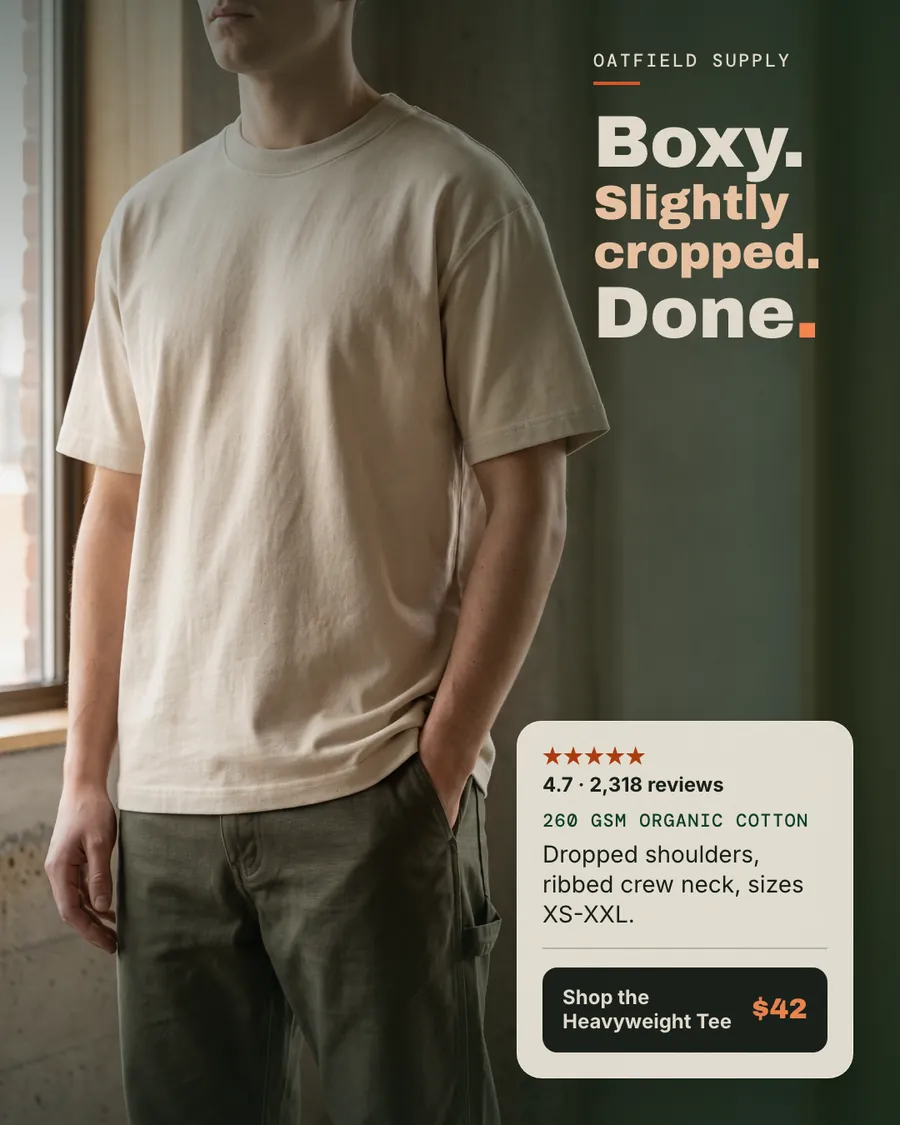
Lifestyle typeFit
Oatfield Supply: Boxy. Slightly cropped. Done.
Fictional sample brand · made by our engine
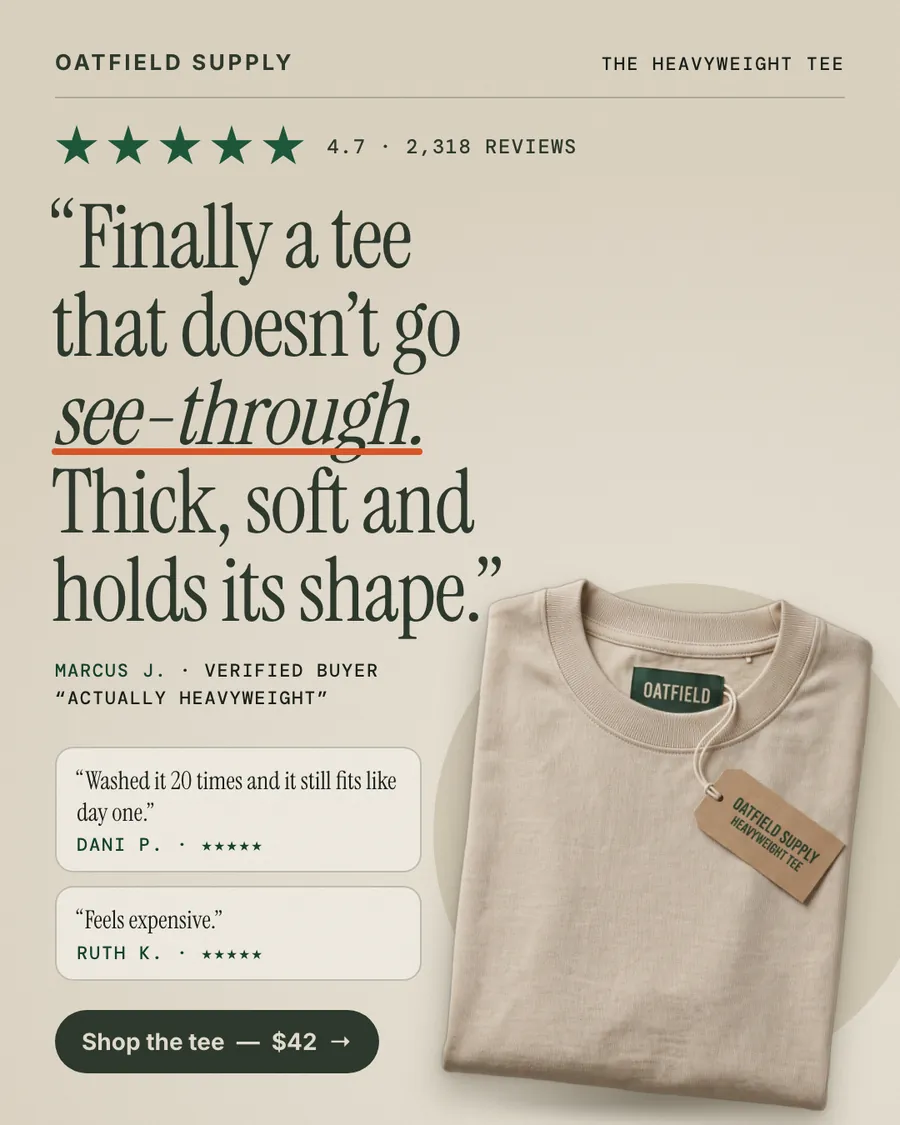
Review cardSocial proof
Oatfield Supply: Finally a tee that doesn't go see-through.
Fictional sample brand · made by our engine
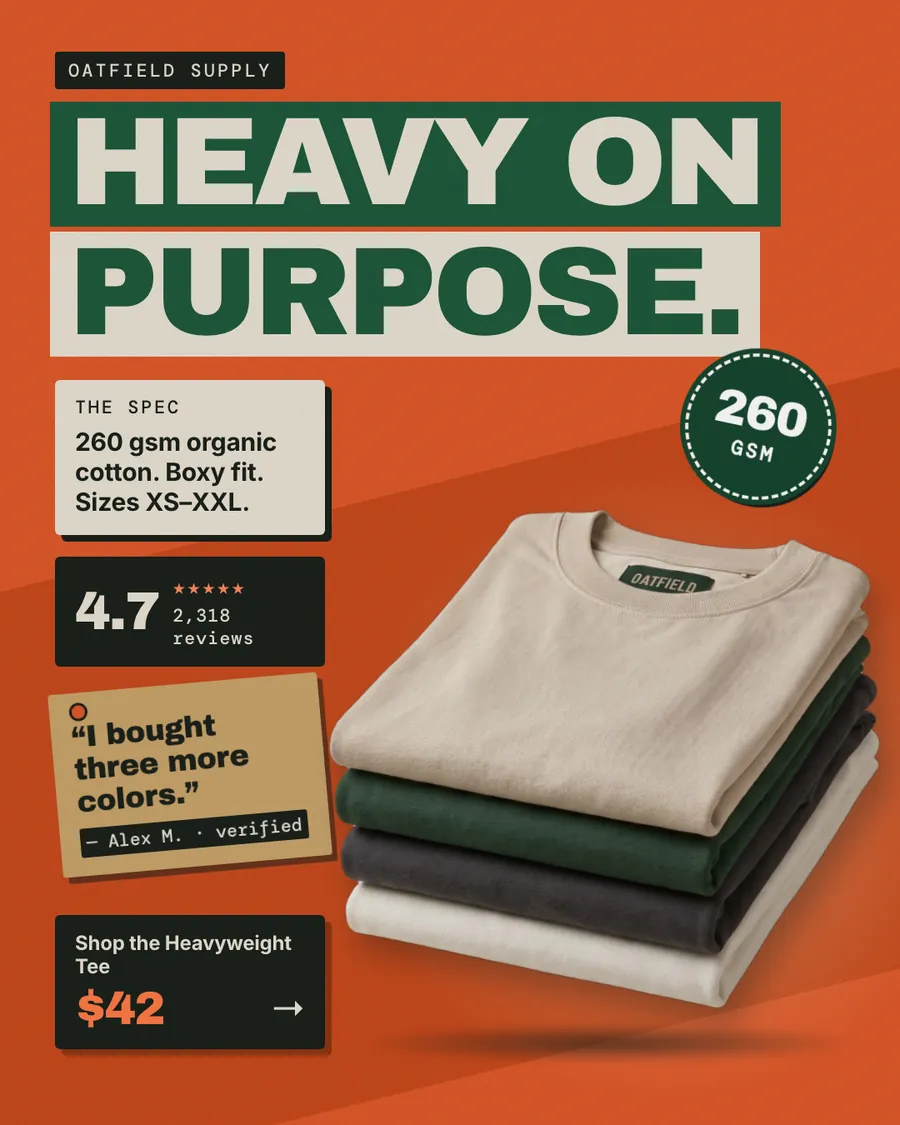
Bold posterQuality
Oatfield Supply: Heavy on purpose.
Fictional sample brand · made by our engine
Policy flags for clothing ads
Clothing isn't a restricted category on Meta or Google. What catches clothing ads is wording: labeling rules that also cover what your ads say, and copy that talks about the viewer's body.
Fiber names and percentages
The FTC's textile rules require fiber content by generic name and percentage on the label, and online promotional materials must say whether a product is made in the US, imported or both. Fabric claims in the ad should match the label.
Source: FTC: Threading Your Way Through the Labeling Requirements Under the Textile and Wool Acts
"Made in USA"
An unqualified claim means all or virtually all of the garment is made in the US. If the fabric comes from abroad, say which steps happened here, as in "cut and sewn in Los Angeles".
"Organic"
The USDA says textiles certified to the Global Organic Textile Standard may be sold as organic, and that naming a fiber as organic needs that fiber certified. The USDA organic seal needs the finished product certified.
Source: USDA Agricultural Marketing Service: Organic Textiles
Copy about the viewer's body
Lines like "Self-conscious about your arms?" speak to the viewer's own body and feelings, and Meta's personal attributes rules don't allow ads that assert or imply things like a person's physical or mental health. Describe the cut instead: "Dropped shoulders, a little room in the sleeve."
Source: Meta Advertising Standards: Privacy Violations and Personal Attributes
Sale and compare-at prices
A struck-through price must be one you offered for a reasonable time before the sale (16 CFR 233.1), which matters when every drop has a launch price.
Source: FTC Guides Against Deceptive Pricing, 16 CFR 233.1 (former price comparisons)
How often to refresh clothing ads, and what to measure
Clothing ads tire on two clocks: the audience gets used to the photo, and the season moves on. A heavyweight tee shot on a summer beach looks wrong in November whatever its numbers say.
On a small budget, plan 2 to 4 new ads every 2 to 4 weeks, and change the photo, not just the headline. Each drop or new color is its own small set of ads, sent to email subscribers first.
Meta flags an ad as "Creative limited" when its cost per result is higher than your past ads, and "Creative fatigue" once it reaches twice their cost. Its suggestion is a materially different image or video, with the original left running.
What to measure
- Return rate by product and size
- It decides what a first order can really cost. A size that comes back often needs a fix in the ad, not more budget.
- Cost per purchase after returns
- Compare it with the break-even above, minus refunds. Scale only what stays under it.
- Add to cart rate by angle
- Fit, fabric and returns angles separate early here, long before purchases are enough to judge.
- Email signups per 100 visitors
- Clothing earns its margin on the second and third drop, so the list is part of what the ads buy.
Questions about advertising a clothing brand
How do I advertise my clothing brand?
Pick one hero product and run five or six ads that each settle a doubt: fit on a body, fabric weight, how it washes, and how easy returns are. Run them in one Meta ad set, leave it alone for a week, then put more behind the angle that sells.
How do I advertise a clothing brand on Instagram?
Instagram ads run from your Meta ad account, so make each ad in 4:5 for the feed and 9:16 for Stories and Reels. Clothing in motion works there: a 10-second try-on, a turn to show the back, the fabric held to the light. Organic posts help, but paid ads reach people who don't follow you yet.
How do I advertise a clothing brand on Facebook?
Use a Sales campaign with one broadly targeted ad set and several ads, each with one reason to buy. Facebook and Instagram run from the same ad set, so you don't need separate Facebook creative: make each ad in 4:5 and 9:16 and let Meta choose the placements.
How do I promote a clothing brand on social media?
Post the garment on real people as often as you can: try-ons, fit comparisons, how it looks after ten washes. Give your followers early access to drops, repost customers who tag you with their permission, and use paid ads to reach beyond your followers.
How do I attract people to my clothing brand?
Be specific about what makes the clothes different, such as fabric weight, cut or where they're made, and prove it in every ad. Vague brand mood attracts likes; a clear reason to buy attracts customers. Early buyers who return for the next drop are worth more than a big first launch.
Is $1,000 enough for Facebook ads for a clothing brand?
It's enough to learn which angle earns clicks and add to carts, about $33 a day for a month. It usually isn't enough to get 50 purchases a week at a clothing break-even, so treat the first $1,000 as a test of angles, not of the brand.
How do I promote a clothing brand online for free?
Organic short video of the clothes on real people, gifting pieces to small creators who fit your style, free product listings on Google through Merchant Center, local pop-ups, and an email list from day one. Paid ads then scale whatever those prove.
How do I advertise kids' clothing?
Parents buy on softness, how it washes, how it sizes by age and how long it will fit. Lead with those facts, show children only with a parent's permission, and make exchanges easy, since parents often guess sizes for a growing child.
How do I advertise clothing on Etsy?
Etsy suits handmade, vintage and print-on-demand clothing. Etsy Ads promote your listings in Etsy search, and Offsite Ads charge a fee only when an ad on another site leads to a sale. Clear on-body photos and measurements in every listing matter as much as the ads.
Should a new clothing brand use influencers or ads first?
Ads first, on one product, so you learn which angle sells with numbers you control. Creators come next, because their try-on videos then become your strongest ads. Paying for big influencer posts before you know your angle is the expensive way to find it.
Get the ads for this plan
Paste your store link and get 3 free ads of your own clothing: we read your products, prices and reviews, design around your real product photo and check every fact against your store.
Where to go next
- Clothing ad ideasSeven sample ads for a heavyweight tee, how to prove fit and fabric online, and the fiber, origin and organic claims to get right.
- ClothingApparel ads that answer the fit question: fabric, size range and on-body photos from your store.
- How to advertise print on demand productsStart from what an order leaves after the supplier's cut, test designs on Meta, push sets over single tees, then add Pinterest and Etsy.
- How to advertise bags and handbagsA plan for a small bag brand: prove capacity and materials first, give a $100 purchase time to happen, and make the first order pay for itself.
- How to advertise jewelryA jewelry ad plan built around the gift calendar: Meta for detail, Pinterest and Shopping before the peaks, and learning done before December.
- T-shirtsTee ads where the print reads at phone size, plus fabric-weight and fit ads for blanks.
- How to make Facebook ads for your Shopify store, start to launchA practical playbook for solo Shopify owners: the setup you do once, the product and angles you pick, three honest ways to make the ads, and the weekly loop that keeps them working.
- PricingFree preview, Starter $49/month, weekly plans from $99/month with a 7-day free trial, 30-day money-back guarantee.
Sources
Platform rules on this page were checked on against:
- Meta Business Help Center: About the learning phase
- Meta Business Help Center: About learning limited
- Meta Business Help Center: About creative fatigue recommendations in Ads Manager
- Meta Advertising Standards: Privacy Violations and Personal Attributes
- FTC: Complying with the Made in USA Standard
- FTC Guides Against Deceptive Pricing, 16 CFR 233.1 (former price comparisons)
- 3 free ads when your spot opens
- Starter $49/month
- Growth $99/month, 7-day free trial
- Pro $149 · Scale $199
- 30-day money-back guarantee