how to advertise cleaning products
How to advertise cleaning products when the first order is the cheap part
A cleaning product earns its money on the second, third and tenth order, not the first. That shapes the whole ad plan: the first ad has to show the product working, the budget has to be judged on refills, and the words have to stay clear of germ claims that only registered products may make. Here it is with Glossbury, a fictional refillable cleaner sold as tablets.
Updated · Budgets and examples use a fictional brand's numbers. Use yours.
In short
What is the best way to advertise cleaning products?
Show the product working in short Meta ads, sell a low-priced starter kit, and earn the ad cost back through refill orders by email. Add Google Shopping for people searching for refills or tablets, and keep every claim to what the product really does: no germ-killing words unless it is registered with the EPA.
StoreToAds makes ready-to-post ads from your product photo, free to try.
At a glance
- What pays for the ads
- Refill orders, not the first kit
- Where to start
- Meta (Facebook and Instagram), with a demo of the product working
- The entry offer
- A low-priced starter kit plus free shipping on a refill
- The claim to drop
- "Kills 99.9% of germs" without EPA registration
- The number to watch
- How many first buyers reorder within your refill window
Which channels fit cleaning products, in the order to try them
Nobody scrolls looking for spray cleaner, but almost everyone stops for a satisfying before and after or a tablet fizzing into water. Start where you can show the product working, then build the channels that bring buyers back for refills.
- 01
Meta (Facebook and Instagram)
Start hereWhy it fits
A short clip or a clear still of a streak-free mirror, a degreased stovetop or a tablet dissolving explains the product faster than any headline. Meta finds buyers you couldn't guess by interest, from new renters to people swapping out plastic.
The trade-off
An $18 kit leaves little room per order, so a weak ad costs more than the sale earns. Expect to need several rounds of ads before one pays for itself.
- 02
Email and SMS
Add nextWhy it fits
This is where a cleaning brand makes money. A reminder sent when the starter tablets should be running low brings back buyers who already trust the formula, at almost no cost.
The trade-off
It only works if the first purchase collects an email or phone number with consent, and the timing has to match how fast your customers really use the product.
- 03
Google Shopping
Add nextWhy it fits
Searches like "refillable cleaning spray" or "cleaning tablets refill" come from people ready to switch, and a Shopping ad shows the kit and price on that search.
The trade-off
The searches are smaller than for big-brand cleaners, and you appear next to cheap bottles. Write titles that say tablet, refill and what surfaces it cleans.
- 04
TikTok
Add laterWhy it fits
Short cleaning demos suit the format, and a tablet turning into a full bottle of cleaner is easy to film on a phone.
The trade-off
It needs fresh video every week, and the same germ-claim rules apply to anything a creator says about your product.
- 05
Amazon
Only if it fitsWhy it fits
Some shoppers only buy household products where they buy everything else, and an Amazon listing can catch refill searches you'd miss.
The trade-off
Refill buyers there belong to Amazon, so your reorder emails can't reach them, and the platform's fees eat into a low-priced refill. Treat it as an extra shelf, not the main store.
- 06
Pinterest
Skip for nowWhy it fits
Cleaning routines and organized homes are popular boards, and a tidy counter with a glass bottle fits them.
The trade-off
Saves take a long time to become orders for a product this cheap. Add it once refills are working.
Your first 30 days advertising cleaning products
Before the first ad, read every claim on your product page and labels. Cleaning ads get into trouble for one word more often than for bad creative, and fixing words after launch means pausing ads that just started learning.
Days 1 to 3
Audit the claims, then fix the page
List every claim on the page, the label and any reviews you plan to quote. Remove germ, antibacterial or disinfecting words unless the product is registered for them, and replace vague green words with specifics, like what's in the formula and what the packets are made of.
Days 4 to 10
Launch 6 ads that show the product working
Make two ads each for the demonstration (tablet to a full bottle), the swap (keep the glass bottle, buy only tablets) and the result buyers see (streak-free glass, a clean stovetop) in customers' own words. One Sales campaign, broad audience, 4:5 and 9:16.
Days 11 to 17
Watch which kit people choose
Leave the ad set alone. Check whether buyers pick the $18 starter kit or the $48 whole home kit, and which angle brought each. A bigger first kit changes how much an ad can afford.
Days 18 to 24
Turn on the refill reminder
Send the first refill email at the point a typical buyer would use up the starter tablets. Use your own order data to set the day; if you don't have it yet, ask a few early customers how fast they go through a bottle.
Days 25 to 30
Add Shopping for refill searches
Start one Google Shopping campaign on the starter kit and the refill pack, with titles that name the product type, the scent and the size. Keep the winning Meta ads running and plan two new ones for next month.
How to size a starting budget for cleaning product ads
Cleaning products have small first orders and big lifetimes, so the first-order math almost always looks bad. Glossbury's starter kit is $18: a 16 oz glass bottle and three tablets, with refill six-packs at $12 and free shipping on orders over $30.
| Order value | $18.00 |
|---|---|
| Margin after product cost, shipping and fees | 50% |
| Most a first order can cost to break even | $9.00 |
| 50 purchases a week at that cost | $450 a week |
| The same budget per day | about $64 |
Meta says an ad set usually leaves its learning phase after about 50 results in the week after its last significant edit, and recommends a budget large enough to get enough results. Meta Business Help Center: About the learning phase
Nine dollars of room per order means very few first orders will pay for their own ads, and that's normal for this category. The plan is to break even (the point where the ads pay for themselves) on the first order as closely as you can and earn the profit on refills:
- Count the refill only with proof. Once you know what share of first buyers reorder within a few months in your own data, you can let a first order cost more than its margin. Until then, assume they won't.
- Use the free-shipping line. The kit plus one refill six-pack comes to $30, exactly Glossbury's free-shipping line. Saying so on the ad nudges the refill into the first order and nearly doubles its value.
- Feature the bigger kit. The $48 whole home kit carries far more room per order than the starter. Give it its own ads once the starter has proven which angle works.
The upside of a cheap product: 50 purchases a week at this break-even is a far smaller weekly budget than for furniture or mattresses, so optimizing for purchases can make sense early.
Offers that work for cleaning products
Cleaning buyers switch reluctantly: their current cleaner works well enough. The offers that move them make trying cheap and refilling easy.
A low-priced starter kit
An $18 kit with the bottle and three tablets is a small bet for a buyer. It gets the bottle onto the counter, which is what earns the refills.
Free shipping when the refill joins the first order
Kit plus refill pack reaching the free-shipping line turns one purchase into two months of cleaner and gets the reorder habit started.
A whole home kit at a real saving
Three bottles and nine tablets for $48, down from $54, suits buyers ready to switch the whole house.
Watch: Show the $54 only if the kit really sold at that price, openly, for a reasonably substantial period before the reduction.
A refill reminder with a small thank-you
A past buyer already knows the formula works. A timely nudge, sometimes with a small thank-you, costs far less than finding a new customer.
Angles to test for cleaning product ads
Each angle shows something a buyer can see for themselves. For the ads themselves and what to photograph, see Cleaning product ad ideas; the first month of the plan runs these angles.
The demonstration
One tablet. 16 oz of cleaner. Ready in 10 minutes.
Keep the bottle
Keep the glass bottle. Refill with tablets.
What's left out
No ammonia, no bleach, no dyes.
On the counter, not under the sink
Pretty enough to leave out.
A customer's result
"Cuts through the grease on my stovetop in one spray."
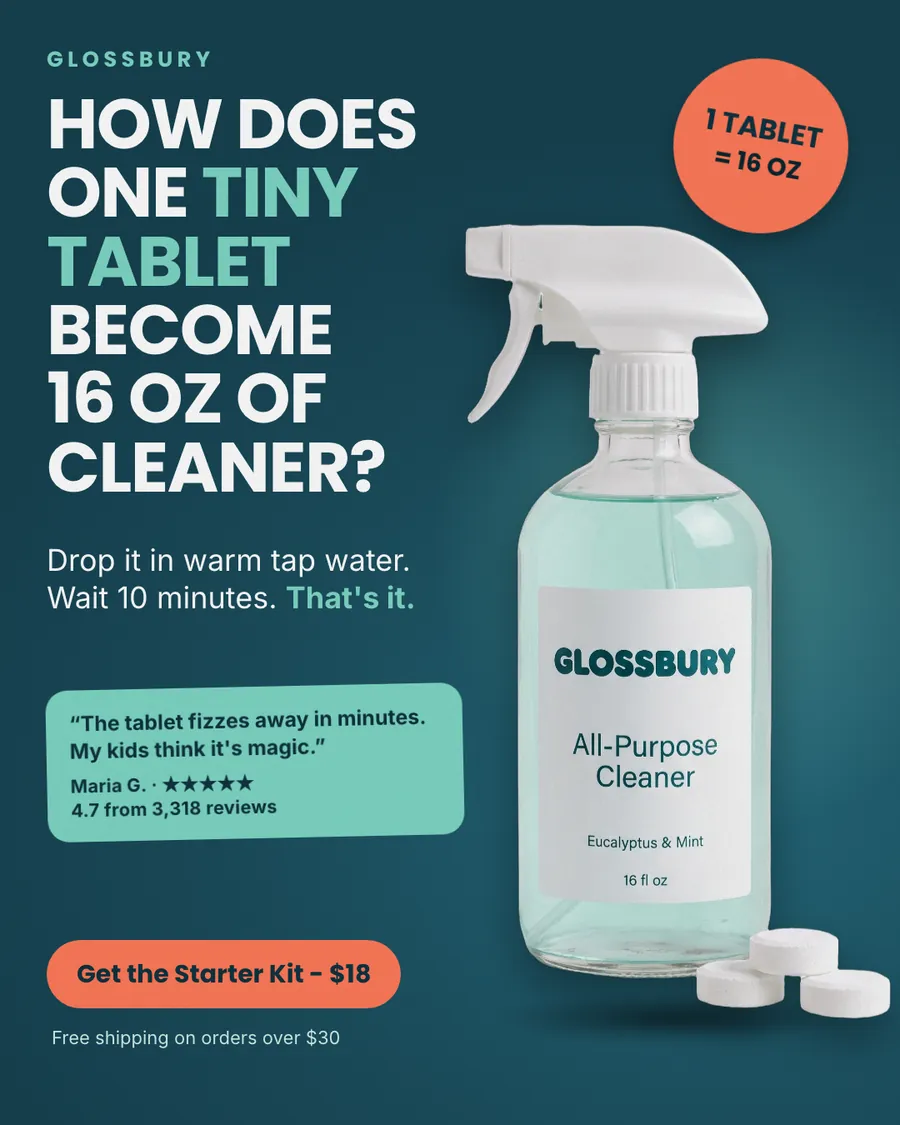
Question hookCuriosity
Glossbury: How does one tiny tablet become 16 oz of cleaner?
Fictional sample brand · made by our engine
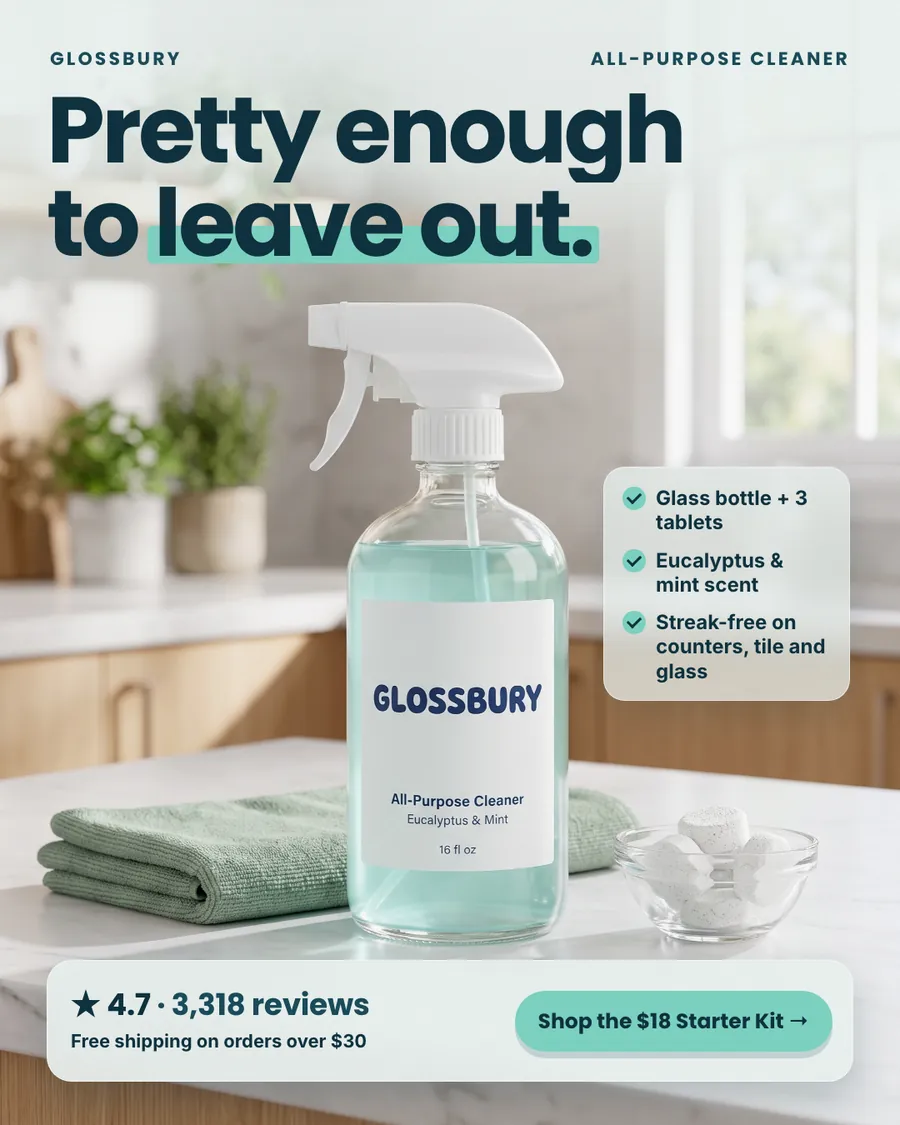
Lifestyle typeFit
Glossbury: Pretty enough to leave out.
Fictional sample brand · made by our engine
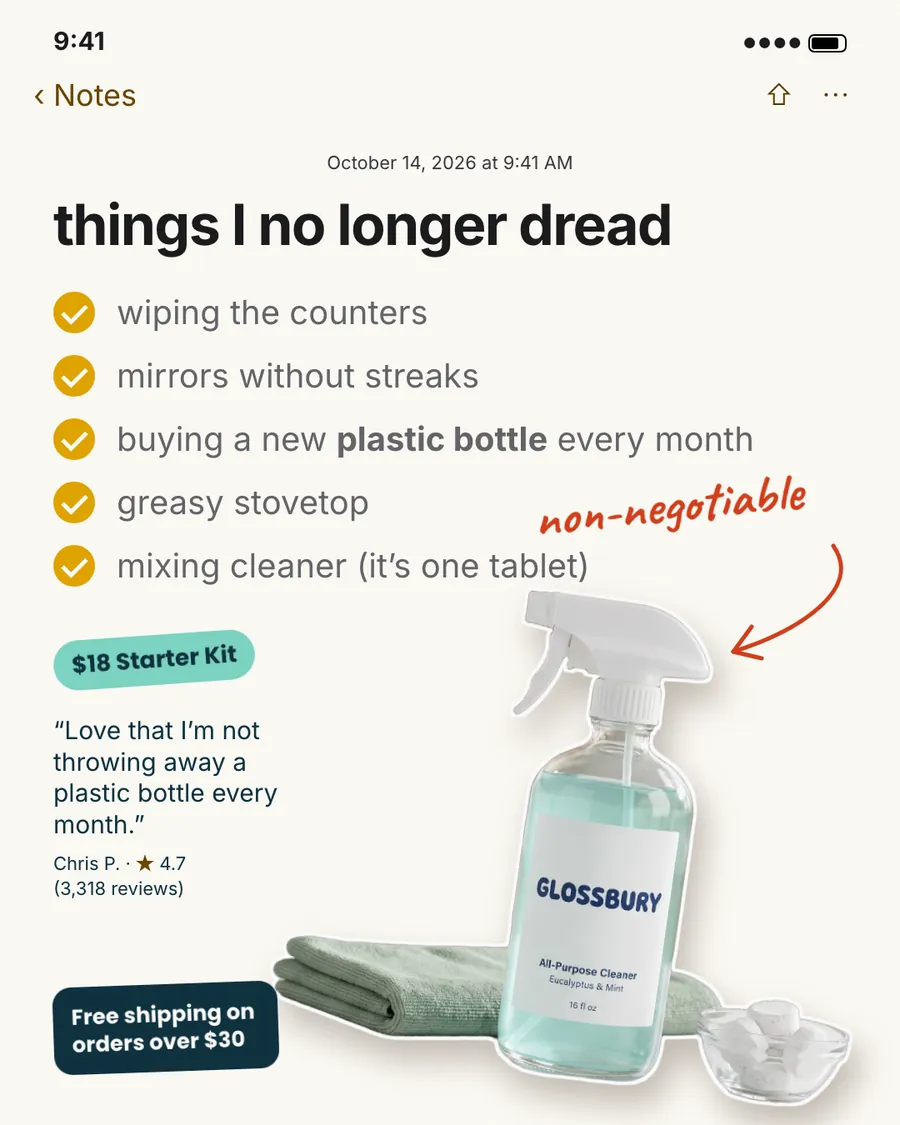
Notes-app listPersonality
Glossbury: things I no longer dread
Fictional sample brand · made by our engine
Words to be careful with
Cleaning is the category where one word turns a product into a regulated one. These flags come from the EPA's pesticide rules and the FTC's Green Guides, and they apply to ads, product pages and creator posts alike.
Germ, virus and bacteria claims
Under 40 CFR 152.15, a product needs pesticide registration when the seller claims, states or implies it can or should be used as a pesticide. The EPA's rules count bacteria and viruses as pests, except those on or in living people or animals. So "kills germs" or "antibacterial" on an unregistered cleaner is a registration problem, not just an ad problem.
Source: 40 CFR 152.15: Pesticide products required to be registered
Antimicrobial bottles and cloths
The treated-article exemption in 40 CFR 152.25(a) covers an item treated to protect the item itself, and only if the pesticide is registered for that use. It doesn't let you say the bottle or cloth protects the people using it.
Source: 40 CFR 152.25: Exemptions for pesticides of a character not requiring regulation
The Safer Choice logo
The EPA says products earn the Safer Choice label through full ingredient disclosure, an assessment and a signed partnership agreement, with branding guidelines provided at the start. Don't put the logo, or a look-alike, on ads for a product that hasn't been through it.
Source: EPA: Steps to get the Safer Choice label on your product
"Non-toxic" and "safe around kids"
The FTC's Green Guides say a non-toxic claim likely conveys that the product is non-toxic for people and the environment, so it needs competent and reliable scientific evidence for both or a clear qualification. Naming what's left out is the safer line.
Refillable and compostable packaging
Under 16 CFR 260.14, call the bottle refillable only if you provide the means to refill it, such as selling refills. A "compostable" packet needs evidence it breaks down into usable compost in a safe and timely manner, and a qualifier if it can't be composted at home.
Source: 16 CFR 260.14: Refillable claims
Kids and pets in the photo
Even a gentle formula shouldn't be shown in a child's hands or next to a pet's bowl. Show it used the way the label says, by an adult, and keep tablets out of reach in every shot.
Rules checked . The sources are linked at the end of this page.
How often to refresh cleaning product ads, and what to measure
Cleaning ads reach a wide audience, which keeps them fresh longer than niche products, but demonstration ads lose their surprise once people have seen the trick.
Plan two or three new ads every three weeks on a small budget, rotating the surface (glass, tile, stovetop) and the format (demo clip, still with a customer quote, a simple list). A new scent or a new kit is a natural reason for a fresh batch.
Meta flags an ad "Creative limited" once its cost per result rises above your past ads, and "Creative fatigue" at twice as much. Its advice is a materially different image or video rather than a new headline over the same clip.
What to measure
- Refill reorder rate
- The share of first buyers who come back for tablets decides how much a first order can cost. It is the most important number in this category.
- Order value of first purchases
- Tells you whether the free-shipping line and the bigger kit are working, or whether most buyers stop at $18.
- Cost per purchase, by angle
- Shows which reason to switch (the demo, the bottle, the formula) brings buyers in most cheaply.
- Days to first refill
- Sets the timing of your reminder email from real behavior instead of a guess.
Questions about advertising cleaning products
Where should a cleaning product brand start advertising?
Start on Meta with short ads that show the product working, sold as a low-priced starter kit. Set up a refill reminder email at the same time, because refills are what pay back the ad cost. Add Google Shopping once you know which kit and which angle sell.
How do I market cleaning products on a small budget?
Pick one product and one starter offer, make a handful of ads that demonstrate it, and spend only on Meta at first. Put most of your effort into the refill email and the product page, since a returning buyer costs almost nothing to reach.
How much should I spend to launch a cleaning product?
Work out the first order's value times your margin after product, packaging, shipping and fees. That is the break-even cost of a first order. Because refills carry the profit, many brands accept a first order near break-even, but only after their own data shows buyers reorder.
How do I get customers to reorder refills?
Send a reminder when a typical buyer would be running low, based on your own order data, and make reordering one tap. Keep the refill price clear and use the free-shipping line to bundle a few packs. A short thank-you for the second order helps too.
Should I sell cleaning products on Amazon?
It can catch shoppers who buy all their household items there, but refill buyers on Amazon are Amazon's customers, so your reorder emails can't reach them, and fees cut into a low-priced refill. Many small brands keep their own store as the main shop and treat Amazon as an extra shelf.
Can I sell cleaning products on Facebook Marketplace?
Marketplace is built for local listings. For a brand shipping products, regular Meta ads reach the same people with proper targeting, a checkout and reporting, and they let you build the audience you will email for refills.
How do I advertise cleaning products on Instagram?
Instagram ads run from the same Meta account. Use 9:16 for Stories and Reels with the product working in the first second, and 4:5 for the feed with the result and the price. Keep words on screen to the claims you can support.
What is the best time of year to advertise cleaning products?
Cleaning products sell all year, so a steady budget usually beats big pushes. Moments like spring cleaning or moving season give you fresh reasons for new ads, and Black Friday, November 27, 2026, suits a bigger kit at a real saving.
How long until I know if my cleaning ads are working?
Give each new ad set about a week without edits, then look at cost per purchase and which kit buyers chose. The full answer comes later, once you see how many of those buyers reorder, so keep a simple monthly view of refills next to ad spend.
Why can't my cleaner's ads say it kills germs?
In the US, a product claimed to kill or control germs is treated as a pesticide and must be registered with the EPA before it can make that claim. Without registration, describe what the product cleans and what's in it instead.
Get the ads for this plan
Paste your store link and get 3 free ads of your own cleaning products: we read your products, prices and reviews, design around your real product photo and check every fact against your store.
Where to go next
- Cleaning product ad ideasSeven sample ads for a refillable tablet cleaner, refill math, and the one word that turns a cleaner into a pesticide.
- How to advertise eco-friendly productsAn eco brand's ad plan: Meta for the everyday swap, Pinterest and gifts for the holidays, a budget built on bundles, and green claims you can prove.
- How to advertise kitchen productsCookware is bought by spec: Google Shopping and Meta demos first, a budget that leans on sets, and the coating claims to word carefully.
- How to advertise home decorPinterest and Meta side by side for a small decor brand, a 30-day plan, a budget for slow deciders and the free-shipping line as your best offer.
- Problem-solutionName the everyday problem, then show your product as the fix, in one honest frame.
- Static ads vs video ads: what to run firstThe honest answer isn't a winner. It's an order: use cheap static ads to find the reason people buy, then put video money behind the reasons that already work.
- PricingFree preview, Lite $29/month for 9 designs a month (optional 2 weekly), Starter $49/month for 20. Meta and a 7-day trial from Growth.
Sources
Platform rules on this page were checked on against:
- Meta Business Help Center: About the learning phase
- Meta Business Help Center: About creative fatigue recommendations in Ads Manager
- FTC Green Guides: Non-toxic claims, 16 CFR 260.10
- FTC Guides Against Deceptive Pricing, 16 CFR 233.1 (former price comparisons)
- 40 CFR 152.15: Pesticide products required to be registered
- 40 CFR 152.5: Pests
- 40 CFR 152.25: Exemptions for pesticides of a character not requiring regulation
- EPA: Steps to get the Safer Choice label on your product
- 16 CFR 260.14: Refillable claims
- 16 CFR 260.7: Compostable claims
- 3 free ads, no signup
- Lite $29/month · 9 designs a month · optional 2 weekly
- Starter $49/month · 20 designs
- Growth $99/month, 7-day free trial
- Pro $149 · Scale $199
- 30-day money-back guarantee