how to advertise kitchen products
How to advertise kitchen products and cookware as a small brand
People shopping for a pan type what they want into a search box: the size, the coating, the cooktop. Then they watch it work. A kitchen ad plan covers both moments, the search and the demo, and it has to word coating and warranty claims with care. The examples use Ironfern, a fictional ceramic cookware brand.
Updated · Budgets and examples use a fictional brand's numbers. Use yours.
In short
What is the best way to advertise kitchen products?
Start with Google Shopping, because cookware buyers search by size, coating and cooktop, and add Meta ads that show the product working: eggs sliding, an even sear, the pan going into the oven. Lead with one hero product, let a set raise order value, and word coating and warranty claims exactly as your documents support.
At a glance
- How people shop
- Search by spec, then watch it work before buying
- Where to start
- Google Shopping and Meta demo ads together
- Your entry product
- One hero pan; the set comes second
- Words that need paperwork
- "PFAS-free", "non-toxic", "lifetime warranty"
- Busiest weeks
- Before Thanksgiving, gift season, and spring registries
Which channels fit kitchen products, in the order to try them
Kitchen products are researched more than most home goods: buyers compare specs, read reviews and want proof it performs. That puts a search channel and a demo channel at the front.
- 01
Google Shopping
Start hereWhy it fits
Cookware searches are specific ("10 inch ceramic skillet induction", "oven safe nonstick pan"), and a Shopping ad answers them with your pan, price and rating. The intent is already there; you only have to match it.
The trade-off
You compete on price with big cookware brands, so your feed titles must carry the specs that set you apart. Vague titles burn budget on the wrong searches.
- 02
Meta (Facebook and Instagram)
Start hereWhy it fits
A three-second clip of an egg sliding off a pan, or an annotated photo of the layers, proves performance in a way a search result can't. Meta finds cooks who weren't shopping that week.
The trade-off
Demo claims get tested in real kitchens and in the comments. Show what the pan really does, at the heat a customer would use.
- 03
Creators and cooks
Add nextWhy it fits
A home cook using your pan on a weeknight is the demo buyers trust most, and their video makes good ad creative with permission.
The trade-off
Gifted posts need clear disclosure under the FTC's Endorsement Guides, and a creator's results with your pan are claims you're responsible for if you reuse them.
- 04
Email
Add nextWhy it fits
Someone who loves one pan is the likeliest buyer of the set. Care tips, a recipe that suits the pan and a set offer turn a $95 customer into a bigger one.
The trade-off
It works on past buyers only. A pan lasts years, so the next sale is a different piece, not a reorder.
- 05
Amazon
Only if it fitsWhy it fits
Many cooks check Amazon for cookware reviews, and Sponsored Products catch searches for your product type there.
The trade-off
Fees and price comparison cut margin, and coating claims get extra scrutiny from shoppers there. You also can't email those buyers about the set.
- 06
Pinterest
Add laterWhy it fits
Kitchen styling and wedding registries live on Pinterest, and a colorful pan photographs well on an open shelf.
The trade-off
Most kitchen pins are recipes, not products, so the clicks are often for the food in the photo. Good for registry season, weak as a first channel.
What cookware shoppers type, and which ad catches it
Kitchen searches fall into a few patterns. Each one wants a different ad or listing:
| They search | What they want | Catch it with |
|---|---|---|
| A spec: "10 inch ceramic skillet induction" | A pan that matches their stove and size | A Shopping listing whose title carries those exact specs |
| A problem: "pan where eggs don't stick" | Proof it solves it | A Meta demo ad, and a product page that shows the same |
| A gift: "cookware set gift" | Something that looks generous and arrives well | The set in Shopping and a gift-season Meta ad with your order-by date |
| Your brand name | Reassurance before buying | A small brand search campaign, so a reseller or competitor doesn't take the click |
Your first 30 days advertising kitchen products
Start with one product people can say yes to quickly, prove it works, and only then introduce the set. For Ironfern that's the 10-inch skillet.
Days 1 to 4
A feed that speaks in specs
Sync the catalog to Google Merchant Center. Rewrite the hero product's title in the order people search: size, material and coating, cooktop, color. Put the oven-safe temperature, cooktop list and warranty on the product page, worded as your supplier's documents support.
Days 5 to 10
Shopping on the hero, demos on Meta
Run a Shopping campaign limited to the hero product. On Meta, launch 6 ads in one ad set: two short demo clips (eggs, an even sear), two annotated photos of the build, one review card, one price ad if there's a genuine markdown.
Days 11 to 17
Read the search terms, leave Meta alone
In Google Ads, read which searches triggered the Shopping ads and add negative keywords for ones that don't fit, like cast iron if you sell ceramic. On Meta, don't touch the ad set while it learns; note which demo gets the most add to carts.
Days 18 to 24
Introduce the set
Add 2 or 3 ads that start from the winning demo and show the set beside the single pan, with the set's real saving. Start an email to buyers of the single pan about two weeks after delivery: a care tip, then the set.
Days 25 to 30
Compare cost per order by channel
Put Shopping and Meta side by side on cost per purchase and order value. They do different jobs, catching searchers and finding new cooks, so keep both if both are under break-even and move money toward the one further under it.
How to size a starting budget for cookware ads
Cookware sits in a useful middle: orders are big enough to carry an ad cost, small enough to buy without weeks of thought. Ironfern ships every order free; most orders are the skillet, some add the saucepan, a few are the $345 set.
| Order value | $130.00 |
|---|---|
| Margin after product cost, shipping and fees | 45% |
| Most a first order can cost to break even | $58.50 |
| 50 purchases a week at that cost | $2,925 a week |
| The same budget per day | about $418 |
Meta says an ad set usually leaves its learning phase after about 50 results in the week after its last significant edit, and recommends a budget large enough to get enough results. Meta Business Help Center: About the learning phase
That figure covers both channels together, not each one. If it's more than you can fund, keep the money in fewer places rather than spreading it thin:
- One Shopping campaign, one Meta ad set. Meta warns that many small ad sets learn less than a few combined ones, and the same goes for splitting a small Shopping budget across many campaigns.
- Let the set lift the average. At $345 a set, even a few set orders a week raise the break-even cost per order for everything else. Show it in ads once the single pan is proven.
- Use add to cart as a stepping stone. If Meta can't reach about 50 purchases a week, its guidance is to optimize for a more frequent event until you can.
Offers that work for kitchen products
Cookware buyers respond to offers that lower the risk of a pricey pan or reward going bigger. Constant discounting makes a $95 pan look like it was never worth $95.
The set at a real saving
Ironfern's 4-piece set is $345, usually $410. A set saving is concrete and raises order value more than any single-pan discount.
Watch: The usual price must be one you charged for a real period.
Free shipping on everything
Heavy cookware costs real money to ship. Taking that off the table removes a reason to hesitate, and it belongs in the ad.
A warranty in plain words
A clear warranty answers the coating worry better than any adjective, because it says what happens if the surface wears.
Watch: Say whose lifetime "lifetime" means, and perform on it promptly.
Seasonal markdowns on one color
Rotating a genuine markdown through colors gives you a fresh price ad without discounting the whole range.
Angles to test for kitchen product ads
Each angle proves one thing a cook wants to know before buying. Ironfern's full set of annotated sample ads, photo checklist and copy lines are on Kitchen product ad ideas; these are the ones to test first.
Speed, measured
Even heat in about 90 seconds.
The cleanup
"Eggs slide right off. Cleanup takes 30 seconds."
Stove to oven
Oven-safe to 550°F. Sear, then finish in the oven.
Works on your cooktop
Gas, electric and induction.
The honest markdown
The sage skillet. $25 off.
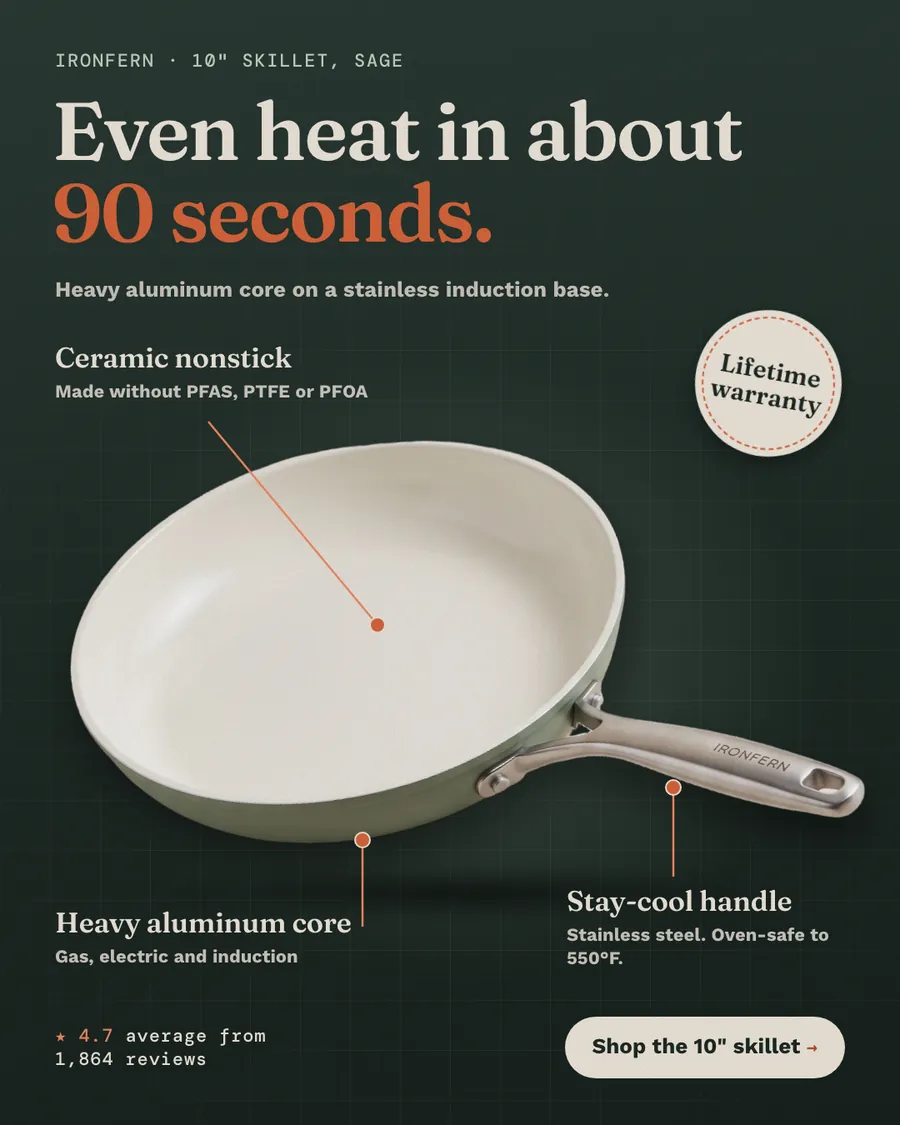
Annotated heroQuality
Ironfern: Even heat in about 90 seconds.
Fictional sample brand · made by our engine
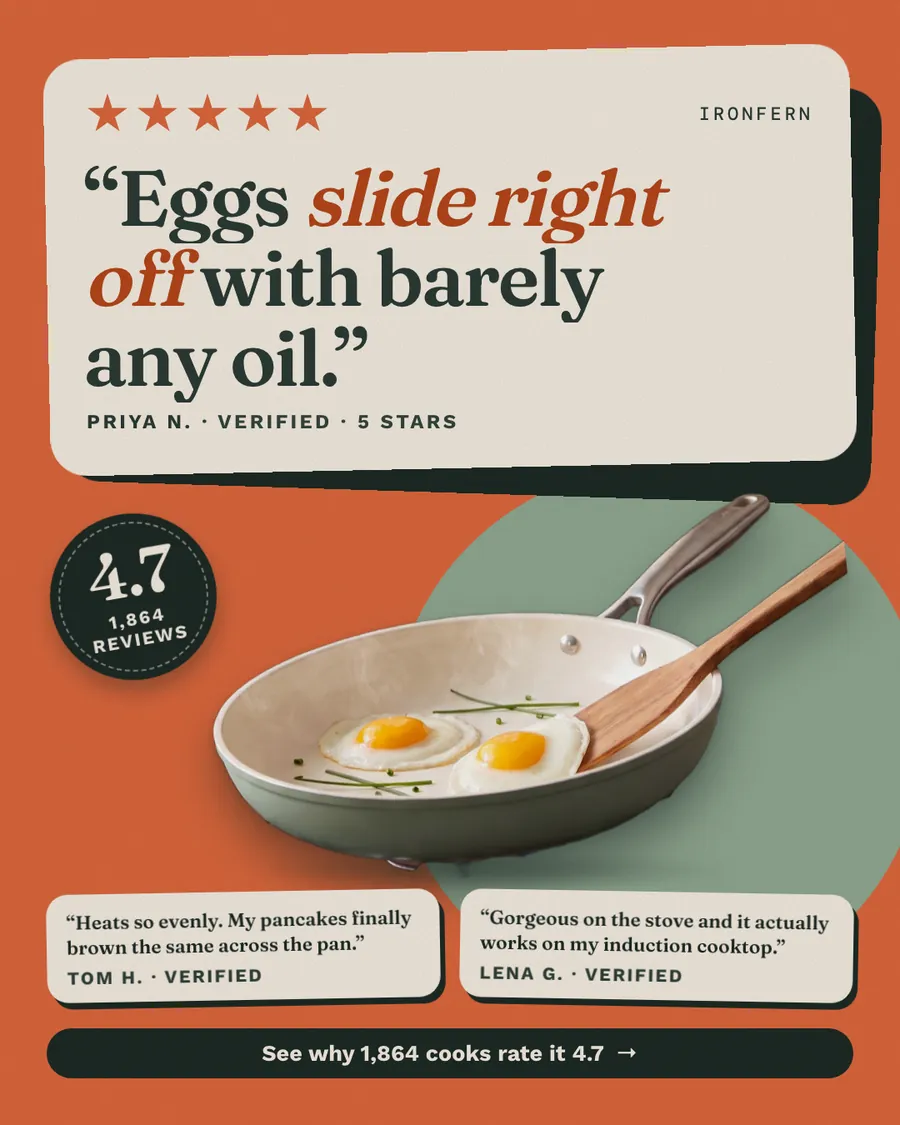
Review cardSocial proof
Ironfern: “Eggs slide right off with barely any oil.”
Fictional sample brand · made by our engine
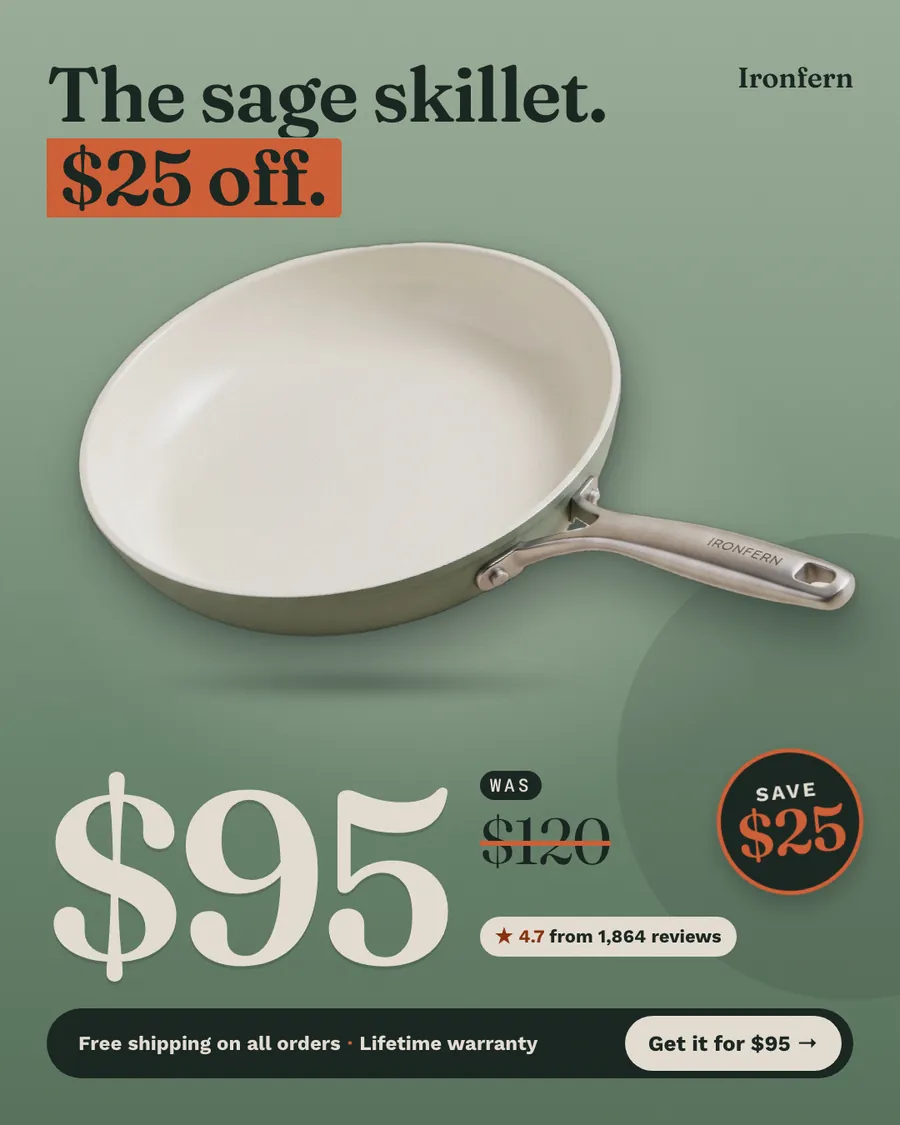
Price dropOffer
Ironfern: The sage skillet. $25 off.
Fictional sample brand · made by our engine
Policy flags for kitchen product ads
Kitchen products aren't restricted on Meta or Google. The risk sits in the claims that sell cookware hardest: coatings, temperatures, warranties and prices.
"Non-toxic" cookware
The FTC's Green Guides treat non-toxic as a claim that needs competent and reliable scientific evidence. Ads often do better naming what the coating is made without, worded the way your supplier's test documents support.
State PFAS rules
Some states regulate PFAS in cookware directly: Minnesota has prohibited intentionally added PFAS in cookware since January 1, 2025, and California's AB 1200 limits "free of" claims for single chemicals from listed classes. Check both before writing coating lines for buyers there.
Source: Minnesota Pollution Control Agency: 2025 PFAS prohibitions
"Lifetime warranty"
The FTC's guides on advertising warranties say to advertise a warranty only if you perform on it promptly, and to make clear whose life a lifetime warranty refers to.
Source: FTC Guides for the Advertising of Warranties and Guarantees, 16 CFR 239
Shopping listings that match the page
Google's Shopping policies don't allow listings that represent you or your products in a way that isn't accurate, realistic and truthful. Keep the feed's price, sale price and specs identical to the product page.
Source: Google Merchant Center: Misrepresentation (Shopping)
Was prices
A crossed-out price, like $120 next to $95, has to be one you genuinely charged for a reasonable time.
Source: FTC Guides Against Deceptive Pricing, 16 CFR 233.1 (former price comparisons)
How often to refresh kitchen product ads, and what to measure
Demo ads tire faster than spec ads: once someone has seen the egg slide twice, the third time does little. Shopping listings barely tire at all, since each search is a new person.
On Meta, add 2 or 3 new ads every two to three weeks, alternating demos (a new dish, a new technique) with spec and review ads. Bring in seasonal ads ahead of Thanksgiving cooking, gift season and spring registries.
Meta flags "Creative limited" when an ad costs more per result than your past ads and "Creative fatigue" at about twice the cost. A materially different demo, not the same clip recut, is what its guidance asks for. On Google, refresh product titles and images when the search terms show new wording.
What to measure
- Cost per purchase, Shopping vs Meta
- The two channels do different jobs; keep both while both stay under your break-even.
- Set share of orders
- The quickest way to raise order value, and with it how much each new customer can cost.
- Search terms that convert
- Tells you which specs buyers care about, which then lead your Meta ads too.
- Second purchase within 90 days
- Pans last years, so repeat buyers buy other pieces. This is the number email exists to move.
Questions about advertising kitchen products
How do I advertise kitchen products on Facebook?
Run one Sales campaign with one ad set and about six ads: short demos of the product working, annotated photos of how it's built, and a review. Make every ad in 4:5 and 9:16, start broad rather than with interests, and don't edit the ad set during its first week of learning.
How do I advertise cookware on Amazon?
Start with Sponsored Products on your hero item, with a title that names the size, coating and cooktop and images that show the base and the handle. Amazon suits cooks who research there, but fees reduce margin and you can't follow up with those buyers about your other pieces.
How do I advertise cookware on Instagram?
Instagram ads come from your Meta account, so the plan is the same. What works there is motion: a few seconds of a sear or an egg sliding off, filmed in a real kitchen. Keep the product and its name visible in the first second, before people scroll past.
Are Google Shopping ads good for kitchen products?
They suit cookware well because people search by spec: size, material, coating and cooktop. Your product title has to carry those words in that order, the price and sale price must match the product page, and the search terms report shows which phrases to exclude.
How much should I spend on cookware ads?
Start from your margin: order value times the share left after product cost, shipping and fees is the most one order can cost. About 50 orders a week at that cost is what Meta's learning phase looks for. Most small brands begin below that, in one Shopping campaign and one Meta ad set.
Do I need video to advertise cookware?
It helps more for cookware than for most products, because performance is the claim. A few seconds filmed on a phone in a real kitchen is enough. Annotated photos of the layers and a review card are good static partners for the demo.
How do I advertise kitchen products online with a small budget?
Pick one hero product and one channel that matches how people find it, usually Google Shopping. Get the feed titles right, add negative keywords from the search terms report, and add Meta demos once Shopping is paying for itself.
How do I advertise cookware on Facebook Marketplace?
Marketplace listings are mostly people selling to people nearby. A cookware brand reaches Marketplace through normal Meta ads instead: with automatic placements, ads can appear in the Marketplace placement as well as the feed, Stories and Reels.
Can my cookware ads say non-toxic?
Only with competent and reliable scientific evidence, according to the FTC's Green Guides. Naming what the coating is made without, worded exactly as your supplier's test documents support, is safer. Check Minnesota's and California's cookware rules if you sell there.
When should kitchen brands advertise most?
Ahead of the cooking holidays, especially early November before Thanksgiving, through gift season to your last shipping date, and in spring for weddings, registries and first homes. January suits weeknight cooking angles without health claims about the pan.
Get the ads for this plan
Paste your store link and get 3 free ads of your own kitchen products: we read your products, prices and reviews, design around your real product photo and check every fact against your store.
Where to go next
- Kitchen product ad ideasSeven sample ads for a ceramic skillet brand, the specs cooks compare, and how to word coating and warranty claims.
- Kitchen productsKitchen product ads that name the chore, the material and the facts buyers check, like dishwasher-safe.
- How to advertise coffeeA roaster's plan: ads that win the first bag, emails and a subscription that win the second, and a budget that counts both.
- How to advertise food productsA plan for sauces, snacks and pantry brands: sell the dish, answer how hot or how sweet, and build first orders that clear free shipping.
- How to advertise home decorPinterest and Meta side by side for a small decor brand, a 30-day plan, a budget for slow deciders and the free-shipping line as your best offer.
- Bundle offerBundle and set ads that show what is in the box and the real saving against buying separately.
- PricingFree preview, Starter $49/month, weekly plans from $99/month with a 7-day free trial, 30-day money-back guarantee.
Sources
Platform rules on this page were checked on against:
- Meta Business Help Center: About the learning phase
- Meta Business Help Center: About learning limited
- Meta Business Help Center: About creative fatigue recommendations in Ads Manager
- Google Merchant Center: Misrepresentation (Shopping)
- FTC Green Guides: Non-toxic claims, 16 CFR 260.10
- FTC Endorsement Guides, 16 CFR 255
- FTC Guides Against Deceptive Pricing, 16 CFR 233.1 (former price comparisons)
- 3 free ads when your spot opens
- Starter $49/month
- Growth $99/month, 7-day free trial
- Pro $149 · Scale $199
- 30-day money-back guarantee