how to advertise eco friendly products
How to advertise eco-friendly products without the greenwashing
People who buy eco-friendly products are also the people most likely to question your claims in the comments. So the ad plan has two jobs: show a swap that is easy and pleasant in an ordinary kitchen, and make every green word specific enough to survive a skeptic. Here it is with Combwise, a fictional brand of beeswax food wraps.
Updated · Budgets and examples use a fictional brand's numbers. Use yours.
In short
How do you advertise eco-friendly products?
Lead with the everyday swap your product makes possible, shown in a real home, and back it with specific facts: the materials, how long it lasts and how it ends its life. Start on Meta, add Shopping and Pinterest, sell bundles to lift order value, and qualify every green claim the way the FTC's Green Guides describe.
StoreToAds makes ready-to-post ads from your product photo, free to try.
At a glance
- What you're selling
- An easy swap, proven with specific materials and lifespan
- Where to start
- Meta (Facebook and Instagram), with the swap shown in a real kitchen
- The order builder
- Bundles and add-ons that cross the free-shipping line
- The busy season
- Gift weeks before Christmas, when eco swaps make easy presents
- The word to drop
- "Eco-friendly" on its own, with no specific benefit
Which channels fit eco-friendly products, in the order to try them
Eco shoppers split into two groups: the committed, who search for exactly the swap they want, and the curious, who would switch if it looked easy. Reach the curious first with a picture, then catch the committed where they search.
- 01
Meta (Facebook and Instagram)
Start hereWhy it fits
A wrap sealed over a salad bowl in an ordinary kitchen makes the swap look normal, which is what curious buyers need. Meta finds them without you guessing interests, and reaches gift buyers in November and December.
The trade-off
Eco ads draw skeptical comments. Budget a little time each day to answer them with specifics, or the thread becomes the ad.
- 02
Google Shopping
Add nextWhy it fits
Searches like "beeswax wraps set" or "reusable food wrap" come from people who have already decided to switch. A Shopping ad shows your set, price and materials right there.
The trade-off
You sit next to cheaper imports, so titles need the materials and sizes, and photos need to show the wrap in use, not just folded.
- 03
Pinterest
Add nextWhy it fits
Zero-waste kitchens, plastic-free swaps and gift guides are classic Pinterest boards, and people save them while planning a change or a present.
The trade-off
Saves turn into orders slowly. Start pins in October so they are working by the gift weeks.
- 04
Email and SMS
Add nextWhy it fits
A wrap that lasts about a year gives you two natural notes: care tips soon after delivery, and a replacement reminder near the end of its life. Gift season adds a third.
The trade-off
It reaches only people who bought or signed up, and SMS needs their clear consent.
- 05
Etsy
Only if it fitsWhy it fits
Handmade and small-batch eco goods sell well where buyers already search for them, and a young brand can find its first customers there.
The trade-off
Offsite Ads take 15% of an attributed order for shops under $10,000 in yearly sales and 12% after, and the buyer stays Etsy's, so your replacement email can't reach them.
- 06
Amazon
Only if it fitsWhy it fits
Some shoppers buy every household swap where they buy everything else, and a listing catches searches you'd miss.
The trade-off
You give up the customer relationship and compete on price with near-identical products. Keep it as an extra shelf once your own store sells.
Your first 30 days advertising eco-friendly products
The most expensive mistake in eco advertising is a vague claim you have to pull after launch. Spend the first days on the words, then on the ads.
Days 1 to 3
Turn every green word into a fact
List each claim you plan to use and next to it the proof: the materials, how long the product lasts, what the packaging is made of, how it can be composted or recycled and any certificate you hold. Anything without proof gets rewritten or dropped.
Days 4 to 10
Launch 6 ads on 3 reasons to switch
Make two ads each for the swap in use (a bowl covered, bread wrapped), the materials (named one by one) and the lifespan (one set for about a year against a roll that is used once). Keep them together in a single Sales campaign aimed broadly, sized 4:5 and 9:16.
Days 11 to 17
Read the results and the comments
Leave the ad set alone and look at cost per purchase by reason. Read the comments too: questions about compost, wax or price tell you what the next ads need to answer.
Days 18 to 24
Add Pinterest and the gift angle
Pin the swap shots in 2:3 and add one gift ad on Meta, with the bundle as the hero. In November and December, gift buyers outnumber switchers for a product like this.
Days 25 to 30
Set up care and replacement emails
Send a care note after delivery and plan a replacement reminder near the end of the product's life. Then write down your holiday dates: USPS recommends shipping Ground Advantage by December 17 for Christmas delivery in the contiguous US.
How to size a starting budget for eco-friendly product ads
Many eco swaps are low-priced, long-lasting products, which is great for the planet and hard on the ad math. Combwise's set of three wraps is $22, with free shipping on orders over $35 and a Kitchen Swap Bundle at $48.
| Order value | $22.00 |
|---|---|
| Margin after product cost, shipping and fees | 55% |
| Most a first order can cost to break even | $12.10 |
| 50 purchases a week at that cost | $605 a week |
| The same budget per day | about $86 |
Meta says an ad set usually leaves its learning phase after about 50 results in the week after its last significant edit, and recommends a budget large enough to get enough results. Meta Business Help Center: About the learning phase
Twelve dollars of room per order leaves little space for a weak ad. The fix isn't a smaller budget; it is a bigger order and a reason to come back:
- Cross the free-shipping line. The $22 set plus the $16 bread wrap comes to $38, past Combwise's $35 line. An ad that says so turns a small order into a bigger one.
- Lead the gift weeks with the bundle. At $48, the Kitchen Swap Bundle roughly doubles the room per order, and gift buyers are happy to buy the full kit.
- Count replacements only with proof. A product built to last a year reorders slowly. Let a first order cost more than its margin only once your own data shows buyers come back.
At these prices, the weekly budget for about 50 purchases is modest compared with high-priced products, so purchase optimization can work early. Start lower than the example and raise it as the cost per purchase holds.
Offers that work for eco-friendly products
Eco buyers dislike pressure, so loud countdowns tend to backfire. The offers that work make switching cheaper or giving easier.
Free shipping over a set amount
A $35 line just above a $22 set nudges a second item into the cart, and buyers like fewer, fuller parcels.
A swap bundle at a real saving
The Kitchen Swap Bundle at $48, down from $56, lets a buyer switch several things at once.
Watch: Show the $56 only if the bundle really sold at that price, openly, for a reasonably substantial period before the reduction.
Gift-ready packaging
In the gift weeks, a set that arrives ready to give answers the buyer's real question. Say how it ships, and only call the packaging plastic-free or recycled if that is accurate.
A replacement reminder for past buyers
Someone whose wraps lasted a year already trusts them. A note near the end of their life brings back a buyer for far less than a new one.
Angles to test for eco-friendly product ads
Each angle makes the swap feel easy and the claim specific. Worked-out ads for each, with the claim wording they rely on, sit on Eco-friendly product ad ideas; the plan above tests them in its first month.
The swap in use
Cover the bowl. Skip the plastic wrap.
Materials, named
Organic cotton, beeswax, tree resin and jojoba oil.
Lifespan against single use
One set, about a year of use.
How it ends
Worn out? Cut it into strips for your home compost.
The gift for someone trying
"Perfect gift for my sister, who's trying to cut down on waste."
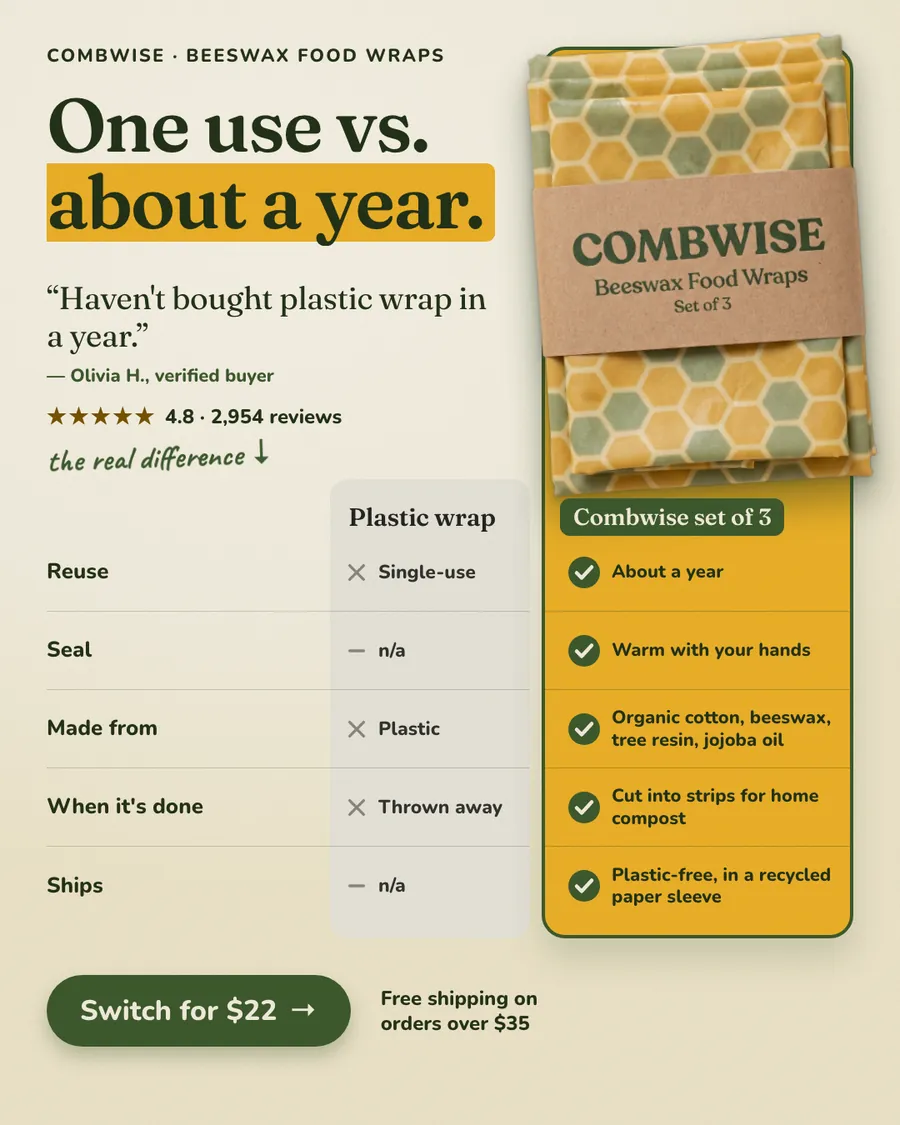
Us vs them tableComparison
Combwise: One use vs. about a year.
Fictional sample brand · made by our engine
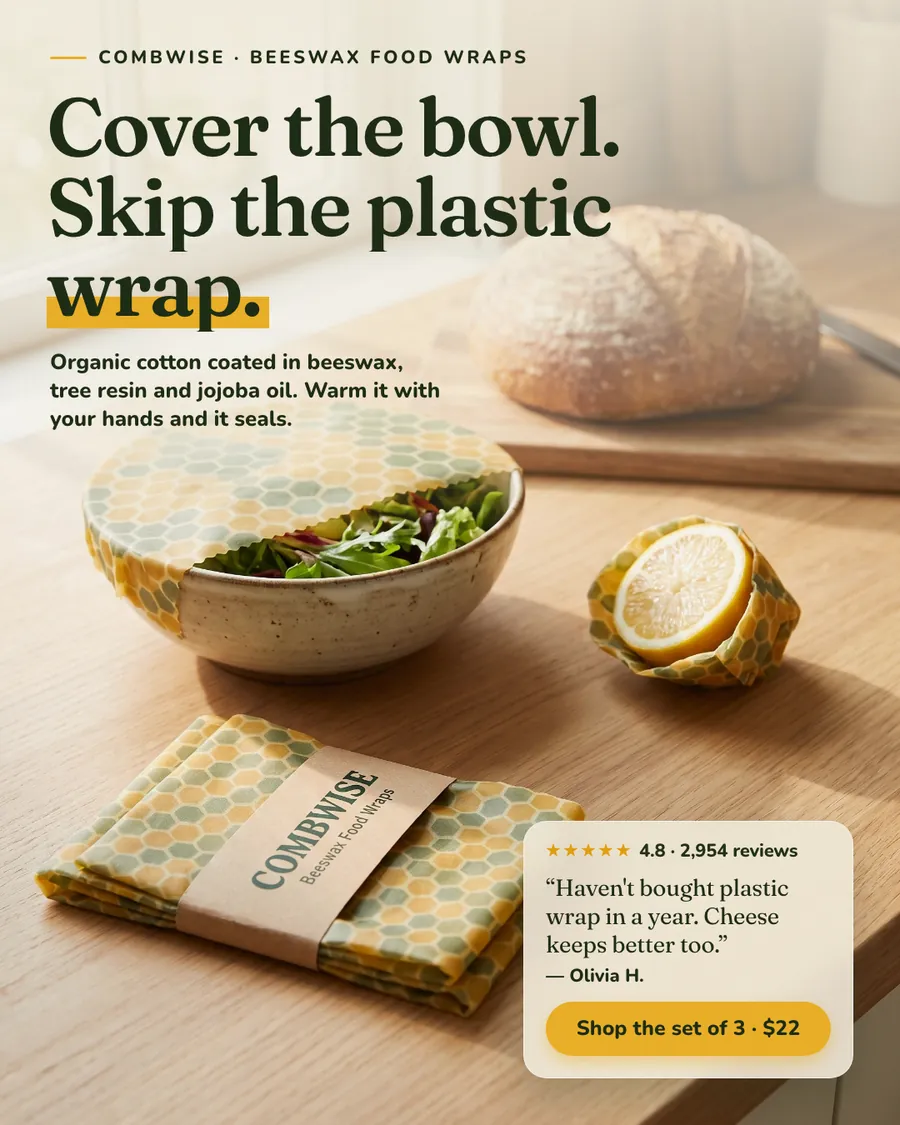
Lifestyle typeBenefit
Combwise: Cover the bowl. Skip the plastic wrap.
Fictional sample brand · made by our engine
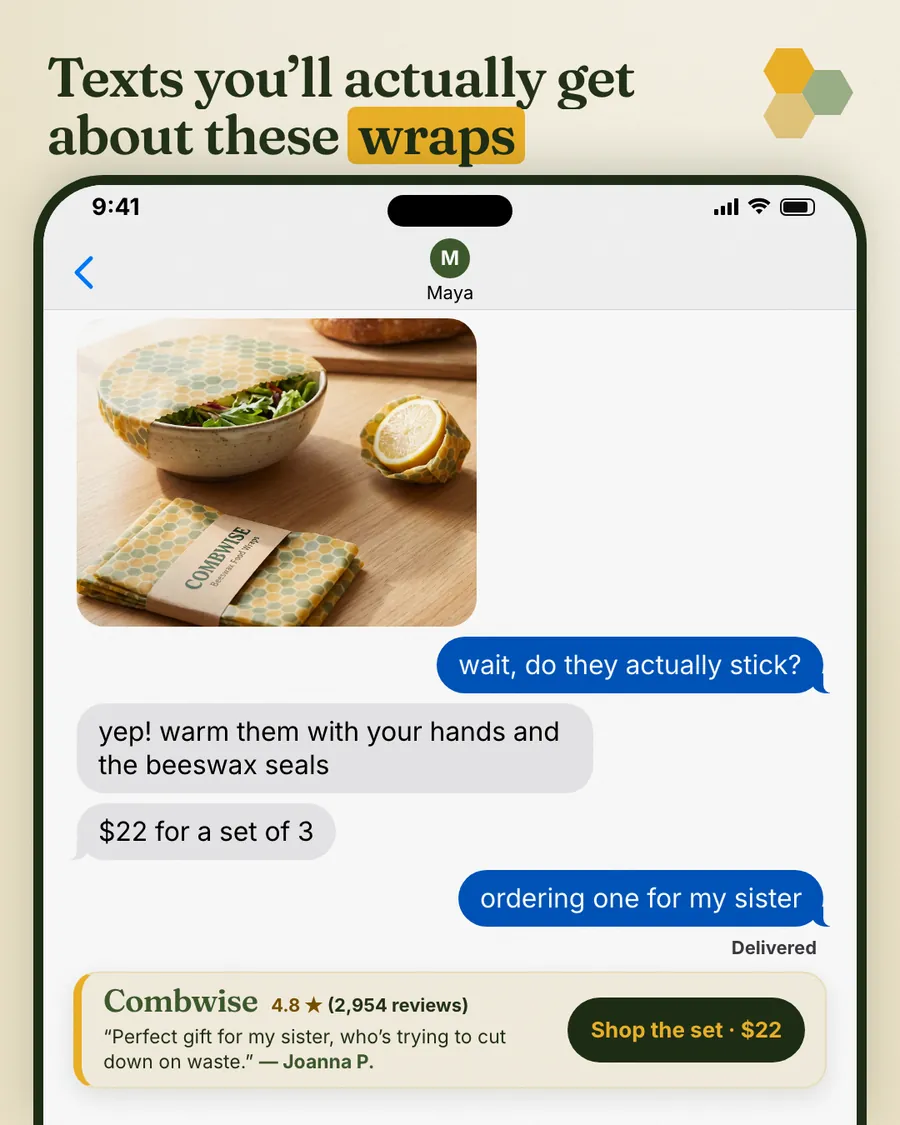
Text threadWord of mouth
Combwise: Texts you'll actually get about these wraps
Fictional sample brand · made by our engine
Words to be careful with
The FTC's Green Guides (16 CFR 260) set the rules for environmental claims. As of November 4, 2026, the FTC's Green Guides page still calls the 2012 revision the most recent update; a review opened in December 2022, and its latest listed step is a May 2023 workshop on recyclable claims.
"Eco-friendly" on its own
The Green Guides say marketers should not make unqualified general environmental benefit claims, and should limit them to a specific benefit with clear and prominent wording. Their own example is "Eco-friendly: made with recycled materials".
Compostable
A compostable claim needs competent and reliable scientific evidence that all the materials break down into usable compost in a safe and timely manner. If the item can't be composted safely or in a timely way in a home compost pile, the claim should say so.
Source: 16 CFR 260.7: Compostable claims
Biodegradable
A degradable claim needs evidence the entire item completely breaks down and returns to nature within a reasonably short time after customary disposal. An unqualified claim is deceptive for items that go to landfills, incinerators or recycling facilities, where full breakdown within one year doesn't happen.
Source: 16 CFR 260.8: Degradable claims
"Plastic-free" and other free-of claims
Even a true free-of claim can be deceptive if the product contains substances with the same or similar environmental risks as the one that's absent, or if that substance was never associated with the product category.
Source: 16 CFR 260.9: Free-of claims
Seals, certificates and organic
A certification seal counts as an endorsement, and a seal that doesn't say what it certifies likely conveys a general environmental benefit, so qualify it. For organic cotton, USDA rules call for at least 95% organic content for an organic label, and only fibers certified under its program can be called organic.
Recycled packaging
Call packaging recycled only if it is made from materials recovered or diverted from the waste stream, and qualify the share by weight if only part of it is.
Rules checked . The sources are linked at the end of this page.
How often to refresh eco-friendly product ads, and what to measure
Eco ads tire at a normal pace, but their comment threads age badly: an ad with a pile of unanswered greenwashing questions should be replaced even if its numbers still look fine.
On a small budget, two or three new ads every three weeks keeps things fresh. Rotate the use (a bowl, bread, cheese, cut fruit) and the reason (the swap, the materials, the lifespan). From mid-November, switch at least half the budget to gift ads and refresh them weekly until your last shipping date.
Meta shows "Creative limited" when an ad's cost per result rises above your past ads and "Creative fatigue" at twice as much. It recommends a new ad with a materially different image or video, not a new caption on the same photo.
What to measure
- Cost per purchase, by reason
- Shows whether buyers respond to the swap, the materials or the lifespan, which tells you what to say next.
- Share of orders over the free-shipping line
- The quickest read on whether add-ons and bundles are lifting order value.
- Gift orders in November and December
- Shows whether the gift ads are pulling their weight in the busiest weeks.
- Replacement orders after a year
- The long-term number that decides how much a first order can really cost.
Questions about advertising eco-friendly products
Where should an eco-friendly brand start advertising?
Start on Meta with your easiest swap shown in a real home, and three clear reasons to switch: the swap itself, the materials and how long it lasts. Add Google Shopping for people searching for the product by name, and Pinterest before gift season.
How do I promote eco friendly products without sounding preachy?
Sell the convenience and the pleasure of the swap first, and let the environmental benefit be one specific fact rather than a lecture. Show the product working in an ordinary kitchen, name the materials and skip guilt-based headlines that tell people they are doing it wrong.
How do I market eco friendly products for the home?
Pick the room where your product makes the clearest swap, usually the kitchen or bathroom, and advertise that one swap first. Bundles for a whole room work well once a first product has proven itself, and they lift the order value small eco products need.
How much should a small eco brand spend on ads?
Take your order value times the margin left after product, packaging, shipping and fees: no first order should cost more in ads. For low-priced swaps, the weekly budget for about 50 purchases is modest, but start lower, lift order value with bundles and raise spend as results hold.
Should I sell eco-friendly products on Etsy or Amazon?
Both can find buyers, but on either one the customer stays with the marketplace, so your replacement emails can't reach them. Etsy's Offsite Ads fee is 15% of an attributed order under $10,000 in yearly sales and 12% after. Many brands use a marketplace to start and grow their own store.
Has the FTC updated the Green Guides?
Not as of November 4, 2026. The FTC's Green Guides page still calls the 2012 revision the most recent update. A review opened in December 2022, the comment period was extended into 2023, and the latest listed step is a May 2023 workshop on recyclable claims.
Should eco brands advertise for the holidays?
Yes, eco swaps make easy, low-risk presents. Start gift pins in October, switch part of the Meta budget to gift ads by mid-November and stop promising Christmas delivery after your last shipping date. USPS recommends Ground Advantage by December 17 in the contiguous US.
How do I get repeat orders for a product that lasts a year?
Send care tips soon after delivery, then a replacement reminder near the end of the product's life, and offer related swaps in between. Gift season brings past buyers back as gift givers, so include them in your holiday emails.
What should I do when people comment that my product is greenwashing?
Answer with specifics: the materials, the lifespan, how it can be composted or recycled and the certificate you hold. If a comment points to a claim you can't back up, fix the ad. A calm, factual reply often persuades more readers than the ad did.
Get the ads for this plan
Paste your store link and get 3 free ads of your own eco-friendly products: we read your products, prices and reviews, design around your real product photo and check every fact against your store.
Where to go next
- Eco-friendly product ad ideasSeven sample ads for a beeswax wrap brand, the Green Guides word by word, and how to make a swap believable.
- Kitchen productsKitchen product ads that name the chore, the material and the facts buyers check, like dishwasher-safe.
- How to advertise cleaning productsA cleaning brand's ad plan: Meta demos first, refill emails that pay for the ads, Shopping for refill searches, and the germ claims to avoid.
- How to advertise kitchen productsCookware is bought by spec: Google Shopping and Meta demos first, a budget that leans on sets, and the coating claims to word carefully.
- How to advertise soapA handmade soap plan: Meta for the ingredients, bundles to lift a $10 order, stock that matches the ad budget, and the claims that turn soap into a drug.
- Christmas ad ideasThe 2026 shipping cutoffs that set your ad calendar, six Christmas offers, copy lines and 16 sample ads for four stores.
- Bundle offerBundle and set ads that show what is in the box and the real saving against buying separately.
- PricingFree preview, Lite $29/month for 9 designs a month (optional 2 weekly), Starter $49/month for 20. Meta and a 7-day trial from Growth.
Sources
Platform rules on this page were checked on against:
- Meta Business Help Center: About the learning phase
- Meta Business Help Center: About creative fatigue recommendations in Ads Manager
- FTC Guides Against Deceptive Pricing, 16 CFR 233.1 (former price comparisons)
- FTC: Green Guides (topic page with the review's dated steps)
- 16 CFR 260.4: General environmental benefit claims
- 16 CFR 260.6: Certifications and seals of approval
- 16 CFR 260.7: Compostable claims
- 16 CFR 260.8: Degradable claims
- 16 CFR 260.9: Free-of claims
- 16 CFR 260.13: Recycled content claims
- USDA AMS: Labeling Organic Products
- Etsy: Fees & Payments Policy
- USPS 2026 Holiday Shipping Deadlines
- 3 free ads, no signup
- Lite $29/month · 9 designs a month · optional 2 weekly
- Starter $49/month · 20 designs
- Growth $99/month, 7-day free trial
- Pro $149 · Scale $199
- 30-day money-back guarantee