cleaning product ads
Cleaning product ads that sell the shine, the smell and the refill
Search for cleaning product ads and you get TV commercials from the 1990s and a 2013 list of clever print ads. Neither helps a small brand with a refillable spray. A cleaning ad today has three jobs: show a result people can check, explain the refill in one line, and stay on the right side of the line between cleaning and killing germs. Below are seven ads our engine made for Glossbury, a fictional tablet cleaner brand.
Updated · The sample ads are for a fictional brand, made by our engine.
In short
What makes a good cleaning product ad?
A good cleaning product ad shows a result people can check (a streak-free mirror, a clean stovetop), explains how the product works in one line, and proves it with a review or rating. It names what's left out exactly. It never says it kills germs unless the product is registered with the EPA for that claim.
Real sample ads
Seven cleaning product ads for Glossbury
Glossbury is a fictional brand. Its product page: the All-Purpose Cleaner Starter Kit, a refillable 16 oz glass spray bottle plus 3 tablets for $18. One tablet in warm tap water makes 16 oz of cleaner in 10 minutes, streak-free on counters, sinks, tile and glass. Plant-based cleaning agents, no ammonia, bleach or dyes, eucalyptus and mint scent. Refill tablets ($12 for 6) ship in compostable paper packets. Rated 4.7 from 3,318 reviews, free shipping over $30. Nothing on the page claims to kill germs, and no ad does.
Glossbury · All-Purpose Cleaner Starter Kit · $18 · 4.7 from 3,318 reviews · fictional
Lifestyle typeFit
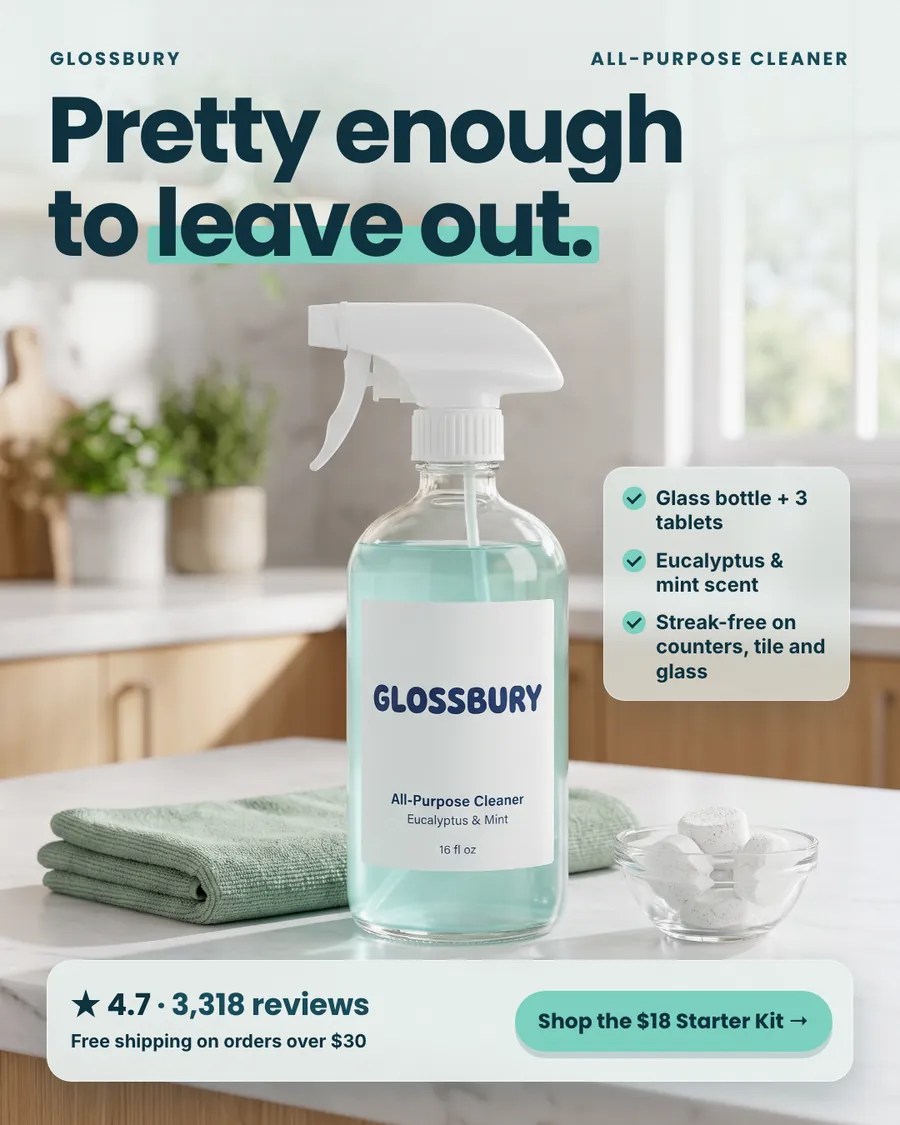
Glossbury: Pretty enough to leave out.
Most sprays live under the sink. This ad sells the opposite: a glass bottle that looks at home on a marble counter, a reason to switch that no germ claim could give. The three checks then say exactly what's in the kit.
Store facts used: $18 Starter Kit, glass bottle + 3 tablets, eucalyptus & mint scent, streak-free claim, 4.7 from 3,318 reviews, free shipping over $30
Matched by the fact check: $30 · $18 · 4.7 rating · 3,318 reviews · free shipping
The 2:3 Pinterest version
Fictional sample brand · made by our engine
Question hookCuriosity
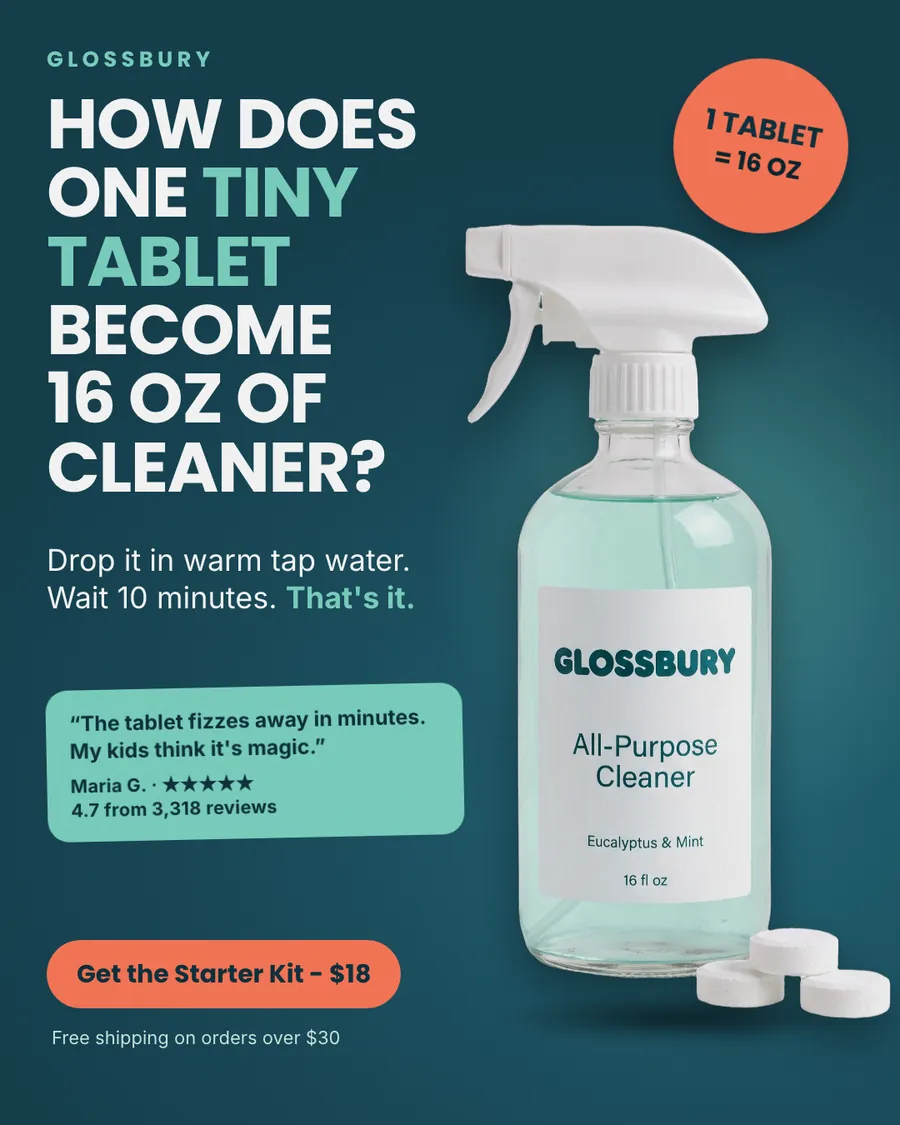
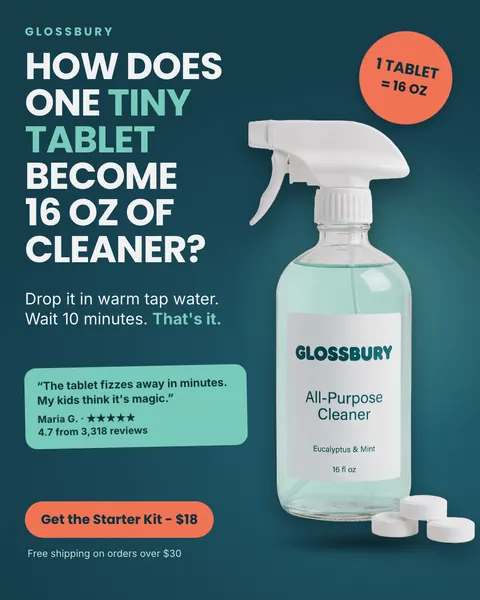
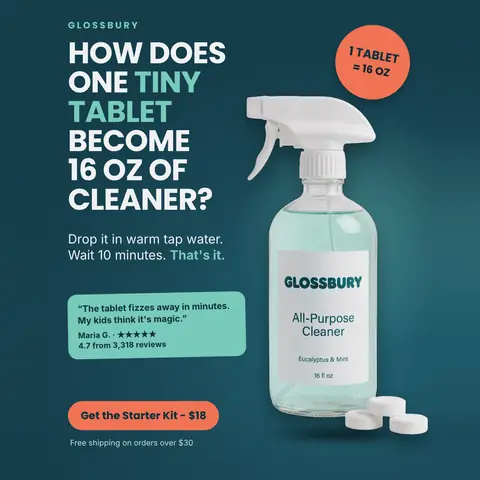
Glossbury: How does one tiny tablet become 16 oz of cleaner?
The tablet is the strange part of this product, so the ad leads with it as a question. 'Drop it in warm tap water. Wait 10 minutes.' is the whole instruction manual, and Maria's line about her kids watching it fizz is a moment people recognize.
Store facts used: 1 tablet = 16 oz, 10 minute wait, $18 Starter Kit, 4.7 from 3,318 reviews, Maria G. quote, free shipping over $30
Matched by the fact check: $18 · $30 · 4.7 rating · 3,318 reviews · 16 oz · 10 minutes · free shipping · 1 review quote, word for word
The 2:3 Pinterest version
Fictional sample brand · made by our engine
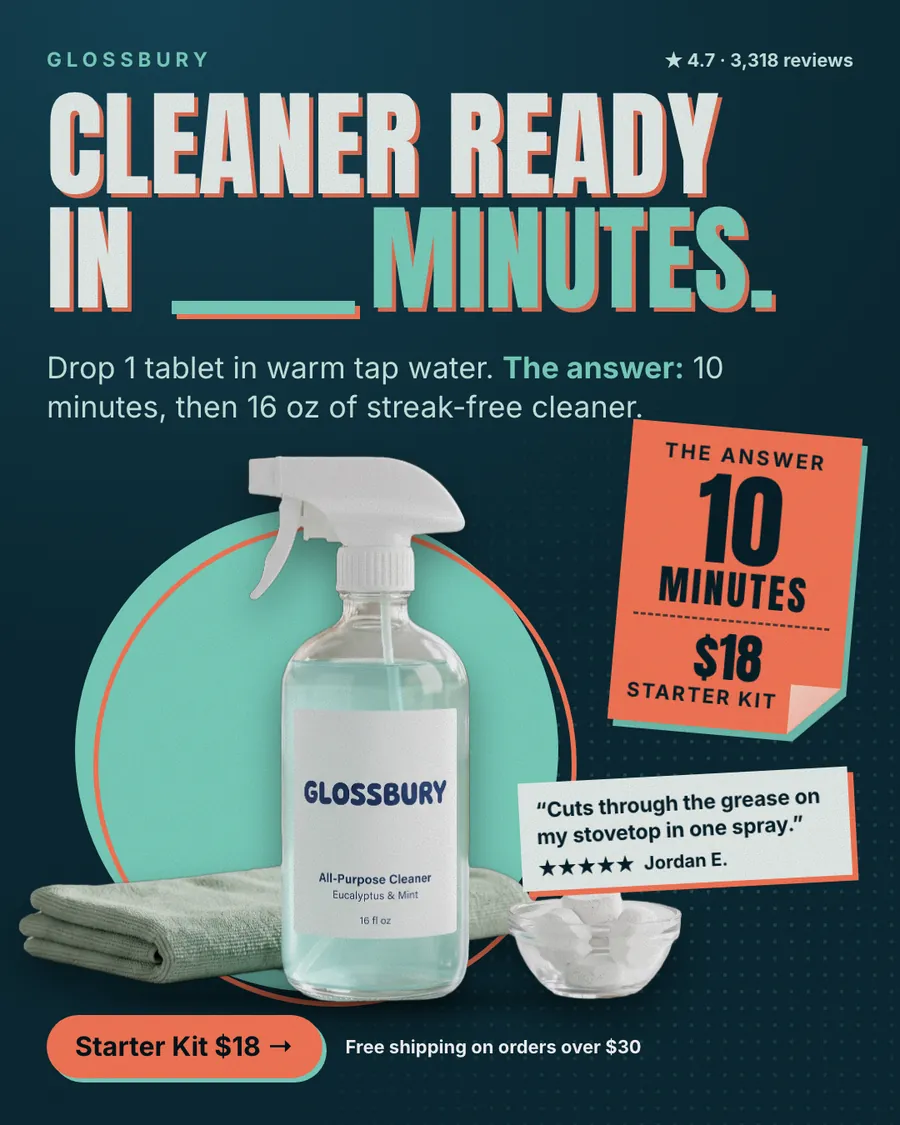
Fill in the blankConvenience
Glossbury: Cleaner ready in ____ minutes.
The blank invites a guess, and the orange note answers it with 10 minutes and $18 right beside the bottle. The steps are short enough to read in one glance: one tablet, warm water, 16 oz of cleaner.
Store facts used: 10 minutes, 16 oz, $18 starter kit, 4.7 from 3,318 reviews, Jordan E. quote, free shipping over $30
Matched by the fact check: $18 · $30 · 4.7 rating · 3,318 reviews · 10 minutes · 16 oz · 1 review quote, word for word
The 2:3 Pinterest version
Fictional sample brand · made by our engine
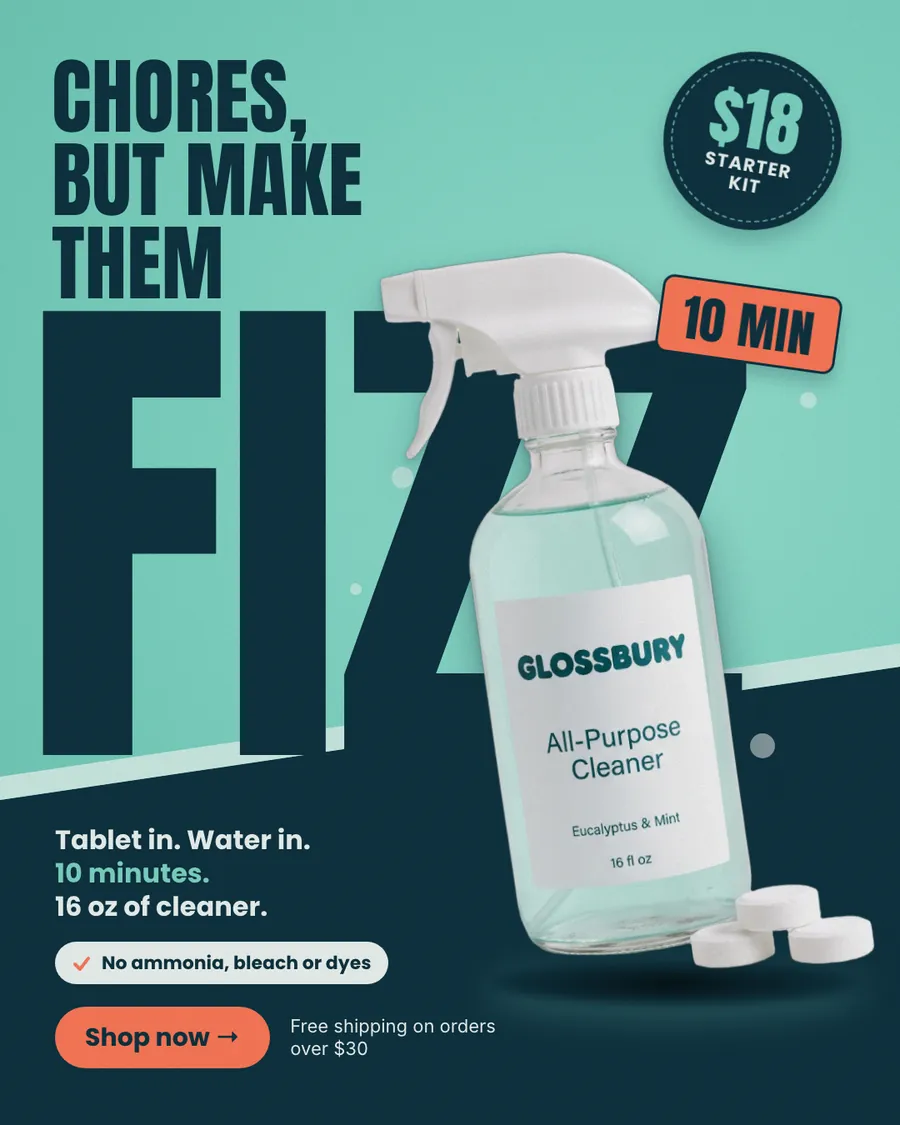
Bold posterConvenience
Glossbury: Chores, but make them fizz.
The oversized FIZZ is the loudest thing on the ad and the bottle overlaps it, so the joke and the product land together. The short line 'Tablet in. Water in.' explains the whole process in seconds.
Store facts used: $18 starter kit, 10 minutes, 16 oz, Eucalyptus & Mint, no ammonia, bleach or dyes, free shipping over $30
Matched by the fact check: $18 · $30 · 10 min · 10 minutes · 16 oz · free shipping
The 2:3 Pinterest version
Fictional sample brand · made by our engine
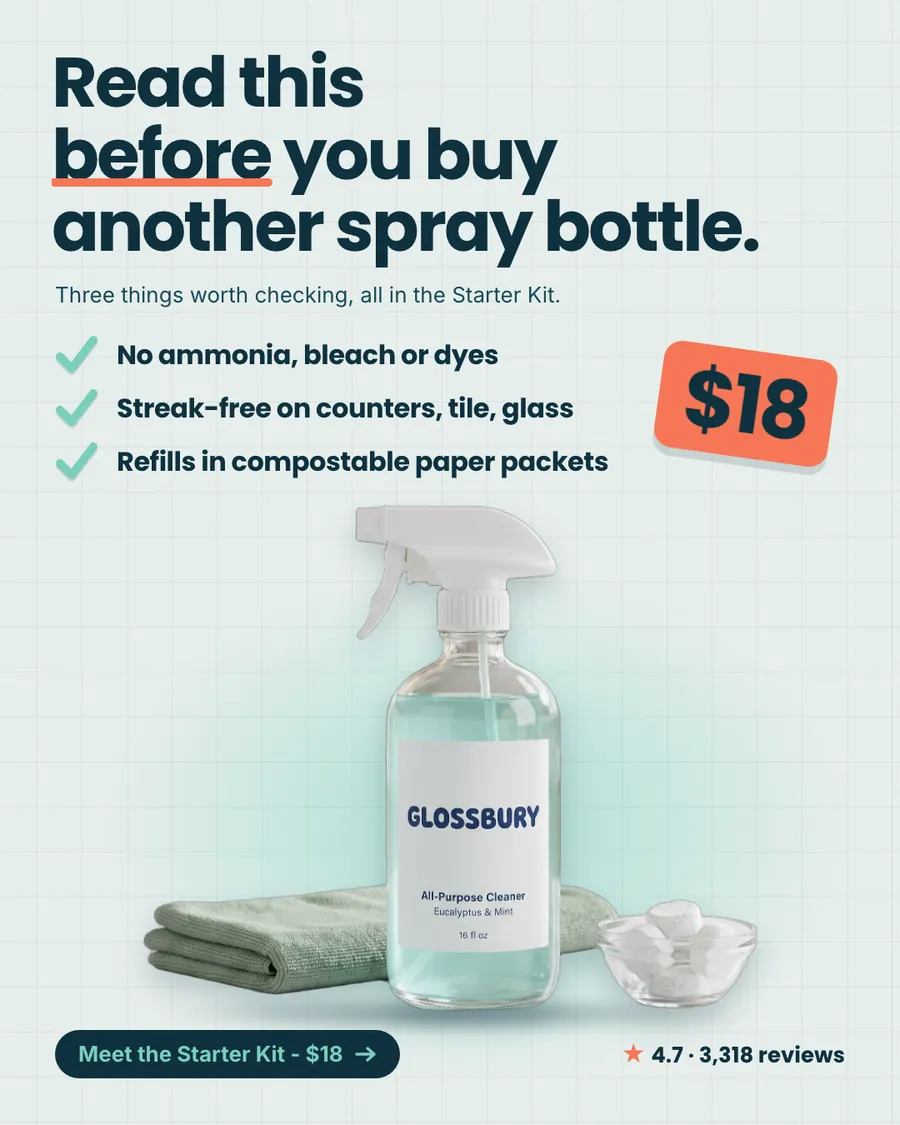
Read this firstComparison
Glossbury: Read this before you buy another spray bottle.
Three things a shopper can verify before buying any spray, and the kit passes all three. One fix for a real store: 'compostable paper packets' needs evidence that the packets break down in a home compost pile, or a qualifier saying where they do.
Store facts used: $18, no ammonia, bleach or dyes, streak-free on counters, tile, glass, compostable paper refills, 4.7 from 3,318 reviews
Matched by the fact check: $18 · 4.7 rating · 3,318 reviews
The 2:3 Pinterest version
Fictional sample brand · made by our engine
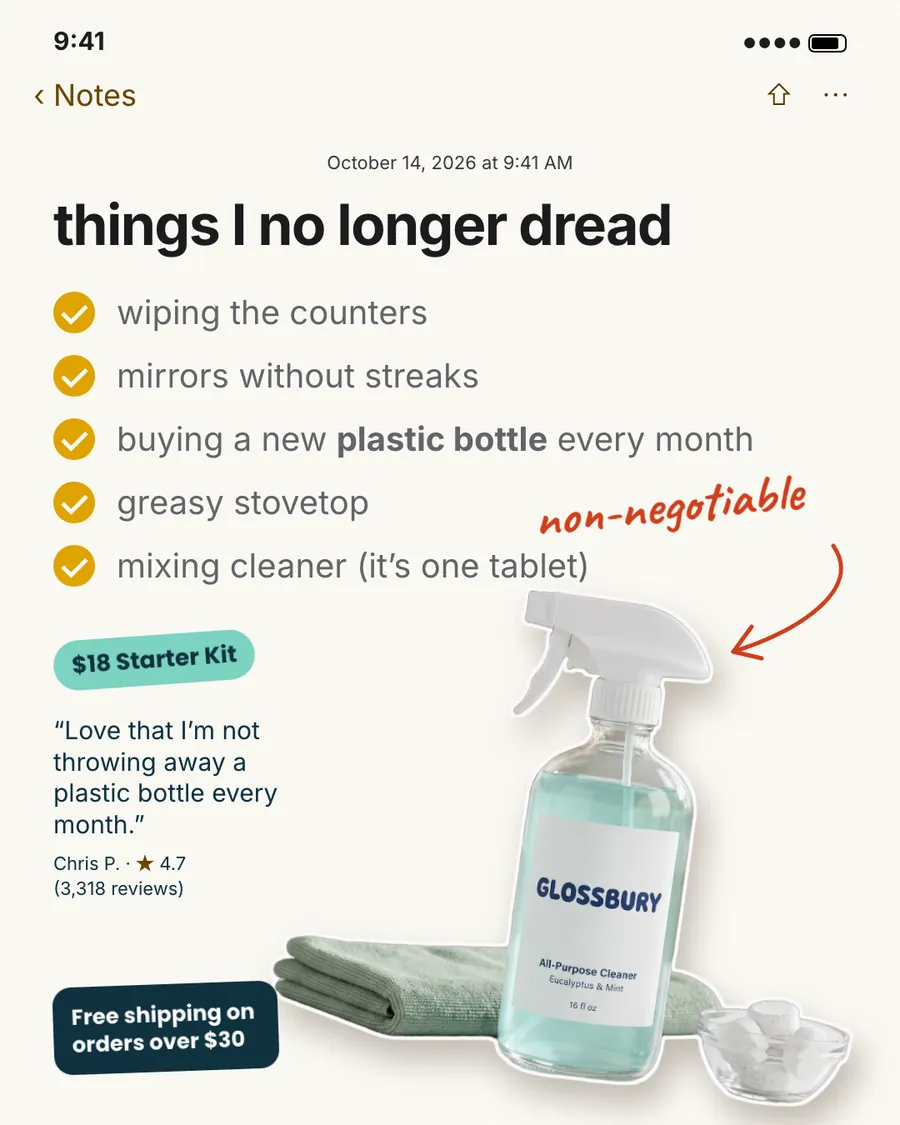
Notes-app listPersonality
Glossbury: things I no longer dread
A list of chores that stopped being annoying says 'convenient' in the brand's cheeky voice. Chris's review about not throwing away a plastic bottle every month makes the refill point in a customer's words instead of the brand's.
Store facts used: $18 Starter Kit, free shipping over $30, 4.7 rating from 3,318 reviews, Chris P. quote on plastic bottles, one-tablet mixing
Matched by the fact check: $18 · $30 · 4.7 rating · 3,318 reviews · free shipping · 1 review quote, word for word
The 2:3 Pinterest version
Fictional sample brand · made by our engine
Big numberSocial proof
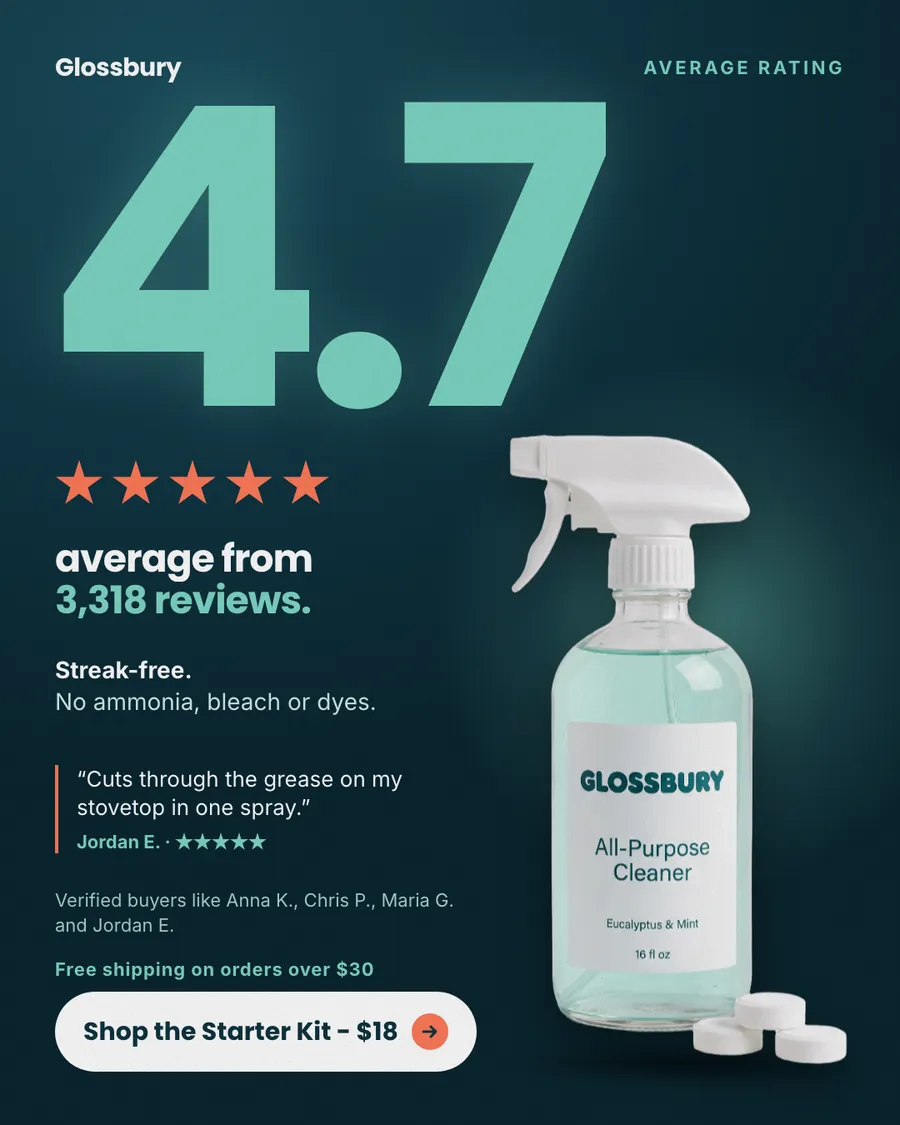
Glossbury: 4.7 average from 3,318 reviews.
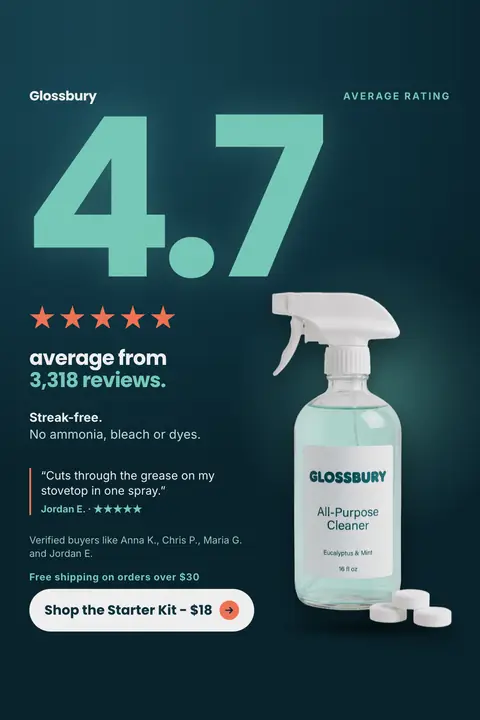
The 4.7 is the biggest thing on the ad, so the rating reads before anything else. The review count, one short quote about a real chore and the $18 button sit below it in reading order.
Store facts used: 4.7 rating, 3,318 reviews, Jordan E. quote, no ammonia, bleach or dyes, $18, free shipping over $30
Matched by the fact check: $30 · $18 · 4.7 rating · 3,318 reviews · free shipping · 1 review quote, word for word
The 2:3 Pinterest version
Fictional sample brand · made by our engine
The same ad in all five sizes
4:5 · Facebook and Instagram feeds
1:1 · Square placements
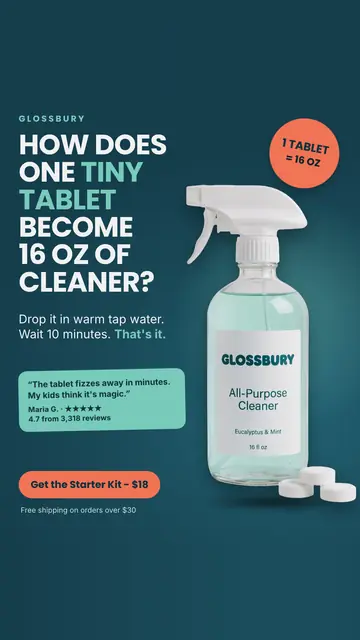
9:16 · Stories, Reels, TikTok
2:3 · Pinterest
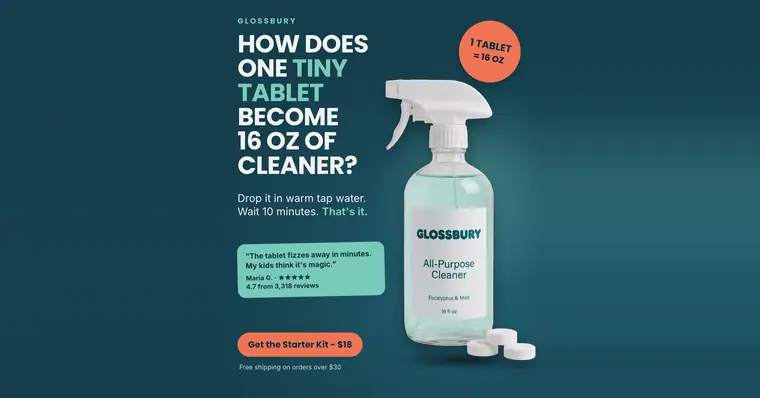
1.91:1 · Google Display
Put the refill math in the ad
A starter-kit price hides the real story of a refill brand: what the second, third and tenth bottle cost. Glossbury's numbers make it easy to show, and every figure is one a shopper can check on the product page.
| What you buy | Price | What it makes |
|---|---|---|
| Starter Kit: glass bottle + 3 tablets | $18 | 3 bottles of cleaner, 16 oz each |
| Refill tablets, 6 pack | $12 | 6 bottles of cleaner, so $2 per 16 oz |
| Whole Home Kit: 3 bottles + 9 tablets | $48 | 9 bottles of cleaner, one bottle per room |
A line like "$2 a bottle after the starter kit" is a value claim people can check, which is why it works. A comparison with a named supermarket spray would need current prices for the same volume, so most small brands are better off comparing with their own starter kit. The Whole Home Kit's $54 compare-at price is three Starter Kits at $18: a real sum, not an invented former price.
What makes a cleaning product ad work: four reasons people switch
People don't switch cleaners for fun. They switch when the new one cleans as well, is easier to live with, smells better, or ends a habit they feel bad about. Each needs a different kind of proof.
- 01
It cleans as well as the old one
The worry with any new or gentler cleaner is that it won't cut grease or will leave streaks on glass.
See it in the ad "Cleaner ready in ____ minutes."Proof the ad needs
A result named on the product page (streak-free on counters, tile and glass) and a review about a hard job (Jordan E.: "Cuts through the grease on my stovetop in one spray.").
- 02
It's easy to use and store
Tablets are new to most shoppers, and anything new needs a one-line explanation before it earns a click.
See it in the ad "How does one tiny tablet become 16 oz of cleaner?"Proof the ad needs
The steps and numbers from the page (1 tablet, warm tap water, 10 minutes, 16 oz) and a photo of the tablet next to the bottle.
- 03
A smell people don't mind
Bleach and ammonia fumes are what many people dislike most about cleaning day.
See it in the ad "Pretty enough to leave out."Proof the ad needs
The scent as the page names it (eucalyptus and mint) and the free-of line next to it (no ammonia, bleach or dyes).
- 04
Less waste, said exactly
Plenty of buyers want to stop buying a plastic spray bottle every month, and vague green words make them suspicious.
See it in the ad "Read this before you buy another spray bottle."Proof the ad needs
The specific facts: a glass bottle you keep, refills in paper packets, a customer who stopped buying plastic bottles. Each word needs backing (the Green Guides rows below).
Photo checklist for cleaning product ads
Cleaning ads need two kinds of photos: the product looking good enough to leave out, and proof of a result. Shoot the result shots in real, slightly messy rooms.
Bottle on a styled counter. The 'pretty enough to leave out' shot. Daylight, a cloth, a plant, and no food sitting on the surface you're about to spray.
The tablet dropping into water, mid-fizz. The one action shot this product has. Shoot a burst and keep the frame with bubbles around the tablet.
A mirror wiped halfway. Before and after in one frame, on your own mirror with your own cleaner. It proves streak-free better than the word does.
A greasy stovetop, then one wipe. Backs a review like Jordan's. Use a real mess and a single spray-and-wipe; a retouched result is a claim you can't support.
Refill packets beside the bottle. Shows what arrives next time and makes the refill model obvious without a paragraph of copy.
A hand mid-spray. Gives scale and makes a 16 oz glass bottle look easy to hold, which matters because glass sounds heavy.
Cleaning product ad copy lines you can adapt
Bright and a little cheeky works for chores. Keep every result to what you've tested and every free-of word to what's really missing from the formula.
One tablet. Warm water. 16 oz of cleaner.
Your steps, in the order people do them.
Ready in 10 minutes.
Pretty enough to leave out.
Only when the bottle really is.
"Cuts through the grease on my stovetop in one spray."
A review, exactly, with the name (Jordan E.).
No ammonia, no bleach, no dyes.
List only substances that are absent and that people expect in a cleaner.
$2 a bottle after the starter kit.
From your refill price; show the sum on the product page.
Keep the bottle. Refill the tablet.
Chores, but make them fizz.
Brand voice. Works when the next line explains the fizz.
Eucalyptus and mint, not bleach.
Lines to leave out of cleaning product ads
| Avoid | Why | Say instead |
|---|---|---|
| "Kills 99.9% of germs" | A claim to kill or reduce bacteria or viruses on surfaces makes the product a pesticide under EPA rules, and it must be registered before it's sold with that claim. | "Cuts through grease and leaves glass streak-free." |
| "Sanitizes" or "disinfects" | To the EPA these are antimicrobial pesticide claims, not cleaning words. | "Cleans counters, sinks, tile and glass." |
| "Non-toxic" | The FTC's Green Guides say it conveys safety for people and the environment and needs scientific evidence or a clear qualifier. | "No ammonia, bleach or dyes." |
| "Chemical-free" | Every cleaner is made of chemicals, water included, so the claim can't be true. | "Made with plant-based cleaning agents" (when your formula sheet supports it). |
| "Zero waste" or "eco-friendly" on its own | The Green Guides advise against unqualified general environmental claims, and any plastic part, a spray trigger for example, would make 'zero waste' untrue. | "Glass bottle you keep. Refills in paper packets." |
Cleaning claims: the EPA, the FTC and the Green Guides
Cleaning products aren't a restricted category in Meta's Advertising Standards. The rules that matter come from the EPA and the FTC, and the costliest mistake is a single word about germs.
| The ad says | What it is to regulators | What you need first |
|---|---|---|
| Cleans, cuts grease, streak-free | A cleaning and performance claim | A reasonable basis, such as your own tests, before the ad runs (FTC substantiation) |
| Sanitizes, disinfects, kills 99.9% of germs, antibacterial | An antimicrobial pesticide claim (EPA) | EPA registration for that product and claim |
| Non-toxic, safe for kids and pets | A safety claim (Green Guides, 16 CFR 260.10) | Scientific evidence for people and the environment, or a clear qualifier |
| No ammonia, bleach or dyes | A free-of claim (260.9) | None of the substance added, and a substance shoppers actually link to cleaners |
| Compostable packets | A compostable claim (260.7) | Evidence they break down safely in a home compost pile, or a qualifier saying where they will |
| Safer Choice logo | An EPA certification mark | Certification of that product under EPA's Safer Choice Standard |
Why one word matters so much: under 40 CFR 152.15, a product is a pesticide that must be registered if the seller claims, states or implies, in labeling or otherwise, that it can be used against pests, and the EPA's definition of pests includes bacteria and viruses on surfaces. The claim alone does it, whatever is in the bottle.
One Glossbury ad is missing from this page on purpose: a review card with a 'No more plastic' tag. The store's data says the bottle is glass and refills ship in paper packets, not that the kit contains no plastic at all, so the tag went further than the facts.
The cleaning calendar: hosting, spring and moving season
Cleaning is bought all year, but a few moments make people look at their counters, mirrors and bottles with fresh eyes.
| When | Moment | What to run |
|---|---|---|
| Now to Nov 25, 2026 | Getting ready to host | Ads about the surfaces guests see: glass, counters, the stovetop, before Thanksgiving on Thu, Nov 26. |
| Nov 27 to 30, 2026 | Black Friday to Cyber Monday | The Whole Home Kit ($48) as the offer. A bundle reads better than a percentage off an $18 kit. See Black Friday ad ideas. |
| December 2026 | After the parties | Grease and glass: the stovetop review and streak-free mirrors. A refill ad to everyone who bought a starter kit in October and November. |
| January 2027 | The reset month | Switch ads: the plastic bottle you stop buying, the glass one you keep. |
| March to April 2027 | Spring cleaning | Start early March, around the clock change on Sun, Mar 14. Run the tablet question, the refill math and the review ads together. |
| Thu, Apr 22, 2027 | Earth Day | Refill math and packaging facts, each stated exactly. Skip 'eco-friendly' on its own. |
| May to August 2027 | Moving season | Starter kits for a new place: a bottle for the kitchen, one for the bathroom, one for glass. |
What people ask about cleaning product ads
What are some catchy slogans for cleaning products?
The ones that describe a result or a ritual people know: "Pretty enough to leave out.", "One tablet. Warm water. 16 oz of cleaner.", "Chores, but make them fizz." Lines that promise sparkling, powerful cleaning are on every bottle already.
What are the current trends in cleaning products?
Among newer brands: refillable bottles you keep, concentrated tablets or refills that ship without water, glass or metal bottles, short free-of lists and named scents. In ads, the brands that do well show the refill and the result rather than a sparkle effect.
How do I advertise cleaning products on Facebook?
Start with three or four ads that each lead with one reason to switch: a result review, how the product works, the scent, and the refill math. Show the real bottle, keep germ words out unless the product is EPA registered, and let a week of purchases pick the winner.
Can I say my cleaner kills germs?
Only if the product is registered with the EPA as an antimicrobial pesticide for that claim. Saying, or even implying, that a product kills bacteria or viruses on surfaces makes it a pesticide that must be registered before it is sold that way.
Can I call my cleaning product non-toxic?
Only with competent and reliable scientific evidence that it is non-toxic for people and the environment, or a clear qualifier, according to the FTC's Green Guides. Naming what's left out, such as no ammonia, bleach or dyes, is easier to defend.
What should a cleaning product ad show?
The product, sharp and recognizable, plus one result people can check: a half-wiped mirror, a clean stovetop, a tablet fizzing into 16 oz of cleaner. Then a rating or review and the price.
Do before-and-after photos work in cleaning ads?
They can, if they are honest: your own product, a real mess, one wipe, no retouching. A mirror wiped halfway shows the result in a single frame. Exaggerated results turn the photo into a claim you can't back.
How do you advertise a refillable cleaning product?
Explain the refill in one line, show the bottle and the refill together, and put the cost per refill in numbers, such as $2 a bottle after the starter kit. A customer review about no longer buying plastic bottles does the waste argument better than the brand can.
What are some creative ideas for cleaning product ads?
A question about how a tiny tablet becomes a full bottle, a fill-in-the-blank for the mixing time, a notes-app list of chores people no longer dread, and a bold poster that leans into the fizz. All four are on this page.
Can I use the Safer Choice logo in my ads?
Only if that product is certified under EPA's Safer Choice program. The label is a certification mark, so it can't be used on a product that only shares some of the traits of certified ones.
Make ads like these for your cleaning products
Paste your store link and get 3 free ads of your own cleaning products: we read your products, prices and reviews, design around your real product photo and check every fact against your store.
Where to go next
- Eco-friendly product ad ideasSeven sample ads for a beeswax wrap brand, the Green Guides word by word, and how to make a swap believable.
- Kitchen product ad ideasSeven sample ads for a ceramic skillet brand, the specs cooks compare, and how to word coating and warranty claims.
- Home decor ad ideasSeven sample ads for a hand-thrown vase, styling and Pinterest advice, honest handmade wording and a decor calendar.
- Problem-solutionName the everyday problem, then show your product as the fix, in one honest frame.
- ComparisonUs-vs-them and old-way-vs-new-way ads with honest rows taken from your own product facts.
- PricingFree preview, Starter $49/month, weekly plans from $99/month with a 7-day free trial, 30-day money-back guarantee.
Sources
Rules and dates on this page were checked on against:
- eCFR: 40 CFR 152.15, pesticide products required to be registered
- eCFR: 40 CFR 152.5, pests (includes bacteria and viruses on surfaces)
- EPA: Antimicrobial Pesticide Registration
- EPA: Safer Choice
- FTC Green Guides: Free-of claims, 16 CFR 260.9
- FTC Green Guides: Compostable claims, 16 CFR 260.7
- FTC Green Guides: Non-toxic claims, 16 CFR 260.10
- FTC Green Guides, 16 CFR 260 (environmental marketing claims)
- FTC Policy Statement Regarding Advertising Substantiation
- FTC: The Consumer Reviews and Testimonials Rule, questions and answers (16 CFR 465)
- 3 free ads when your spot opens
- Starter $49/month
- Growth $99/month, 7-day free trial
- Pro $149 · Scale $199
- 30-day money-back guarantee