how to advertise matcha tea
How to advertise tea and matcha as a small brand
Tea is a habit product. A good matcha gets made every morning, the tin empties in a couple of weeks, and the buyer either comes back or drifts to whatever the grocery store has. So a tea plan spends its first money teaching a ritual and its second winning the refill. The example is Jadecliff Tea Co., a fictional matcha brand with tea from one family farm in Kagoshima.
Updated · Budgets and examples use a fictional brand's numbers. Use yours.
In short
How do you promote a tea brand?
Sell the daily ritual and one fact a buyer can check, such as the harvest, the grade or the origin, on a few Meta ads. Point new buyers at a starter kit that clears free shipping, email them before the tin runs out, and keep health and influencer claims within FTC and FDA rules.
StoreToAds makes ready-to-post ads from your product photo, free to try.
At a glance
- What you're selling
- A morning ritual, made with a product that runs out
- Where to start
- Meta (Facebook and Instagram) ads, with a starter kit as the first order
- The refill clock
- A 30 g tin is about 15 bowls: two weeks at one a day
- The claims trap
- Antioxidant, detox and energy lines that drift into health claims
- The busy weeks
- Gift season, when the kit doubles as a present
Which channels fit tea and matcha, in the order to try them
Most people who try good matcha need to be shown how to make it and why it tastes different. The channels below go from showing the ritual, to teaching it, to making the refill automatic.
- 01
Meta (Facebook and Instagram)
Start hereWhy it fits
A bright green bowl, a bamboo whisk and morning light stop a scroll, and Meta finds both curious first-timers and people already making lattes at home.
The trade-off
A $32 tin on its own leaves little room for ad cost. Ads should point new buyers at the kit or a basket that ships free.
- 02
Email and refills
Add nextWhy it fits
A daily drinker empties a 30 g tin in about two weeks. A refill note just before that, or a subscription, wins the second order without another ad.
The trade-off
It needs a first order first, and a subscription that is hard to pause turns into refunds.
- 03
Recipe creators
Add nextWhy it fits
Iced lattes and whisking videos teach the ritual better than a still photo, and creators who already make drinks at home show it in a real kitchen.
The trade-off
Paid or gifted posts need a clear disclosure, and the creator's health claims become your problem, as the FTC's 2020 case against a tea marketer showed.
- 04
Google Search and Shopping
Add nextWhy it fits
Someone searching "ceremonial matcha" or "first harvest matcha" already knows what they want, and a Shopping ad puts your tin, grade and price in front of them.
The trade-off
Those searches compare price per gram against big tins, so explain the grade on the page and list the larger Daily Matcha too.
- 05
Pinterest
Add laterWhy it fits
Drink recipes get saved and come back each season, so an iced matcha latte pin can keep working for months.
The trade-off
Saves turn into orders slowly. Judge it over a season, not a week.
- 06
Cafes and wholesale
Only if it fitsWhy it fits
A cafe that serves your matcha puts it in front of drinkers every day, and some will look for the tin to make it at home.
The trade-off
Wholesale pricing cuts the margin and takes sales time. Leave it until direct orders are steady.
Your first 30 days advertising matcha
Month one should tell you whether the hot bowl or the iced latte sells, whether people start with the tin or the kit, and how many come back for a refill.
Days 1 to 3
Teach the ritual on the product page
Show the grade, the harvest, the origin and how to make it: Jadecliff says 2 g of matcha whisked with 70 ml of water at 80°C. Say how many bowls a tin makes. Test a purchase and confirm Meta Events Manager records it.
Days 4 to 10
Launch 6 ads on three angles
Two ads each for the morning ritual, the taste (smooth, not bitter) and the coffee swap in a customer's words. Use one Sales campaign with a broad audience, sized 4:5 and 9:16, and send half the ads to the tin and half to the starter kit.
Days 11 to 17
Leave it alone, then compare tin and kit
Make no edits for a week. Then compare cost per purchase for the tin ads and the kit ads, and look at which angle brings first-timers versus people who already own a whisk.
Days 18 to 24
Send the refill note and add a recipe
Email each buyer about ten days after delivery, before the tin runs dry, with a refill or the larger Daily Matcha. Add two ads with an iced latte recipe, and send tins to a few drink creators with a written disclosure request.
Days 25 to 30
Set up gift season
Make gift ads for the starter kit and pick your order-by date for Christmas, working back from your carrier's last date. Black Friday is November 27, 2026; decide now whether you'll run an offer or simply push the kit.
How to size a starting budget for matcha ads
Matcha carries a better margin than most food, but a single tin is still a small order. Jadecliff's tin is $32 and free shipping starts at $45, so its ads lead first-timers to the Matcha Starter Kit at $72.
| Order value | $72.00 |
|---|---|
| Margin after product cost, shipping and fees | 55% |
| Most a first order can cost to break even | $39.60 |
| 50 purchases a week at that cost | $1,980 a week |
| The same budget per day | about $283 |
Meta says an ad set usually leaves its learning phase after about 50 results in the week after its last significant edit, and recommends a budget large enough to get enough results. Meta Business Help Center: About the learning phase
Few small tea brands can spend that every week from day one. The good news is that tea is bought again and again, so the first order doesn't have to carry the whole cost if the refills really come.
- Use the kit to raise the first order. A kit built for beginners lifts the order past free shipping without a discount on the tea itself.
- Count refills only once you've seen them. If your records show buyers reorder within a month, a first order can cost more than its margin. Use your own numbers, not hopes.
- Start on a more frequent goal if needed. Below about 50 purchases a week, Meta suggests optimizing for an event that happens more often, such as add to cart.
The tin math: bowls, price per bowl and the refill date
Jadecliff's serving is 2 g of matcha, so each pack is a number of bowls and a date the buyer will run out. Simple division of its store prices (fictional):
| Pack | Price | Bowls at 2 g | Per bowl | Lasts at one a day |
|---|---|---|---|---|
| Ceremonial Matcha, 30 g tin | $32 | About 15 | About $2.13 | About two weeks |
| Daily Matcha, 100 g | $38 | About 50 | About $0.76 | About seven weeks |
| Two ceremonial tins | $64 | About 30 | About $2.13 | About a month |
The refill note works best a few days before the last bowl, which for a daily drinker of the 30 g tin is roughly ten days after delivery.
Offers that work for tea and matcha
Tea offers should remove the beginner's doubts or make the refill easy. A discount on one tin mostly brings in people who leave when the price goes back.
A starter kit for first-timers
Jadecliff's kit is $72 against $86 before. It answers "what do I need to start" and clears free shipping in one step.
Watch: The earlier price has to be a real one you charged, for a real period.
A refill subscription
A tin that arrives as the last one empties keeps the habit going and saves the buyer a reminder.
Watch: Show how often it ships, the price and how to cancel before checkout.
The bigger bag for daily drinkers
Once someone drinks matcha every day, the 100 g Daily Matcha works out far cheaper per bowl, which keeps them from switching to a grocery tin.
A gift kit with a real order-by date
The starter kit makes a complete present. In December, a clear date for Christmas delivery is worth more than a code.
Watch: For 2026, USPS recommends sending Ground Advantage by December 17 for delivery before Christmas in the lower 48.
Angles to test for tea and matcha ads
Each angle answers why this matcha and not a cheaper tin. The whisking shots and finished matcha ads are on Tea ad ideas; here are the angles the opening month should compare.
The ritual
21 days in shade. One calm bowl.
The taste myth
MYTH: Good matcha has to be bitter.
The coffee swap, in a customer's words
"Replaced my second coffee with this. It's my morning ritual now."
The process as a question
Why does this matcha spend 21 days in the shade?
The recipe
"Makes the best iced matcha latte I've had outside a cafe."
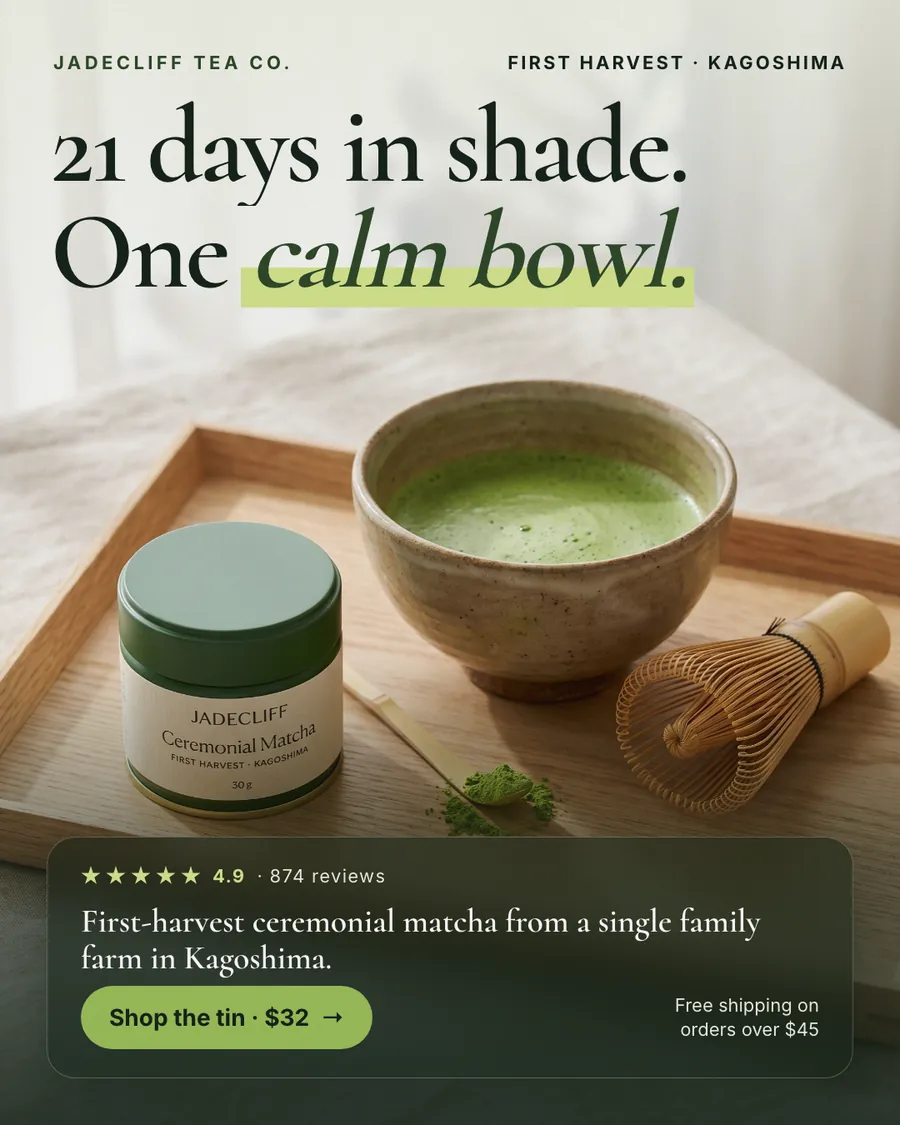
Lifestyle typeRitual
Jadecliff Tea Co.: 21 days in shade. One calm bowl.
Fictional sample brand · made by our engine
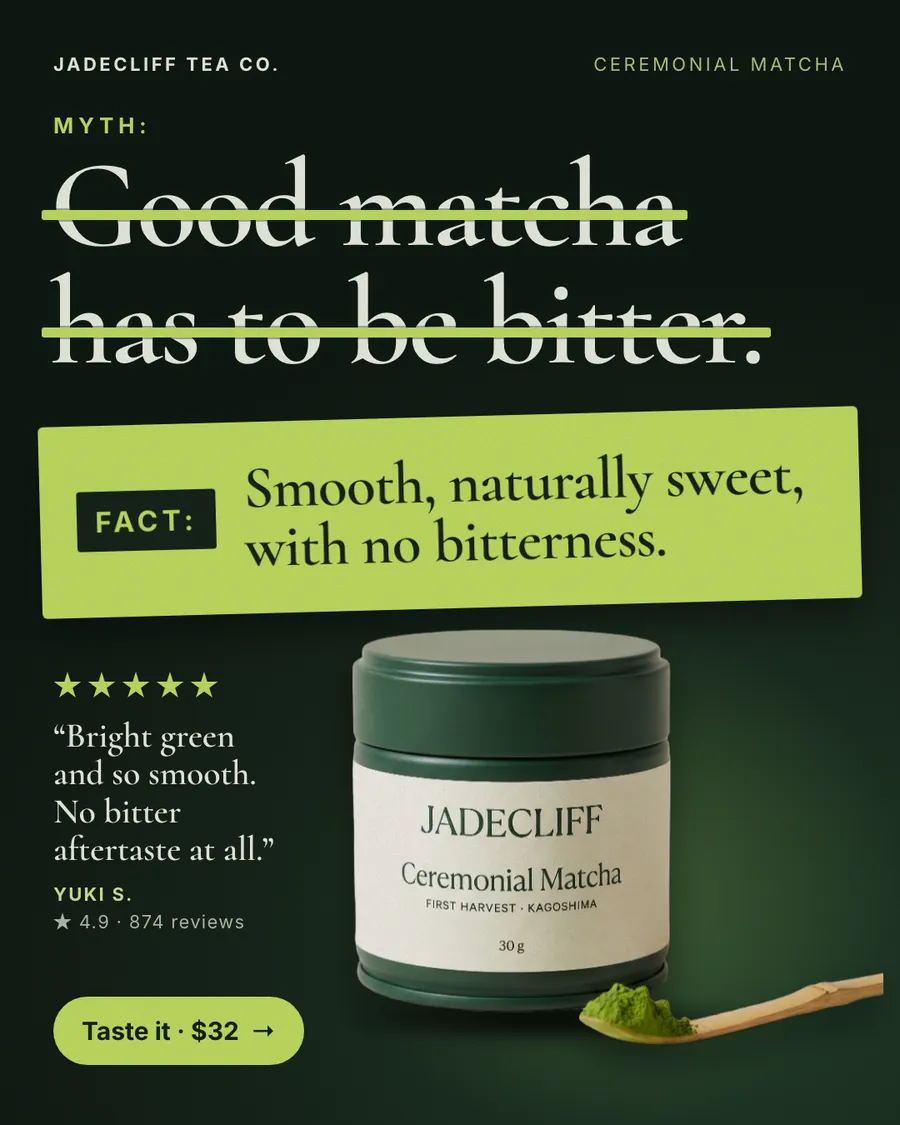
Myth vs factTaste
Jadecliff Tea Co.: MYTH: Good matcha has to be bitter.
Fictional sample brand · made by our engine
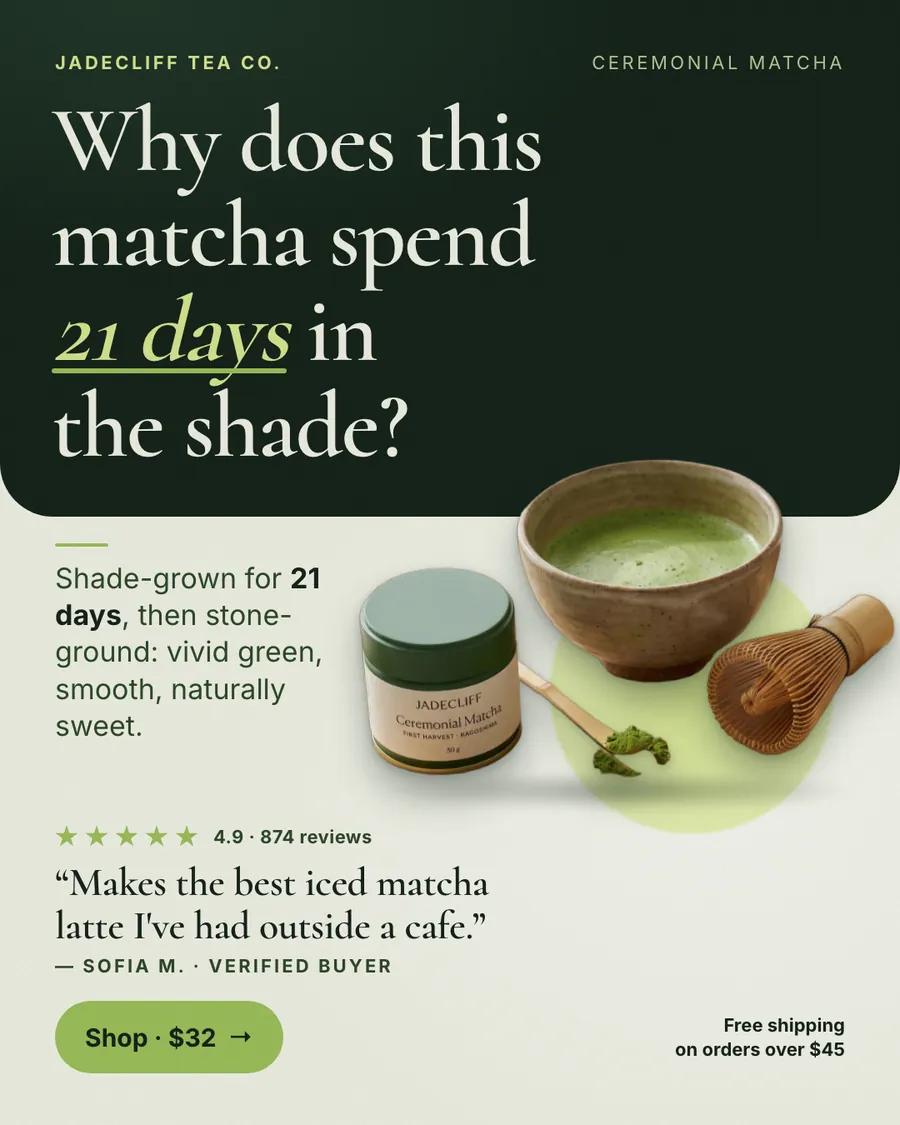
Question hookCraft
Jadecliff Tea Co.: Why does this matcha spend 21 days in the shade?
Fictional sample brand · made by our engine
Words to be careful with
Tea is not a restricted category on Meta or Google. The risk is wellness language: tea has a long history of ads that promise more than a drink can, and regulators have acted on it.
Antioxidants and disease
The FDA treats a line linking a food substance to a disease or health-related condition as a health claim, which needs FDA authorization. Structure or function claims for regular foods must come from the food's nutritive value. "Rich in antioxidants that fight disease" crosses that line.
Source: FDA: Label Claims for Conventional Foods and Dietary Supplements
Caffeine numbers
FDA cites 400 mg a day as an amount not generally linked to negative effects in healthy adults, and its figure for green tea is about 37 mg per 12 fl oz, which doesn't describe a bowl of matcha. The amount isn't required on labels, so print a number only if you measured your own.
Source: FDA: Spilling the Beans: How Much Caffeine Is Too Much?
Influencer posts
In 2020 the FTC settled with a tea marketer whose paid influencer posts showed the disclosure only after a "more" click, alongside weight loss claims without reliable evidence: a $15.2 million judgment, suspended after a $1 million payment. The FTC says disclosures must be visible without clicking "more".
Source: FTC: Tea marketer misled consumers, didn't adequately disclose payments to influencers
Detox and weight words on Meta
Meta requires ads for weight loss and dietary products to target people 18 or older, and it doesn't allow statements of inferiority about someone's appearance. A detox tea ad lands in that category; a ritual ad doesn't.
Grade, harvest and origin
"First harvest", "shade-grown 21 days" and "one family farm" are objective claims. The FTC expects a reasonable basis for them before the ad runs, such as your supplier's paperwork.
Source: FTC: Policy Statement Regarding Advertising Substantiation
Rules checked . The sources are linked at the end of this page.
How often to refresh tea ads, and what to measure
Ritual ads can run longer than most, because the image of a calm morning doesn't date. They still tire with the same audience, and the seasons change what people drink.
On a small budget, add two or three new ads every three or four weeks, and switch the drink with the weather: hot bowls in the cold months, iced lattes from spring. In gift season, refresh weekly while spend is up.
Ads Manager (Facebook's tool for running ads) shows "Creative limited" when an ad costs more per result than your past ads and "Creative fatigue" when it costs at least twice as much. Meta recommends a materially different image or video, and notes that keeping the original running may still help results.
What to measure
- Cost per purchase, tin against kit
- Tells you which first order to send the next batch of ads to.
- Refill orders within 30 days
- A daily drinker empties a tin in about two weeks; if they don't come back within a month, the refill note or the offer needs work.
- Share of orders over the free-shipping line
- Single-tin orders that ship at your cost erode the margin the ads rely on.
- Subscription pauses and cancels
- An early cancel often means the delivery comes too often, not that the tea disappointed.
Questions about advertising tea and matcha
How do I start advertising a matcha brand?
Teach the ritual on your product page first: grade, harvest, origin and how to make a bowl. Then run six Meta ads in one campaign on the ritual, the taste and a customer's coffee swap, send half to a starter kit, and leave them alone for a week before judging.
How much should a tea brand spend on ads?
Multiply your typical first order by the margin left after tea, packaging, shipping and fees. That is the most a new customer can cost before you lose money. Meta's learning phase (Facebook's first days of testing who to show the ad to) looks for about 50 results a week, so smaller brands often start on add to cart.
Should a matcha brand work with influencers?
Recipe creators can teach the ritual well, but every paid or gifted post needs a clear disclosure that's visible without clicking more, and the FTC (the US consumer protection agency) expects brands to monitor what the people they pay say. Give them only the facts you can prove and ask to see posts before they go up.
How do I get tea customers to reorder?
Work out when the tin runs out, about two weeks for a daily drinker of a 30 g tin, and send a refill note a few days before. Offer a subscription and the larger bag for people who drink it every day.
Should I sell my tea on Amazon?
Start on your own site, where you keep the customer and can time the refill. Add Amazon later if buyers ask for it, knowing that fees eat into a small tin and those buyers won't be on your email list.
Can I advertise matcha as a coffee replacement?
You can quote a real customer who says they swapped their second coffee, because that describes their habit. Be careful with energy or focus claims, and if you mention caffeine, give a number you've measured for your own matcha rather than a general figure.
Can a tea ad mention weight loss or detox?
Only with reliable scientific evidence behind it, which few teas have. The FTC acted against a tea marketer over unsupported weight loss claims in 2020, and Meta requires weight loss and dietary product ads to target adults 18 and older.
When should a tea brand advertise gift sets?
Start gift ads in early November, with Black Friday on November 27, 2026, and put an order-by date in every ad from December 1. Work that date back from your carrier's last day for Christmas delivery and your packing time.
How do I promote matcha drinks at a cafe?
A cafe's plan is local: claim the free Google Business Profile listing, post the seasonal drink with a real photo, and run Meta ads to people within a short distance of the shop. If you also sell tins, put them by the register.
Get the ads for this plan
Paste your store link and get 3 free ads of your own tea: we read your products, prices and reviews, design around your real product photo and check every fact against your store.
Where to go next
- Tea ad ideasSeven sample matcha ads: origin, taste, the daily ritual and reviews, plus grade words, caffeine and health claim rules.
- TeaTea and matcha ads from your page: origin, harvest, how to brew it and reviews, with health and caffeine claims held back.
- How to advertise coffeeA roaster's plan: ads that win the first bag, emails and a subscription that win the second, and a budget that counts both.
- How to advertise drinksA plan for a drink brand selling cases online: a trial-sized first order, Meta and TikTok first, and a budget that survives shipping weight.
- How to advertise mugsA plan for handmade mugs: Meta for gift and self buyers, Etsy only with its fees in mind, a set that ships free, and claims you can prove.
- Christmas ad ideasThe 2026 shipping cutoffs that set your ad calendar, six Christmas offers, copy lines and 16 sample ads for four stores.
- Product photos that sell: the shots every ad needsAds ask more of a photo than a product page does. Here is how to shoot, with a phone and a window, the handful of photos that can carry months of ads.
- PricingFree preview, Lite $29/month for 9 designs a month (optional 2 weekly), Starter $49/month for 20. Meta and a 7-day trial from Growth.
Sources
Platform rules on this page were checked on against:
- Meta Business Help Center: About the learning phase
- Meta Business Help Center: About creative fatigue recommendations in Ads Manager
- FDA: Label Claims for Conventional Foods and Dietary Supplements
- FDA: Spilling the Beans: How Much Caffeine Is Too Much?
- FTC: Tea marketer misled consumers, didn't adequately disclose payments to influencers
- FTC: FTC's Endorsement Guides: What People Are Asking
- Meta Advertising Standards: Health and Wellness
- FTC: Policy Statement Regarding Advertising Substantiation
- Google: Business Profile
- USPS 2026 Holiday Shipping Deadlines
- 3 free ads, no signup
- Lite $29/month · 9 designs a month · optional 2 weekly
- Starter $49/month · 20 designs
- Growth $99/month, 7-day free trial
- Pro $149 · Scale $199
- 30-day money-back guarantee