how to advertise drinks
How to advertise drinks online as a small beverage brand
A drink is the hardest thing to sell from a screen: nobody can taste it, and the smallest sensible order is a heavy case. Most beverage marketing advice is written for bars and supermarket shelves. This plan is for a brand shipping cans to homes, worked through with Sora, a fictional sparkling yuzu water.
Updated · Budgets and examples use a fictional brand's numbers. Use yours.
In short
How do you advertise drinks as a small brand?
Decide the first order before the first ad: a variety pack or two cases that clear free shipping. Then run Meta and short-video ads that sell the taste through customers' words, the label facts and the price per can, and win the reorder with a restock email when the case runs out.
At a glance
- The barrier
- Nobody can taste it, and the first order is a whole case
- Sell first
- A variety pack or the order that clears free shipping
- Where to start
- Meta ads, then TikTok once you have short videos
- The rule that bites
- Label words like calorie free have legal definitions
- Plan around
- Weather: summer heat lifts demand and ad competition
Which channels fit drinks, in the order to try them
Drinks are bought on taste and habit, then restocked without much thought. You need a channel that makes a stranger curious enough to try a case, and a way to be there when the fridge is empty.
- 01
Meta (Facebook and Instagram)
Start hereWhy it fits
A can at phone size, a customer saying what it tastes like and a price per can is enough to make someone curious. Habit angles, like replacing the afternoon soda, give people a reason to try it this week.
The trade-off
Taste is the reason to buy and the one thing an image can't deliver, so expect more clicks than orders until reviews and per-can value do the work.
- 02
TikTok
Add nextWhy it fits
Taste tests, fridge restocks and the sound of a can opening are native formats there, and drinks are easy to show in a few seconds.
The trade-off
It runs on new video every week. Without someone filming regularly, a static-only TikTok account stalls.
- 03
Email and SMS restock reminders
Add nextWhy it fits
Twelve cans last a daily drinker under two weeks. A reminder timed to that, with the per-can price, is cheaper than finding a new buyer.
The trade-off
It needs a first order and an opt-in. SMS requires explicit consent before any marketing text.
- 04
Pinterest
Add laterWhy it fits
Mocktail and spritz recipes get saved there, especially before summer and holiday hosting, and a recipe pin can feature your can as the mixer.
The trade-off
Buyers there are planning, not ordering, so it suits a brand whose drink works in recipes more than one sold only on its own.
- 05
Google Shopping
Add laterWhy it fits
People who already know a flavor or a brand search it by name, and Shopping catches them with the pack and price.
The trade-off
Generic searches like "sparkling water" are owned by big brands at supermarket prices. It gets useful once your own name or flavor is searched.
- 06
Amazon
Only if it fitsWhy it fits
Many households already restock drinks there, and a subscription habit can form on its own.
The trade-off
Heavy cases mean high fulfillment fees on a low-margin product, price comparison sits right next to you, and the customer relationship stays with Amazon.
Offers that work for drinks
The first offer has one job: lower the risk of buying a case of something you haven't tasted. After that, offers should reward restocking, not train people to wait for the next sale.
A variety pack as the first order
Several flavors in one box answer the unspoken question, what if I don't like it. Sora's 24-can variety pack works out cheaper per can than a single 12-pack.
Free shipping on two cases
Shipping is what makes a drink order feel expensive. Sora's free shipping on two packs turns a $29 order into $58 and makes the per-can price the headline.
Watch: Check the threshold still leaves margin once heavy boxes are actually shipped.
A real compare-at price
Sora's 12-pack is $29, compared with $34. A price drop is a clear reason to try now.
Watch: Only if $34 was a genuine price you sold at, not a number made up to frame the sale.
Restock and save
A standing order every few weeks fits a fridge staple and gives you predictable volume.
Watch: Show the rhythm, the price and how to cancel next to the offer.
Pick the first order before you pick the ad
Every ad should point at one entry product. For a drink, the right one balances price, risk and shipping. Here are Sora's options, from its own product page:
| First order | Price | Per can | Why it might win |
|---|---|---|---|
| Sparkling Yuzu, one 12-pack | $29 | About $2.42 | Lowest price, but pays shipping |
| Two 12-packs | $58 | About $2.42 | Clears free shipping; doubles the order your budget starts from |
| Variety Pack, 24 cans | $52 | About $2.17 | Lowest per-can price and lets people find a favorite |
Your first 30 days advertising drinks
Four weeks: set the entry product, let a few ads learn, then build the restock loop. It assumes you sell from your own store and run ads from a Meta ad account.
Days 1 to 3
Make the product page answer the label questions
Show the nutrition panel, the calories and sugar per can, the can size and count, the per-can price and the free shipping rule on the page every ad opens. Confirm purchases are tracked with a test order.
Days 4 to 7
Launch eight ads on four reasons to try
Two each for the taste (a customer's words), the label (zero sugar, calories per can), the habit (the afternoon soda swap) and the value (price per can). One Sales campaign, one ad set, broad targeting where you ship, 4:5 and 9:16 versions.
Days 8 to 14
Let the ad set learn
Change nothing in the ad set. Look at which reason gets add to carts, and whether people choose the variety pack or the single flavor.
Days 15 to 21
Start the restock reminder
Email first buyers about ten days after delivery with the per-can price and a one-click reorder. Pause clear losers and add two new ads on the best reason, plus a short video if you can film one.
Days 22 to 30
Plan for the weather
If cost per purchase is under break-even, raise the budget in small steps. Before summer, prepare cold-drink ads in advance, because demand and ad competition both rise with the temperature.
How to size a starting budget for drink ads
Use the order that clears free shipping, because that's what most first buyers should be nudged toward. For Sora that's two 12-packs, and the margin is thin once heavy boxes ship free.
| Order value | $58.00 |
|---|---|
| Margin after product cost, shipping and fees | 32% |
| Most a first order can cost to break even | $18.56 |
| 50 purchases a week at that cost | $928 a week |
| The same budget per day | about $133 |
Meta says an ad set usually leaves its learning phase after about 50 results in the week after its last significant edit, and recommends a budget large enough to get enough results. Meta Business Help Center: About the learning phase
Shipping weight is the line most new drink brands underestimate: cans are heavy, so a free-shipping offer takes a bigger share of the order than it would for a candle or a T-shirt. Check that margin against real carrier invoices before you trust the number above.
- Count the restock, from your own data. Drinks are reordered, so a first order can cost more than its margin if your buyers come back. Measure the share who reorder within 45 days before relying on it.
- Optimize for add to cart until purchases flow. Meta's own fix for an ad set that can't get enough purchases is a more frequent event; switch back once you reach steady orders.
- Sell more cans per box. One 24-can box usually costs less to ship per can than two separate 12-packs, which lifts margin without a discount.
Angles to test for drink ads
Drinks need the taste in someone else's words and one hard fact from the label. The sample ads, photo notes and claim wording are on Beverage ad ideas; these are the angles the plan above tests.
The taste, from a customer
"Tastes like actual citrus, not candy."
One label fact
Zero sugar. 5 calories a can.
The habit swap
Your 3 pm soda, replaced.
Price per can
Two cases, free shipping, about $2.42 a can.
The cold moment
Straight from the fridge, on the hottest day of the year.
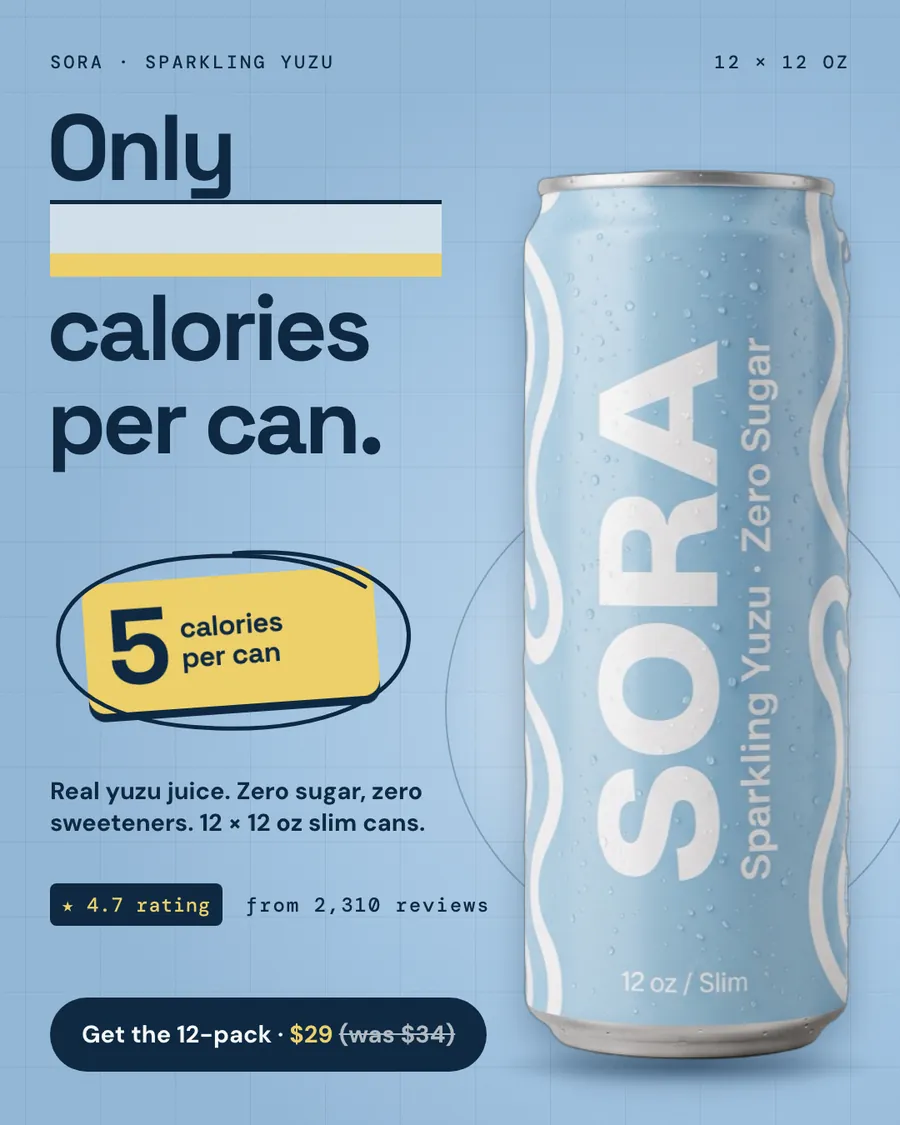
Fill in the blankBenefit
Sora: Only ___ calories per can.
Fictional sample brand · made by our engine
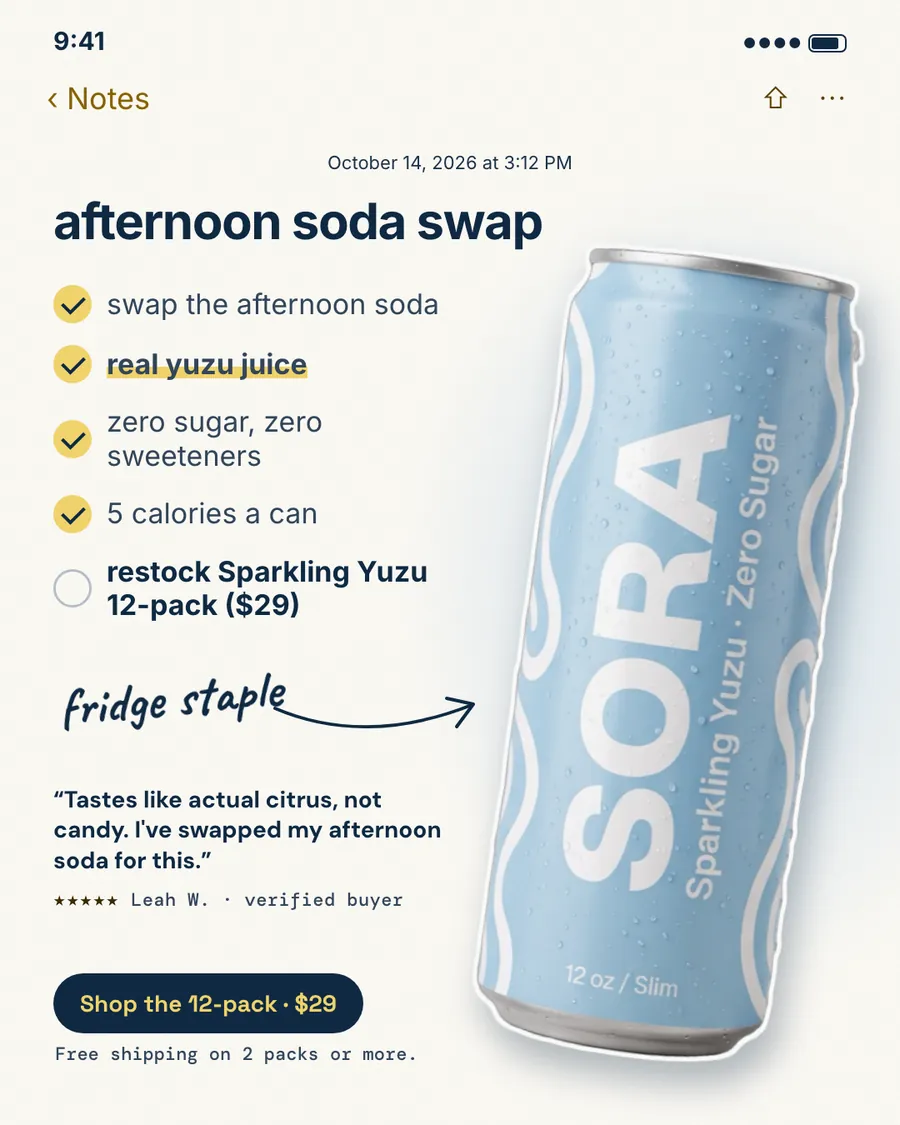
Notes-app listRitual
Sora: afternoon soda swap
Fictional sample brand · made by our engine
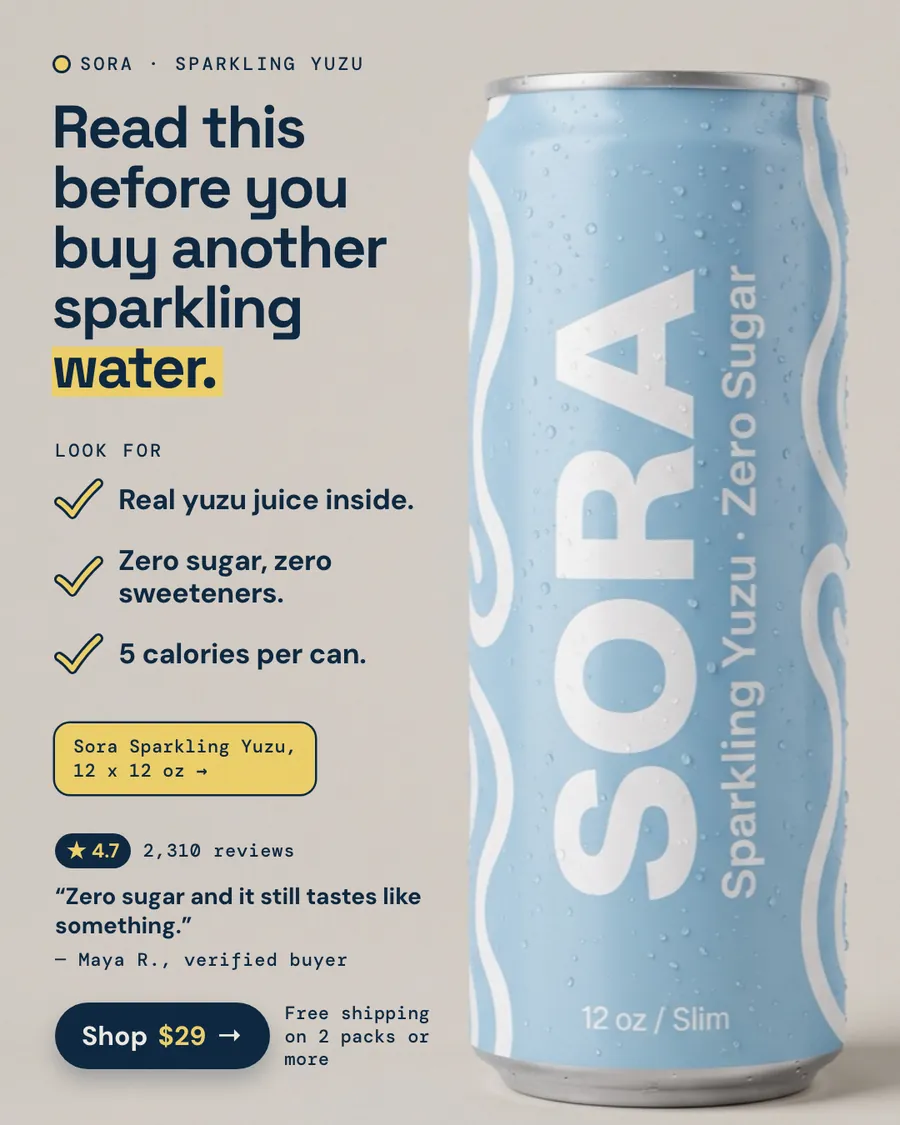
Read this firstComparison
Sora: Read this before you buy another sparkling water.
Fictional sample brand · made by our engine
Policy flags for drink ads
Soft drinks and sparkling water are general food products on Meta and Google. Four things change that: label words, health or weight angles, anything that looks like alcohol, and price claims.
Calorie and sugar words
"Calorie free" means fewer than 5 calories per serving under FDA rules, so a 5-calorie can should print the number. "Sugar free" and "no added sugar" have definitions too, and the ad can't say more than the label may.
Source: eCFR: 21 CFR 101.60, nutrient content claims for the calorie content of foods
Weight loss angles
A drink sold for weight loss changes the rules: Meta requires dietary and weight-loss product ads to target people 18 and over, and TikTok restricts weight loss claims to adults, tied to a healthy lifestyle, with no unrealistic, easy or guaranteed results and no body shaming.
Source: TikTok Advertising Policies: Weight Management and Body Image
Drinks that resemble alcohol
Google's Shopping alcohol policy covers alcoholic drinks and drinks that resemble them, including non-alcoholic beer, wine and spirits. Plain sparkling water is outside it; a zero-proof aperitif is not.
Alcohol itself
Meta requires alcohol ads to follow local laws and industry codes, never reach anyone under 18, and target 21 and over in the United States.
Was-now prices
A former price in an ad should be one you actually offered for a reasonable time, not an inflated number set up to make a sale look bigger.
Source: FTC Guides Against Deceptive Pricing, 16 CFR 233.1 (former price comparisons)
How often to refresh drink ads, and what to measure
Drink ads follow the thermometer and the calendar more than most. The reason to buy stays the same; the scene around the can should change with the season.
Plan three creative seasons a year: cold-weather and hosting ads from November, a reset angle in January, and cold-can ads from late spring. Inside each season, add two or three new ads every couple of weeks on whichever reason is winning.
Watch the delivery column in Ads Manager: "Creative limited" means cost per result has risen above your past ads, and "Creative fatigue" means it has reached twice that. Meta's advice is a new, clearly different image, keeping the old ad live while the new one learns.
What to measure
- Reorder rate within 45 days
- Drinks are a restock business. This number decides how much a first case may cost.
- Margin per order after real shipping
- Free shipping on heavy boxes can quietly turn a winning ad into a losing one.
- Entry product mix
- Which first order people pick (variety pack or single flavor) shows what to put in the next ads.
- Cost per purchase by season
- The same ad can cost more in peak summer when more drink brands compete, so compare like with like.
Questions about advertising drinks
How do I advertise drinks on Facebook?
Run one Sales campaign with a single ad set and several ads, each built on one reason: a customer's words about the taste, a label fact, a habit it replaces, or the price per can. Use 4:5 and 9:16 images with the can large, and send people to a page that shows the nutrition panel.
How do I advertise a beverage business online?
Choose the first order people should buy, usually a variety pack or the amount that clears free shipping, and point every ad at it. Start with Meta, add short videos for TikTok, and set up a restock email so the second case doesn't depend on another ad.
How do you promote a new drink nobody has tasted?
Borrow other people's mouths. Lead with customer quotes that describe the flavor exactly, offer a mixed pack so the risk is lower, and send cases to a handful of creators who film honest first sips. Ads sell the curiosity; reviews sell the case.
How much should I spend to advertise a drink brand?
Start from the order value that clears free shipping times your margin after real shipping costs; that is the most a first order can cost. Meta's learning phase usually needs about 50 purchases a week at that cost, so many small brands begin lower and optimize for add to cart first.
How do I promote food and beverage products together?
Sell them in the moment people use them: a drink next to the meal, the snack and the can in the same cooler. Bundles that combine both raise the order value, which matters because food and drinks often have small prices and real shipping costs.
What is a catchy slogan for a drink?
One that names the flavor or a label fact instead of a feeling. "Zero sugar. All yuzu." works; "refreshing taste" does not, because every can could say it. Short, specific lines also survive being read on a phone in half a second.
How do I advertise energy drinks on social media?
Lead with flavor and the caffeine per can as printed on the label, and keep claims about focus, stamina or performance out unless you have scientific evidence. Short videos with the can in hand suit TikTok and Reels better than polished studio shots.
How do I advertise drinks online if shipping is expensive?
Make the order bigger rather than the price lower: two cases with free shipping, or a 24-can pack that ships in one box. Show the price per can in the ad, so the total feels reasonable before the buyer reaches checkout.
How do I advertise a homemade drink like zobo?
Lead with what makes it different: the deep red pour, the hibiscus and the spices you add, named exactly as on your label. Show it cold in a glass, quote customers who grew up with it, and check your local food rules before selling bottles online.
Can I sell non-alcoholic wine or beer with normal ads?
Treat it carefully. Google's Shopping alcohol policy includes non-alcoholic beer, wine and spirits, so those listings follow alcohol rules there. Check each platform's alcohol policy before launch rather than assuming zero proof means no restrictions.
Get the ads for this plan
Paste your store link and get 3 free ads of your own drinks: we read your products, prices and reviews, design around your real product photo and check every fact against your store.
Where to go next
- Beverage ad ideasSeven sample ads for a sparkling water brand: taste, label claims, price per can, habits, and what the FDA's zero-sugar words mean.
- DrinksCan and bottle ads that lead with flavor, the number on the label and multipack prices.
- How to advertise coffeeA roaster's plan: ads that win the first bag, emails and a subscription that win the second, and a budget that counts both.
- How to advertise food productsA plan for sauces, snacks and pantry brands: sell the dish, answer how hot or how sweet, and build first orders that clear free shipping.
- How to advertise protein powderA plan for a small protein brand: Meta and short video first, a taste trial to beat the chalky-tub doubt, and the muscle-claim rules.
- Black Friday drink adsMulti-pack offers, shipping and lines for drinks brands, with four sample ads for Sora.
- PricingFree preview, Starter $49/month, weekly plans from $99/month with a 7-day free trial, 30-day money-back guarantee.
Sources
Platform rules on this page were checked on against:
- Meta Business Help Center: About the learning phase
- Meta Business Help Center: About learning limited
- Meta Business Help Center: About creative fatigue recommendations in Ads Manager
- eCFR: 21 CFR 101.60, nutrient content claims for the calorie content of foods
- Meta Advertising Standards: Health and Wellness
- TikTok Advertising Policies: Weight Management and Body Image
- Google Merchant Center: Alcohol (Shopping)
- Meta Advertising Standards: Alcohol
- FTC Guides Against Deceptive Pricing, 16 CFR 233.1 (former price comparisons)
- 3 free ads when your spot opens
- Starter $49/month
- Growth $99/month, 7-day free trial
- Pro $149 · Scale $199
- 30-day money-back guarantee