how to advertise coffee
How to advertise coffee online when you're a small roaster
Almost everyone who sees a coffee ad already has a bag in the cupboard. So the first ad isn't selling coffee, it's selling a reason to switch once, and the money comes from the bags after that. The plan below is built for that shape, with Halden, a fictional specialty roaster, as the worked example.
Updated · Budgets and examples use a fictional brand's numbers. Use yours.
In short
How do you advertise coffee as a small roaster?
Run Meta ads that each lead with one reason to switch: named tasting notes, a real roast day, the origin or a customer's words about the cup. Point them at a bag or a subscription, then win the second order by email before the first bag runs out. Judge everything on repeat orders.
At a glance
- The real sale
- The second bag and the subscription, not the first order
- Where to start
- Meta ads plus a reorder email timed to an empty bag
- The proof buyers want
- A roast day, named notes and the origin on the label
- The rule that bites
- Subscription terms shown before checkout
- New ads
- Each new lot or origin is a new ad; swap when one sells out
Which channels fit coffee, in the order to try them
Coffee is a daily habit with a fixed refill clock. The channels that work either catch someone ready to try a new bag, or remind a past buyer just before theirs is empty.
- 01
Meta (Facebook and Instagram)
Start hereWhy it fits
Specialty drinkers respond to specifics, and a feed ad can show the bag, three tasting notes and a roast day before anyone scrolls on. You don't need coffee-specific targeting; an ad about a washed Ethiopian finds its own people.
The trade-off
A single bag is a small order, so the cost of a first purchase can eat the whole margin. That only works if you also measure what happens after it.
- 02
Email and a subscription
Start hereWhy it fits
A 340 g bag is about 20 cups, so a daily drinker runs out in two or three weeks. A brew tip on arrival and a reorder nudge before it runs out cost almost nothing and turn one bag into several.
The trade-off
It only reaches people who already bought. A subscription also brings legal duties: clear terms before payment and an easy way to cancel.
- 03
Google Shopping and Search
Add nextWhy it fits
Some coffee buyers search with intent, like "light roast Ethiopian whole bean" or "fresh roasted coffee subscription". Shopping shows your bag and price on exactly those searches.
The trade-off
Big roasters and grocery brands sit next to you at lower prices. Your product titles need the origin, roast level, weight and whole bean or ground to stand a chance.
- 04
Pinterest
Add laterWhy it fits
Pour-over ratios, cold brew recipes and coffee corner setups get saved there, and a pin that teaches a brew method can carry the bag along with it.
The trade-off
People plan on Pinterest more than they buy, so it's slow and works best once you know which origin sells.
- 05
Home-barista creators
Only if it fitsWhy it fits
A creator who weighs, grinds and tastes on camera explains a light roast better than a static ad can.
The trade-off
Coffee creators are sent a lot of bags, so expect few posts per bag sent. Gifted posts need a clear disclosure.
- 06
Amazon
Skip for nowWhy it fits
Lots of people do buy coffee on Amazon, mostly the brands they already know.
The trade-off
A roasted-to-order promise doesn't survive a warehouse shelf, the roast date is hard to show, and you can't email those buyers about the next bag.
Your first 30 days advertising coffee
The month is organized around one question: does the first bag lead to a second? Everything you launch should be able to answer it by day 30.
Days 1 to 3
Fix the pages the ads land on
Put the roast schedule, the tasting notes, the weight and the grind options on every product page. On the subscription page, show the price per bag, how often it ships, and how to skip or cancel before anyone enters a card. Then place a test order to check purchases reach Ads Manager.
Days 4 to 7
Launch six ads on three reasons to switch
Two ads each for tasting notes, the roast-to-door promise and a customer's description of the cup. One Sales campaign, one ad set, broad targeting, images in 4:5 and 9:16. Send half the ads to the single bag and half to the subscription page, so you learn which entry point people take.
Days 8 to 14
Hold still and watch the entry point
No edits to the ad set while it learns. Track one-off bags and subscription starts separately: a subscription start is worth several bags, so an ad with fewer but subscribing buyers may be the better one.
Days 15 to 21
Switch on the second-bag emails
Send a brew guide the day the first bag arrives and a reorder email about two weeks later. Pause ads that spent twice your break-even cost without a sale, and test a second origin, such as Halden's Colombia Huila, to see whether buyers respond to origin or to freshness.
Days 22 to 30
Count the second order, then decide
Look at how many first buyers came back. If they do, a first bag can cost more than its own margin and you can raise the budget gradually. If they don't, fix the product page and the email before spending more on ads.
How to size a starting budget for coffee ads
A coffee budget starts from the smallest honest order: one bag. Halden's light roast is $21 for 340 g, and here is what that one bag can afford.
| Order value | $21.00 |
|---|---|
| Margin after product cost, shipping and fees | 50% |
| Most a first order can cost to break even | $10.50 |
| 50 purchases a week at that cost | $525 a week |
| The same budget per day | about $75 |
Meta says an ad set usually leaves its learning phase after about 50 results in the week after its last significant edit, and recommends a budget large enough to get enough results. Meta Business Help Center: About the learning phase
Read that as the budget for a business that never gets a second order. No roaster lives on that, which is why the useful number is what a buyer is worth over the next few months, worked out from your own orders.
- Raise the first order. A two-origin set or a 2-bag subscription start lifts the order value the math begins with, without discounting the coffee itself.
- Optimize one step earlier while volume is low. When an ad set can't reach about 50 purchases a week, Meta suggests a more frequent event such as add to cart. Move back to purchases once orders come in steadily.
- Keep one ad set. A small budget split across origins gives each too little data. Put all origins in one ad set and let the ads compete.
Be careful with a steep first-bag discount: it can fill the subscription with people who cancel after the cheap bag. Compare it with a modest saving and look at who is still subscribed two months later.
What a coffee buyer is worth, from your own numbers
Before you raise a coffee budget, write down three numbers from your store. They tell you how much a first order may cost.
| Number | Where to find it | What it changes |
|---|---|---|
| Share of first buyers who order again within 60 days | Your orders export, grouped by customer | How far above one bag's margin a first order may cost |
| Bags per subscriber per month | Your subscription app | The monthly profit a subscriber adds |
| Months the average subscriber stays | Subscription start and cancel dates | How many of those months you can count on |
Offers that work for coffee
Coffee offers should get the first bag into a grinder and make the second one automatic. Deep discounts on single bags mostly attract people who were never going to switch.
Subscribe and save
Coffee runs out on a schedule, so a standing order is a convenience, not just a discount. Halden's saves 15%.
Watch: Show the price per bag, the shipping rhythm and how to cancel next to the offer.
An origin pair
Two bags from different origins answer the buyer's real question, which one will I like, and double the first order. Halden could pair Guji with Colombia Huila.
Whole bean or ground, your choice
Not an offer in price, but it removes the most common reason a curious buyer stops: no grinder at home.
Gift subscriptions in December
Three months of coffee is a gift that ships after Christmas, so it keeps selling once the bag shipping deadline has passed.
Watch: State clearly whether it renews or simply ends.
Angles to test for coffee ads
Each ad needs one reason to switch that a coffee drinker can check. The worked examples, copy lines and photo tips are on Coffee ad ideas; these are the angles the 30-day plan tests.
Named tasting notes
Jasmine, peach and honey. In a light roast.
The roast clock
Roasted Monday. In your mailbox within days.
A customer's cup
"Bright and floral, like peach tea."
Price per cup
About a dollar a cup, ground fresh at home.
The subscription chore
Never run out on a Monday morning again.
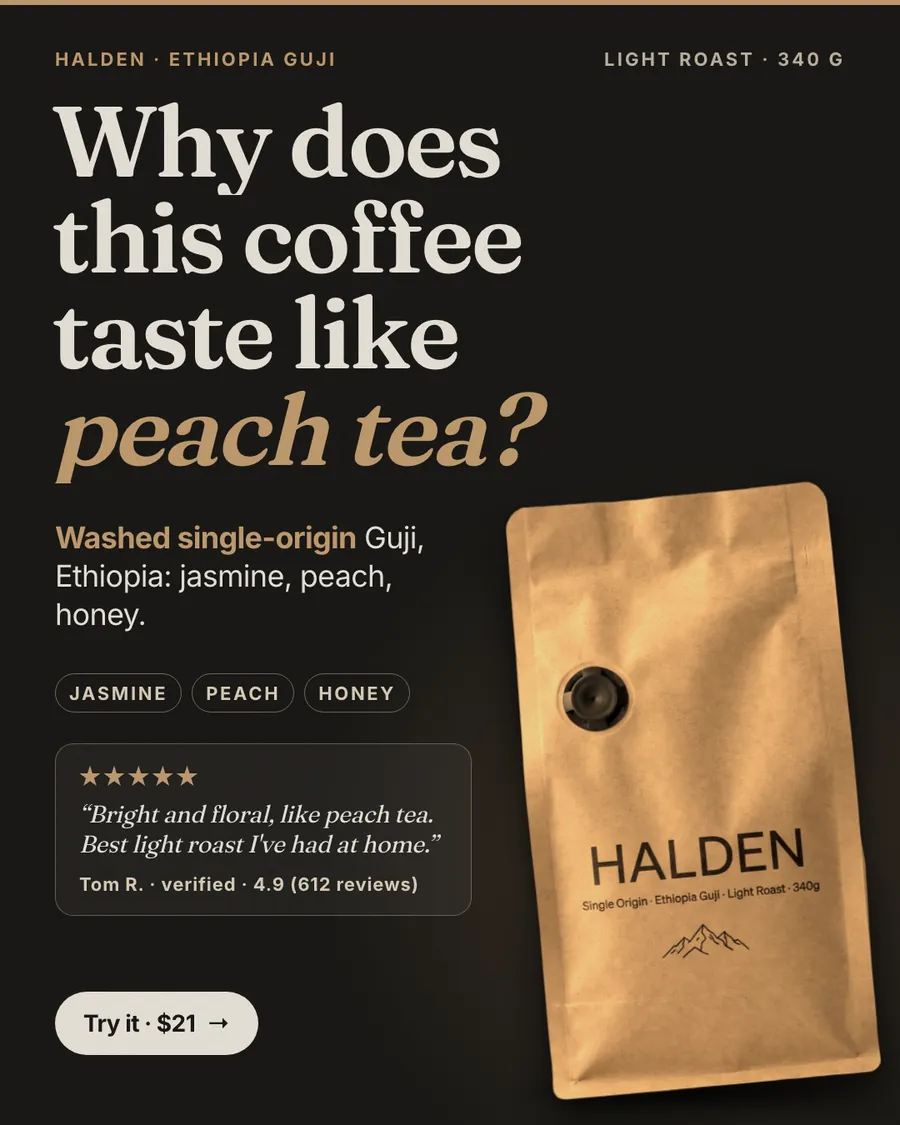
Question hookTaste
Halden: Why does this coffee taste like peach tea?
Fictional sample brand · made by our engine
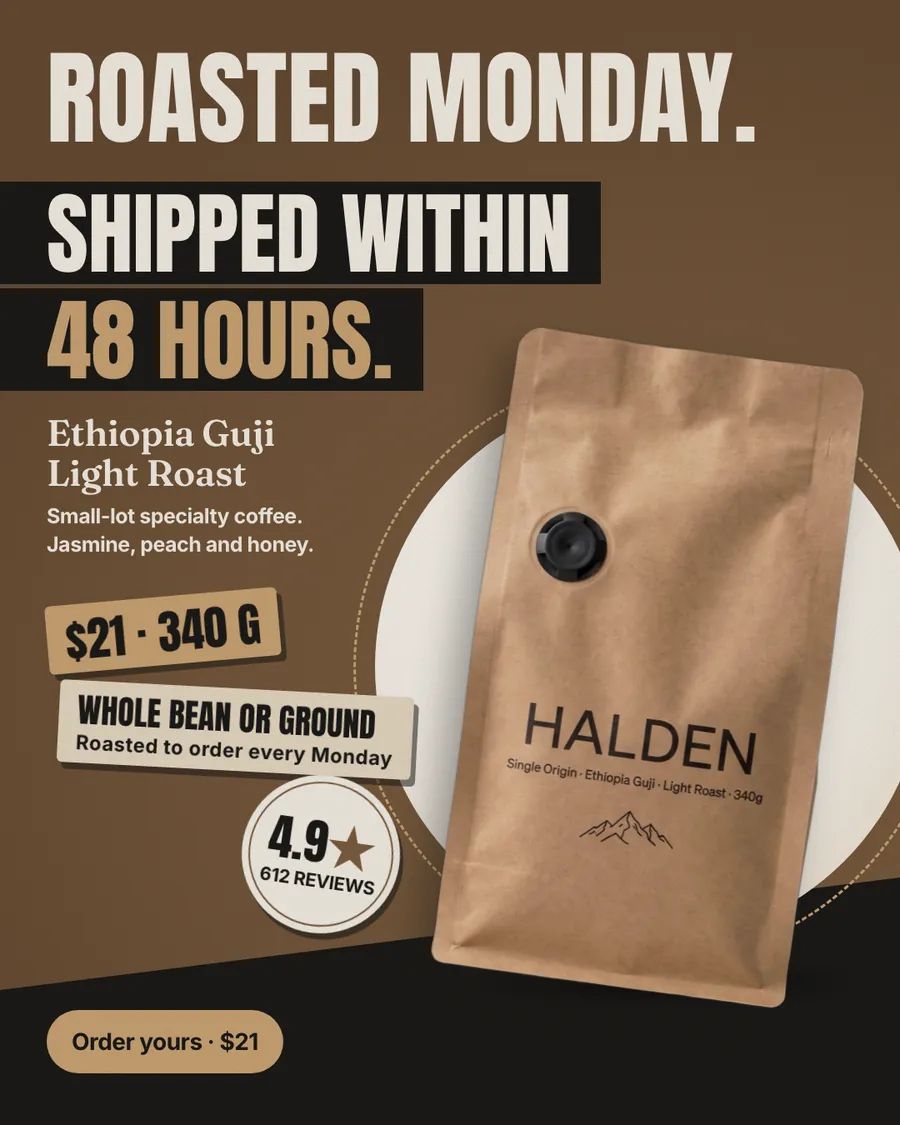
Bold posterCraft
Halden: Roasted Monday. Shipped within 48 hours.
Fictional sample brand · made by our engine
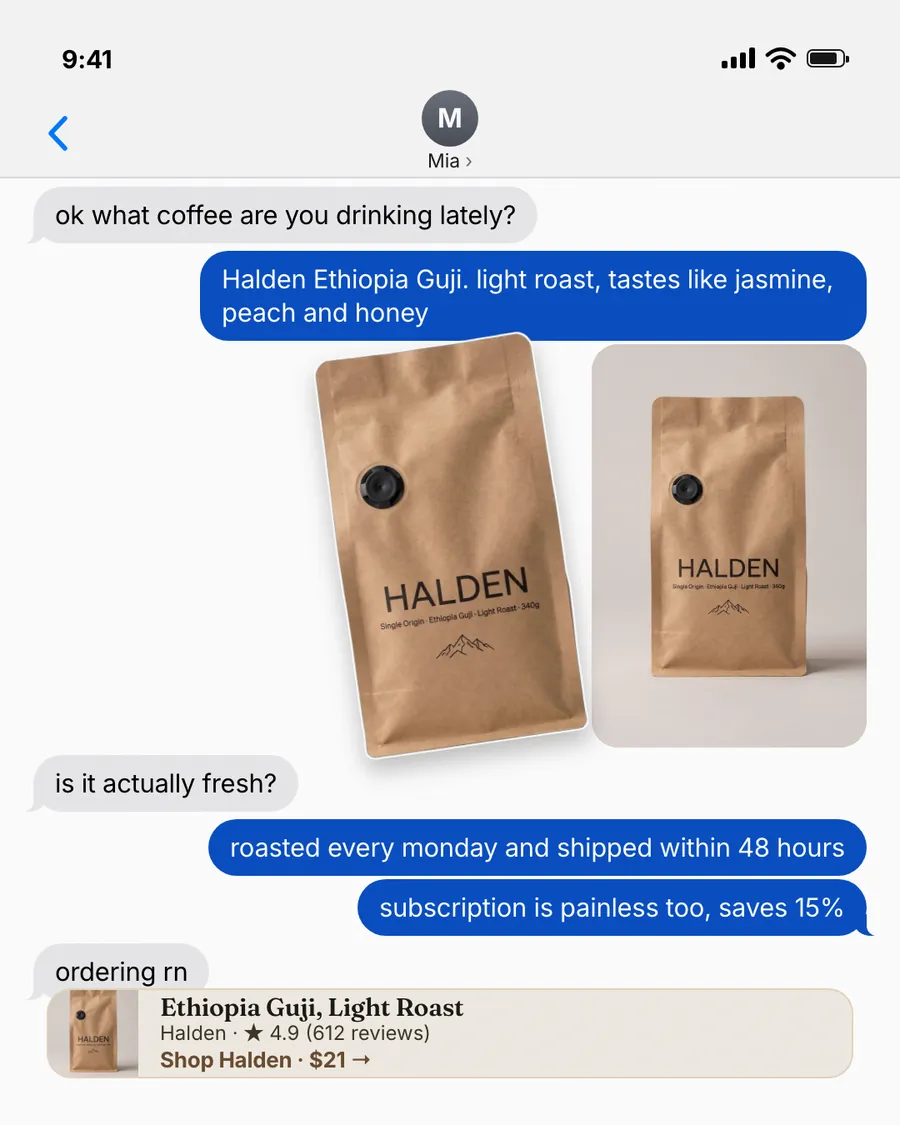
Text threadWord of mouth
Halden: ok what coffee are you drinking lately?
Fictional sample brand · made by our engine
Policy flags for coffee ads
Coffee is an ordinary food on the ad platforms. The trouble comes from health promises, certification words and how subscriptions are sold.
Subscription terms
US law on online subscriptions (ROSCA) requires the material terms to be clear before billing details are taken, the buyer's express consent, and a simple way to stop the charges.
Source: FTC: Restore Online Shoppers' Confidence Act (ROSCA)
Energy, focus and metabolism
Caffeine claims like "burns fat" or "sharper focus" are health claims, and the FTC expects competent and reliable scientific evidence behind them. Meta also rejects lines that assume the viewer is tired or unwell.
Source: FTC Health Products Compliance Guidance (December 2022)
"Organic"
Under USDA rules, coffee sold, labeled or represented as organic needs at least 95% certified organic content, and an ad counts as a representation.
Source: USDA Agricultural Marketing Service: Labeling organic products
Shopping feed accuracy
Google Shopping listings must represent the product accurately, so the roast level, weight and grind in your feed have to match the page the ad opens.
Source: Google Merchant Center: Misrepresentation (Shopping)
How often to refresh coffee ads, and what to measure
Coffee refreshes itself more than most products: lots sell out and new harvests land. Let the menu set the rhythm.
Give every new origin or lot its own ad, shown to past buyers first and then to everyone. When a lot sells out, pause its ads the same day; an ad for a bag that's gone wastes money and annoys people who click.
Between new lots, add two or three fresh ads on the winning reason every few weeks. Meta flags an ad as "Creative limited" when its cost per result is above your past ads and "Creative fatigue" at twice that, and suggests a materially different image rather than a small edit.
What to measure
- Second-order rate within 30 days
- The one number that says whether coffee ads are worth scaling for your store.
- Cost per subscription start
- Track it apart from cost per bag; a subscriber is worth several one-off orders.
- Subscription cancellations after the first box
- If many cancel right away, the offer is attracting bargain hunters, not coffee drinkers.
- Cost per purchase by origin
- Tells you which coffee to lead with in the next ads and the next feed titles.
Questions about advertising coffee
How do I advertise coffee online?
Start with Meta ads that each give one reason to try your bag: tasting notes, a roast day, the origin or a customer's words. Send buyers into a reorder email and a subscription, and judge the ads on how many first buyers come back, not only on the first sale.
How do I promote a coffee brand on a small budget?
Spend where the second order happens first: a good product page, a brew guide email and a reorder reminder. Then run a few Meta ads in one ad set, leave them alone for a week, and keep only the reasons to switch that bring buyers back.
How much should a small roaster spend on ads?
Work it out from one bag: price times the margin left after coffee, packaging, shipping and fees is the most a first order can cost if nobody reorders. About 50 purchases a week at that cost is what Meta's learning phase usually needs. Most roasters start below that and count repeat orders.
Should I advertise single bags or my subscription?
Test both in the same campaign. Single bags convert more easily; subscription starts are worth more. Count them separately for a few weeks, then put more ads behind whichever brings more value per dollar for your store.
How do I advertise coffee on Instagram?
Instagram runs through the same Meta ad account, so use the same plan with 4:5 images for the feed and 9:16 for Stories and Reels. Close-ups of the label, a pour-over in progress and a text-thread style ad about a friend's new coffee all look native there.
Do Google Shopping ads work for coffee beans?
They can for searches that name a roast, origin or freshness. Write product titles with the origin, roast level, weight and grind, keep prices in the feed current, and expect to compete with cheaper grocery brands on generic searches like coffee beans.
How do I get people to switch from supermarket coffee?
Give them something a supermarket bag can't show: a recent roast day, named tasting notes and a specific origin. Lower the risk of the first try with a choice of grind and a small origin set, then let the second bag do the convincing.
Should a small coffee brand sell on Amazon?
Usually not at first. A roasted-to-order story is hard to tell from a warehouse shelf, fees cut into a small bag's margin, and you can't email those buyers about their next bag. Build repeat buyers on your own store, then reconsider.
When is the busiest time of year to advertise coffee?
Late November and December, when bags and gift subscriptions are bought as presents, and January, when people set new routines. New lots and seasonal blends give you reasons to advertise in between.
How do I advertise a coffee gift subscription?
Lead with the gift and the number of months, show what arrives and when, and say whether it renews or ends. Gift subscriptions keep selling after the last shipping date for bags, so keep those ads running into late December.
Get the ads for this plan
Paste your store link and get 3 free ads of your own coffee: we read your products, prices and reviews, design around your real product photo and check every fact against your store.
Where to go next
- Coffee ad ideasSeven sample ads for a specialty roaster: tasting notes, roast dates, origin, subscriptions, and the claims to keep off a coffee ad.
- CoffeeCoffee ads with your real bag, your tasting notes, your roast dates and your subscription offer.
- How to advertise drinksA plan for a drink brand selling cases online: a trial-sized first order, Meta and TikTok first, and a budget that survives shipping weight.
- How to advertise chocolateA plan for a small chocolate maker: ads timed to gift dates, a sampler as the first order, and a summer plan for the heat.
- How to advertise food productsA plan for sauces, snacks and pantry brands: sell the dish, answer how hot or how sweet, and build first orders that clear free shipping.
- Black Friday coffee adsSubscription offers, roast timing and lines for coffee brands, with four sample ads for Halden.
- PricingFree preview, Starter $49/month, weekly plans from $99/month with a 7-day free trial, 30-day money-back guarantee.
Sources
Platform rules on this page were checked on against:
- Meta Business Help Center: About the learning phase
- Meta Business Help Center: About learning limited
- Meta Business Help Center: About creative fatigue recommendations in Ads Manager
- FTC: Restore Online Shoppers' Confidence Act (ROSCA)
- FTC Health Products Compliance Guidance (December 2022)
- Meta Advertising Standards: Privacy Violations and Personal Attributes
- USDA Agricultural Marketing Service: Labeling organic products
- Google Merchant Center: Misrepresentation (Shopping)
- 3 free ads when your spot opens
- Starter $49/month
- Growth $99/month, 7-day free trial
- Pro $149 · Scale $199
- 30-day money-back guarantee