tea ad ideas
Tea ad ideas, worked through on a matcha brand's real ads
Tea sells on taste, origin and ritual, and none of the three shows up in a photo of a tin. Good tea ads make them visible: the farm and the harvest, how the leaf is grown and ground, how it tastes in a customer's words, how to make it at home. Below are seven ads our engine made for Jadecliff Tea Co., a fictional matcha brand. The ideas carry over to loose leaf, bagged and herbal tea.
Updated · The sample ads are for a fictional brand, made by our engine.
In short
What makes a good tea ad?
A good tea ad makes an invisible product visible: the color in the cup, where it's grown, how it's made and how it tastes, ideally in a customer's words. Show the real tin or bag, give one checkable fact (first harvest, shade-grown 21 days, servings per tin) and the price. Leave health promises out unless you can prove them.
Real sample ads
Seven matcha ads for Jadecliff Tea Co.
Jadecliff Tea Co. is a fictional brand. Its product page: Ceremonial Matcha in a 30 g tin, first harvest, shade-grown for 21 days and stone-ground, from a single family farm in Kagoshima, Japan; smooth and naturally sweet with no bitterness; whisk 2 g with 70 ml of 80°C water; about 15 servings per tin. $32, rated 4.9 from 874 reviews, free shipping on orders over $45. The ads use only those facts and four customer reviews.
Jadecliff Tea Co. · Ceremonial Matcha, 30 g Tin · $32 · 4.9 from 874 reviews · fictional
Lifestyle typeRitual
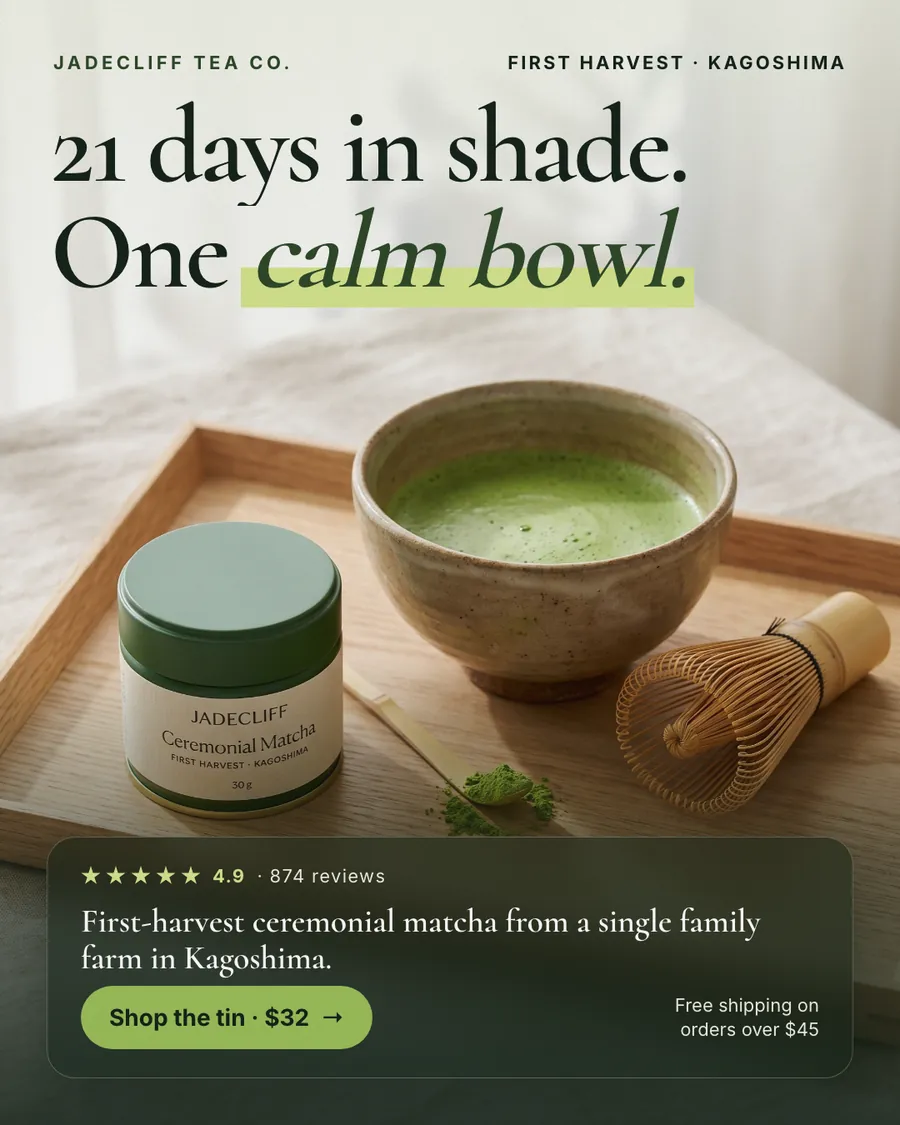
Jadecliff Tea Co.: 21 days in shade. One calm bowl.
The two short lines set up the slow process and the calm result. The photo shows the whole ritual (tin, bowl, whisk, scoop), and the price, rating and shipping offer sit together at the bottom.
Store facts used: 21 days in shade, first harvest, single family farm in Kagoshima, 30 g tin, $32, 4.9 from 874 reviews, free shipping over $45
Matched by the fact check: $32 · $45 · 4.9 rating · 874 reviews · 21 days · free shipping
The 2:3 Pinterest version
Fictional sample brand · made by our engine
Question hookCraft
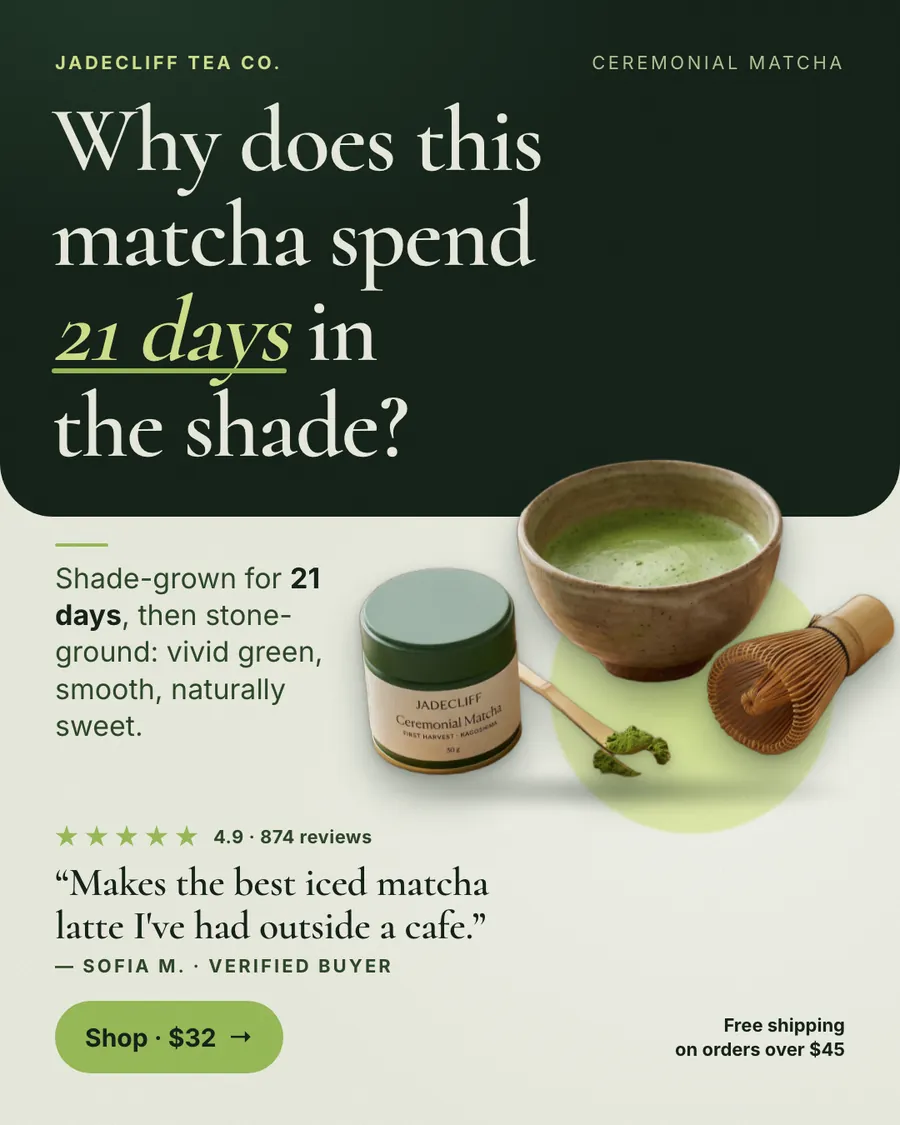
Jadecliff Tea Co.: Why does this matcha spend 21 days in the shade?
Shade-growing explains the color and the price, but nobody knows to care about it. Asking why turns a farming detail into a question people want answered, and the answer (21 days, then stone-ground) sits right under it with a latte review for the people who don't drink it straight.
Store facts used: 21 days shade-grown, stone-ground, $32, 4.9 from 874 reviews, quote from Sofia M., free shipping over $45
Matched by the fact check: $32 · $45 · 4.9 rating · 874 reviews · 21 days · free shipping · 1 review quote, word for word
The 2:3 Pinterest version
Fictional sample brand · made by our engine
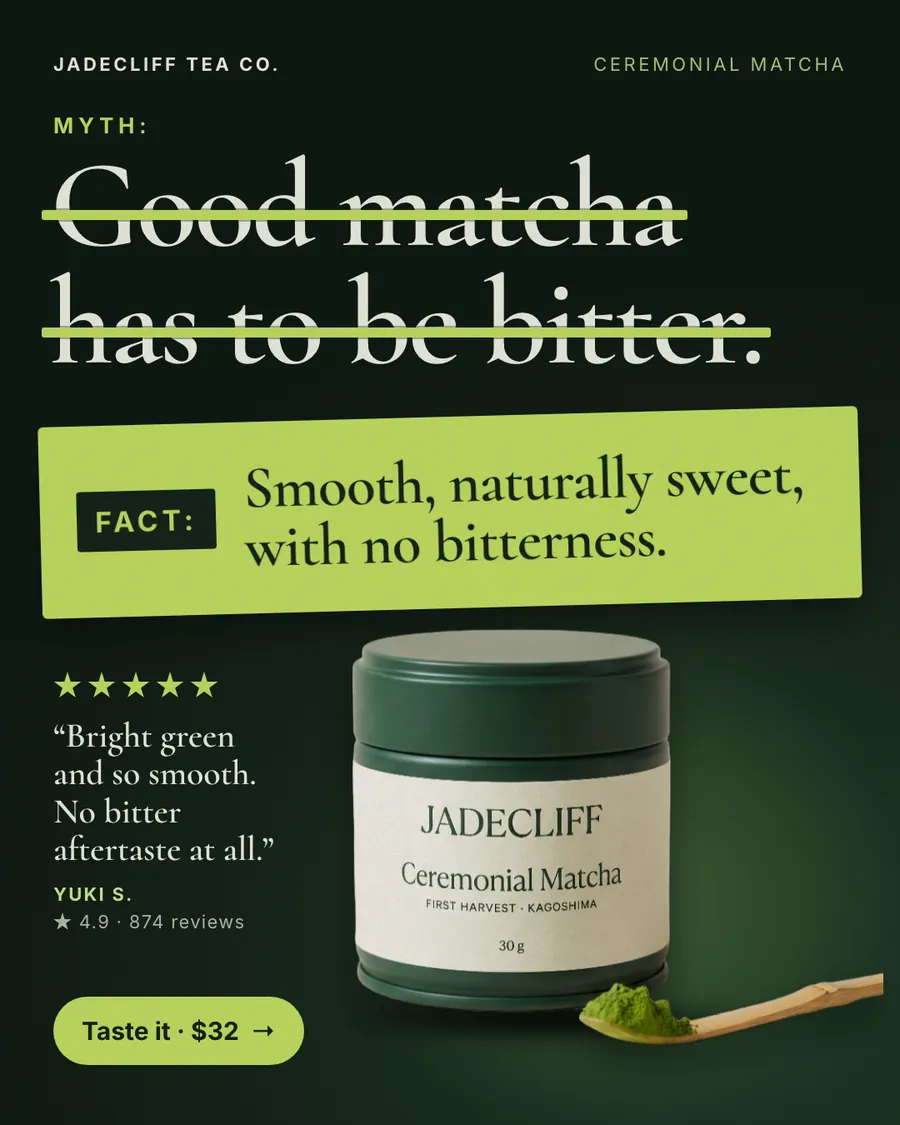
Myth vs factTaste
Jadecliff Tea Co.: MYTH: Good matcha has to be bitter.
Bitterness is what many people remember from a bad first matcha, so the myth names a real objection rather than a straw man. Yuki S.'s quote repeats the fact in a drinker's words, right beside the tin.
Store facts used: Ceremonial Matcha 30 g tin, First Harvest Kagoshima, $32, 4.9 rating, 874 reviews, quote from Yuki S.
Matched by the fact check: $32 · 4.9 rating · 874 reviews · 1 review quote, word for word
The 2:3 Pinterest version
Fictional sample brand · made by our engine
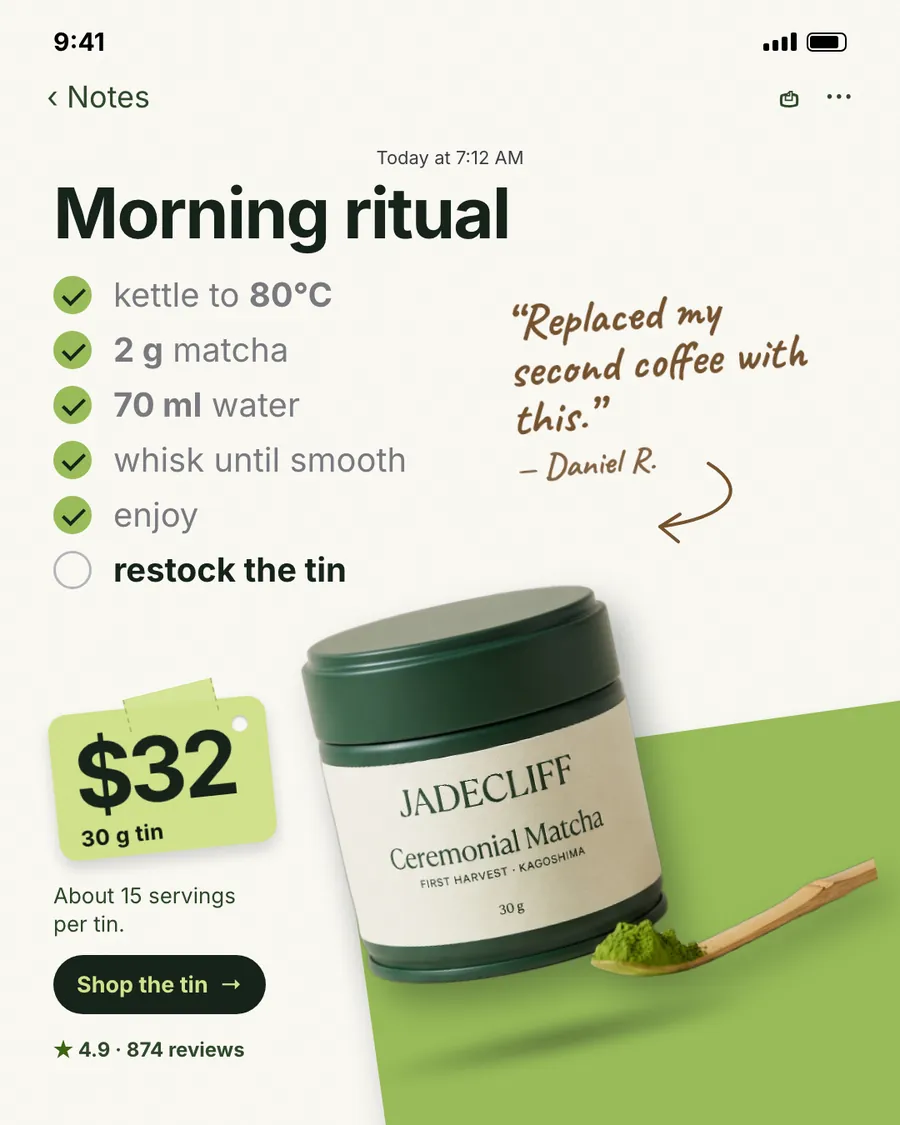
Notes-app listRitual
Jadecliff Tea Co.: Morning ritual
Not knowing how to make it is a quiet reason people never buy matcha. The notes-app list gives the whole recipe in five short lines (80°C, 2 g, 70 ml, whisk) and leaves one line unchecked, restock the tin, which is the ask.
Store facts used: 2 g matcha, 70 ml water, 30 g tin, $32, about 15 servings, 4.9 from 874 reviews, Daniel R. quote
Matched by the fact check: $32 · 4.9 rating · 874 reviews · 2 g · 70 ml · 30 g · 15 servings · 1 review quote, word for word
The 2:3 Pinterest version
Fictional sample brand · made by our engine
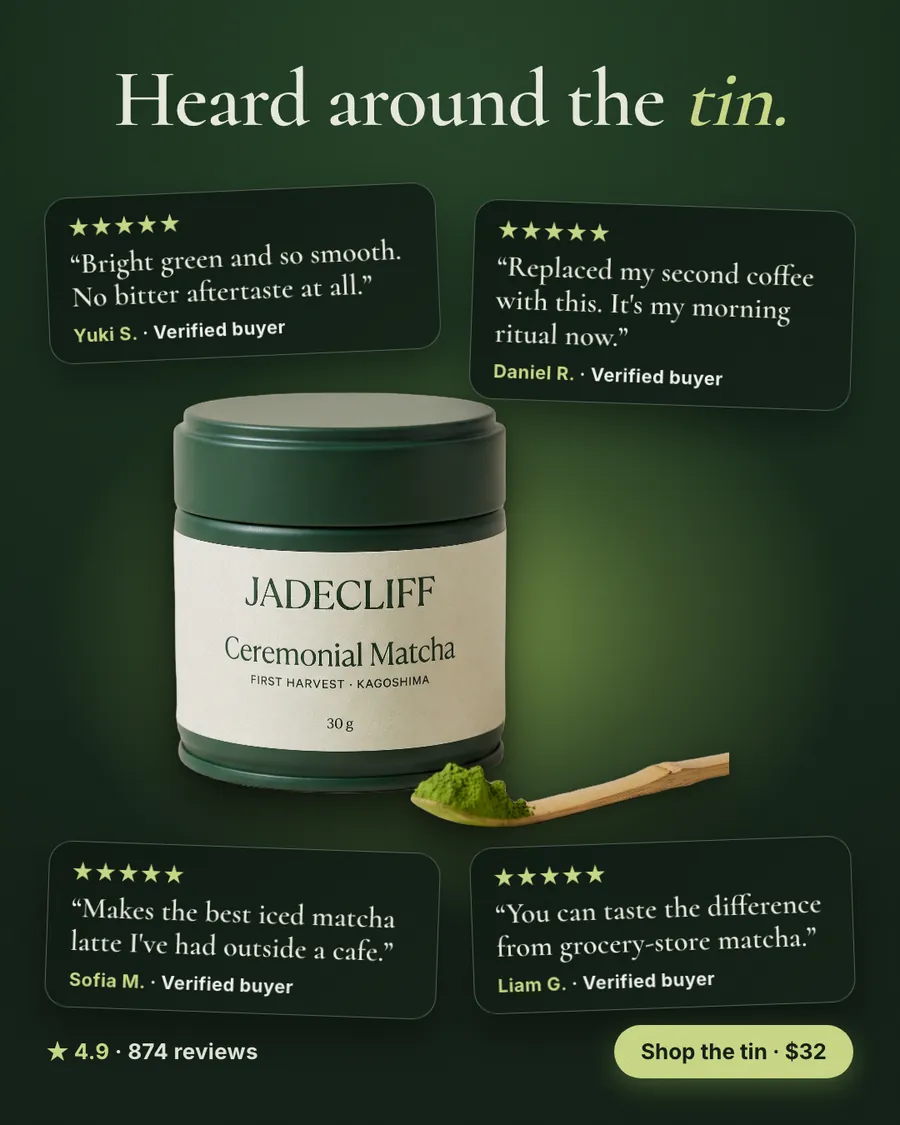
Review wallSocial proof
Jadecliff Tea Co.: Heard around the tin.
Four reviews, four reasons: color, a coffee swap, an iced latte, and a comparison with grocery-store matcha. Daniel R.'s line is about his routine, not about energy or health, which is why it can lead a tea ad safely.
Store facts used: Four customer quotes, 4.9 rating, 874 reviews, $32, Ceremonial Matcha, First Harvest Kagoshima, 30 g
Matched by the fact check: $32 · 4.9 rating · 874 reviews · 4 review quotes, word for word
The 2:3 Pinterest version
Fictional sample brand · made by our engine
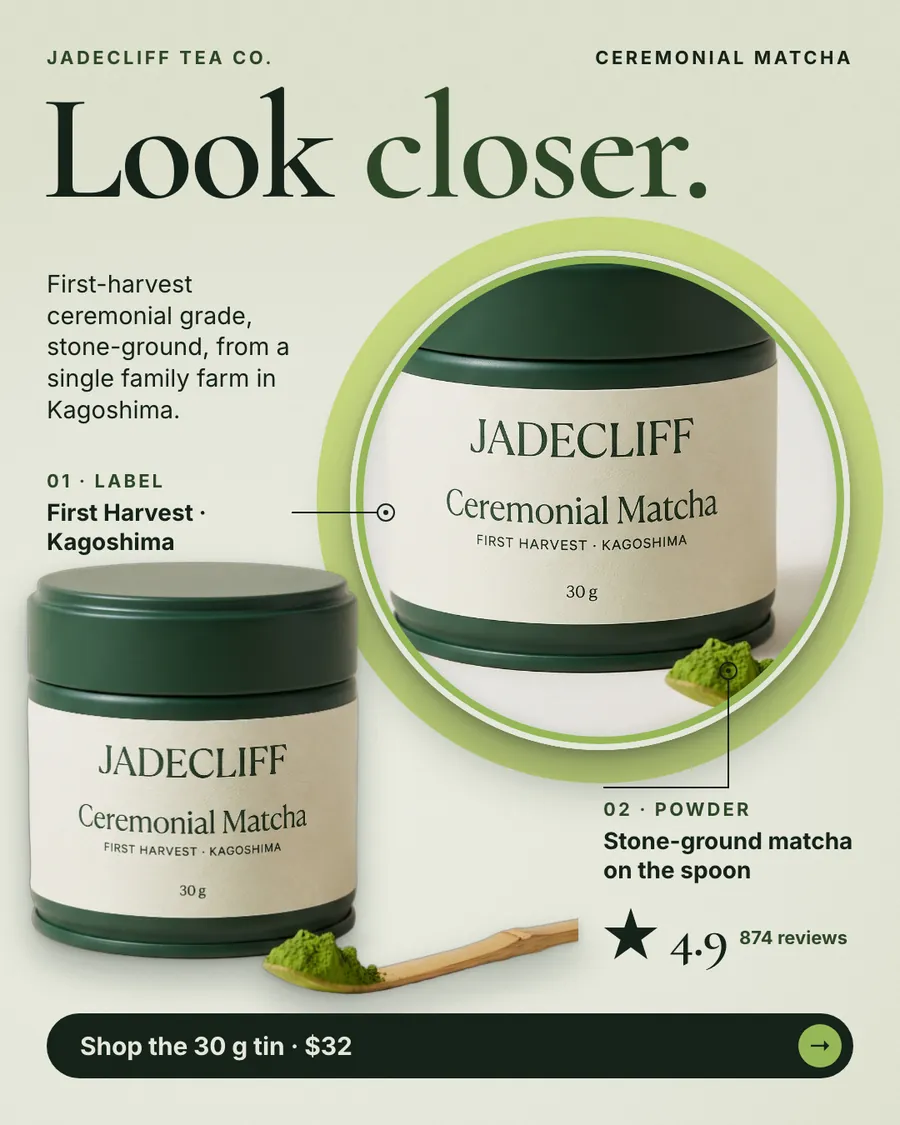
Look closerTransparency
Jadecliff Tea Co.: Look closer.
The zoom circle makes you do what the headline says, and numbered callouts point at the label and the powder. The proof is on the product itself, so the claims feel checkable.
Store facts used: First harvest, Kagoshima, stone-ground, single family farm, 30 g tin, $32, 4.9 from 874 reviews
Matched by the fact check: $32 · 4.9 rating · 874 reviews · 30 g
The 2:3 Pinterest version
Fictional sample brand · made by our engine
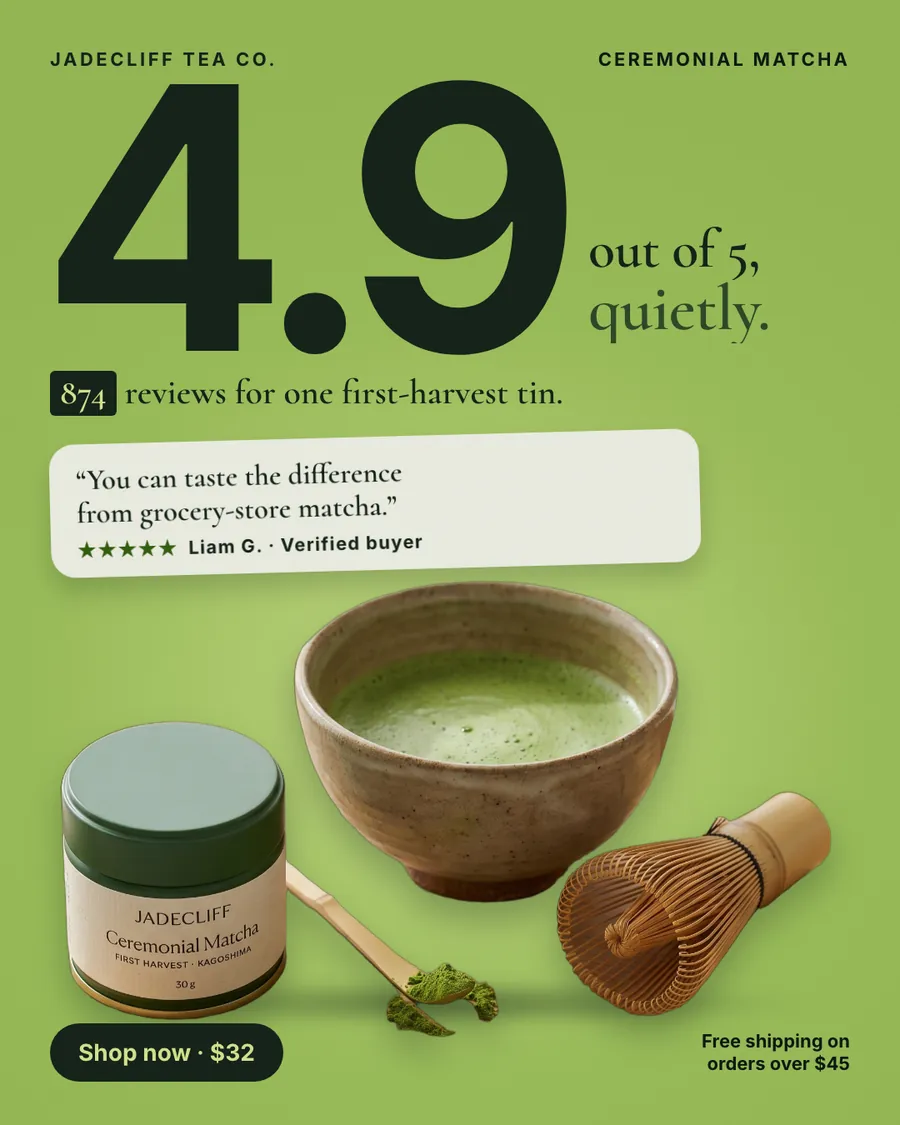
Big numberSocial proof
Jadecliff Tea Co.: 4.9 out of 5, quietly.
The oversized 4.9 is readable at a glance, and the small word 'quietly' gives it a calm tone. The review quote and the count of 874 sit right below, so the number has support.
Store facts used: 4.9 rating, 874 reviews, quote from Liam G., $32, first harvest Kagoshima, 30 g tin, free shipping over $45
Matched by the fact check: $32 · $45 · 4.9 rating · 874 reviews · free shipping · 1 review quote, word for word
The 2:3 Pinterest version
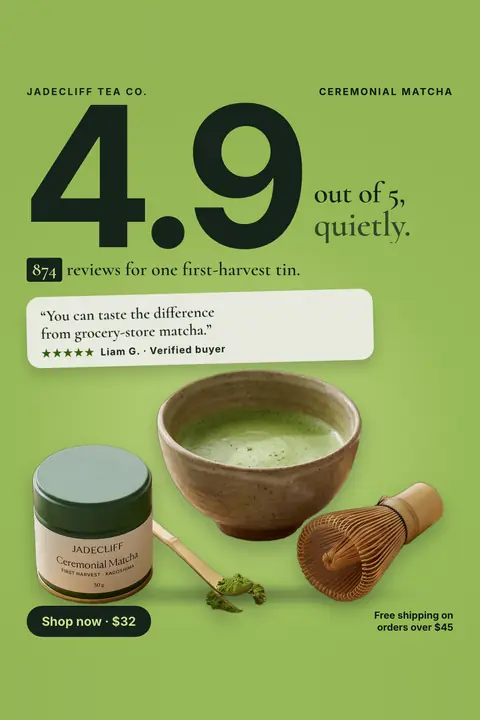
Fictional sample brand · made by our engine
The same ad in all five sizes
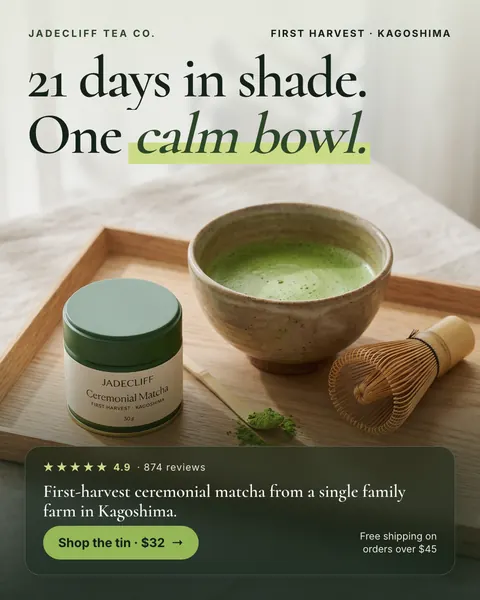
4:5 · Facebook and Instagram feeds
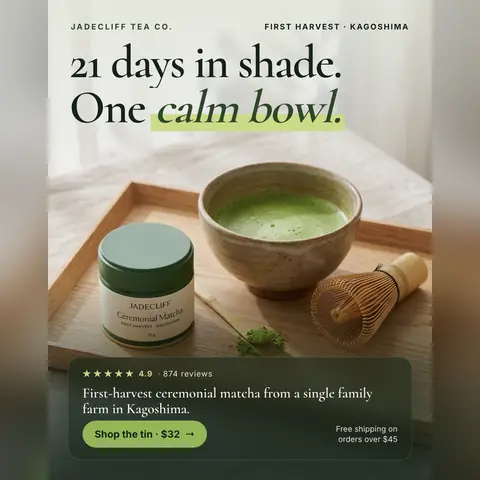
1:1 · Square placements
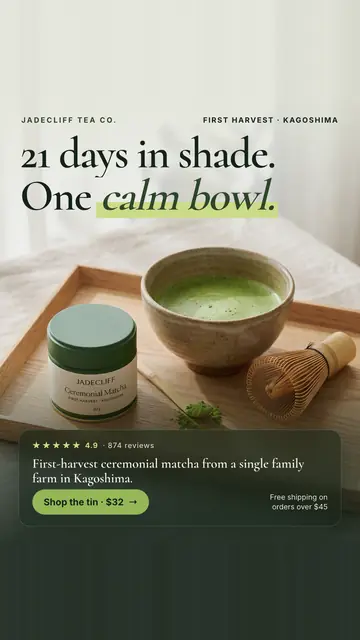
9:16 · Stories, Reels, TikTok
2:3 · Pinterest
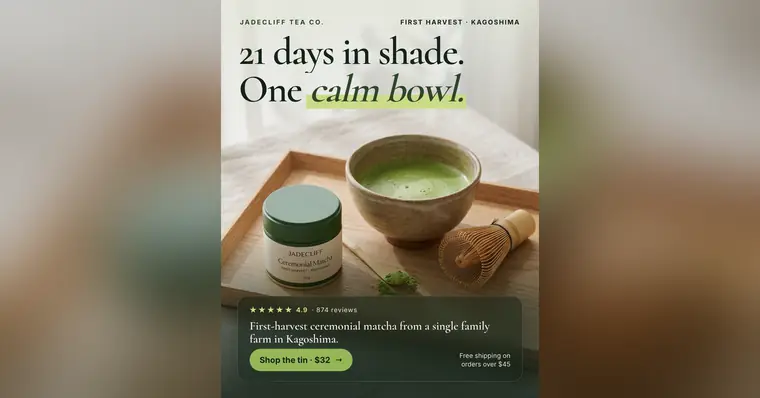
1.91:1 · Google Display
What makes people try a new tea
Tea buyers are loyal once they find one they like, so the ad's job is to make switching feel safe. Four reasons do that work, and each has a store fact behind it.
- 01
Where it comes from
Origin is to tea what a grape variety is to wine: a named region, farm and harvest suggest care and explain a higher price.
See it in the ad "Look closer."Proof the ad needs
Region, farm and harvest exactly as your page states them (a single family farm in Kagoshima, first harvest), visible on the label in the ad.
- 02
How it tastes
Most people have had a bitter or grassy cup somewhere. They want to hear this one is different before they spend $32.
See it in the ad "MYTH: Good matcha has to be bitter."Proof the ad needs
Taste words from your page (smooth, naturally sweet, no bitterness) and a reviewer who confirms them, quoted exactly.
- 03
A ritual they can keep
Tea is a habit purchase. People buy the routine as much as the leaf, and a routine needs to look easy.
See it in the ad "Morning ritual"Proof the ad needs
Preparation in exact numbers (2 g, 70 ml, 80°C), servings per tin, and a review about the habit.
- 04
Proof from people who finish the tin
$32 for 30 g is a lot per gram, so buyers look for people who drank it daily and came back.
See it in the ad "Heard around the tin."Proof the ad needs
Rating and review count beside the tin, and quotes that each give a different reason (Yuki S., Daniel R., Sofia M., Liam G.).
Photo checklist for tea ads
Tea photos fail in two ways: the drink looks dull, or the tin disappears into a styled table. These seven shots keep both the color and the package in the ad.
The tin straight on, label sharp. For cutouts and callout layouts. Shoot it level so the farm and harvest on the label stay readable at phone size.
The prepared bowl from above, foam visible. Vivid green with a fine foam is the quality signal matcha drinkers look for. Shoot in daylight; warm bulbs turn it olive.
The full set on a tray: tin, scoop, whisk, bowl. Shows a first-timer everything they need, and sets up the whisk and bowl set as the second purchase.
Powder on the scoop, close up. Fine, bright powder is visible proof of stone-grinding and a fresh tin.
An iced latte in a clear glass. Plenty of people drink matcha as a latte. Show it when your reviews mention it, as Sofia M.'s does.
Hands whisking. Motion and a how-to in one frame. A zigzag blur of the whisk reads as preparation, not a still life.
The farm or the harvest, from your supplier. Only real photos of your source. A stock photo of a tea field passed off as your farm is an origin claim you can't stand behind.
Tea words on an ad, and what has to stand behind them
Tea packaging is full of words that sound official. Some are facts you can document, some are marketing, and a few are claims regulators define. Know which is which before a word goes in a headline.
| The word | What shoppers hear | What makes it honest |
|---|---|---|
| Ceremonial grade | The top quality, for drinking straight | No official grading standard defines it. Say what it means for your tin: first harvest, shaded, stone-ground. |
| First harvest | The youngest spring leaves | Harvest records from your farm or importer. |
| Shade-grown 21 days | A sweeter, greener tea | The farm's growing practice, in writing from your supplier. |
| Stone-ground | Slow milling, a fine powder | How your supplier mills it, documented. |
| Single origin, family farm | Traceable to one place | One named farm or estate, not a blend sold under a region's name. |
| Organic | Certified organic | Certification to the USDA organic standard for tea sold as organic in the US. |
| Caffeine | Energy | If you state milligrams per serving, measure them. Never turn caffeine into a promise about how someone will feel. |
| Antioxidants | A health benefit | FDA allows antioxidant claims only for nutrients with a set daily value. Tea catechins don't have one, so leave it out. |
The safest headline words in tea are the ones you can photograph or measure: the color, the harvest, the grams, the water temperature, the servings in a tin.
Tea ad copy lines you can adapt
Calm, exact lines suit tea. Each of these carries one fact or one moment; swap in your own numbers and keep every claim on your product page first.
Shade-grown 21 days. Stone-ground. Whisked in a minute.
Process facts, then how easy it is to make.
About $2.13 a bowl.
$32 divided by about 15 servings. Say about, and do the math from your own tin.
First harvest, from one family farm in Kagoshima.
Origin as the headline.
"Bright green and so smooth. No bitter aftertaste at all."
Yuki S., quoted exactly.
2 g. 70 ml. 80°C. Whisk.
The recipe as the hook, for people who've never made it.
Not bitter. Naturally sweet.
Only if your page and your reviews both say it.
Your 3 pm, rethought.
An afternoon moment with no promise about energy.
Fifteen bowls in. Time for another tin.
For past buyers about two weeks after a 30 g tin ships, if they drink one a day.
Start with the tin. Add the whisk.
Cross-sells the $48 whisk and bowl set to first-timers.
Lines to keep out of tea ads
| Avoid | Why | Say instead |
|---|---|---|
| "Boosts metabolism" or "burns fat" | Weight claims are health claims that need scientific evidence under the FTC's health products guidance, and Meta's health and wellness standards only allow weight loss ads aimed at people 18 or older. | "Smooth, naturally sweet, no bitterness." |
| "Calm focus without the crash" | For an ordinary food, FDA expects structure/function claims to come from nutritional value. A promise about focus and energy from caffeine is a claim about the body you'd have to prove. | "A slower afternoon ritual." |
| "Packed with antioxidants" | FDA allows antioxidant content claims only for named nutrients with a set daily value (21 CFR 101.54(g)), which tea catechins lack. | Talk about the color, the harvest and the taste. |
| "Detox tea" | In 2020 the FTC settled with Teami over claims that its detox teas helped weight loss and fought disease, and over paid influencers who didn't disclose the payments. | Describe the blend and the moment you drink it. |
| "Better than coffee" | A comparison you can't prove, aimed at a drink most of your buyers also love. | "Replaced my second coffee with this." (Daniel R., in his own words) |
Tea claims: health, caffeine, origin and influencers
Tea is a food, so the rules are the ones for food and health claims. The line to watch is where a ritual turns into a promise about the body.
- Health and wellness. FDA sorts food label claims into health claims, nutrient content claims and structure/function claims, and for ordinary foods a structure/function claim has to come from nutritional value. The FTC wants competent and reliable scientific evidence for any health claim in an ad. FDA's list of qualified health claims has one green tea entry, on breast and prostate cancer risk (letter updated April 17, 2012), and it comes with required qualifying words; it is not something to paraphrase in a matcha ad.
- Detox and weight. In March 2020 the FTC settled with Teami, a seller of detox teas, over claims that its teas helped people lose weight and fought cancer and colds, and over influencer posts that hid the payments. Meta's health and wellness standards also require weight loss ads to target people 18 or older.
- Caffeine. FDA cites 400 mg a day as an amount not generally associated with negative effects for most adults. If an ad states caffeine per serving, measure it, and leave how it makes someone feel out of the ad.
- Origin and grade. "Single family farm in Kagoshima" and "first harvest" are facts to hold records for. "Ceremonial grade" has no official definition, so the words around it have to carry the proof.
- Reviews and influencers. The FTC's reviews rule bans fake or altered reviews, so customer quotes stay word for word. Anyone you pay or send free tins to has to disclose it where people will see it, under the FTC's Endorsement Guides.
The tea calendar, autumn 2026 to summer 2027
Tea has a hot season and an iced season, plus the same gift peaks as most food. Matcha adds a third moment: the first warm days, when iced lattes come back.
| When | Moment | What to run |
|---|---|---|
| Now to Nov 1, 2026 | Hot tea season starts | The ritual ad and the recipe ad: tray, whisk, steam, the 80°C detail. |
| Nov 27 to 30, 2026 | Black Friday to Cyber Monday | The Matcha Starter Kit at $72. Show its $86 compare-at price only if the kit really sold at $86. Black Friday ad ideas has the dated plan. |
| Dec 1 to your order-by date | Gift season | Tin plus whisk set for people new to matcha, with your order-by date. USPS recommends Ground Advantage by Dec 17 for delivery before Christmas. See Christmas ad ideas. |
| January 2027 | New routines | The morning ritual, without promising energy, focus or a healthier you. |
| Feb 1 to 14, 2027 | Valentine's Day (Sun, Feb 14) | A tin and two bowls: matcha for two, with an order-by date. |
| Apr 18 to May 9, 2027 | Mother's Day (Sun, May 9) | Gift sets three weeks out, the tin beside a bowl and a mug. |
| May to August 2027 | Iced season | Iced latte ads with a customer quote about lattes, in clear glasses, outdoors. |
| Every 2 to 4 weeks after an order | Restock window | About 15 servings per 30 g tin: daily drinkers run out in about two weeks, so remind them then. |
What people ask about tea ads
What is a catchy slogan for tea?
One that names something real about your tea: "21 days in shade. One calm bowl.", "2 g. 70 ml. 80°C. Whisk.", "About $2.13 a bowl." Puns on "tea-rrific" are everywhere; a fact from your tin is harder to copy.
What are some good slogans for tea companies?
For a brand rather than a product, build the slogan on what you do differently: one farm, one harvest, a way of growing, a ritual. Keep it short enough to sit under a logo, and make sure every word in it is something you can show.
How do you promote a tea brand?
Start with four ads that each lead with a different reason to buy: origin, taste, the daily ritual and reviews. Show the real tin in every one, add the price, and send past buyers a restock ad timed to how long a tin lasts. Gift sets carry the fourth quarter.
What are good matcha ad ideas?
A myth-versus-fact on bitterness, a question about why it's shade-grown, a notes-app recipe with a restock line, a review wall where each quote gives a different reason, and a close-up of the label and powder. Each one appears in the gallery above.
How do I advertise matcha on Instagram?
Lead with color: the green bowl or an iced latte in daylight stops a scroll. Then use the 9:16 story size for the recipe and a 4:5 feed ad for reviews. If you work with creators, they have to disclose that you paid them or sent free tins.
Can I say my tea is healthy or full of antioxidants?
Not in the way most brands write it. FDA defines when foods can use nutrient claims and allows antioxidant claims only for named nutrients with a daily value, which tea catechins lack. Health benefits need scientific evidence under FTC rules.
What does ceremonial grade matcha mean in an ad?
Nothing official: no grading standard defines it. Shoppers read it as the best matcha, for drinking straight, so back it with facts you can document, such as first harvest, shade-grown for 21 days and stone-ground.
Should a tea ad mention caffeine?
Only as a measured number if your buyers ask for it, never as a promise about energy or focus. FDA cites 400 mg a day as an amount not generally associated with negative effects for most adults, but that's a safety figure, not a selling point.
Do Facebook ads work for tea brands?
They can, especially for a product people reorder. The first order is the hard part, so test several reasons to buy, judge them on purchases, and put a share of the budget on restock ads to people who already bought.
Should tea ads show the price?
Yes, and per serving if it helps. $32 sounds like a lot for a small tin until the ad says about $2.13 a bowl, well under the price of a cafe latte.
Make ads like these for your tea
Paste your store link and get 3 free ads of your own tea: we read your products, prices and reviews, design around your real product photo and check every fact against your store.
Where to go next
- Christmas ad ideasThe 2026 shipping cutoffs that set your ad calendar, six Christmas offers, copy lines and 16 sample ads for four stores.
- Black Friday ad ideasThe 2026 dates, six Black Friday offers and the products they suit, copy lines, and 16 sample ads for four stores.
- Coffee ad ideasSeven sample ads for a specialty roaster: tasting notes, roast dates, origin, subscriptions, and the claims to keep off a coffee ad.
- Beverage ad ideasSeven sample ads for a sparkling water brand: taste, label claims, price per can, habits, and what the FDA's zero-sugar words mean.
- Mug ad ideasSeven sample ads for a handmade stoneware mug: the handle, the glaze, the dishwasher question, gifting and lead-free proof.
- PremiumAds that justify a higher price with materials, craft and proof instead of a discount.
- PricingFree preview, Starter $49/month, weekly plans from $99/month with a 7-day free trial, 30-day money-back guarantee.
Sources
Rules and dates on this page were checked on against:
- FDA: Label Claims for Conventional Foods and Dietary Supplements
- FDA: Qualified Health Claims, Letters of Enforcement Discretion (green tea entry)
- 21 CFR 101.54: nutrient content claims, including (g) claims using the term "antioxidant"
- FDA: Spilling the Beans, How Much Caffeine is Too Much?
- FTC: Tea marketer misled consumers, didn't adequately disclose payments to well-known influencers (Teami, March 2020)
- FTC Health Products Compliance Guidance (December 2022)
- Meta Advertising Standards: Health and Wellness
- FTC Endorsement Guides, 16 CFR 255
- FTC: The Consumer Reviews and Testimonials Rule, questions and answers (16 CFR 465)
- USPS 2026 Holiday Shipping Deadlines
- 3 free ads when your spot opens
- Starter $49/month
- Growth $99/month, 7-day free trial
- Pro $149 · Scale $199
- 30-day money-back guarantee