how to advertise shoes
How to advertise shoes when every buyer is worried about the size
A shoe ad can make a sneaker look perfect and still lose the sale on one question: will my size fit? Online shoe buyers can't try anything on, so the brands that grow are the ones that answer fit before they spend much on reach. This plan starts there, then builds out channel by channel, with the numbers of Courtlace, a fictional brand making one leather court sneaker.
Updated · Budgets and examples use a fictional brand's numbers. Use yours.
In short
What is the best way to advertise shoes as a small brand?
Pick one hero pair, make its sizing and exchange policy easy to trust, and run a handful of Meta ads that each answer a different doubt: how it looks worn, how it is built, whether it fits. Add Google Shopping for people searching that exact shoe, and count size exchanges before setting a budget.
StoreToAds makes ready-to-post ads from your product photo, free to try.
At a glance
- The doubt that stops the sale
- Will my usual size fit, and what happens if it doesn't?
- Where to start
- Meta (Facebook and Instagram) ads for one hero pair, shown on feet, not on a white floor
- The hidden cost
- Size exchanges ship twice. Count them before you set a budget.
- Second channel
- Google Shopping, for people searching the exact style and color
- Words with legal meaning
- "Leather", "waterproof" and "Made in USA"
Which channels fit shoes, in the order to try them
Shoes are bought in two ways: someone sees a pair on a person and wants the look, or someone already knows the style and searches for it. A small brand needs one channel for each, then a way to bring buyers back for the second pair.
- 01
Meta (Facebook and Instagram)
Start hereWhy it fits
A pair worn with jeans on a real street shows the one thing a product page can't: how the shoe looks in an outfit. Reels and Stories also give you room to show the sole, the lining and the walk.
The trade-off
Big footwear brands buy the same feeds every day, so plan for several ads with different reasons to buy, not one polished photo.
- 02
Google Shopping
Add nextWhy it fits
Shoe buyers often type exactly what they want: "white leather sneakers", "court sneaker size 11", "suede sneakers sand". A Shopping ad puts your pair, its colors and its price on that search.
The trade-off
Your product feed needs every size and color as a clean variant with stock levels, or the ad sends people to a size you can't ship. Expect to sit next to big retailers on price.
- 03
Email and SMS
Add nextWhy it fits
Shoes give past buyers real reasons to hear from you: a size back in stock, a second color, a care reminder after a few months of wear.
The trade-off
The list only grows as fast as the ads and the site feed it, and texts need clear opt-in consent.
- 04
Creators and try-on clips
Add laterWhy it fits
A creator walking in your pair for a day and saying how the size ran is the closest thing to a fitting room. Several creators with different feet answer more questions than one.
The trade-off
Gifted pairs and paid posts need a clear disclosure, and you need permission before running a creator's clip as your own ad.
- 05
TikTok
Only if it fitsWhy it fits
Unboxings, first-wear clips and outfit rotations are native there.
The trade-off
It rewards new video every week. If nobody on the team films regularly, wait.
- 06
Amazon
Skip for nowWhy it fits
Many shoppers search shoes there first, and fast delivery is part of the appeal.
The trade-off
Fees plus size returns eat a small brand's margin, and your pair becomes one listing among many lookalikes. Build the brand on your own site first.
Your first 30 days advertising shoes
The plan assumes one hero pair in one or two colors. If the range has eight styles, choose the one with the best reviews and the fewest exchanges, and keep the others out of the ads for a month.
Days 1 to 3
Make the size question easy to answer
Put a size note right under the price: whole sizes only, how the pair runs, and what to do between sizes. Spell out how a size exchange works and who pays the postage. Pull two or three reviews that mention fit, and check that a test purchase shows in Meta Events Manager.
Days 4 to 9
Six ads, two for each doubt
Two ads show the pair worn in outfits, two show how it is built (the stitched sole, the leather, the lining), and two lead with a customer's words about fit or comfort. Put all six in a single Sales campaign aimed broadly, built in 4:5 and 9:16.
Days 10 to 16
Read the exchanges, not just the sales
Don't touch budgets or ads during learning. Each day, note which ads earn purchases and which sizes come back for exchange. A run of half-size-up exchanges is a page problem, not an ad problem: fix the size note before adding budget.
Days 17 to 23
Add Google Shopping for the hero pair
Set up the product feed with every size as its own variant, real stock levels and the right color names. Start with the hero pair only, and add exact searches that turn into sales as keywords you watch.
Days 24 to 30
Bring buyers back for a second color
Write a short email for buyers who kept their size: the same shoe in another color, or the care kit. People who already know their size in your last are the cheapest second sale you will find.
How to size a starting budget for shoe ads
Courtlace's numbers: nearly every order is one pair at $135, and some add the $24 leather care kit. Shipping is free both ways on size exchanges, which is good for conversion and hard on the margin.
| Order value | $135.00 |
|---|---|
| Margin after product cost, shipping and fees | 45% |
| Most a first order can cost to break even | $60.75 |
| 50 purchases a week at that cost | $3,038 a week |
| The same budget per day | about $434 |
Meta says an ad set usually leaves its learning phase after about 50 results in the week after its last significant edit, and recommends a budget large enough to get enough results. Meta Business Help Center: About the learning phase
Treat that weekly figure as a ceiling to grow into, not a starting point. Most small shoe brands begin far below it and still learn plenty in the first month.
- Take exchanges out of the margin first. Every exchange is a second shipment and often a return label. If one pair in six comes back for another size, the true break-even (the point where the ads pay for themselves) per order is lower than the figure above.
- Spend where the size range is deep. If the popular sizes are short, ads sell pairs you can't deliver. Check stock before raising the budget.
- Count the second pair only with your own data. If buyers come back for a second color, a first order can cost more than its margin. Wait until you see it happen.
Exchanges are where shoe budgets leak
Most exchange requests trace back to a question the ad or the page left open. Each one has a fix you can show before anyone orders:
| What the buyer wonders | Answer it in the ad | Answer it on the page |
|---|---|---|
| Does it run big or small? | A short review quote about fit | One line under the price: how the size runs |
| I'm a half size. Which way do I go? | Whole sizes only, named in the copy | A clear between-sizes rule and a foot measuring tip |
| Is it narrow? | The pair worn by more than one person | Width notes from reviews |
| Will it hurt at first? | What the lining and insole are made of | Care and break-in notes from real buyers |
| What if it doesn't fit? | "Free size exchanges" in the ad, if it is true | Step-by-step exchange instructions |
Offers that work for shoes
Shoe buyers worry more about fit than price, so the strongest offers remove risk. Discounts come last, and only when you have a real reason.
Free size exchanges
It answers the fit worry in three words. Courtlace puts it in the ad itself, not only in the footer.
Watch: Price the second shipment into your margin, and only say free if the buyer truly pays nothing.
Free shipping on every order
A $135 pair with a shipping fee at checkout feels like a surprise. Folding it into the price keeps the cart clean.
The pair plus a care kit
For leather shoes, a care kit is a practical add-on that lifts the order: Courtlace pairs the $135 sneaker with its $24 kit.
A second color for past buyers
Someone who kept their size already trusts your fit. A short note about the second color sells to them without a discount.
A holiday gift card
Shoes are a hard gift because of size. A gift card lets the giver skip the size question near Christmas.
Watch: USPS suggests mailing Ground Advantage by December 17, 2026 for delivery by Christmas, so a gift card is the safer offer after that date.
Angles to test for shoe ads
Each angle answers one doubt a shoe buyer has. The full set of sample ads, copy lines and photo notes is on Shoe ad ideas; here are the angles this plan tests in its first month.
It goes with what you own
Jeans, chinos, a summer dress. Same pair.
Built to last longer
Why is the sole stitched? So it can be resoled.
Fit, in a buyer's words
"True to size, and they go with literally everything."
No break-in
"Comfortable right out of the box, no break-in."
The exchange promise
Wrong size? The exchange is on us.
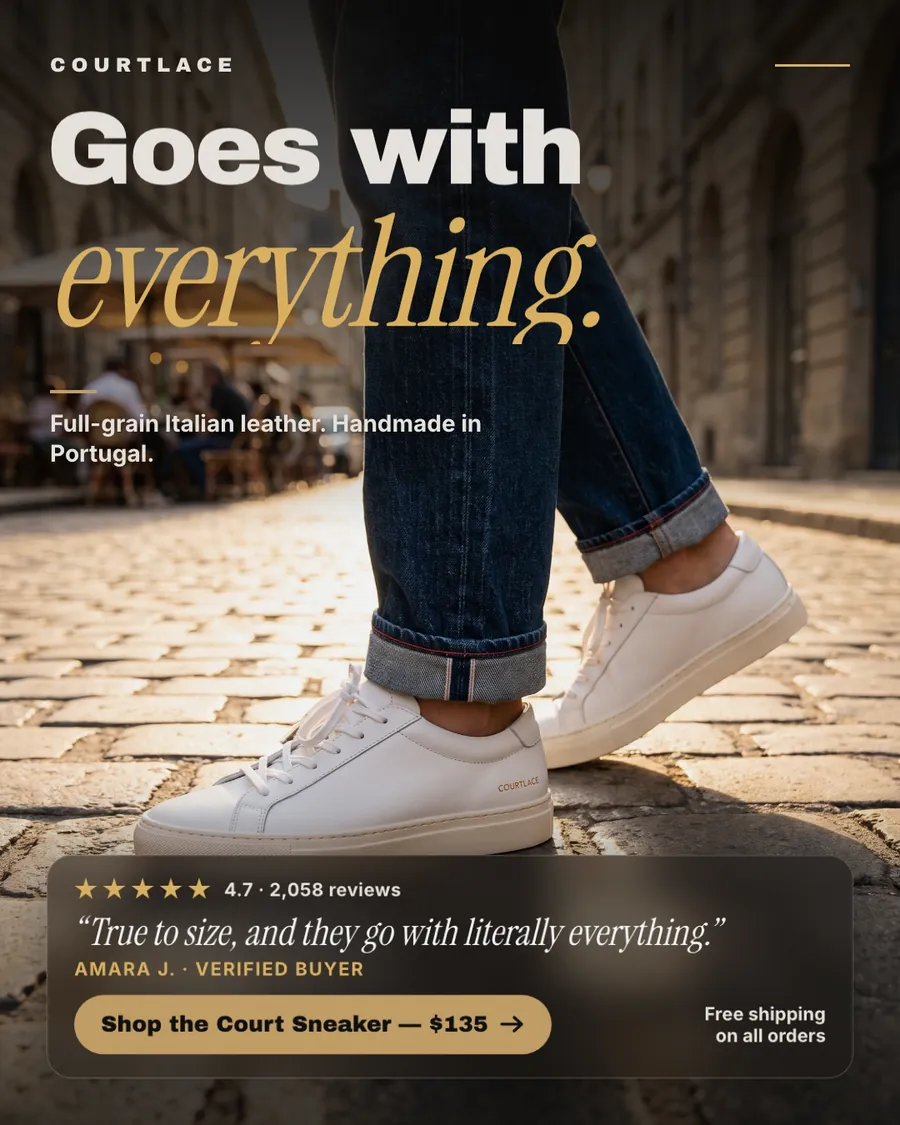
Lifestyle typeBenefit
Courtlace: Goes with everything.
Fictional sample brand · made by our engine
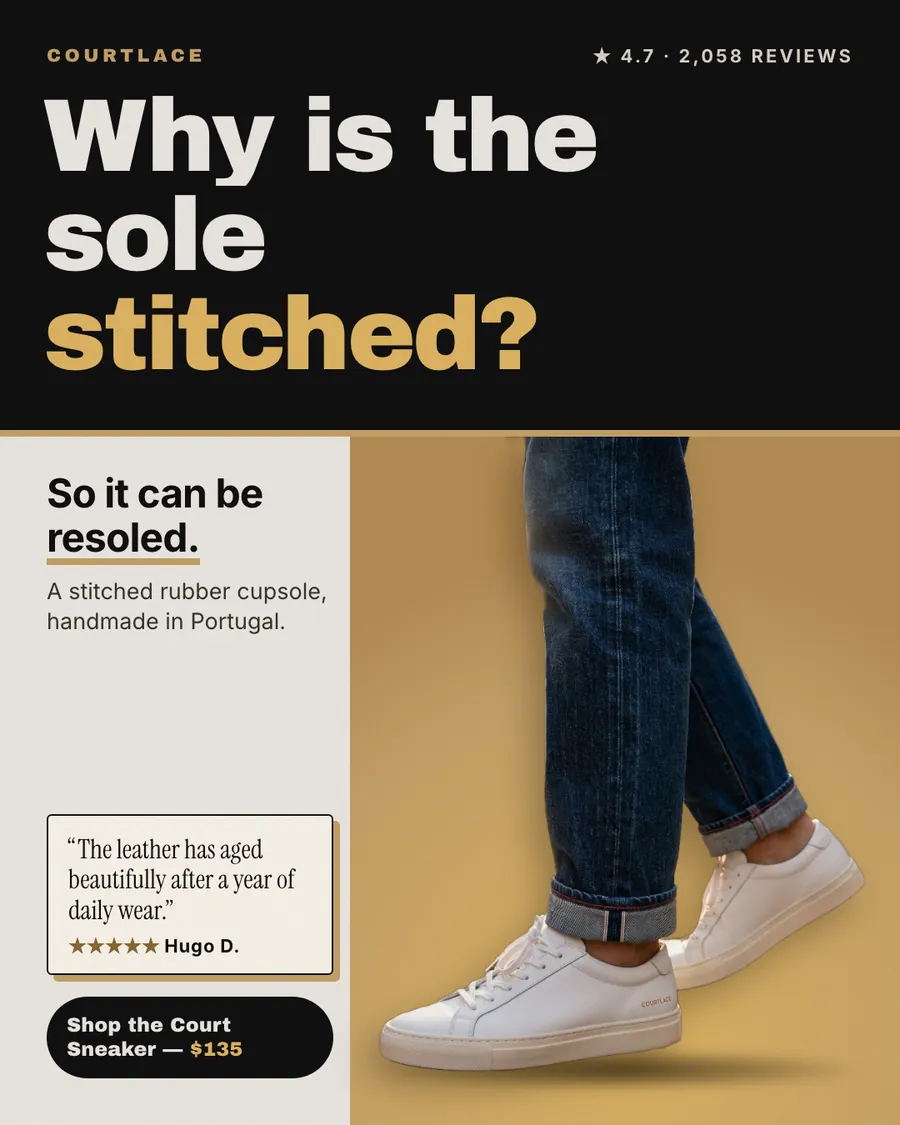
Question hookCraft
Courtlace: Why is the sole stitched?
Fictional sample brand · made by our engine
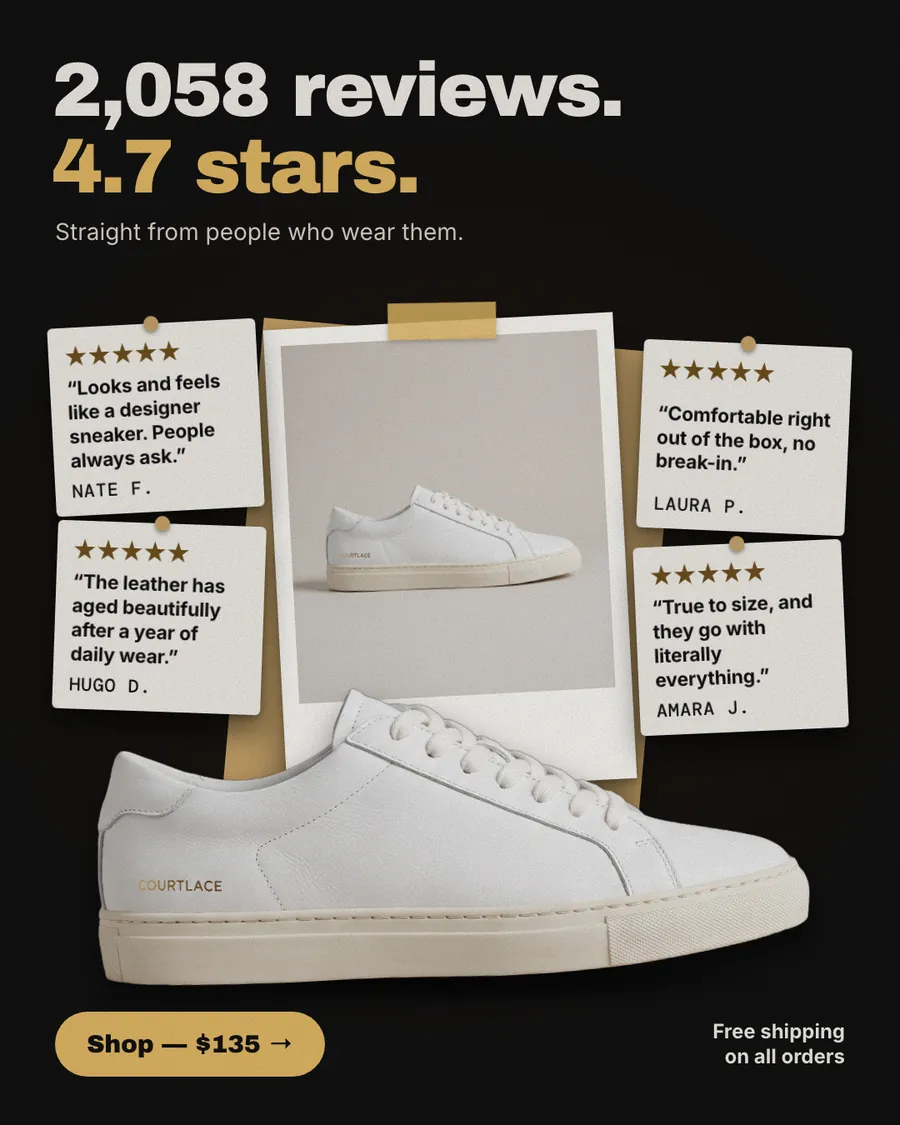
Review wallSocial proof
Courtlace: 2,058 reviews. 4.7 stars.
Fictional sample brand · made by our engine
Words to be careful with
Shoes aren't a restricted category on the main ad platforms. The trouble comes from material words, origin claims, comfort promises and borrowing someone else's brand.
"Leather" on a shoe with a rubber sole
The FTC's leather guides cover footwear. They say not to use an unqualified "leather" unless the product is leather in all substantial parts, and a claim about one part should name that part. "Full-grain leather upper, stitched rubber sole" is the safe shape of the line.
"Waterproof" and "scuff resistant"
The same guides say "waterproof" is misused unless the product keeps water from reaching its contents, and "scuff resistant" needs a basis and a surface that meaningfully resists scuffing. Treated leather that repels a splash is water resistant at most.
Source: 16 CFR 24.3: Misuse of "waterproof" and related terms
Where the pair is made
An unqualified "Made in USA" means all or virtually all of the shoe is made in the US. A pair designed at home and made abroad can say both, like the FTC's "Designed in USA, Made in Finland" example, but the ad should never let the design claim read as an origin claim.
Lookalikes of famous sneakers
Meta doesn't allow ads that infringe another party's trademark, copy a brand's name or logo, or promote counterfeit goods. Keep other brands' names, logos and signature marks out of your ads, even as a comparison.
Source: Meta Advertising Standards: Third-Party Intellectual Property Infringement
Foot pain and posture claims
Lines like "relieves heel pain" or "fixes your posture" are health claims, and the FTC (the US consumer protection agency) expects competent and reliable scientific evidence before an ad runs. Meta also rejects copy that asserts a health condition, so "Do your feet hurt?" is out while "Cushioned insole you can take out" is fine.
Source: FTC Health Products Compliance Guidance (December 2022)
Rules checked . The sources are linked at the end of this page.
How often to refresh shoe ads, and what to measure
A shoe brand's calendar refreshes the ads for it: a new color, a new material, the first warm week of spring. Between those, the question is how fast the current ads tire.
On a small budget, two or three new ads every three to four weeks usually keeps results steady. Around a launch, Black Friday (November 27, 2026) or the holiday weeks, the same people see your ads more often, so plan new ones every week or two.
Ads Manager (Facebook's tool for running ads) flags tired ads for you: "Creative limited" when an ad costs more per result than your past ads, and "Creative fatigue" once it costs twice as much. Meta's advice is a new ad with a materially different image or video, so swap the outfit or the setting, not just the headline.
What to measure
- Cost per purchase, by angle
- Tells you whether buyers come for the look, the build or the fit proof, which decides what the next ads lead with.
- Exchange rate by size
- A cluster of exchanges at one size is a sizing note to fix on the page, and it changes your real break-even.
- Shopping search terms that convert
- Shows which words people use for your pair, so the feed titles and the next ads can match them.
- Second-pair rate at 90 days
- Tells you whether the second-color email works, and how much a first order can afford to cost.
Questions about advertising shoes
How do I start advertising a shoe business online?
Start with one hero pair and fix its page first: a clear note on how the size runs, an easy exchange policy and fit reviews near the price. Then run six Meta ads in one ad set, each with a different reason to buy, and leave them alone for a week before judging.
Which platform is best for selling shoes as a new brand?
Meta is the usual first channel, because a pair worn in an outfit stops a scroll and broad targeting finds the right people. Google Shopping comes second for people searching a specific style. Marketplaces like Amazon can wait until your brand and your margins can absorb their fees and returns.
How much should a small shoe brand spend on ads?
Work out the most a first order can cost: order value times the margin left after the pair, shipping, exchanges and fees. Meta says an ad set usually leaves learning after about 50 results in a week, so multiply your break-even by 50 for the ceiling and start below it.
Is Google Shopping worth it for a shoe brand?
It is often worth it once the hero pair sells on Meta, because shoe searches are specific: style, color and size. The feed has to list every size and color as its own variant with accurate stock, or the ads will send buyers to sizes you can't ship.
How do I advertise shoes on Facebook without lots of size returns?
Answer fit in the ad and on the page before anyone orders. Use a review that mentions how the size runs, say whether you sell whole sizes only, and put the exchange policy in plain words. Then track why pairs come back and fix the page note that caused it.
When is the best time of year to advertise sneakers?
Demand follows the weather and the gift calendar: spring for white and light sneakers, back to school in late summer, and November and December for gifts. Shoes are a hard gift because of sizing, so holiday ads often work better with a gift card or an easy exchange promise.
Do I need influencers to sell shoes?
Not at the start. Creators help most once your own ads show which angle sells, because then you can brief them on it. Several creators with different feet are more useful than one big name, since they answer the fit question for more people.
How long before I know if my shoe ads are working?
Give a new ad set about a week without edits, since changes restart Meta's learning. After two weeks you can usually tell which angle earns purchases. After a month, add exchanges into the picture: an ad that sells many pairs that come back is weaker than it looks.
Is this plan different for a shop reselling sneakers?
Yes. Resellers sell many models in limited sizes, so search and marketplace listings matter more than building one hero pair. This plan is for a brand selling its own shoes, where the work is proving fit and quality for one design until it sells steadily.
Get the ads for this plan
Paste your store link and get 3 free ads of your own shoes: we read your products, prices and reviews, design around your real product photo and check every fact against your store.
Where to go next
- Shoe ad ideasEight sample ads for a leather court sneaker: fit, comfort, materials and resoling, the proof each needs and the words to avoid.
- SneakersSneaker ads with a clean side profile, the true colorway and a real reason to buy now.
- How to advertise socksA sock brand's ad plan: sell the pack, not the pair, win the reorder, and time the gift push for stocking season.
- How to advertise a clothing brandOne hero product, fit proof on real bodies, returns counted before the budget: a first-month ad plan for a small clothing brand.
- How to advertise bags and handbagsA plan for a small bag brand: prove capacity and materials first, give a $100 purchase time to happen, and make the first order pay for itself.
- Black Friday ad ideasThe 2026 dates, six Black Friday offers and the products they suit, copy lines, and 16 sample ads for four stores.
- Ad creative testing on a small budget: an honest guideOne ad is a bet; fifty ads is a spray. Here is the middle path for small budgets: a few angles that disagree with each other, enough spend to read them, and a weekly loop that builds on what works.
- Product photos that sell: the shots every ad needsAds ask more of a photo than a product page does. Here is how to shoot, with a phone and a window, the handful of photos that can carry months of ads.
- PricingFree preview, Lite $29/month for 9 designs a month (optional 2 weekly), Starter $49/month for 20. Meta and a 7-day trial from Growth.
Sources
Platform rules on this page were checked on against:
- Meta Business Help Center: About the learning phase
- Meta Business Help Center: About creative fatigue recommendations in Ads Manager
- 16 CFR 24.0: Scope of the leather guides (includes footwear)
- 16 CFR 24.2: Deception as to composition
- 16 CFR 24.3: Misuse of "waterproof" and related terms
- FTC: Complying with the Made in USA Standard
- Meta Advertising Standards: Third-Party Intellectual Property Infringement
- FTC Health Products Compliance Guidance (December 2022)
- Meta Advertising Standards: Privacy Violations and Personal Attributes
- USPS 2026 Holiday Shipping Deadlines
- 3 free ads, no signup
- Lite $29/month · 9 designs a month · optional 2 weekly
- Starter $49/month · 20 designs
- Growth $99/month, 7-day free trial
- Pro $149 · Scale $199
- 30-day money-back guarantee