how to advertise socks
How to advertise socks when one order is only a few dollars of margin
Socks are cheap to try and easy to forget. A single order barely pays for the ad that won it, so a sock brand grows on packs, reorders and gift season rather than on one-off sales. This plan is built around that, using the numbers of Woolgather, a fictional brand selling merino crew socks in packs of three.
Updated · Budgets and examples use a fictional brand's numbers. Use yours.
In short
What is the best way to advertise socks?
Sell packs, not single pairs, and start on Meta with ads that prove one thing each: the fiber, the comfort in a buyer's words, the guarantee. Collect emails from the first order so reorders cost little, and save your biggest push for November and December, when socks become gifts and stocking stuffers.
StoreToAds makes ready-to-post ads from your product photo, free to try.
At a glance
- The money problem
- A small order value leaves little room for ad cost per sale
- Where to start
- Meta (Facebook and Instagram), with the 3-pack as the thing you sell
- Where the profit is
- Second and third orders, which email wins for almost nothing
- Busiest weeks
- Late November to mid-December, for gifts and stockings
- Label words to get right
- Fiber names, "100%", "lifetime" and where the socks are made
Which channels fit socks, in the order to try them
A sock buyer rarely searches for your brand. They notice a pair on someone, need a fresh drawer, or want a small gift. The channels below follow those three moments, with a list to keep the buyer once they've worn a pair.
- 01
Meta (Facebook and Instagram)
Start hereWhy it fits
Feet by a fire, a muddy trail, a drafty office: socks are easy to show in a moment people recognize. Broad targeting works because almost everyone wears socks, and the ad itself picks out who cares about merino.
The trade-off
With a low order value, ad costs that look small on paper can still be more than an order is worth. Sell packs from day one.
- 02
Email and SMS
Start hereWhy it fits
Socks wear out and drawers run short, so a buyer who liked the first pack is the cheapest second sale you have. A reorder note, a new color and a holiday gift reminder do most of the work.
The trade-off
It only works once people have bought or signed up, and texts need explicit opt-in.
- 03
Google Shopping
Add nextWhy it fits
Some shoppers search exactly what you sell: "merino crew socks", "wool hiking socks", "no-show wool socks". Shopping ads show the pack and its price right on that search.
The trade-off
Price sits next to big retailers' multi-packs, so the listing has to show why yours costs more: the fiber, the guarantee, the reviews.
- 04
Pinterest
Add laterWhy it fits
Gift guides, stocking stuffers and cozy winter boards are planned there weeks ahead. A styled pack in a gift setting fits right in.
The trade-off
Results come slowly: a pin saved in early November may turn into an order in December.
- 05
Etsy
Only if it fitsWhy it fits
For hand-knit or novelty socks, Etsy search already brings gift buyers looking for exactly that, and Etsy Ads spend inside that search.
The trade-off
Etsy's Offsite Ads fee is 15% of an attributed order (12% once a shop reaches $10,000 of yearly sales), and the buyer's email stays with Etsy, which cuts off the reorder.
- 06
TikTok
Skip for nowWhy it fits
Funny sock clips and drawer makeovers do get views.
The trade-off
Views are cheap; sales of a low-priced pack are not. Wait until your Meta ads show which angle sells.
Your first 30 days advertising socks
This month is about one product, the 3-pack, and one habit: getting the buyer's email. Hiking socks, no-shows and the six-pack can ride along on the product page until the hero sells steadily.
Days 1 to 3
Make the pack the hero and fix the page
Put the full fiber content, the country of origin, the care line and the guarantee terms on the 3-pack's page in plain words. Show all three colors in one photo, and check that a test order shows up in Meta Events Manager.
Days 4 to 10
Launch six ads for the 3-pack
Two ads lead with the material and what it does, two with a buyer's words about comfort or wear, and two with the guarantee. Group them in a single Sales campaign, broad audience, 4:5 and 9:16, and resist editing for a week.
Days 11 to 17
Watch the pack size people choose
Look at which ad earns orders, and how many of those orders reach the free shipping line or the six-pack. If buyers keep stopping at one pack, the next ads should show the value of six.
Days 18 to 24
Set up the gift season
Make one gift-ready offer (a six-pack in a box, or a hiking and everyday mix) and two ads for it. Plan to start gift ads in late November and to put your last order date for Christmas delivery on them from early December.
Days 25 to 30
Turn on the reorder and thank-you emails
Send a thank-you with care tips a few days after delivery, then a reorder note once the first pack has had a season of wear. Your own data will show when buyers come back; adjust the timing to match it.
How to size a starting budget for sock ads
Woolgather's numbers: the typical order is one 3-pack at $42, which just clears the $40 free shipping line. A share of buyers move up to the $79 six-pack, which is where the margin gets comfortable.
| Order value | $42.00 |
|---|---|
| Margin after product cost, shipping and fees | 50% |
| Most a first order can cost to break even | $21.00 |
| 50 purchases a week at that cost | $1,050 a week |
| The same budget per day | about $150 |
Meta says an ad set usually leaves its learning phase after about 50 results in the week after its last significant edit, and recommends a budget large enough to get enough results. Meta Business Help Center: About the learning phase
The weekly figure looks friendly next to pricier products, but read the per-order line first: that is all a new customer can cost before the first order loses money. Most sock ads won't hit it on day one.
- Raise the order, not the bid. The six-pack nearly doubles the order value, and every buyer who chooses it doubles what the ad that won them can cost.
- Let reorders carry part of the cost, once you can see them. If your own records show buyers come back for a second pack, a first order can cost more than its margin. Until then, plan as if they won't.
- Keep the budget in one ad set. Splitting a small budget across crew, hiking and no-show socks leaves each one short of results.
- Spend more in gift weeks. From late November the same ad often earns larger orders, because people buy for several feet at once.
Offers that work for socks
Sock offers work best when they make a bigger pack feel obvious. Cutting the price of one pack mostly trains buyers to wait for the next sale.
Free shipping over a pack's price
Setting the line just under one 3-pack ($40 against $42) means nearly every order ships free without a discount code.
A six-pack with a real saving
Woolgather's six-pack is $79, against $84 for two 3-packs. It makes stocking up the sensible choice.
Watch: If you show a "was" price, it has to be one you actually charged for a reasonable period, not a number set up to make the sale look bigger.
The guarantee, stated as an offer
"If they wear out, we replace them" turns a $42 pack into a low-risk try for a buyer who has been burned by thin socks before.
Watch: Say who it covers and how a replacement is claimed, in the ad or one tap away.
A gift box or stocking mix
In December, a ready-to-give pack answers the gift buyer's question in one tap and raises the order value.
Watch: USPS suggests mailing Ground Advantage by December 17, 2026 for Christmas delivery. Stop promising delivery after your own cutoff.
Angles to test for sock ads
Each angle gives a reason to pay more than a supermarket multi-pack. The full set of sample ads, photo notes and copy lines is on Socks ad ideas; these are the angles this plan tests first.
The fiber, explained
72% merino. Warm in winter, cool in summer.
Durability in a buyer's words
"Two years in and not a single hole."
A moment people know
Feet up. Fire on. Toes toasty.
The guarantee
Wear them out and we'll replace them.
Gift season
Three pairs, one less gift to think about.
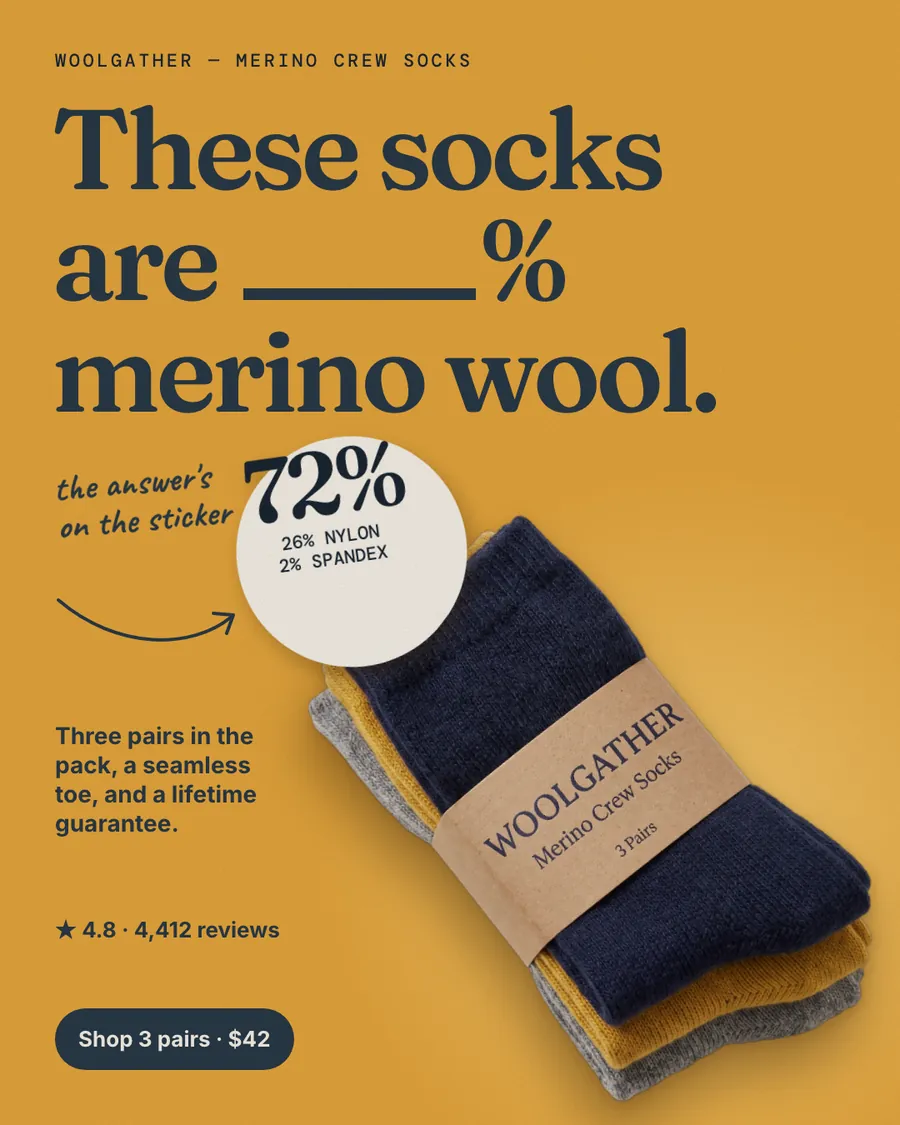
Fill in the blankTransparency
Woolgather: These socks are ____% merino wool.
Fictional sample brand · made by our engine
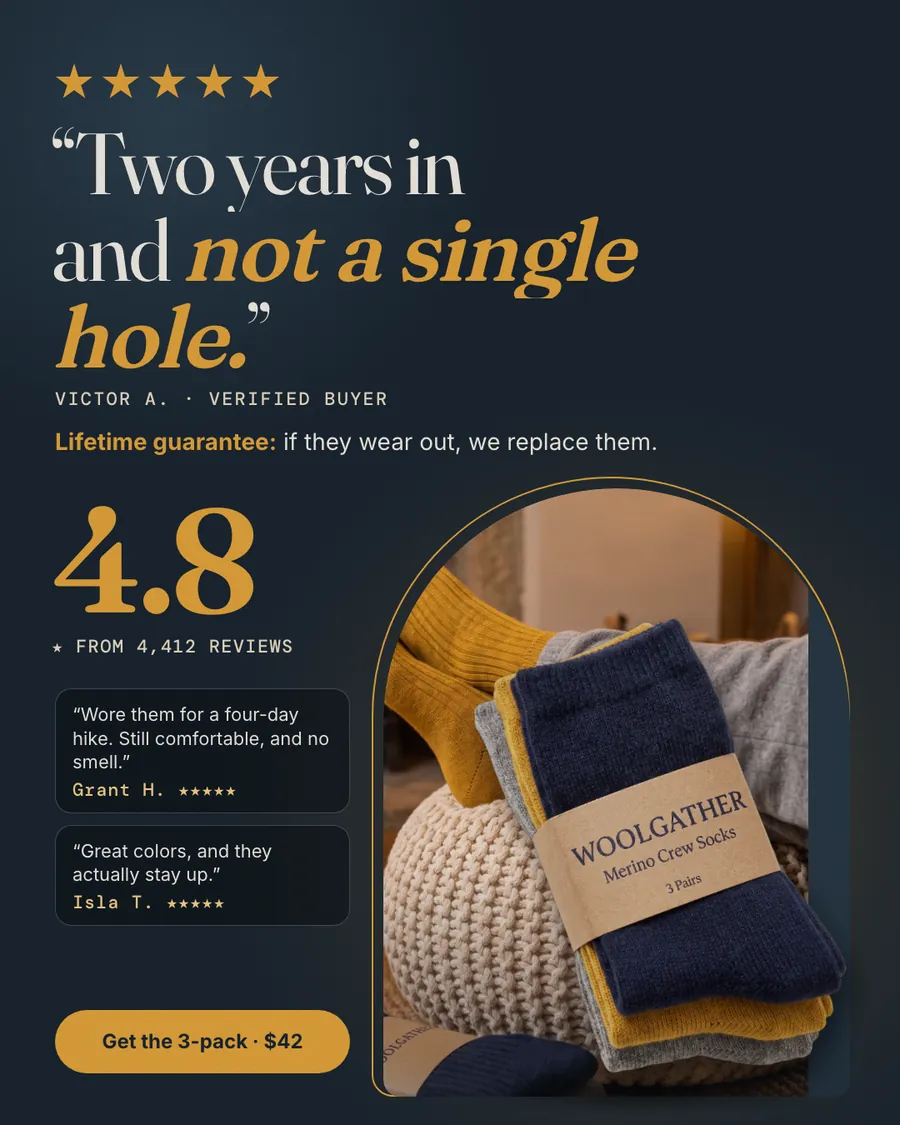
Review cardDurability
Woolgather: “Two years in and not a single hole.”
Fictional sample brand · made by our engine
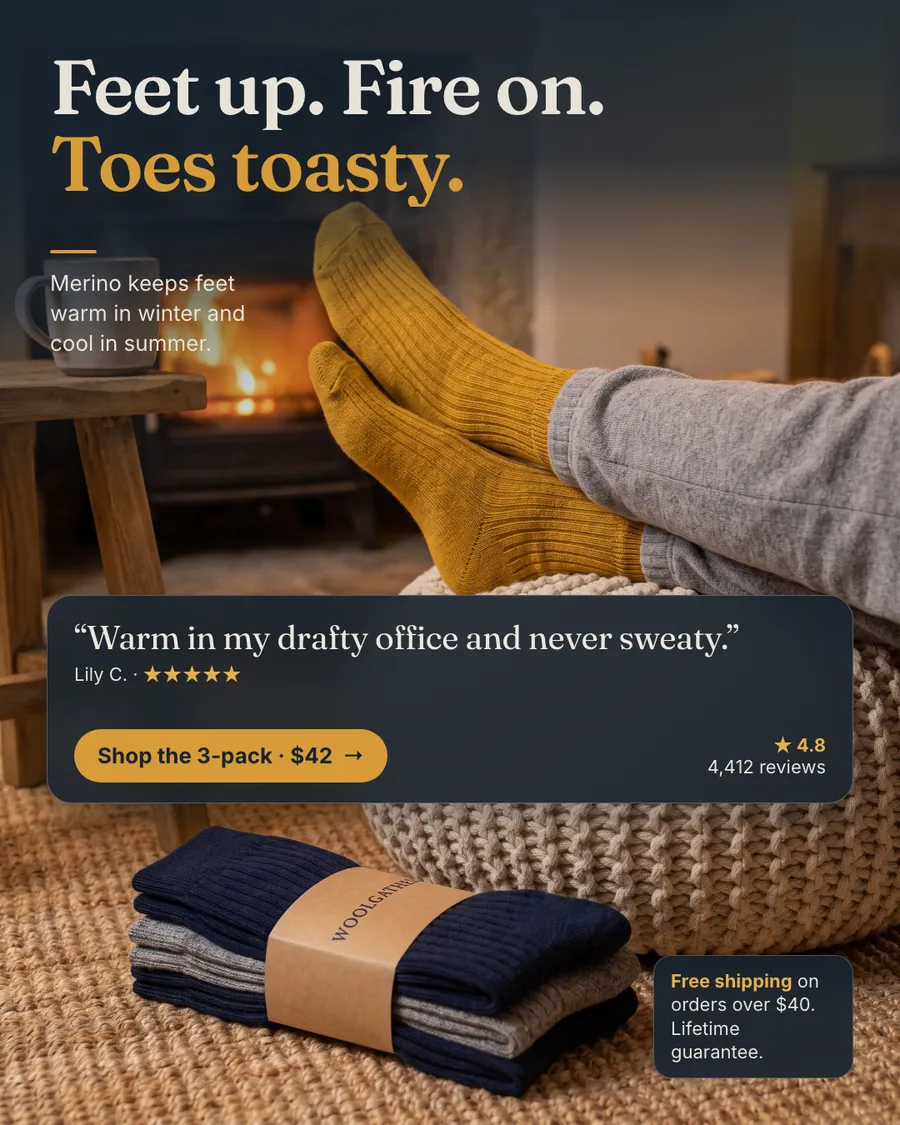
Lifestyle typeRitual
Woolgather: Feet up. Fire on. Toes toasty.
Fictional sample brand · made by our engine
Words to be careful with
Socks aren't a restricted category on the main ad platforms. The rules that catch sock brands are the FTC's textile and wool rules, guarantee wording and comfort claims that drift into health.
Naming the fiber in an ad
The FTC's textile and wool guide says socks are covered, and that an ad naming a fiber should carry the fiber content required on the label, minus the percentages. A merino ad for Woolgather's sock should also name the nylon, with the 2% spandex listed as other fiber, since fibers under 5% can be grouped that way.
Source: FTC: Threading Your Way Through the Labeling Requirements Under the Textile and Wool Acts
"100% merino"
The wool rules allow "100%" or "all" only when a product is made wholly of one fiber, apart from small ornamentation. A blend that needs nylon to last is a merino blend, so say so.
"Lifetime guarantee"
The FTC's guarantee guides say an ad using "lifetime" should state what life it refers to, and an ad mentioning a guarantee should disclose its material conditions. "If they wear out, we replace them, for as long as you own them" is clearer than "lifetime" alone.
Source: 16 CFR 239.4: "Lifetime" and similar representations
Where the socks are made
The same FTC (the US consumer protection agency) guide says online product descriptions for textile products must say whether the item was made in the US, imported or both, and most socks must name the country of origin on the front of the package or label.
Source: FTC: Threading Your Way Through the Labeling Requirements Under the Textile and Wool Acts
Odor, blisters and circulation
"Resists odor" is a claim you need a basis for before the ad runs. "Prevents blisters" or "improves circulation" go further: they are health claims, and the FTC expects competent and reliable scientific evidence for those.
Source: FTC Health Products Compliance Guidance (December 2022)
Rules checked . The sources are linked at the end of this page.
How often to refresh sock ads, and what to measure
Sock ads tire fast because the audience is wide and the same people scroll past daily. New colors and the seasons give you natural reasons to make new ones.
On a small budget, plan two or three new ads every three weeks, and a fresh gift set from mid-November until your last shipping date. A new colorway is a new ad, and so is a new setting: the trail in autumn, the office in winter, the fireplace in December.
Meta labels worn-out ads in the Delivery column. An ad marked "Creative limited" costs more per result than your earlier ads did; "Creative fatigue" marks one costing double or worse. Meta suggests a new ad with a materially different image or video, so change the scene, not just the words.
What to measure
- Cost per first order
- Compared with the break-even (the point where the ads pay for themselves) line above, it tells you whether the ads pay on the first pack or need the reorder.
- Share of orders that are six-packs
- The quickest way to make a low-priced product pay for its ads. If it doesn't move, the ads aren't showing the value.
- Reorder rate at 90 and 180 days
- Tells you how much a first order is really worth, and when to send the reorder email.
- Guarantee claims per hundred orders
- A cost to budget for, and an early warning if a color or size wears out faster than the rest.
Questions about advertising socks
Where should I start advertising a sock brand?
Start on Meta with one pack, not the whole range, and run six ads that each give a different reason to buy. Ask every buyer for an email at checkout, because the second order is where a sock brand makes its money. Add Google Shopping once one pack sells steadily.
Can ads for socks make money with such a low price?
They can, but rarely on a single pair. Sell packs, set the free shipping line just under one pack's price, and offer a larger pack with a real saving. Then win the reorder by email, which costs very little compared with finding a new buyer.
How much should a small sock brand spend on ads at first?
Multiply your order value by the margin left after socks, packaging, shipping and fees. The result is your ceiling per new customer. About 50 orders a week at that cost is what Meta's learning phase (Facebook's first days of testing who to show the ad to) looks for, so start lower and raise the budget as packs and reorders lift order value.
Is it worth selling socks on Etsy?
It can be for hand-knit, custom or novelty socks, since Etsy shoppers search for exactly that. Etsy charges an Offsite Ads fee of 15% on attributed orders until a shop reaches $10,000 of yearly sales, then 12%, and the buyer stays an Etsy customer, so reorders are harder to win.
When should a sock brand start holiday ads?
Get gift ads ready in November and start the main push in late November, with Black Friday on November 27, 2026. From early December, put a clear last order date for Christmas delivery in every gift ad. USPS suggests mailing Ground Advantage by December 17 within the contiguous US.
Should I advertise socks on Instagram or Facebook?
Both run from the same Meta ad account, and one campaign can show your ads in both apps. Build every ad in 4:5 for the feeds and 9:16 for Stories and Reels, so you don't have to choose between them.
Do sock subscriptions work?
They can for brands whose buyers reorder on a steady rhythm, but most people don't think of socks on a schedule. Start with reorder emails, look at how often buyers come back on their own, and offer a subscription only if a clear pattern shows up.
How do I advertise socks as a small online shop with no reviews yet?
Get a few dozen honest reviews before spending much: early buyers, friends who wear them hard, a small launch offer for your list. In the meantime, lead ads with what can be checked, like the fiber content and the guarantee, rather than with comfort claims nobody has confirmed yet.
What should I measure first in sock ads?
Cost per first order against your break-even, and the share of buyers who choose the bigger pack. After a few months, add the reorder rate, because it decides how much a first order can really afford to cost.
Get the ads for this plan
Paste your store link and get 3 free ads of your own socks: we read your products, prices and reviews, design around your real product photo and check every fact against your store.
Where to go next
- Sock ad ideasSeven sample ads for a merino sock 3-pack: warmth, a rib that stays up, durability and odor, plus wool and guarantee wording.
- ClothingApparel ads that answer the fit question: fabric, size range and on-body photos from your store.
- How to advertise shoesA plan for a small shoe brand: settle sizing before spending, start with one hero pair on Meta, and count exchanges in the budget.
- How to advertise a clothing brandOne hero product, fit proof on real bodies, returns counted before the budget: a first-month ad plan for a small clothing brand.
- How to advertise camping gearA camping gear brand's ad plan: Meta and Shopping before trip season, spec proof in ounces, a sleep-system bundle and a budget for a big ticket.
- Christmas ad ideasThe 2026 shipping cutoffs that set your ad calendar, six Christmas offers, copy lines and 16 sample ads for four stores.
- Bundle offerBundle and set ads that show what is in the box and the real saving against buying separately.
- Christmas gift adsShip-to-them offers, what's-inside ads and last-minute timing for gift boxes, with four ads for Bowfinch.
- PricingFree preview, Lite $29/month for 9 designs a month (optional 2 weekly), Starter $49/month for 20. Meta and a 7-day trial from Growth.
Sources
Platform rules on this page were checked on against:
- Meta Business Help Center: About the learning phase
- Meta Business Help Center: About creative fatigue recommendations in Ads Manager
- FTC: Threading Your Way Through the Labeling Requirements Under the Textile and Wool Acts
- 16 CFR 300.17: Use of the terms "all" or "100%"
- 16 CFR 239.3: Disclosure of material conditions
- 16 CFR 239.4: "Lifetime" and similar representations
- FTC Guides Against Deceptive Pricing, 16 CFR 233.1 (former price comparisons)
- FTC Health Products Compliance Guidance (December 2022)
- Etsy: Fees & Payments Policy
- USPS 2026 Holiday Shipping Deadlines
- 3 free ads, no signup
- Lite $29/month · 9 designs a month · optional 2 weekly
- Starter $49/month · 20 designs
- Growth $99/month, 7-day free trial
- Pro $149 · Scale $199
- 30-day money-back guarantee