how to advertise pet products
How to advertise pet products when you're a small brand
Pet treats, chews and toys have an odd ad problem: the person pays, but the animal decides whether there's a second order. So the plan below spends on getting the first pouch into the house and earns its money on the reorder. It's built around Scout & Bramble, a fictional dog treat brand, and its real-looking numbers.
Updated · Budgets and examples use a fictional brand's numbers. Use yours.
In short
How do you advertise pet products as a small brand?
Start on Meta with five to eight ads that each lead with one fact owners check, like the first ingredient or calories per treat, and send buyers into a reorder email. Size the budget from your margin per order, leave the ads alone for a week, then add Google Shopping and creator gifting.
At a glance
- Who decides
- The owner buys once; the dog decides whether they buy again.
- Where to start
- Meta ads, plus a reorder email from day one
- Where the margin is
- The second and third pouch, not the first order
- The rule that bites
- No health or disease claims on treats and food
- New ads
- Every 2 to 3 weeks on a small budget, plus seasonal swaps
Which channels fit pet products, in the order to try them
Treats and food are cheap, repeat purchases, and owners discover them while scrolling, then reorder on habit. That favors one channel that finds new owners and one that brings them back.
- 01
Meta (Facebook and Instagram)
Start hereWhy it fits
Dog and cat owners are easy to reach without narrow targeting, because an ad that's plainly about training a dog filters its own audience. Feed and Stories ads can show the treat, the pouch and the label in one swipe.
The trade-off
Meta needs purchase data to optimize, so the pixel and Conversions API have to work before you spend. A low-price product makes the learning phase expensive (see the budget section).
- 02
Email and SMS
Start hereWhy it fits
A 300-bite pouch runs out in a few weeks of training, so a reorder reminder timed to that is the cheapest sale you'll make. Subscribe and save lives here too.
The trade-off
It only works on people who already bought or signed up, so it can't replace an ad channel. SMS needs explicit opt-in consent.
- 03
Google Shopping
Add nextWhy it fits
People search for specifics like "low calorie training treats" or "salmon dog treats". Shopping ads show your photo and price right on that search.
The trade-off
You sit next to big pet retailers on price, and the product feed has to be clean (titles with the protein, size and count) before it earns clicks.
- 04
Creators and gifting
Add nextWhy it fits
Dog accounts on Instagram and TikTok are where owners see a treat being used. A pouch sent to 20 small creators costs less than a week of ads and gives you real videos to test.
The trade-off
Slow and uneven: some never post. Posts need a clear #ad disclosure, and you need permission before you run their video as an ad.
- 05
Amazon
Only if it fitsWhy it fits
Many owners buy treats where they buy everything else, and Sponsored Products ads catch searches for your exact product type.
The trade-off
Fees and price comparisons squeeze margin, and Amazon owns the customer, so your reorder email can't reach them.
- 06
TikTok
Add laterWhy it fits
Dog videos travel well there, and a funny 10-second clip can carry a treat brand.
The trade-off
It wants new video every week. Without a steady supply of clips, it's a channel you can't keep fed yet.
- 07
Pinterest
Skip for nowWhy it fits
Pinterest suits beds, bowls and accessories that people plan a room or a new puppy around.
The trade-off
Treats are an everyday reorder, not something owners plan on a board, so the clicks there are less likely to be buyers.
Your first 30 days advertising pet products
One campaign, one ad set, a handful of ads with different reasons to buy, and patience. The steps assume a Shopify-style store and a Meta ad account.
Days 1 to 3
Make sure sales are counted
Connect the Meta pixel and Conversions API (Shopify's Facebook and Instagram app does both), place a test order and check the purchase shows in Events Manager. Put the first ingredient, calories per treat, size and count on the product page, because that's where the ad sends people.
Days 4 to 7
Launch 6 to 8 ads on 4 angles
Make two ads for each of four angles: the first ingredient, calories per bite, an owner's review about a picky dog, and a training joke. Run them in one Sales campaign with one ad set, broad targeting in your shipping country and automatic placements, in 4:5 and 9:16.
Days 8 to 14
Leave it alone
Don't edit the ad set, its budget or its audience: a significant edit restarts learning. Look, don't touch. Note which angle gets the most link clicks and add to carts per dollar.
Days 15 to 21
Feed the winning angle
Turn off ads that spent your break-even cost per order twice without an add to cart, and add 2 or 3 new ads on the best angle plus 1 on an angle you haven't tried. Switch on the welcome email and a reorder reminder about 3 weeks after the first order.
Days 22 to 30
Decide what to scale and what to add
If cost per purchase is under your break-even, raise the budget in modest steps rather than all at once. If it isn't, try a new angle before a new channel. Then start a small Shopping campaign or send pouches to creators.
How to size a starting budget for pet product ads
Start from what one order is worth to you, not from a number someone posted on Reddit. Here is the math with Scout & Bramble's numbers: most orders are the $42 variety 3-pack, because it clears the free shipping line.
| Order value | $42.00 |
|---|---|
| Margin after product cost, shipping and fees | 45% |
| Most a first order can cost to break even | $18.90 |
| 50 purchases a week at that cost | $945 a week |
| The same budget per day | about $135 |
Meta says an ad set usually leaves its learning phase after about 50 results in the week after its last significant edit, and recommends a budget large enough to get enough results. Meta Business Help Center: About the learning phase
That's more than most new treat brands want to spend in month one, and it's the honest reason pet ads feel expensive: a $16 product has little room for a first-order ad cost. Three ways to make it fit:
- Count the reorder, carefully. If your own data shows owners buy a second pouch, a first order can cost more than its margin and still pay back. Use your repeat rate, not a hoped-for one.
- Optimize for a more frequent event first. Meta suggests choosing an event that happens more often, like add to cart, when an ad set can't get enough purchases. Switch to purchases once you have the volume.
- Keep everything in one ad set. Splitting $40 a day across three ad sets gives each too little data. Meta recommends combining similar ad sets.
A smaller test budget still works for learning which angle gets clicks, as long as you read "Learning limited" as "not enough data yet" rather than "this failed".
Offers that work for pet products
Good pet offers lower the risk of a picky eater and reward the reorder. Deep discounts mostly teach owners to wait for the next one.
Subscribe and save
Treats and food get used up on a schedule, so a standing order suits owners and gives you predictable revenue. Scout & Bramble's is 15%.
Watch: Say in the ad that skipping or cancelling is easy, and make it easy.
A bundle that clears the free shipping line
A 3-pack at $42 against a $40 threshold makes the shipping question disappear and raises the order value your budget math starts from.
A picky-eater promise
"If your dog won't eat them, we'll refund you" answers the biggest worry in pet treat reviews.
Watch: Only if you actually honor it, and state the conditions on the page.
A first-order code for email signups
It builds the list your reorder emails need.
Watch: Keep it modest; it comes straight out of the first order's margin.
Angles to test for pet product ads
Each ad should lead with one reason an owner can check. Here are the angles behind the plan above; the full set of sample ads, photo checklist and copy lines are on Pet product ad ideas.
The first ingredient
Wild-caught Alaskan salmon. Ingredient #1.
Calories per piece
3 calories a bite. Train all afternoon.
The picky dog
"My picky rescue does tricks for these."
Price per treat
About 300 bites a pouch. About 5 cents each.
The training cue
Sit. Stay. Salmon.
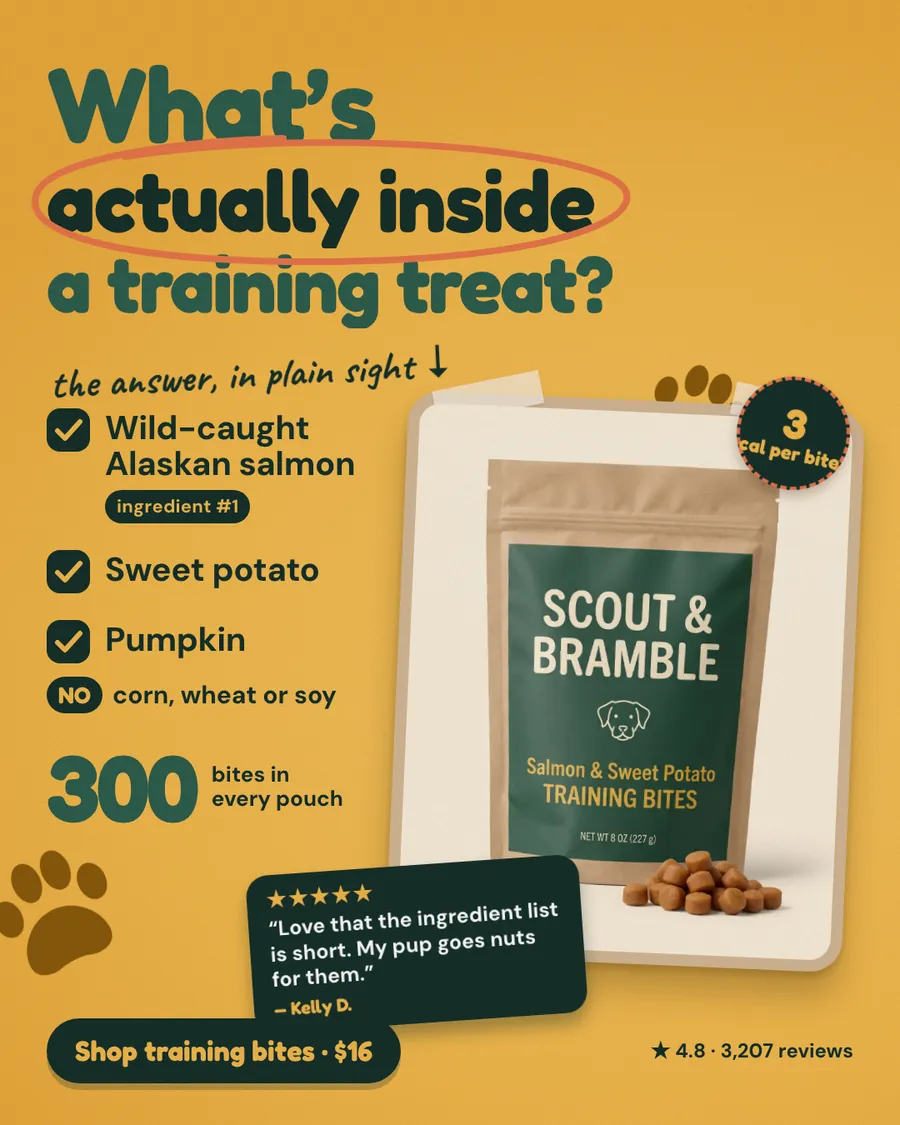
Question hookIngredients
Scout & Bramble: What's actually inside a training treat?
Fictional sample brand · made by our engine
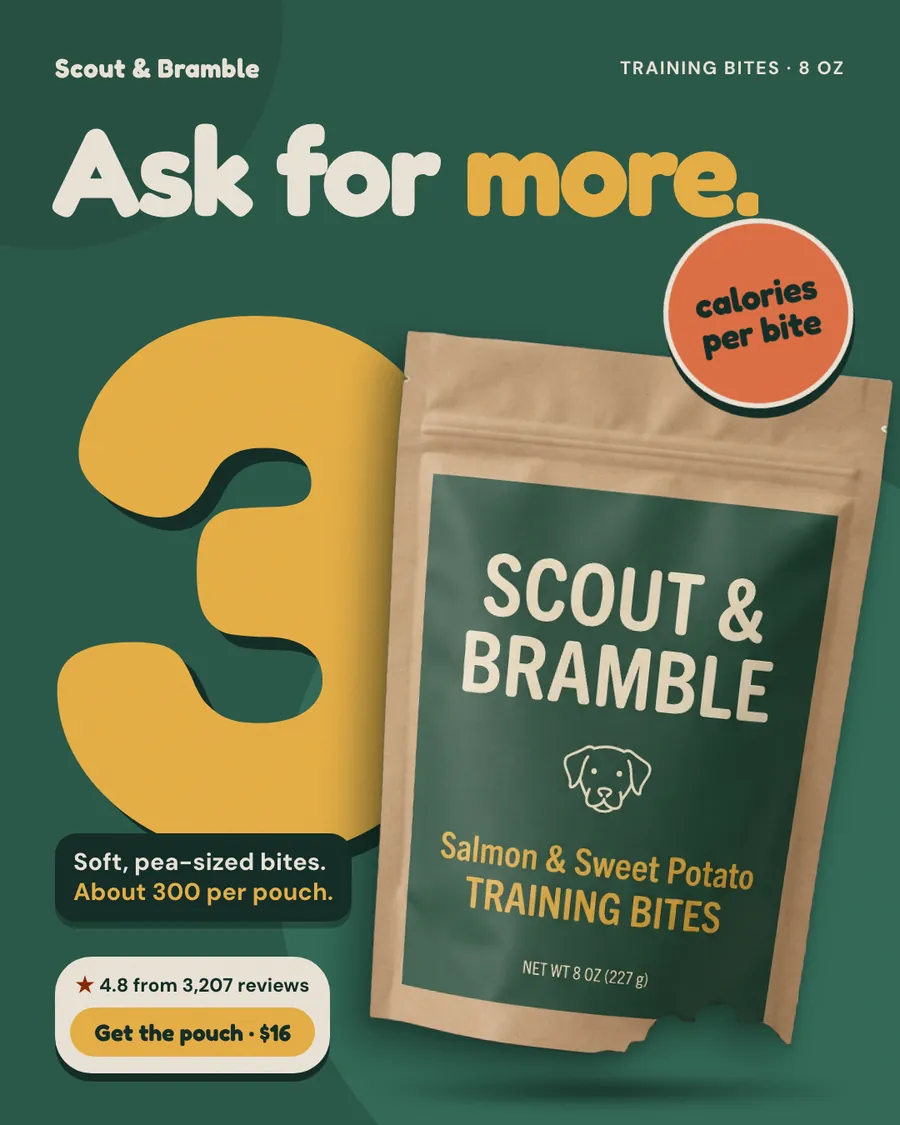
Big numberBenefit
Scout & Bramble: Ask for more.
Fictional sample brand · made by our engine
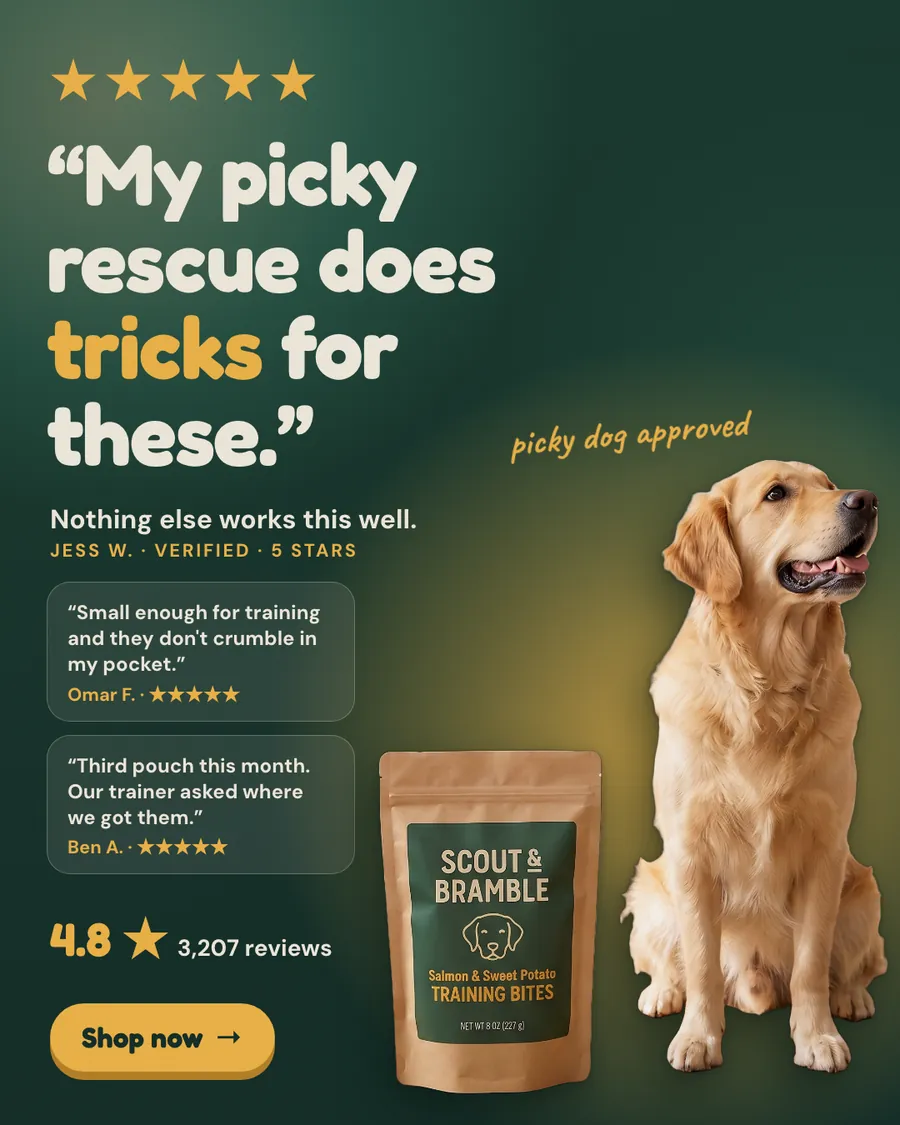
Review cardSocial proof
Scout & Bramble: “My picky rescue does tricks for these.”
Fictional sample brand · made by our engine
Policy flags for pet product ads
Pet food and treats follow labeling rules that also cover ads and websites, and the ad platforms add their own. These are the ones small pet brands run into.
Health and disease claims
Under the AAFCO model rules most US states use, claiming that a food or treat treats or prevents a disease misbrands it unless it contains an approved drug. "Eases sore joints" is that kind of claim.
"Human grade"
Acceptable only when the whole product meets AAFCO's human grade requirements, not because one ingredient is human-edible.
"Vet approved" and creator posts
An expert endorsement needs real veterinarians who evaluated the product, and gifted creator posts need a clear disclosure (FTC Endorsement Guides).
Animals in the ad
Meta doesn't allow ads for peer-to-peer sales of live animals. Treats, toys and supplies are ordinary products; just keep the ad about the product.
Source: Meta Advertising Standards: Sale of Non-Endangered Animals and Endangered Species
Pet supplements
Calming chews and joint supplements fall under health rules on every platform. Google Shopping restricts unapproved supplements, and Meta reviews health claims closely.
Source: Google Merchant Center: Healthcare and medicines (Shopping)
How often to refresh pet product ads, and what to measure
There's no fixed lifespan for an ad. On a small budget the same owners see your ad less often, so it lasts longer; at higher spend it wears out faster.
A workable rhythm for a small pet brand: 2 to 4 new ads every 2 to 3 weeks, built on the angle that's winning, plus one new angle each time. Swap in seasonal ads for Halloween, stocking stuffers and January's new dogs.
Meta labels an ad "Creative limited" when its cost per result is above your past ads, and "Creative fatigue" when it reaches twice their cost. Meta suggests a new image or video that is materially different, while keeping the original running.
What to measure
- Cost per purchase vs your break-even
- The number from the budget section. Under it, you can scale; over it, change the ad before the budget.
- Reorder rate at 30 and 60 days
- The number that decides how much a first order may cost. Track it per product, not storewide.
- Add to cart rate per angle
- Tells you which reason to buy works long before purchases are numerous enough to judge.
- Frequency
- How many times the average person has seen the ad. When it climbs and clicks fall, the ad is tiring.
Questions about advertising pet products
How do I advertise dog treats on Facebook?
Run one Sales campaign with one broadly targeted ad set and six to eight ads, each leading with one fact owners check: the first ingredient, calories per treat, the count per pouch or an owner's review. Make sure purchases are tracked first, and don't edit the ad set during its first week.
How do I advertise dog treats on Instagram?
Instagram ads run from the same Meta ad account, so the plan is the same; just make every ad in 4:5 for the feed and 9:16 for Stories and Reels. Real dogs in real homes look native there, and short creator clips often do better than studio shots.
How do I advertise pet products on Amazon?
Start with Sponsored Products on your exact product type, with a listing whose title names the protein, size and count and whose images show the label. Amazon suits owners who already shop there, but fees cut margin and you can't email those buyers to reorder.
How do I advertise pet products on Etsy?
Etsy Ads promote your listings inside Etsy search, and Offsite Ads charge a fee only when an ad on another site leads to a sale. Etsy suits handmade collars, beds and personalized tags better than consumables, which buyers prefer to reorder from a store.
How do I advertise pet food on social media?
Lead with what owners compare: the first ingredients, which life stage the food is complete and balanced for, and feeding cost per day. Show the bag and the bowl, use owners' stories, and keep disease claims out of the copy, since the label rules apply to ads too.
How much should I spend to advertise pet products?
Work it out from your margin: order value times the margin left after product cost, shipping and fees is the most a first order can cost. About 50 purchases a week at that cost is what an ad set usually needs to leave Meta's learning phase. Many small brands start below that and optimize for add to cart first.
How do I sell pet products online?
Make the product page answer what owners ask, like ingredients, size, calories and feeding directions, with real reviews and clear photos of the label. Then bring people to it with ads that each lead with one of those answers, and keep them with reorder emails.
Where can I advertise a pet product for free?
Free routes are slower but real: your own Instagram and TikTok with dog videos, gifting pouches to small pet creators, local dog trainers and groomers, Google's free product listings through Merchant Center, and your email list. Paid ads speed up what these prove works.
Is selling pet supplies profitable?
It can be when the product gets reordered, because the first sale often only covers its ad cost. Check your margin after shipping and fees before you advertise, and track how many buyers come back within 60 days. That number tells you how much you can afford per new customer.
What should a pet product ad say?
One reason to buy per ad, proved by a fact from your package or product page, then the price. Owners respond to specifics such as the first ingredient, calories per piece and the count per pouch, more than to words like premium or natural.
Get the ads for this plan
Paste your store link and get 3 free ads of your own pet products: we read your products, prices and reviews, design around your real product photo and check every fact against your store.
Where to go next
- Pet product ad ideasSeven sample ads for a dog treat brand that win the dog and the owner, plus the AAFCO label rules your ad copy follows.
- Pet productsPet product ads that say what's inside, who it's for and why owners trust it, using only your label's claims.
- How to advertise supplementsA rules-first plan for a small supplement brand: adults-only Meta, a reorder email, then Shopping, with the claims each channel accepts.
- How to advertise food productsA plan for sauces, snacks and pantry brands: sell the dish, answer how hot or how sweet, and build first orders that clear free shipping.
- How to advertise baby productsA plan for a small baby brand that sells to parents and to gift buyers: Meta first, Pinterest and Shopping next, safe-sleep photo rules.
- Ad creative testing on a small budget: an honest guideOne ad is a bet; fifty ads is a spray. Here is the middle path for small budgets: a few angles that disagree with each other, enough spend to read them, and a weekly loop that builds on what works.
- PricingFree preview, Starter $49/month, weekly plans from $99/month with a 7-day free trial, 30-day money-back guarantee.
Sources
Platform rules on this page were checked on against:
- 3 free ads when your spot opens
- Starter $49/month
- Growth $99/month, 7-day free trial
- Pro $149 · Scale $199
- 30-day money-back guarantee