how to advertise camping gear
How to advertise camping gear: a plan for a small outdoor brand
A tent is bought months before the trip it's for, by someone who has read the spec sheet twice. Camping gear advertising runs on that delay: the ads have to reach people while they plan, and the numbers in them have to survive a buyer who weighs things. This plan is worked through with Cairnline Outfitters, a fictional brand selling a two-person backpacking tent.
Updated · Budgets and examples use a fictional brand's numbers. Use yours.
In short
What is the best way to advertise camping gear?
Advertise before the season, not during the trip: run Meta ads on one hero product, each led by a spec a backpacker checks, like trail weight or setup time. Add Google Shopping for people searching by capacity and weight, bundle the sleep system to lift order value, and keep proof for every number.
StoreToAds makes ready-to-post ads from your product photo, free to try.
At a glance
- What buyers check
- Weight, packed size, setup time and how it handled real rain
- Where to start
- Meta (Facebook and Instagram) for trip planners and Google Shopping for spec searches
- The hero product
- One tent or bag, with the rest of the range sold as add-ons
- When the money goes
- Before spring trips, again before fall trips, and for gifts in Q4
- The words to prove
- "Waterproof", "lightweight" and any origin or warranty claim
Which channels fit camping gear, in the order to try them
Outdoor buyers research and plan, so the channels split between catching them while they daydream about a trip and showing up when they search for a specific spec. Pick channels that let you show the gear outdoors and print the numbers clearly.
- 01
Meta (Facebook and Instagram)
Start hereWhy it fits
A lit tent in a meadow at dusk does the daydreaming for the viewer, and a weight or setup time underneath turns that mood into a reason. Meta finds hikers and campers without you building interest lists.
The trade-off
At a few hundred dollars per order, sales come slowly and often after several visits. Budget for showing the ads again to people who looked, and judge results over weeks.
- 02
Google Shopping
Start hereWhy it fits
Many gear buyers search by what they need: a two-person tent, a 20 degree bag, a light pad. A Shopping listing shows your photo and price inside that search.
The trade-off
Large outdoor retailers fill the same row, and they run sales often. Precise titles with capacity, weight and season rating are how a small brand earns its clicks.
- 03
YouTube gear reviews
Add nextWhy it fits
Backpackers watch long videos of someone pitching a tent in wind and packing it into a stuffed pack. An honest trail review gives your ads a second voice and answers questions a photo can't.
The trade-off
You give away units and can't shape the verdict. Reviewers who got the gear free must say so, and the video may take months to pay off.
- 04
Email and SMS
Add nextWhy it fits
A tent buyer needs a bag, a pad and a chair eventually. Messages timed to the next trip season sell the rest of the sleep system to people who already trust your stitching.
The trade-off
It works only on buyers and subscribers you already have, and SMS needs explicit consent.
- 05
Pinterest
Add laterWhy it fits
Trip planners save packing lists and campsite photos well ahead of time, and a tall gear photo fits those boards.
The trade-off
Saves turn into orders slowly. Treat it as a spring planning channel, not a weekly sales channel.
- 06
Amazon
Only if it fitsWhy it fits
Some campers only buy gear where they already shop, and a listing catches the searches that never reach your site.
The trade-off
You compete on the same page as big brands and lookalike tents, the buyer belongs to the marketplace, and reviews split across two stores.
Your first 30 days advertising camping gear
Put one product in front of the plan. A tent with a clear weight and setup time is easier to test than a whole catalog, and the bag, pad and chair can follow in email and retargeting (showing ads again to people who visited your shop).
Days 1 to 4
Put the proof on the product page
List trail weight and packaged weight side by side, the rainfly's waterproof rating with how it was tested, the packed size, and a short setup video. Show the free return window near the price, and confirm a test purchase reaches Meta Events Manager.
Days 5 to 11
Launch 6 ads on the hero product
Two ads each on weight, setup time and the two-door layout. Use a lifestyle photo (a photo of the product in use, in a real setting) for one of each pair and a clean product shot with callouts (labels pointing at parts of the product) for the other. One Sales campaign, broad audience, 4:5 and 9:16, no edits for a week.
Days 12 to 18
Add Google Shopping with spec titles
Write titles like capacity, product type, weight and color, and make sure the feed's price matches the site, sale prices included. Start small and check the search terms report for the specs people actually type.
Days 19 to 25
Retarget with reviews and the return window
Visitors who didn't buy already like the tent; what they lack is confidence. Show them a review ad and the free returns, and send email subscribers the sleep system: the bag and pad that go inside the tent.
Days 26 to 30
Set your season dates
Write down when your customers plan their spring trips, when fall trips start, and your Black Friday and Christmas order dates. Order stock against them, so the ads never sell a tent you can't ship on time.
How to size a starting budget for camping gear ads
A tent order is large, which helps the math: one sale can afford a high cost. Cairnline's numbers: the Switchback 2 sells at $289, down from $329, with free shipping on orders over $75.
| Order value | $289.00 |
|---|---|
| Margin after product cost, shipping and fees | 40% |
| Most a first order can cost to break even | $115.60 |
| 50 purchases a week at that cost | $5,780 a week |
| The same budget per day | about $826 |
Meta says an ad set usually leaves its learning phase after about 50 results in the week after its last significant edit, and recommends a budget large enough to get enough results. Meta Business Help Center: About the learning phase
Few small gear brands can spend that every week, and they shouldn't in the off season. The budget should follow the trip calendar: steady and modest while you test, then much heavier in the weeks before people head out.
- Read add to carts while sales are few. With a big ticket, a week may bring only a handful of orders. Compare angles by cost per add to cart until purchases are numerous enough to trust.
- Sell the system, not just the shelter. A tent with the $249 bag and the $129 pad is a far larger order. Bundles let a first sale carry a higher ad cost.
- Keep stock ahead of the ads. A sold-out tent during peak spend wastes the budget and breaks shipping promises.
How the camping year shapes your spend
Use the break-even (the point where the ads pay for themselves) number as a ceiling and let the trip calendar set how close to it you go. A rough shape for a small brand selling three-season gear, using Cairnline's range:
| Season | What campers are doing | What to run |
|---|---|---|
| Late winter | Planning trips, writing gear lists, booking campsites | Steady tests, Pinterest pins, Shopping on |
| Spring to early summer | Buying for the first trips of the year | Highest spend; weight and setup angles lead |
| Midsummer | Out on trips, sharing photos | Refresh ads with customer trip photos |
| Early fall | Planning colder trips | The 20°F bag and pad lead the ads |
| November and December | Buying gifts for the campers they know | Chair and pad as gifts; Black Friday is Nov 27, 2026 |
Offers that work for camping gear
Gear buyers trust brands that stand behind the product more than brands that shout about a sale. The strongest offers lower the risk of buying a tent you haven't pitched.
A long, free return window
Free returns within 60 days let someone pitch the tent in the backyard and decide. That answers the biggest doubt about buying gear online.
Watch: Spell out what condition a returned tent has to be in, so the promise doesn't turn into disputes.
A sleep-system bundle
Tent, bag and pad sold together save the buyer three decisions and raise the order value well above a single item.
A real end-of-season price
Cairnline's tent at $289, down from $329, gives a planner a reason to buy now for next year.
Watch: Only compare against a price you really charged for a meaningful stretch of time.
Free shipping above a line
Free shipping over $75 nudges a chair or a pad into a tent order, and big items cost real money to ship.
Angles to test for camping gear ads
Each angle gives a backpacker a number or a moment to weigh. Trail photos, spec layouts and lines to borrow are on Camping gear ad ideas; the plan's first weeks test these angles.
Weight as the headline
Home weighs 3 lb 14 oz.
Setup in the dark
Camp's up in about 5 minutes.
The two-door argument
A 2-person tent needs 2 doors.
A night of real rain
"Stayed bone dry through a whole night of Cascade rain."
Packed size you can picture
Packs down to 18 x 6 in.
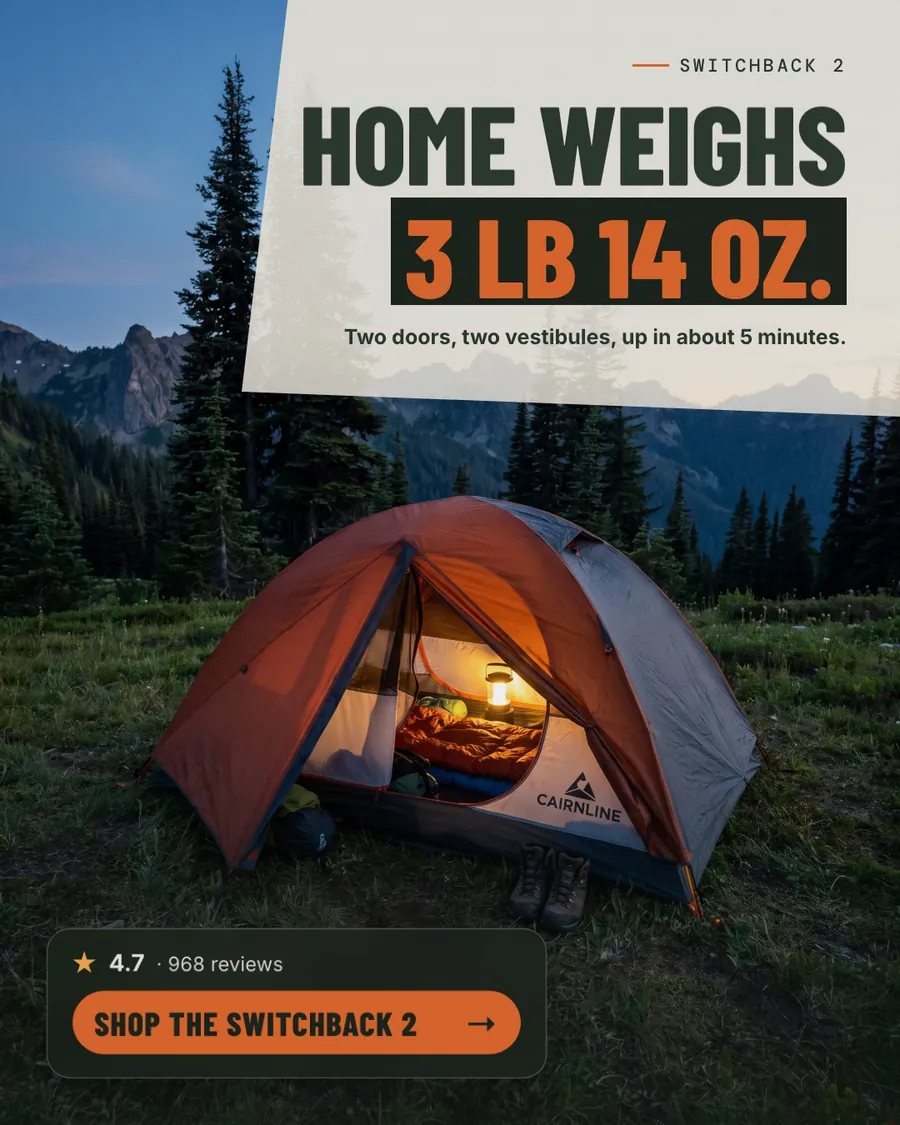
Lifestyle typeBenefit
Cairnline Outfitters: Home weighs 3 lb 14 oz.
Fictional sample brand · made by our engine
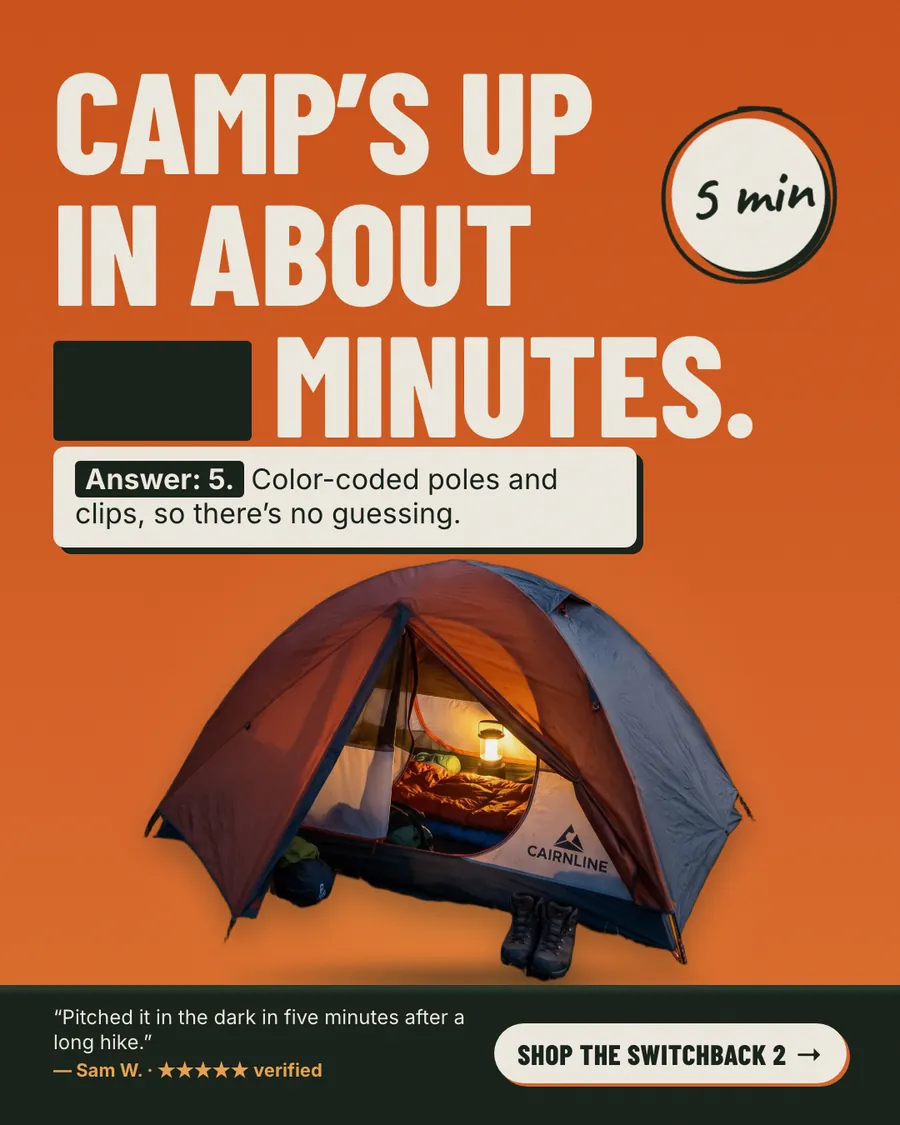
Fill in the blankConvenience
Cairnline Outfitters: Camp's up in about ____ minutes.
Fictional sample brand · made by our engine
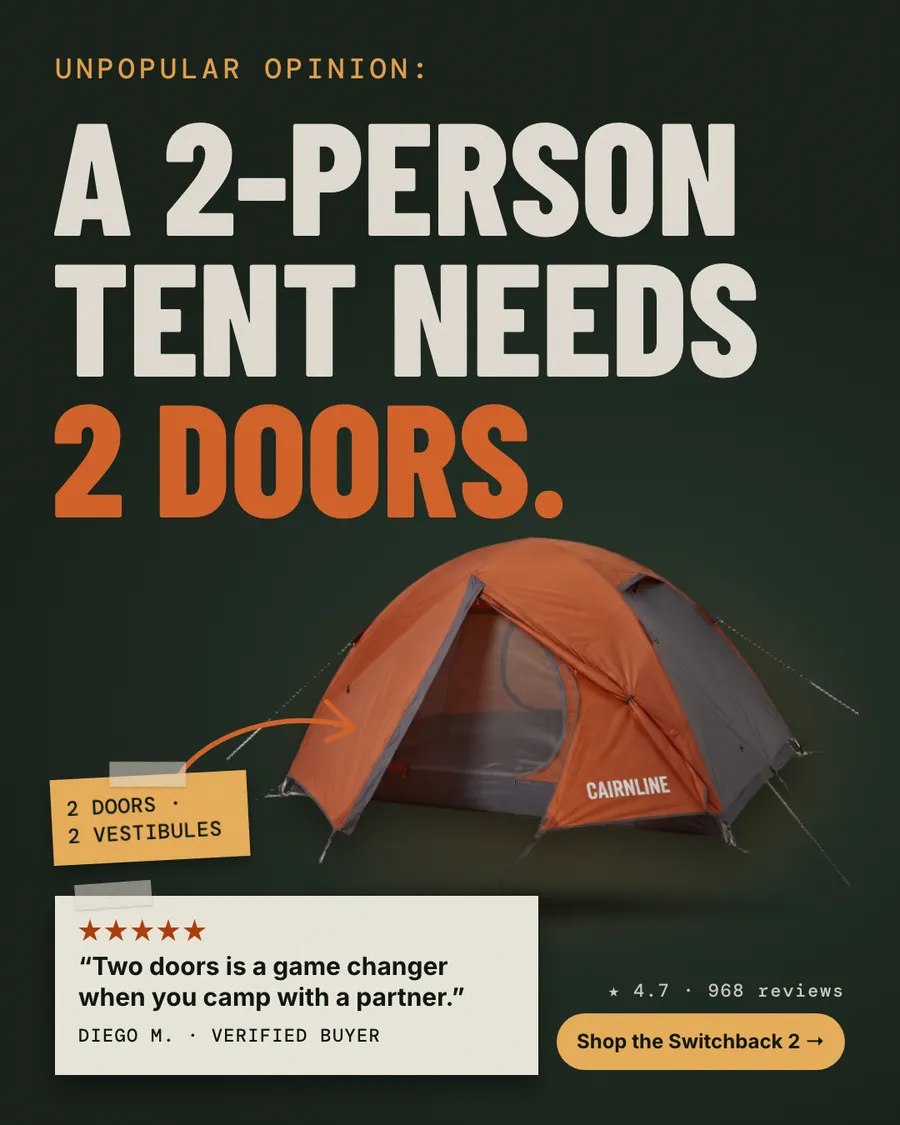
Unpopular opinionBenefit
Cairnline Outfitters: Unpopular opinion: A 2-person tent needs 2 doors.
Fictional sample brand · made by our engine
Words to be careful with
Camping gear isn't a restricted category on the main ad platforms. What gets brands into trouble is a spec that doesn't hold up, a claim about origin, and where the photos were taken.
"Waterproof" and "ultralight"
An objective claim needs a reasonable basis in hand before the ad goes out, the FTC (the US consumer protection agency) says. State the rainfly's rating and how you tested it, and say which weight you mean, because trail weight and packaged weight differ.
Source: FTC: Policy Statement Regarding Advertising Substantiation
Shooting ads in a national park
The National Park Service says filming and still photography need no permit when a group of eight or fewer stays in areas open to the public, uses hand-carried equipment, doesn't need exclusive use of a site, doesn't harm the park or other visitors, and adds no administrative costs. Otherwise expect a permit and location fees, commercial or not.
Source: National Park Service: Filming and still photography permits
"Made in USA" and flags in the photo
An unqualified "Made in USA" claim means all or virtually all of the product is made here, with final assembly or processing in the US. The FTC says U.S. flags or map outlines can imply the claim on their own. "Designed in USA" with the real country of manufacture is the honest version.
Lifetime warranties
If an ad calls a warranty "lifetime", the FTC's guide says it should disclose, clearly, whose or what life it refers to: the first owner's, or the product's.
Source: 16 CFR 239.4: Lifetime representations (Cornell LII)
Preorders and restocks
Under the FTC's mail order rule, you need a reasonable basis for any ship date you state, or for shipping within 30 days if you state none. If you can't ship on time, ask the buyer to agree to the delay or refund them.
Source: FTC: Business Guide to the Mail, Internet, or Telephone Order Merchandise Rule
Rules checked . The sources are linked at the end of this page.
How often to refresh camping gear ads, and what to measure
Gear ads tire slowly in the off season and quickly before trips, when the same campers see your tent every day. Plan new creative for the weeks you spend the most.
In quiet months, a new pair of ads every three to four weeks keeps the test going. In the run-up to trip season, add a new batch every week or two, using customer photos from real trips as they arrive.
Meta labels an ad "Creative limited" when it costs more per result than your past ads, and "Creative fatigue" at twice the cost. A new ad with a materially different image or video is its suggested fix, with the original left on.
What to measure
- Cost per add to cart, by angle
- Weight, setup and layout appeal to different campers. Find the one that fills carts before purchases are many enough to compare.
- Share of orders with a second item
- Shows whether the sleep system offer works, and how much a first order can afford to cost.
- Returns and the reasons given
- Returns that mention weight or leaks point at a claim to fix. Returns about size point at the product page.
- Shopping clicks on your top spec searches
- Tells you whether your feed titles match the way people actually search for gear.
Questions about advertising camping gear
How do I advertise camping gear online?
Pick one hero product and put its proof on the product page first: weight, packed size, setup time and the return window. Then run a few Meta ads, each led by one of those numbers, and list the product on Google Shopping so people searching by spec can find it.
How much should a camping gear brand spend on ads to start?
Work it out from your margin: the order value times what's left after product cost, shipping and fees is the most a first order can cost. Gear orders are large, so that number is generous, but sales come slowly; most small brands start modestly and raise spend before trip season.
When should I start advertising camping gear each year?
Before people go, not while they're out. Spring and early summer trips are planned weeks ahead, so the heavier spend belongs in that run-up. Fall trips and holiday gifts give you two more windows, with Black Friday on November 27, 2026.
Is Google Shopping worth it for a small gear brand?
It often is, because campers search by need, like a two-person tent or a 20 degree bag. Your listing shows up inside that search with a photo and price. Expect large retailers in the same row and win with exact specs in the title.
Should I sell camping gear on Amazon too?
Only if you can handle a second store. A marketplace reaches campers who never visit brand sites, but the buyer belongs to the marketplace, your reviews split, and lookalike products sit beside yours. Many small brands start on their own site.
How do I advertise an expensive tent on a small budget?
Narrow everything: one product, one channel, three angles, and a week without edits. Judge the ads by add to carts while purchases are few, and show visitors a review and your return window, because confidence is what a high price needs.
Do gear reviewers help a small outdoor brand?
Often more than a bigger ad budget would. A reviewer who pitches your tent in bad weather answers what an ad can't. Send units with no script, accept honest verdicts, and make sure anyone who got gear free says so.
How do I sell camping gear in the off season?
Lean on gifts and planning. Run gift ads for smaller items like a chair or a pad in November and December, offer a real end-of-season price on the tent, and collect email subscribers you can reach before spring.
Should I advertise my whole range or one product?
One product. A single tent with clear numbers teaches you which angle sells, and the rest of the range follows through email, bundles and visitors who come back. Spread across ten products, the budget can't show you anything.
Can I take preorders for gear that isn't in stock yet?
Yes, if you have a reasonable basis for the ship date you give. The FTC's mail order rule says that without a stated date you need to be able to ship within 30 days, and if you're late you must ask the buyer to accept the delay or refund them.
Get the ads for this plan
Paste your store link and get 3 free ads of your own camping gear: we read your products, prices and reviews, design around your real product photo and check every fact against your store.
Where to go next
- Camping gear ad ideasEight sample ads for a backpacking tent brand: specs printed the way hikers compare them, photos, claims and a season plan.
- How to advertise water bottlesA drinkware ad plan: Meta and short video built on tests anyone can repeat, bundles over the free-shipping line, and the custom tumbler route.
- How to advertise socksA sock brand's ad plan: sell the pack, not the pair, win the reorder, and time the gift push for stocking season.
- How to advertise fitness productsA plan for a small fitness gear brand: Meta demos first, then Shopping and short video, with the order-value math a one-time purchase needs.
- Black Friday ad ideasThe 2026 dates, six Black Friday offers and the products they suit, copy lines, and 16 sample ads for four stores.
- Product photos that sell: the shots every ad needsAds ask more of a photo than a product page does. Here is how to shoot, with a phone and a window, the handful of photos that can carry months of ads.
- Ad creative testing on a small budget: an honest guideOne ad is a bet; fifty ads is a spray. Here is the middle path for small budgets: a few angles that disagree with each other, enough spend to read them, and a weekly loop that builds on what works.
- PricingFree preview, Lite $29/month for 9 designs a month (optional 2 weekly), Starter $49/month for 20. Meta and a 7-day trial from Growth.
Sources
Platform rules on this page were checked on against:
- Meta Business Help Center: About the learning phase
- Meta Business Help Center: About creative fatigue recommendations in Ads Manager
- FTC: Policy Statement Regarding Advertising Substantiation
- National Park Service: Filming and still photography permits
- FTC: Complying with the Made in USA Standard
- 16 CFR 239.4: Lifetime representations (Cornell LII)
- FTC: Business Guide to the Mail, Internet, or Telephone Order Merchandise Rule
- 3 free ads, no signup
- Lite $29/month · 9 designs a month · optional 2 weekly
- Starter $49/month · 20 designs
- Growth $99/month, 7-day free trial
- Pro $149 · Scale $199
- 30-day money-back guarantee