how to advertise a mattress
How to advertise a mattress people can't lie on before they buy
A mattress is one of the biggest things people buy online without trying first, so they research for days, read reviews, compare firmness charts and come back several times. A mattress ad plan is built around that research: be found when they search, be there when they return, and make the trial and returns impossible to miss. Here it is with Lowmoon Sleep, a fictional hybrid mattress brand.
Updated · Budgets and examples use a fictional brand's numbers. Use yours.
In short
How should a small brand advertise a mattress online?
Run Google Shopping for people already searching and Meta for people who aren't yet. Optimize Meta for add to cart until orders come weekly, show returning visitors the trial, firmness and reviews, and judge results over a month. Keep sleep and health claims to what you can prove, and state trial and return terms up front.
StoreToAds makes ready-to-post ads from your product photo, free to try.
At a glance
- How long buyers take
- Days to weeks of research and comparison
- Where to start
- Google Shopping and Meta (Facebook and Instagram) together
- What to optimize for
- Add to cart until orders come every week
- What closes the sale
- The home trial, free returns and reviews on the second visit
- The claim to drop
- "Fixes back pain" or "non-toxic" without the evidence
Which channels fit mattresses, in the order to try them
Mattress buyers start in two places: a search box, when the old mattress has already failed, or a feed, when an ad makes them notice how badly they sleep on it. Cover both from the first week, then build the channels that bring researchers back.
- 01
Google Shopping
Start hereWhy it fits
Searches like "hybrid mattress queen medium firm" come from people who have already decided to buy something soon. Shopping shows your mattress, price and free shipping right on that search.
The trade-off
You compete with large mattress companies that bid hard on the same words, so a feed with vague titles and a single photo burns money. Lead with size, type and firmness in the title.
- 02
Meta (Facebook and Instagram)
Start hereWhy it fits
Meta reaches people who aren't searching yet, and it can show a second and third ad to people who read your product page but left. For a product researched this long, those return visits matter most.
The trade-off
Orders arrive slowly and come in small numbers, too few for purchase optimization at first. Plan the budget around add to cart (see below).
- 03
Email and SMS
Add nextWhy it fits
A mattress buyer who left a cart is still deciding. A short series with the trial terms, the firmness guide and real reviews often finishes the job, and buyers can be offered the protector or pillow after delivery.
The trade-off
You need consent and a working signup on the product page before anyone is on the list.
- 04
TikTok
Add laterWhy it fits
A compressed mattress unrolling and expanding is satisfying to watch, and a short setup video answers the "how does a mattress fit in a box" doubt.
The trade-off
Orders from it are hard to trace because buyers research elsewhere before paying. Add it once search and Meta are steady.
- 05
Pinterest
Add laterWhy it fits
Bedroom makeover boards are full of beds, and a well-styled room with your mattress and base can collect saves from people planning a move or a new room.
The trade-off
It is a slow, upper-funnel channel for a product this considered. Treat it as a bonus, not a base.
- 06
Facebook Marketplace listings
Skip for nowWhy it fits
Many people search for how to sell a mattress on Marketplace, but listings there suit local sellers moving one used item.
The trade-off
For a brand shipping new mattresses in a box, regular Meta ads do the same job with targeting, reporting and a proper checkout.
How to size a starting budget for mattress ads
Mattresses have the opposite problem to cheap products: each order is worth a lot, and there are very few of them. Lowmoon's queen hybrid sells for $1,095, down from $1,295, with free shipping, free returns and a 100-night home trial.
| Order value | $1,095.00 |
|---|---|
| Margin after product cost, shipping and fees | 30% |
| Most a first order can cost to break even | $328.50 |
| 50 purchases a week at that cost | $16,425 a week |
| The same budget per day | about $2,346 |
Meta says an ad set usually leaves its learning phase after about 50 results in the week after its last significant edit, and recommends a budget large enough to get enough results. Meta Business Help Center: About the learning phase
Fifty mattress orders a week is a large business, so no new mattress brand should expect its ad sets to learn on purchases. That doesn't mean the math is useless. It sets the ceiling, and the steps below set the plan:
- Learn on add to carts, not orders. Meta suggests a more frequent event when an ad set is learning limited, and gives add to cart instead of purchase as its example. A mattress page collects far more add to carts than orders.
- Budget from the add to cart. Once a month of data shows what share of add to carts become orders in your shop, the most an add to cart can cost is that share of the break-even (the point where the ads pay for themselves) above.
- Count returns before you scale. Free returns on a 100-night trial mean some orders come back after the ad and the pickup are paid for. Lower the break-even by your own return rate.
- Judge over a month, not a week. Buyers take days or weeks to decide, so a quiet week says little. Look at cost per add to cart weekly and at orders monthly.
What to optimize for as a mattress brand grows
Move up a step only when the current one gets enough results every week. Changing the event is the kind of edit that can send an ad set back into learning, so don't switch often.
| Stage | Optimize Meta for | Why |
|---|---|---|
| First weeks, few orders | Add to cart | It happens often enough to leave learning, and buyers who add a mattress are serious |
| Steady add to carts, some orders | Initiate checkout | Closer to a sale, still more frequent than orders |
| Orders arriving every week in volume | Purchase | The ad set can now learn from real orders |
Your first 30 days advertising a mattress
Before spending, make sure the page can answer what the ads will promise. A mattress shopper who clicks and can't find the firmness, the trial terms or how returns work leaves for a competitor's page.
Days 1 to 5
Make the product page answer every doubt
Show the firmness on a scale, who it suits (back, side and combination sleepers for Lowmoon), the layers inside, the trial and return steps, the warranty terms and how it arrives. Check that add to cart, checkout and purchase all fire in Meta Events Manager and in Google.
Days 6 to 12
Start Shopping and three Meta angles
Run Google Shopping on the queen with a clear title. On Meta, launch two ads each for the trial, the construction and the reviews, optimized for add to cart, broad audience, in 4:5 and 9:16.
Days 13 to 20
Follow up with people who visited
Build a second Meta ad set for people who viewed the mattress in the last 30 days and show them reviews, the firmness guide and the return steps. Turn on cart emails the same week.
Days 21 to 27
Move budget to what earns add to carts
Compare cost per add to cart by angle and by channel. Shift budget toward the winners and pause the weakest ads, but leave each ad set alone for a week after a change.
Days 28 to 30
Plan your sale calendar honestly
Black Friday is November 27, 2026. Decide now what you will offer, and make sure any "was" price is one the mattress really sold at before the sale.
Offers that work for mattresses
The biggest barrier to buying a mattress online is fear of being stuck with the wrong one. The offers that work remove that fear first and lower the price second.
A home trial with clear terms
100 nights in your own bed answers "what if I hate it" better than any discount. Lowmoon's trial belongs in the headline of at least one ad.
Watch: Say how long it lasts, how a return works and any minimum time before returning, on the ad or one tap away.
Free shipping and free returns
Shipping and returning something this heavy is what buyers dread. Saying both are free removes the hidden-cost worry.
Watch: Under the FTC's guide on the word "free", any conditions go clearly at the start of the offer, not in an asterisk footnote.
A real sale price
$1,095 against $1,295 is a meaningful saving on a big purchase, and mattress buyers expect sales.
Watch: The former price must be one the mattress actually sold at, openly, for a reasonably substantial period. An inflated list price set up for a permanent sale is deceptive.
The protector and pillow at checkout
A $99 protector and a $79 pillow are natural add-ons once someone has chosen the mattress, and they raise the order without a discount.
Angles to test for mattress ads
Each angle answers one question a researching buyer has. Each is drawn out as a finished ad on Mattress ad ideas, together with what to shoot; the first 30 days test them one against another.
The trial removes the risk
Try it at home for 100 nights before you decide.
What's inside
Wrapped coils below. Three foam layers on top.
Who it's made for
Medium-firm, 6 out of 10, for back, side and combination sleepers.
A partner's restless nights
"My partner tosses all night and I don't feel a thing."
The box doubt
"Set up in five minutes. It was fully expanded by bedtime."
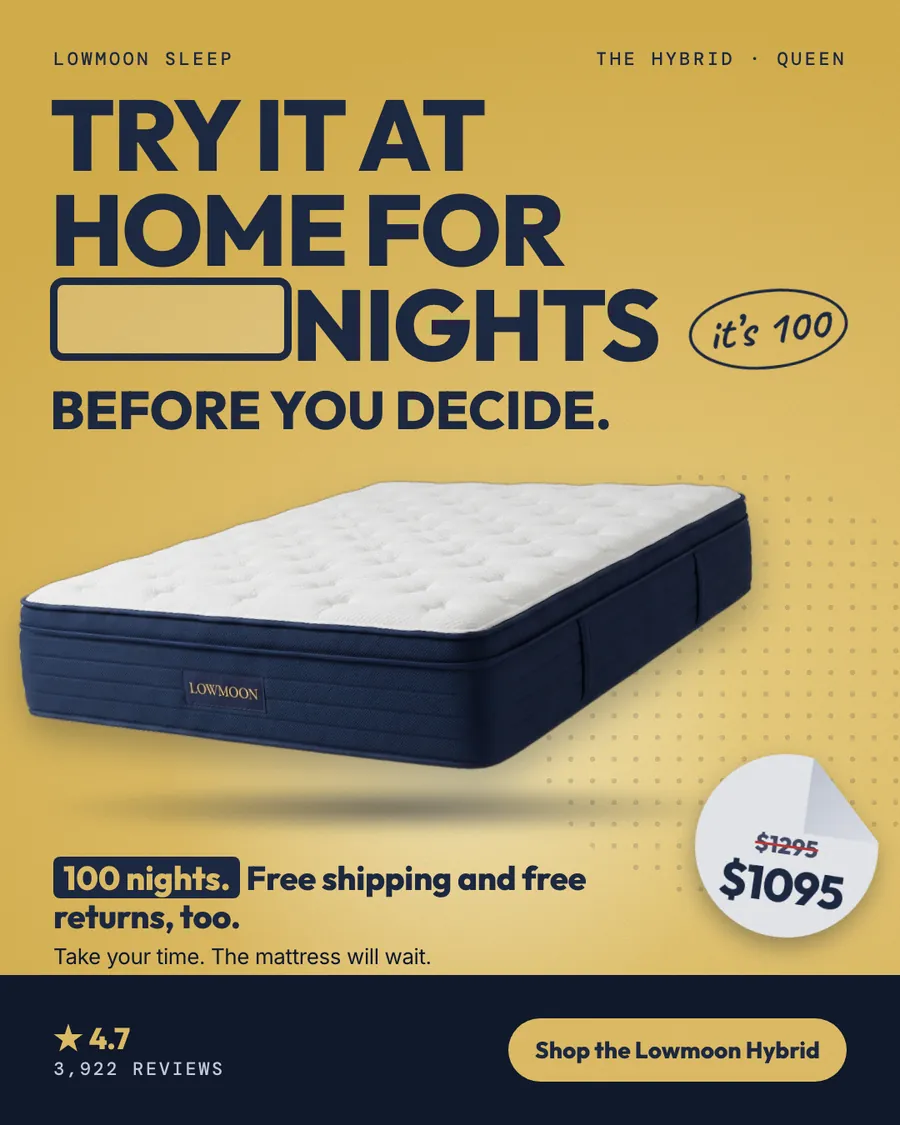
Fill in the blankOffer
Lowmoon Sleep: Try it at home for ____ nights before you decide.
Fictional sample brand · made by our engine
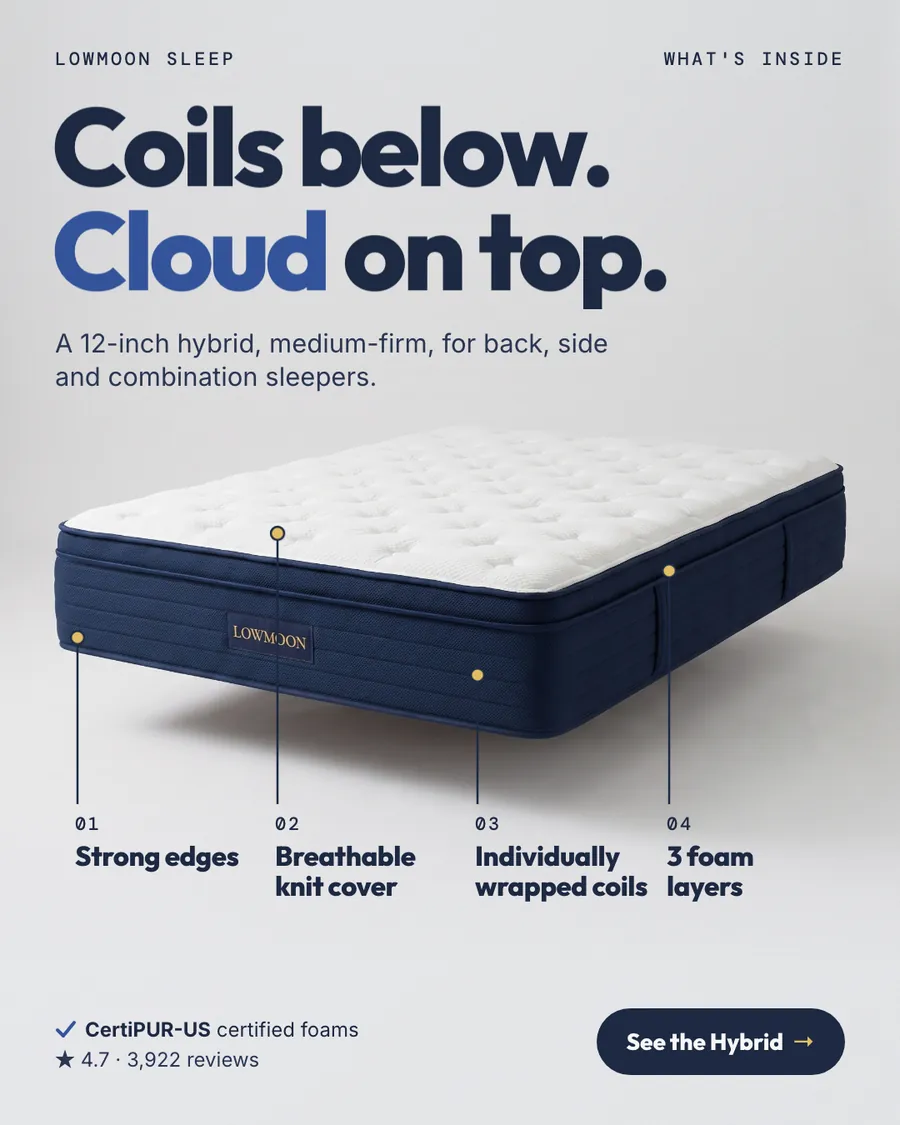
Annotated heroTransparency
Lowmoon Sleep: Coils below. Cloud on top.
Fictional sample brand · made by our engine
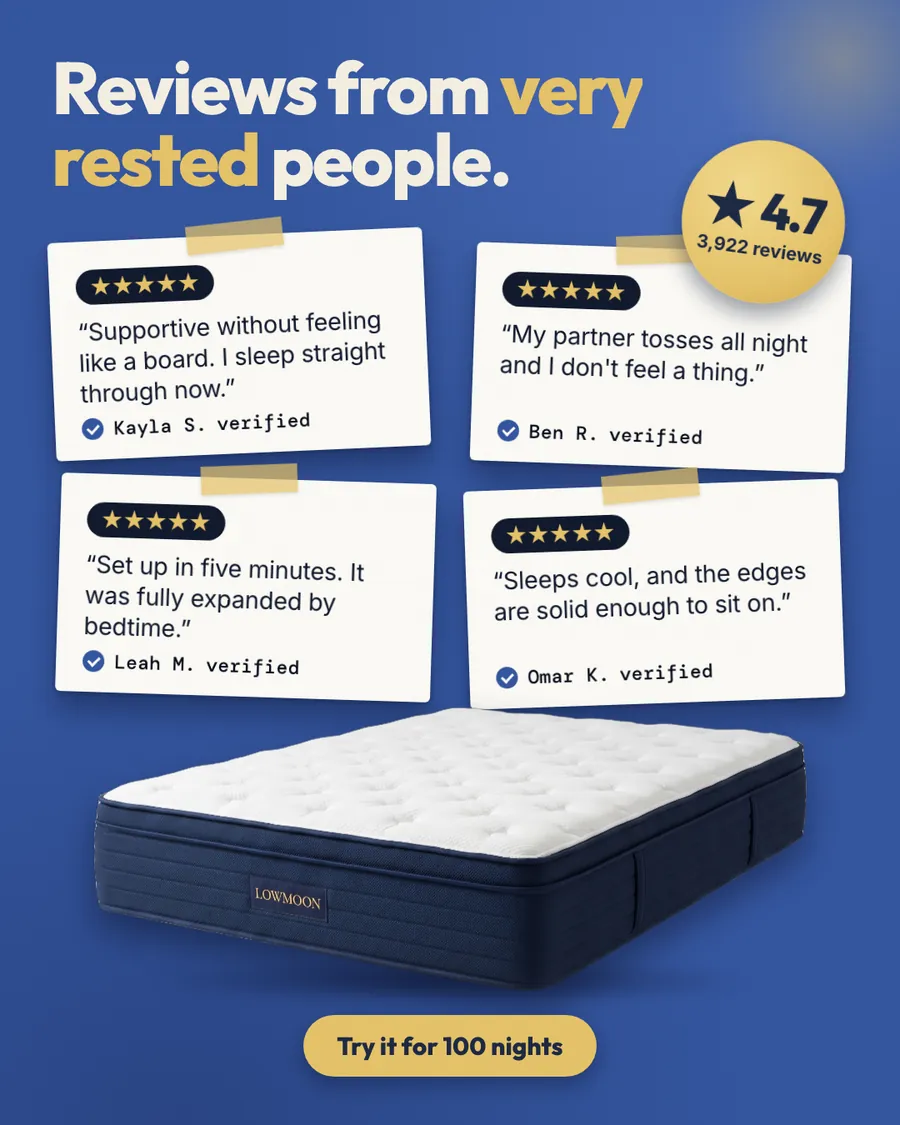
Review wallSocial proof
Lowmoon Sleep: Reviews from very rested people.
Fictional sample brand · made by our engine
Words to be careful with
Mattress ads attract claims that go past what a mattress can promise. These are the flags to clear before an ad goes live.
Back pain and better sleep
Saying a mattress relieves back pain or improves sleep is a health claim, and the FTC (the US consumer protection agency) expects competent and reliable scientific evidence, generally randomized controlled human trials. Meta also doesn't allow ads that assert or imply a person's physical or mental health.
Source: FTC Health Products Compliance Guidance (December 2022)
"VOC-free" and "non-toxic"
In 2013 the FTC barred three mattress sellers from claiming their mattresses were VOC-free unless the VOC level is zero micrograms per cubic meter, or trace level, and required scientific evidence for such claims. The Green Guides say "non-toxic" conveys safety for people and the environment.
CertiPUR-US wording
The program's rules ask for "CertiPUR-US certified foam", not "CertiPUR-US certified" alone, which implies the whole mattress is certified. They don't allow words like chemical-free, safe, non-toxic, hypoallergenic or eco-friendly next to the mark.
Source: CertiPUR-US: Program rules
Flammability labels
The CPSC says mattresses must meet both the smoldering standard (16 CFR 1632) and the open flame standard (16 CFR 1633), carry a permanent label, and have a General Certificate of Conformity. Those are legal minimums, not selling points to dress up in an ad.
Free trials, sales and warranties
Conditions of a "free" offer go at the start of the offer, not in a footnote. A former price must be a real one. And when an online ad mentions the warranty, the FTC's warranty guide says it should tell buyers they can get the complete terms free from the seller.
Source: 16 CFR 251.1: Guide concerning use of the word "free"
Rules checked . The sources are linked at the end of this page.
How often to refresh mattress ads, and what to measure
A mattress audience is small at any moment, since few people are shopping for one this month. The same people see your ads again and again while they research, so ads tire faster than the slow sales would suggest.
Plan two or three new ads every two to three weeks, and a fresh batch for each sale window. Keep the follow-up ads for past visitors changing too: someone who saw the same review card six times has stopped reading it.
Meta shows "Creative limited" when an ad's cost per result rises above your past ads and "Creative fatigue" when it reaches twice as much. Its advice is a materially different image or video, and leaving the original ad on may still help.
What to measure
- Cost per add to cart
- The number your ad sets learn on in the early months. Read it weekly, by angle and by channel.
- Share of add to carts that become orders
- Turns the break-even per order into a target per add to cart, and shows when your page or offer is losing people.
- Orders kept after the trial
- The true cost of a customer includes the mattresses that came back. Raise budgets on kept orders, not on sales.
- Days from first visit to order
- Tells you how long to keep following up, and how long to wait before judging a new ad.
Questions about advertising mattresses
Where should a new mattress brand spend its first ad dollars?
On Google Shopping for people already searching and on Meta for everyone else, with a second Meta ad set for people who visited the product page. Fix the page first: firmness, layers, trial and return steps, and warranty terms all need to be easy to find.
How much does it cost to advertise a mattress?
Start from your order value times the margin left after the mattress, shipping, returns and fees. That is the most an order can cost. Fifty of those a week is out of reach for a new brand, so most start smaller, optimize for add to cart and judge results monthly.
Why are my mattress ads stuck in learning?
Because purchases are rare. Meta says an ad set usually leaves learning after about 50 results in the week after its last significant edit. For a mattress, optimize for add to cart instead, combine small ad sets and avoid frequent budget changes, which restart learning.
How should a mattress brand plan its sale ads?
Run the sale price in a few ads with the trial and free returns next to it, and show the sale to past visitors first, since they were already close. Only show a former price the mattress really sold at for a reasonable period, and put any conditions on the ad.
Should I advertise mattresses on Facebook Marketplace?
Marketplace listings suit people selling one used item locally. A brand shipping new mattresses gets more from regular Meta ads, which reach the same people with targeting, a proper checkout and reporting.
How long does it take a mattress ad to turn into an order?
Often days or weeks, because buyers compare brands and reread reviews before paying. Measure the time from first visit to order in your own data, keep following up with visitors for at least that long, and don't judge a new ad on its first week of orders.
Does a 100-night trial make mattress advertising more expensive?
Returned mattresses raise the real cost of each kept customer. The trial also removes the main reason people don't buy online. Track how many orders are kept past the trial and lower your break-even cost per order by the share that comes back.
Should I advertise the mattress alone or with a protector and pillow?
Advertise the mattress alone, because that is the decision buyers are making. Offer the protector and pillow at checkout and in the delivery emails, where they raise the order value without making the ad harder to read.
When should a mattress brand plan its biggest ad pushes?
Around the sale windows your buyers expect, such as Black Friday, which is November 27, 2026, and around times your own past orders rose. Have new ads ready before each window and keep honest former prices, because sale claims draw the most scrutiny.
Can I say my mattress is CertiPUR-US certified in an ad?
Say the foams are certified, for example CertiPUR-US certified foam, rather than calling the whole mattress certified. The program's rules also don't allow words like non-toxic, chemical-free or safe next to the mark.
Get the ads for this plan
Paste your store link and get 3 free ads of your own mattresses: we read your products, prices and reviews, design around your real product photo and check every fact against your store.
Where to go next
- Mattress ad ideasSix sample ads for a boxed hybrid mattress: the home trial, the layers, firmness, reviews and the sale weekends.
- MattressesMattress ads from your page: what's inside, firmness, sleeper types, trial, warranty and reviews, with sale prices kept honest.
- How to advertise beddingA bedding brand's ad plan: Meta for the feel, Shopping for exact searches, a trial that sells the set, and a budget that waits out returns.
- How to advertise furnitureA plan for a small furniture brand: Google Shopping and Meta first, a budget built on add to cart, and ads for buyers who measure and come back.
- How to advertise home decorPinterest and Meta side by side for a small decor brand, a 30-day plan, a budget for slow deciders and the free-shipping line as your best offer.
- Black Friday ad ideasThe 2026 dates, six Black Friday offers and the products they suit, copy lines, and 16 sample ads for four stores.
- Ad creative testing on a small budget: an honest guideOne ad is a bet; fifty ads is a spray. Here is the middle path for small budgets: a few angles that disagree with each other, enough spend to read them, and a weekly loop that builds on what works.
- PricingFree preview, Lite $29/month for 9 designs a month (optional 2 weekly), Starter $49/month for 20. Meta and a 7-day trial from Growth.
Sources
Platform rules on this page were checked on against:
- Meta Business Help Center: About the learning phase
- Meta Business Help Center: About learning limited
- Meta Business Help Center: About creative fatigue recommendations in Ads Manager
- Meta Advertising Standards: Privacy Violations and Personal Attributes
- FTC Health Products Compliance Guidance (December 2022)
- FTC Green Guides: Non-toxic claims, 16 CFR 260.10
- FTC Guides Against Deceptive Pricing, 16 CFR 233.1 (former price comparisons)
- FTC: Three companies barred from advertising mattresses as free of VOCs without scientific proof (2013)
- CertiPUR-US: Program rules
- CPSC: Mattresses business guidance
- 16 CFR 251.1: Guide concerning use of the word "free"
- 16 CFR 239.2: Disclosures in warranty or guarantee advertising
- 3 free ads, no signup
- Lite $29/month · 9 designs a month · optional 2 weekly
- Starter $49/month · 20 designs
- Growth $99/month, 7-day free trial
- Pro $149 · Scale $199
- 30-day money-back guarantee