how to advertise bedding
How to advertise bedding when nobody can touch the sheets
Sheets are bought for how they feel, and a phone screen can't feel anything. So a bedding ad plan leans on what can travel through a screen: a real bed in real light, words a buyer can test (fiber, size, weave) and a trial that removes the risk. Here is the plan, worked through with Duneloft, a fictional stonewashed linen brand.
Updated · Budgets and examples use a fictional brand's numbers. Use yours.
In short
What is the best way to advertise bedding online?
Start with Meta ads for one hero sheet set, shown on a slept-in bed and paired with your trial or return terms. Add Google Shopping for people searching by fiber and size, email the cross-sell during the trial, and judge results over weeks, because returns arrive late and bigger orders come with gift season.
StoreToAds makes ready-to-post ads from your product photo, free to try.
At a glance
- What you're selling
- A feel, proven with fiber, weave and a trial
- Where to start
- Meta (Facebook and Instagram), with one hero set in one or two colors
- The slow part
- A trial means an order isn't final for months
- The order builder
- Pillowcases, a duvet cover or a throw added to the set
- The rule to know
- Name a fiber in an ad and the full fiber content must appear too
Which channels fit bedding, in the order to try them
Bedding buyers fall into two groups: people who already know they want linen or percale in a queen, and people who will only want it once they see a bed that looks better than theirs. The order below covers both, then brings buyers back for the rest of the bed.
- 01
Meta (Facebook and Instagram)
Start hereWhy it fits
A sunlit, unmade bed is exactly the kind of picture that stops someone scrolling at night. Meta finds buyers who weren't searching for sheets yet, and it can show a second ad to people who visited your set but didn't order.
The trade-off
Few people buy a $189 set on the first view, so purchases arrive slowly at the start. Expect to judge early ads on add to carts and saves before orders pile up.
- 02
Google Shopping
Add nextWhy it fits
Searches like "linen sheet set queen" or "deep pocket linen sheets" come from people close to buying. A Shopping ad puts your photo, price and color in front of that exact search.
The trade-off
You sit next to big home stores with cheaper cotton sets, so the title has to carry the material, size and pocket depth. A vague feed title wastes the click.
- 03
Pinterest
Add nextWhy it fits
People plan bedroom makeovers on Pinterest long before they buy, and a calm, styled bed fits those boards.
The trade-off
A save can take weeks to become an order. Judge it over a season and keep words on the pin short.
- 04
Email and SMS
Add nextWhy it fits
A sheet buyer has a whole bed left to dress. A note during the trial with the matching pillowcases, the duvet cover or a throw adds to the order without paying for a new customer.
The trade-off
It reaches only people who already bought or signed up, and SMS needs their clear consent.
- 05
Etsy
Only if it fitsWhy it fits
Handmade quilts, pillow covers and small-batch throws suit Etsy, where buyers search for exactly that, and Etsy Ads spend inside that search.
The trade-off
Offsite Ads take 15% of an attributed order for shops under $10,000 in yearly sales and 12% after, and those buyers stay Etsy's customers, so your email can't reach them.
- 06
TikTok
Skip for nowWhy it fits
Bed-making and sheet-texture videos do well there, and a stonewashed fabric moves nicely on camera.
The trade-off
It needs new video every week. Start once your Meta ads are profitable and someone on the team enjoys filming.
Your first 30 days advertising bedding
A bedding range has many sizes and colors, and spreading the first budget across all of them teaches you nothing. One set, one or two colors, and three clear reasons to buy will.
Days 1 to 3
Choose the hero set and write its facts once
Pick the queen set in your best-selling one or two colors. On its page, state the fiber content, the weave, what's in the set, the pocket depth, care, where it was made and the trial terms in plain words. Every ad will borrow from this list, so get it right first.
Days 4 to 10
Test feel, risk and proof in 6 ads
Make two ads each for the feel (a close look at the fabric), the risk (the trial or return window) and the proof (reviews that mention softness or fit). Run them in one Sales campaign with a broad audience, in 4:5 for feeds and 9:16 for Stories.
Days 11 to 17
Read add to carts by color and by reason
Don't touch the ad set this week. Look at which color and which reason collects the most add to carts per dollar. With a $189 set, add to carts tell you more this early than the few orders will.
Days 18 to 24
Add Google Shopping with a clean feed
Give each variant a title with fiber, item, size and color, like "Stonewashed Linen Sheet Set, Queen, Oat". Start one Shopping campaign on the hero set only, and keep the Meta ads that won running.
Days 25 to 30
Set up trial emails and plan gift season
Send buyers a care note in week one and the matching pillowcases a few weeks later. Then plan November: Black Friday is November 27, 2026, and a gift set or a throw needs its ads ready before then.
Which bedding product to lead with
Each piece of a bedding range plays a different role in the plan:
| Product | Role in the plan | Best place to advertise it |
|---|---|---|
| Sheet set | The hero: the first order and the main ad budget | Meta, then Google Shopping |
| Pillowcases | The add-on that raises order value | Email to buyers, and on the product page |
| Duvet cover | The second order, once the sheets win trust | Email during and after the trial |
| Throw or blanket | The gift and the cold-weather ad | Meta and Pinterest from autumn |
| Pillows | A separate decision with its own fit questions | Only once sheets sell steadily |
How to size a starting budget for bedding ads
Bedding has a higher order value than most home goods, which helps, and a trial, which delays the truth. Duneloft's queen linen set sells for $189, down from $229, with free shipping on every order and a 100-night trial.
| Order value | $189.00 |
|---|---|
| Margin after product cost, shipping and fees | 45% |
| Most a first order can cost to break even | $85.05 |
| 50 purchases a week at that cost | $4,253 a week |
| The same budget per day | about $608 |
Meta says an ad set usually leaves its learning phase after about 50 results in the week after its last significant edit, and recommends a budget large enough to get enough results. Meta Business Help Center: About the learning phase
About $85 of room per order sounds generous until you multiply it by 50 orders a week. Few young bedding brands sell that many sets, so plan the first months around the steps that happen more often, and around the trial.
- Optimize for add to cart while orders are rare. When an ad set can't get enough results, Meta suggests choosing a more frequent event, such as add to cart instead of purchase. Switch back once weekly orders are steady.
- Leave room for trial returns. With a 100-night trial, some orders come back after the ad has been paid for. Use your own return rate from past orders to lower the break-even (the point where the ads pay for themselves) number before you scale.
- Raise the order, not the discount. The $59 pillowcase pair or the $98 throw added to a set lifts the order value the whole calculation starts from. A bigger cart beats a bigger coupon.
Google Shopping learns from conversions too, so give its campaign enough budget to collect data and avoid daily changes while it settles.
Offers that work for bedding
Sheet buyers worry about feel, fit and being stuck with the wrong set. Good offers answer one of those worries.
A long trial, with its terms in the ad
Duneloft's 100-night trial lets a buyer wash and sleep on the set before deciding. For a product sold on feel, that is the strongest reason to try it now.
Watch: Say what the trial covers and how a return works, on the ad or one tap away. A trial with hidden conditions turns into angry comments.
A real price drop
$189 against $229 is a clear saving on a set people compare carefully.
Watch: Show a former price only if the set really sold at it, openly, for a reasonably substantial period. An inflated "was" price is the classic trap.
Free shipping on every order
Sheets are bulky, and buyers notice shipping at checkout. Saying it on the ad removes one reason to wait.
The finishing piece for past buyers
Someone who kept the sheets past the trial trusts the fabric. A note with the matching pillowcases or duvet cover sells to them at a fraction of the cost of a new buyer.
Angles to test for bedding ads
Each angle gives a buyer something they can check before they touch the fabric. Bedding ad ideas shows each one as a finished linen ad with its photo notes; below are the five the first month compares.
The feel, in plain words
Stonewashed, so it's soft from night one.
The trial as the headline
Sleep on it for 100 nights, then decide.
The fit buyers worry about
Fits mattresses up to 16 in deep.
A fair price drop
Now $189. It was $229.
The look, rumpled on purpose
Made to look slept in. In a good way.
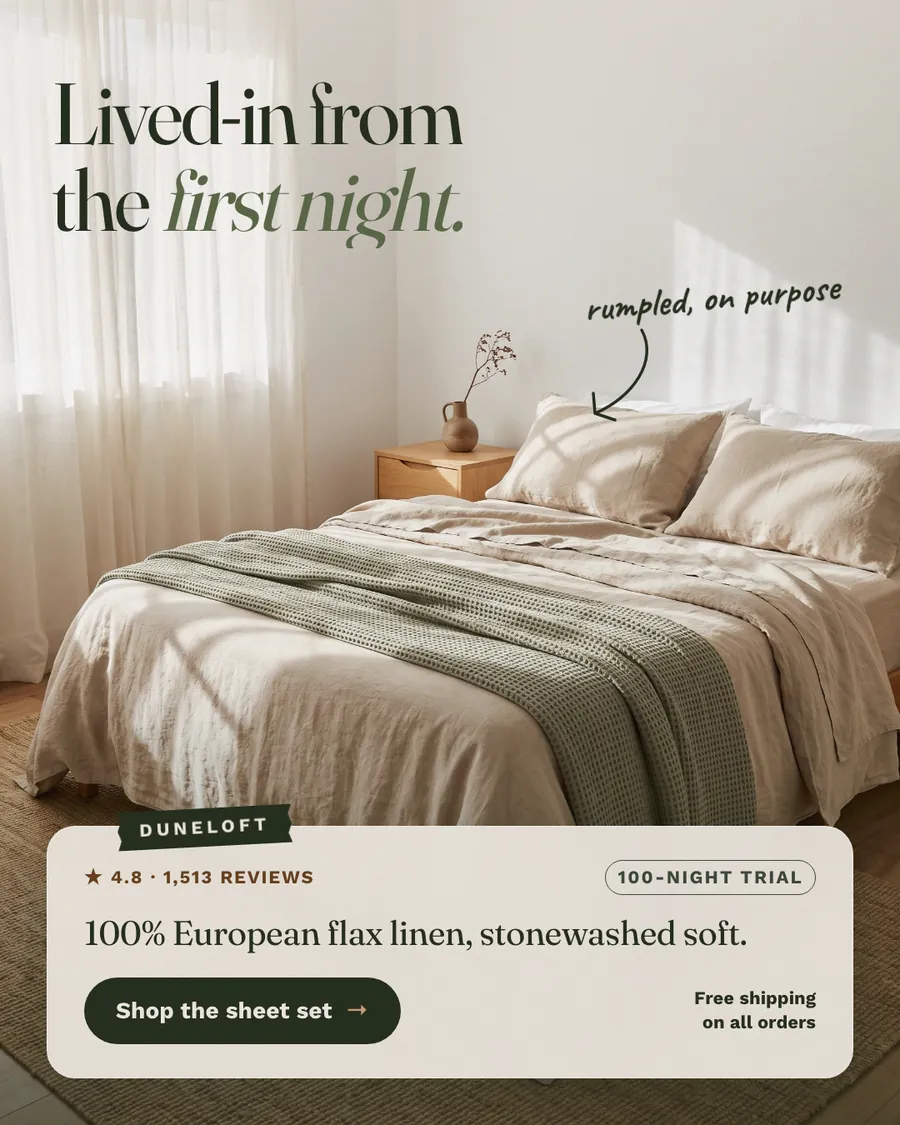
Lifestyle typeBenefit
Duneloft: Lived-in from the first night.
Fictional sample brand · made by our engine
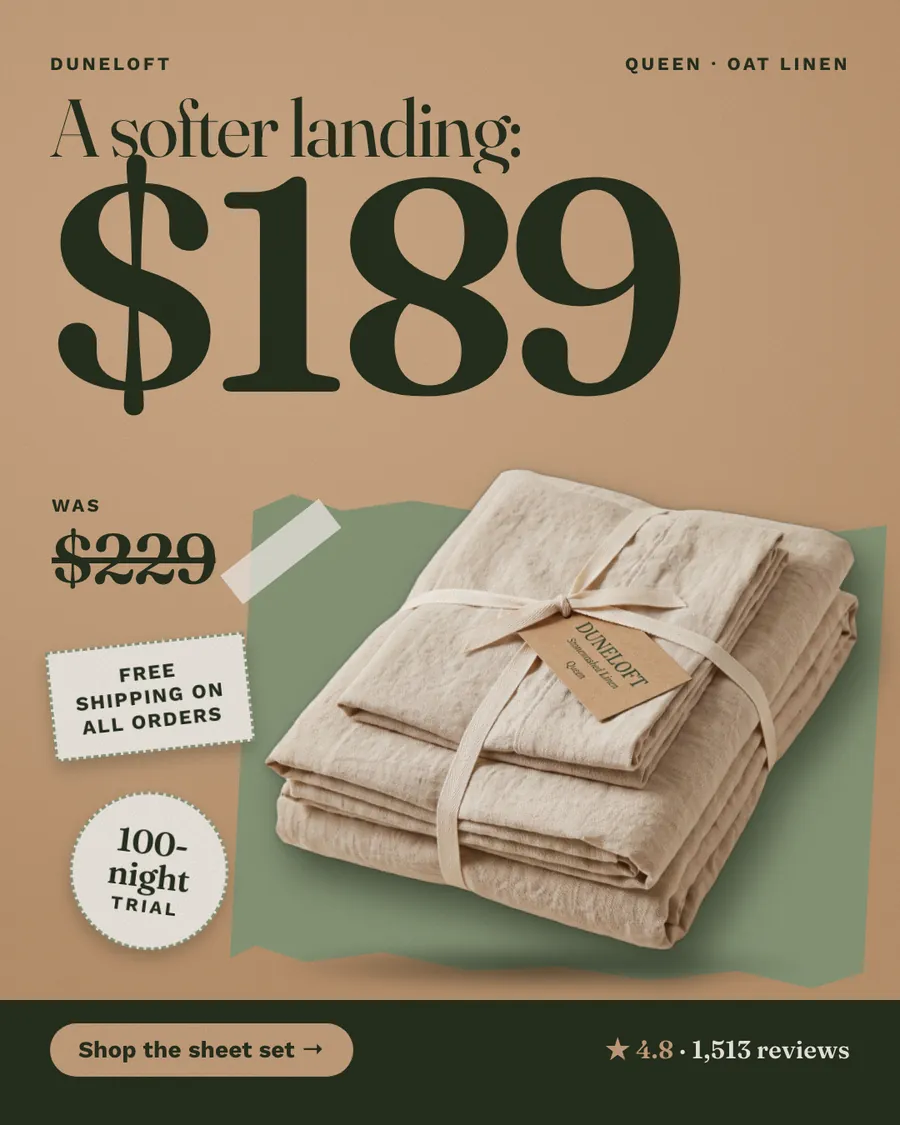
Price dropOffer
Duneloft: A softer landing: $189
Fictional sample brand · made by our engine

Read this firstCuriosity
Duneloft: Read this before you buy another sheet set.
Fictional sample brand · made by our engine
Words to be careful with
Bedding isn't a restricted category on Meta or Google. The trouble comes from sleep promises, fiber words used loosely, and safety rules that apply as soon as the range grows past sheets.
"Sleep better" and "Can't sleep?"
Meta doesn't allow ads that assert or imply a person's physical or mental health, so a headline asking "Can't sleep?" is a problem. Saying sheets improve sleep is a health claim, and the FTC (the US consumer protection agency) expects competent and reliable scientific evidence for those, generally human clinical testing. "Sleeps cool" from a reviewer is a different, safer line.
Source: Meta Advertising Standards: Privacy Violations and Personal Attributes
Naming the fiber
Under 16 CFR 303.41, an ad that uses a fiber name like linen or cotton must disclose the product's full fiber content at least once in the ad. The FTC's textile guide adds that the fiber names must match the label, without the percentages.
Source: 16 CFR 303.41: Use of fiber trademarks and generic names in advertising
Where it was made
The FTC's textile guide says internet advertising for textile products must disclose country of origin, as "Made in U.S.A.", "imported" or both, and that it must match the label.
Source: FTC: Threading Your Way Through the Labeling Requirements Under the Textile and Wool Acts
Mattress pads in the range
If you add mattress pads, the CPSC says they must meet the smoldering flammability standard, 16 CFR 1632, carry a permanent label with the month and year of manufacture, and be labeled with a "T" if treated with a chemical flame retardant. Pillows are outside the definition of a mattress.
Certification and organic words
Anyone can check whether an OEKO-TEX label is official by entering its number on the OEKO-TEX Label Check, so quote the exact label your supplier gave you. For organic, USDA rules let only fibers certified under its program be called organic, and textiles certified to GOTS may be sold as organic but can't show the USDA organic seal.
Source: OEKO-TEX: Label Check
Rules checked . The sources are linked at the end of this page.
How often to refresh bedding ads, and what to measure
Bedding ads wear out more slowly than ads for impulse products, because the audience is people furnishing a bedroom. Seasons give you natural reasons to change them.
On a small budget, two or three new ads a month keeps the set fresh. Swap the photo with the season: linen on a bright summer morning, then the same bed layered with a throw once nights turn cold. Have a new batch ready before Black Friday, when spend and frequency both rise.
Meta labels an ad "Creative limited" when its cost per result climbs above your past ads, and "Creative fatigue" once it reaches twice as much. Its advice is a new ad with a materially different image or video, and keeping the original running may still help results.
What to measure
- Cost per add to cart, by color
- Color choice decides most bedding orders. Put budget behind the color people actually add, not the one you like best.
- Orders kept after the trial
- The real cost of a customer includes the sets that came back. Track it from your own orders before raising budgets.
- Items per order
- Tells you whether pillowcases, duvet covers and throws are landing as add-ons or being ignored.
- Shopping search terms
- Shows the words buyers use for your fabric and size, which feed better titles and better ad lines.
Questions about advertising bedding
Where should a small bedding brand start advertising?
Start on Meta with one hero sheet set in your best one or two colors. Show it on a lived-in bed, give buyers a reason they can check, like the fiber, the fit or the trial, and let the ads run a week before changing anything. Add Google Shopping once the product page and feed titles are clean.
How do I sell bedsheets online without a showroom?
Replace the touch test with things a buyer can verify: the exact fiber, the weave, the pocket depth, care instructions, close-up photos of the fabric and reviews that describe the feel. A trial or an easy return window does the rest of a showroom's job, so state its terms clearly.
How much should I spend on bedding ads at first?
Work out your order value times the margin left after product, shipping and fees, which caps what a sheet buyer can cost you. Most small brands can't fund 50 of those a week, so start with a smaller daily budget, optimize for add to cart, and raise it as orders become steady.
Is Google Shopping worth it for sheets?
Usually yes, once your feed is clean. People search for bedding by fiber, size and color, which is exactly what a Shopping ad matches. Write titles like fiber, item, size and color, use your best photo, and start with the hero set only.
How do I market luxury bedding?
Let the details carry the price: the fiber and where it comes from, the finish, the weight, how it washes, the trial and real reviews. Use calm, well lit photos of a real bedroom, avoid discount-heavy ads, and spend more on bringing back people who visited than on cheap first clicks.
How do I market eco or organic bedding?
Be specific instead of saying eco-friendly: name the certified fiber, the certification you actually hold and what it covers. Only certified fibers can be called organic in the US, and textiles certified to GOTS can't show the USDA organic seal, so check the wording against your certificate.
Should I sell bedding on Etsy or my own website?
Etsy suits handmade quilts, pillow covers and small runs, where its search already brings buyers. Your own site keeps the customer for the pillowcases and duvet cover later and avoids the Offsite Ads fee of 15% under $10,000 in yearly sales and 12% after. Many makers start on Etsy and grow on their own site.
When is the best time of year to advertise bedding?
Bedding sells all year, with natural peaks around Black Friday, which is November 27, 2026, and the December gift weeks, plus seasonal swaps when buyers change to lighter or warmer layers. For Christmas delivery, USPS recommends shipping Ground Advantage by December 17 in the contiguous US.
Does a 100-night trial make bedding ads cost more?
It can, because some orders return after the ad has been paid for. It also lowers the risk that stops people from buying. Track the share of orders kept past the trial in your own data and lower your break-even cost per order by that share before scaling the budget.
Get the ads for this plan
Paste your store link and get 3 free ads of your own bedding: we read your products, prices and reviews, design around your real product photo and check every fact against your store.
Where to go next
- Bedding ad ideasSeven sample ads for a linen sheet brand, the specs sheet buyers check, fiber and origin rules, and a sales calendar.
- Home decorHome decor ads that show the finish, the scale and the room, using your own product and lifestyle photos.
- How to advertise mattressesA plan for a boxed mattress brand: search and Meta together, a budget built on add to cart, and ads that answer the trial, firmness and returns.
- How to advertise home decorPinterest and Meta side by side for a small decor brand, a 30-day plan, a budget for slow deciders and the free-shipping line as your best offer.
- How to advertise furnitureA plan for a small furniture brand: Google Shopping and Meta first, a budget built on add to cart, and ads for buyers who measure and come back.
- Black Friday ad ideasThe 2026 dates, six Black Friday offers and the products they suit, copy lines, and 16 sample ads for four stores.
- Product photos that sell: the shots every ad needsAds ask more of a photo than a product page does. Here is how to shoot, with a phone and a window, the handful of photos that can carry months of ads.
- PricingFree preview, Lite $29/month for 9 designs a month (optional 2 weekly), Starter $49/month for 20. Meta and a 7-day trial from Growth.
Sources
Platform rules on this page were checked on against:
- Meta Business Help Center: About the learning phase
- Meta Business Help Center: About learning limited
- Meta Business Help Center: About creative fatigue recommendations in Ads Manager
- Meta Advertising Standards: Privacy Violations and Personal Attributes
- FTC Health Products Compliance Guidance (December 2022)
- FTC Guides Against Deceptive Pricing, 16 CFR 233.1 (former price comparisons)
- CPSC: Mattresses business guidance
- 16 CFR 303.41: Use of fiber trademarks and generic names in advertising
- FTC: Threading Your Way Through the Labeling Requirements Under the Textile and Wool Acts
- OEKO-TEX: Label Check
- USDA AMS: Labeling Organic Products
- Etsy: Fees & Payments Policy
- USPS 2026 Holiday Shipping Deadlines
- 3 free ads, no signup
- Lite $29/month · 9 designs a month · optional 2 weekly
- Starter $49/month · 20 designs
- Growth $99/month, 7-day free trial
- Pro $149 · Scale $199
- 30-day money-back guarantee