how to advertise luggage
How to advertise luggage when buyers measure before they buy
Nobody buys a suitcase on impulse. Travelers compare dimensions, weights and warranties, read reviews over several visits and often buy just before a trip. That makes luggage a patient product to advertise: the ads have to prove size and capacity, and the budget has to wait for a considered purchase. This plan uses the numbers of Farhaven, a fictional brand selling one hardside carry-on.
Updated · Budgets and examples use a fictional brand's numbers. Use yours.
In short
How should a small brand advertise luggage?
Show exact dimensions, weight and capacity in the ads, packed for a real trip, and start on Meta and Google Shopping, where travelers compare. Give the purchase time: judge ads over weeks, not days, follow up by email, and word airline, lock and warranty claims exactly, since each one is easy to overstate.
StoreToAds makes ready-to-post ads from your product photo, free to try.
At a glance
- What buyers check first
- Outside size with wheels, empty weight and how much fits
- Where to start
- Meta (Facebook and Instagram) for the trip moment, Google Shopping for exact searches
- Buying pace
- Slow: compared over several visits, often bought before a trip
- Repeat orders
- Rare. The first sale has to pay for most of the ad cost.
- Claims to word exactly
- Airline fit, "TSA-approved" locks and "lifetime" warranties
Which channels fit luggage, in the order to try them
Luggage buyers do two things: picture the trip and check the numbers. The first channels serve both, then a follow-up channel catches the many buyers who compare for days before choosing.
- 01
Meta (Facebook and Instagram)
Start hereWhy it fits
A carry-on rolling through a terminal or sliding into an overhead bin puts the viewer in the trip. A short clip of the bag being packed shows capacity better than any number.
The trade-off
A $245 bag rarely sells on the first view. Expect people to click, leave and come back, so judge ads on add to carts and on purchases over a longer window.
- 02
Google Shopping
Add nextWhy it fits
Travelers search in specs: "22 inch hardside carry-on", "carry-on with compression", "lightweight spinner carry-on". A Shopping ad answers with the bag, the price and the reviews on the same screen.
The trade-off
Prices sit next to department stores and discount brands, so the title and images need to show why yours costs what it does.
- 03
Email and SMS
Add nextWhy it fits
Most visitors leave to compare. A follow-up with the size chart, the warranty terms and a packing list brings them back without a discount.
The trade-off
It needs an email captured first, and texts need clear opt-in.
- 04
Travel creators and reviewers
Add laterWhy it fits
Packing videos and long-term reviews are how many travelers research a bag. A creator packing a week of clothes into yours is proof you can't stage yourself.
The trade-off
Paid or gifted reviews need clear disclosure, and a reviewer's honest complaint will be public. Send the bag only when you trust it.
- 05
Amazon
Only if it fitsWhy it fits
Many travelers compare suitcases there, and sponsored listings sit right inside that search.
The trade-off
Fees, price pressure from many lookalike shells, and a customer who belongs to Amazon rather than to you. Most small brands build their own site first.
- 06
Facebook Marketplace
Skip for nowWhy it fits
It shows up in searches like how to advertise luggage for sale.
The trade-off
It is built for people selling items locally, often used ones. A brand reaches the same people better through Meta ads.
Your first 30 days advertising luggage
The month centers on one bag. If you sell a carry-on, a check-in and cubes, lead with the carry-on: it is the bag people buy first and the one with the clearest proof.
Days 1 to 3
Put the numbers where buyers look
List the outside size with wheels and handles, the empty weight and the capacity right under the price, plus the lock type and the full warranty terms. Measure a sample yourself rather than trusting the factory sheet, and check that purchases reach Meta Events Manager.
Days 4 to 10
Launch 6 ads on 3 kinds of proof
Two ads show size: the bag in an overhead bin or next to a person. Two show capacity: what fits for a week away. Two show how it holds up, using reviews and the warranty. Launch the six together in a single Sales campaign, aimed broadly.
Days 11 to 17
Judge on carts, not only on sales
A considered purchase takes time, so early days may show few orders. Watch add to carts and checkouts by ad, and hold off on edits during learning. Turn on an email for people who left at checkout.
Days 18 to 24
Add Google Shopping with spec titles
Write product titles the way people search: size in inches, shell type, wheel type, color. Add the bag's weight and capacity to the description, and start with the hero carry-on only.
Days 25 to 30
Plan the gift and trip calendar
Make one set offer with packing cubes for the holidays, and a reminder for past visitors before big travel weeks. From early December, put your last order date for Christmas delivery in every gift ad.
How to size a starting budget for luggage ads
Farhaven's numbers: most orders are the $245 carry-on alone, and some are the $275 set with packing cubes. Free shipping and free returns mean a bulky box can travel twice.
| Order value | $245.00 |
|---|---|
| Margin after product cost, shipping and fees | 45% |
| Most a first order can cost to break even | $110.25 |
| 50 purchases a week at that cost | $5,513 a week |
| The same budget per day | about $788 |
Meta says an ad set usually leaves its learning phase after about 50 results in the week after its last significant edit, and recommends a budget large enough to get enough results. Meta Business Help Center: About the learning phase
A high price makes the break-even (the point where the ads pay for themselves) per order generous, but it also makes 50 purchases a week a big ask for a new brand. Most luggage brands can't fund that from day one, and they don't need to.
- Optimize for a step people take more often. When an ad set can't reach enough purchases, Meta suggests a more frequent event, such as add to cart. Move back to purchases once orders build.
- Count returns in the margin. A returned suitcase costs shipping both ways and may not resell as new. Use your real return rate before trusting the per-order figure.
- Let the set lift the order. Cubes add little to shipping and raise the value of every order the ad wins.
- Don't count on the second bag. Repeat buyers are rare in luggage. Plan for the first order to cover the ad, and treat a later check-in bag as a bonus.
Offers that work for luggage
A luggage buyer is weighing risk, not chasing a bargain. The offers that work make a $245 decision feel safe.
Free shipping and free returns
Buyers want to measure the bag at home and roll it around before committing. Free returns let them do that, and the ad can say it in four words.
Watch: A returned suitcase is bulky. Price the return trip into your margin before promising it.
A carry-on and cubes set
Farhaven's set is $275, $18 less than the carry-on and cubes bought separately, and it answers the packing question at the same time.
Watch: Show the saving against the two separate prices. A "was" price has to be one the set itself really sold at for a reasonable period.
The warranty as the offer
For a hardside shell, a long warranty is the strongest reassurance you can give, and it costs nothing until a claim comes in.
Watch: Say whose lifetime and what it covers, as the policy flag below explains.
A real order-by date in December
Luggage is a common gift for travelers. A clear date for Christmas delivery is worth more than a discount in the last weeks.
Watch: USPS suggests mailing Ground Advantage by December 17, 2026 and Priority Mail by December 18 within the contiguous US. Set your own date earlier to allow for packing.
Angles to test for luggage ads
Each angle proves one thing a traveler checks before buying. The full set of sample ads, photo notes and copy lines is on Luggage ad ideas; these are the angles this plan tests first.
Capacity you can picture
How does a 22-inch bag hold a week of clothes?
A trip in a buyer's words
"Ten days in Japan out of one carry-on."
Everything is built in
Spinner wheels, an aluminum handle and a built-in lock.
The numbers up front
22 inches. 39 liters. 7.9 lb.
Skip the checked bag
The best checked bag is no checked bag.
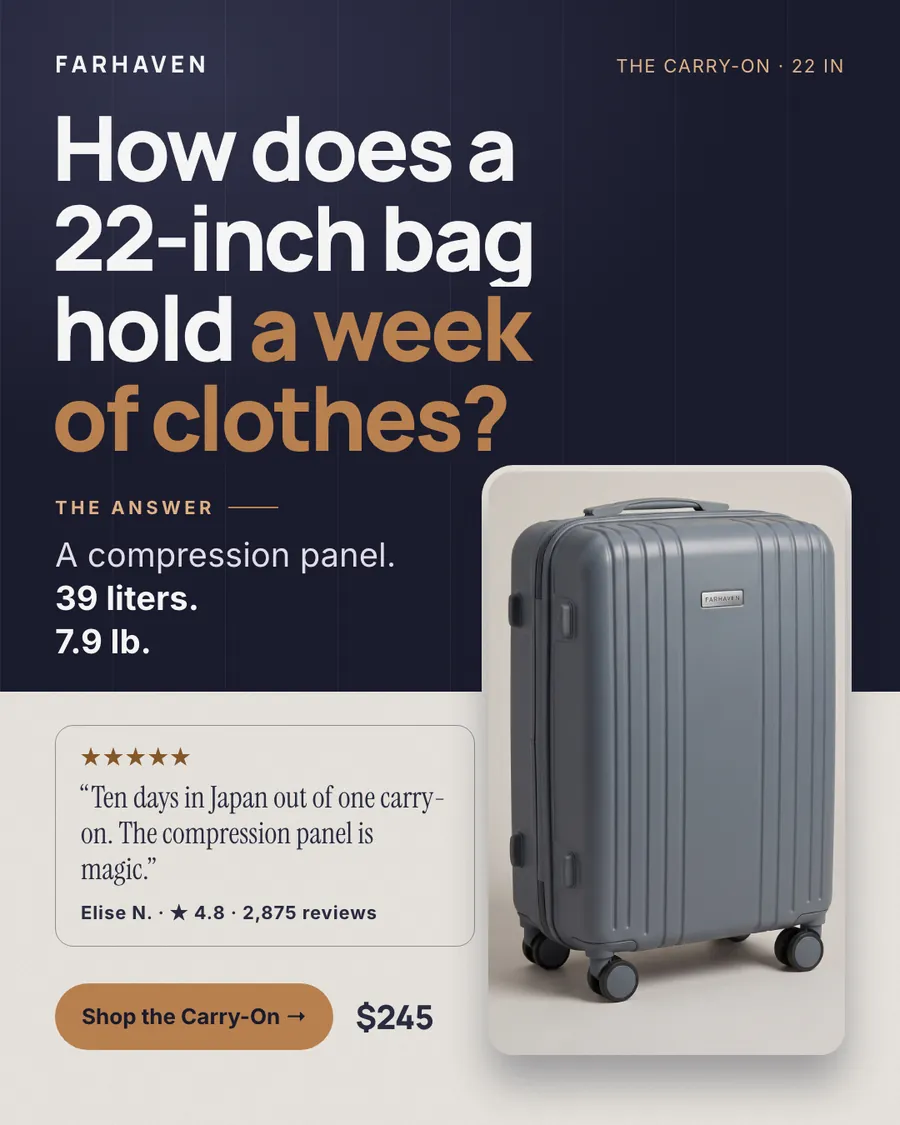
Question hookCuriosity
Farhaven: How does a 22-inch bag hold a week of clothes?
Fictional sample brand · made by our engine
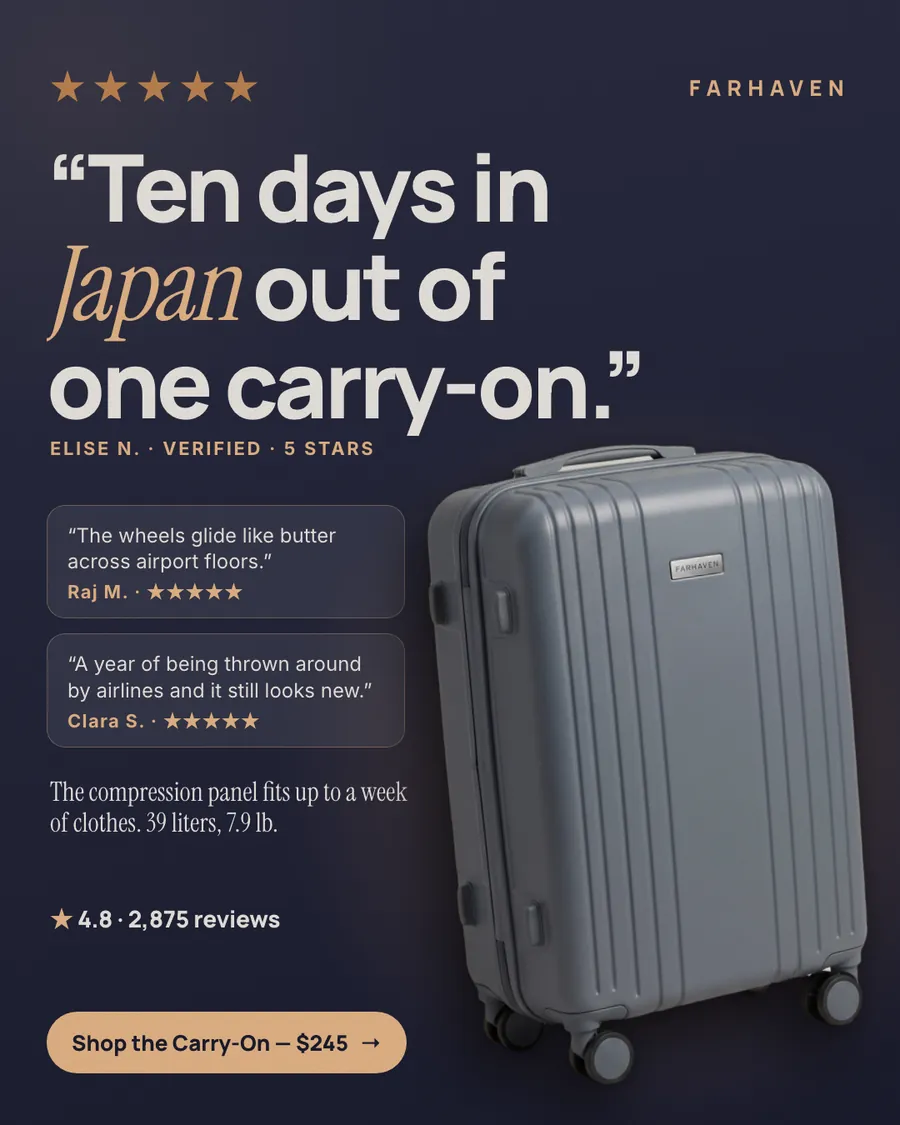
Review cardSocial proof
Farhaven: “Ten days in Japan out of one carry-on.”
Fictional sample brand · made by our engine
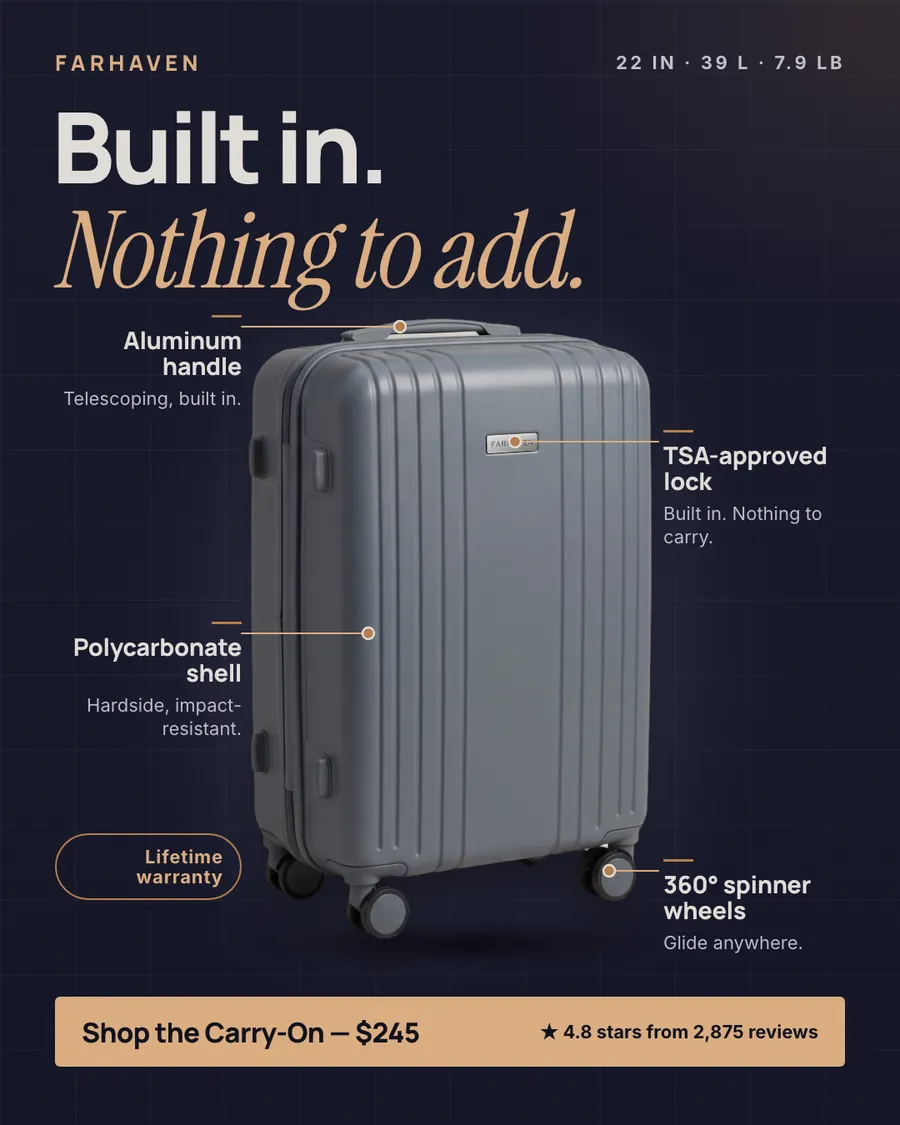
Annotated heroConvenience
Farhaven: Built in. Nothing to add.
Fictional sample brand · made by our engine
Words to be careful with
Luggage isn't a restricted category on the ad platforms. The risk is in claims that sound simple and aren't: which planes a bag fits, what the lock is, how long the warranty lasts and how tough the shell is.
"Fits every airline"
Airlines set their own limits. Delta, for example, allows 22 x 14 x 9 inches including handles and wheels, may gate check bags on very full flights, and on its regional flights with 50 seats or fewer allows only personal items in the cabin. Claim the size you measured, not a guarantee about every plane.
Source: Delta: Carry-on baggage
"TSA-approved lock"
TSA says it can open recognized locks with master keys, that the lock packaging should say so, and that it may cut locks it can't open. TSA also says it takes no position on how well these locks protect a bag. Say the lock can be opened by TSA; don't suggest TSA approved your suitcase.
Source: TSA: Travel tips (locks)
"Lifetime warranty"
The FTC's warranty guides say an ad using "lifetime" should state the life it refers to, and any ad mentioning a warranty should disclose its material conditions. "Lifetime warranty for the original owner, covering shell, wheels and handle" is the clear shape.
Source: 16 CFR 239.4: "Lifetime" and similar representations
"Waterproof" shells and leather trim
The FTC's leather guides cover suitcases and traveling bags. They treat "waterproof" as misused unless the product keeps water from reaching its contents, and a bag with leather trim shouldn't be called leather unless it is leather in all substantial parts.
Source: 16 CFR 24.3: Misuse of "waterproof" and related terms
"Unbreakable" and drop tests
Durability claims need a reasonable basis before the ad runs, and an ad that says "tested" or shows a test needs at least that level of proof. "Impact-resistant polycarbonate" backed by your supplier's data is safer than "unbreakable".
Source: FTC Policy Statement Regarding Advertising Substantiation
Rules checked . The sources are linked at the end of this page.
How often to refresh luggage ads, and what to measure
Luggage ads tire more slowly than most, because buyers come and go with their trips. They still wear out in the busy weeks before holidays and summer travel.
On a small budget, two or three new ads a month keeps things steady. Before a big travel season or the holiday gift weeks, add a new batch: a new destination, a new color, a new packing demo.
Ads Manager (Facebook's tool for running ads) shows the wear: an ad marked "Creative limited" costs more per result than your earlier ads, and one marked "Creative fatigue" costs at least double. Meta recommends a new ad with a materially different image or video, so change the setting or the shot, not only the headline.
What to measure
- Cost per purchase over a long window
- Luggage buyers take their time, so a week-one view of results undercounts what an ad really earns.
- Add to cart to purchase rate
- If many people add the bag and few buy, the page is missing a number they need, often the outside size or the warranty terms.
- Return reasons
- "Too big for my airline" and "heavier than expected" are fixes for the ad and the page, not the product.
- Share of orders with cubes
- The easiest lift to the order value, and a sign the packing angle lands.
Questions about advertising luggage
Where should a new luggage brand start advertising?
Start on Meta with one hero bag and six ads that prove size, capacity and durability, then add Google Shopping for travelers searching by size and features. Put the outside dimensions, weight and warranty terms on the product page first, because buyers check them before they buy.
How much should I spend to advertise a suitcase brand?
Work out the most a first order can cost: order value times the margin left after the bag, shipping, returns and fees. Meta says an ad set usually leaves learning after about 50 results in a week, which is a lot of purchases at luggage prices, so many brands optimize for add to cart at first.
Is Google Shopping good for luggage?
Usually, because people search luggage by specifics: size in inches, hardside or softside, spinner wheels, color. Titles that use those words and images that show the bag packed help it stand out from cheaper shells in the same results.
Can I say my carry-on fits all airlines?
It is safer not to. Airlines set their own limits and some regional flights allow only personal items in the cabin. State the measured size including wheels and handles, and name an airline's limit only if your bag meets it.
Should I sell luggage on Amazon?
It can add sales once your brand has reviews and a margin that survives fees and returns. As a first channel it puts your bag next to many lookalike shells on price, and the customer relationship stays with Amazon.
How do I advertise luggage on Facebook?
Run a Sales campaign with a broad audience and a handful of ads in 4:5 and 9:16, each proving one thing: the bag in a real overhead bin, a week packed inside, or reviews about wear. Judge them over two weeks or more, since luggage buyers rarely decide on the first view.
When do people buy luggage?
Mostly before trips and as gifts. Holiday weeks and the run-up to summer travel are the busy times for many brands, but your own order history is the best guide. Have new ads ready before those weeks rather than making them once sales pick up.
Is this plan useful if I'm selling used luggage?
Not really. Selling a used suitcase is a single local sale, where a marketplace listing with clear photos and measurements does the job. This plan is for a brand selling its own new luggage online, where proof and repeat ads matter.
How long should I run a luggage ad before judging it?
At least two weeks without edits, longer on a small budget. Changes can restart Meta's learning, and luggage buyers often return days later to buy. Look at add to carts early and purchases over the longer window.
Get the ads for this plan
Paste your store link and get 3 free ads of your own luggage: we read your products, prices and reviews, design around your real product photo and check every fact against your store.
Where to go next
- Luggage ad ideasSeven sample ads for a hardside carry-on: fit, capacity, weight and durability, with airline size rules and lock and warranty wording.
- BagsBag ads that show capacity, straps and materials, with sizes and prices from your product pages.
- How to advertise bags and handbagsA plan for a small bag brand: prove capacity and materials first, give a $100 purchase time to happen, and make the first order pay for itself.
- How to advertise camping gearA camping gear brand's ad plan: Meta and Shopping before trip season, spec proof in ounces, a sleep-system bundle and a budget for a big ticket.
- How to advertise headphonesA headphone brand's ad plan: proof for every spec first, Meta and Google Shopping side by side, creators for trust, and a Q4 that starts early.
- Christmas ad ideasThe 2026 shipping cutoffs that set your ad calendar, six Christmas offers, copy lines and 16 sample ads for four stores.
- Bundle offerBundle and set ads that show what is in the box and the real saving against buying separately.
- Ad creative testing on a small budget: an honest guideOne ad is a bet; fifty ads is a spray. Here is the middle path for small budgets: a few angles that disagree with each other, enough spend to read them, and a weekly loop that builds on what works.
- PricingFree preview, Lite $29/month for 9 designs a month (optional 2 weekly), Starter $49/month for 20. Meta and a 7-day trial from Growth.
Sources
Platform rules on this page were checked on against:
- Meta Business Help Center: About the learning phase
- Meta Business Help Center: About creative fatigue recommendations in Ads Manager
- Delta: Carry-on baggage
- TSA: Travel tips (locks)
- 16 CFR 239.3: Disclosure of material conditions
- 16 CFR 239.4: "Lifetime" and similar representations
- 16 CFR 24.0: Scope of the leather guides (includes luggage)
- 16 CFR 24.3: Misuse of "waterproof" and related terms
- FTC Guides Against Deceptive Pricing, 16 CFR 233.1 (former price comparisons)
- FTC Policy Statement Regarding Advertising Substantiation
- USPS 2026 Holiday Shipping Deadlines
- 3 free ads, no signup
- Lite $29/month · 9 designs a month · optional 2 weekly
- Starter $49/month · 20 designs
- Growth $99/month, 7-day free trial
- Pro $149 · Scale $199
- 30-day money-back guarantee