how to advertise headphones
How to advertise headphones when big brands own the search results
People who buy headphones compare. They read spec sheets, watch reviews and check three tabs before they pay $179, and the famous brands are in every one of those tabs. A small audio brand wins on proof it can show quickly: the hours, the quiet, the warranty. This plan is worked through with Velorin Audio, a fictional headphone brand.
Updated · Budgets and examples use a fictional brand's numbers. Use yours.
In short
What is the best way to advertise headphones?
Collect test proof for every spec first, then run Meta ads built on one benefit each, like hours of battery or a quieter commute. Add Google Shopping for people searching by feature, send review units to a few creators, and start gift season ads in early November with a real offer and a clear order-by date.
StoreToAds makes ready-to-post ads from your product photo, free to try.
At a glance
- What buyers check
- Battery hours, noise cancelling, comfort and the warranty, in that kind of detail
- Where to start
- Meta (Facebook and Instagram) for discovery and Google Shopping for people already comparing
- How they decide
- Slowly: reviews and second looks matter more than the first ad
- The busy weeks
- Black Friday through mid December, when headphones become gifts
- Before any ad runs
- Your own test notes for every number, and the FCC authorization in hand
Which channels fit headphones, in the order to try them
A headphone buyer moves in two modes: scrolling, when a line about a quiet flight catches them, and searching, when they type the feature they want. The first two channels below cover those two modes. The rest build the trust a $179 purchase needs.
- 01
Meta (Facebook and Instagram)
Start hereWhy it fits
Most people don't know a small audio brand exists until an ad shows them one benefit in a moment they recognize: a commute, a flight, a long workday at a laptop. Meta finds those people without you naming interests, and it carries reviews and specs well in a still image.
The trade-off
Few people buy headphones on the first view. Expect most sales to come after a second or third look, so judge the ads over two weeks and keep a budget for showing them again to site visitors.
- 02
Google Shopping
Start hereWhy it fits
Plenty of buyers search by feature and price, not brand. A Shopping listing with the photo, the price and a clear title puts you in front of someone already deciding.
The trade-off
You sit next to the famous brands in the same row, often at lower prices than theirs on sale days. Clean product titles and exact specs in your feed do more here than clever words.
- 03
Creator reviews (YouTube and short video)
Add nextWhy it fits
Comparison shoppers look for someone who wore the headphones on a train or a plane. A handful of honest reviews gives your ads something to point at and answers the sound question a still ad can't.
The trade-off
Review units cost money and you can't control the verdict. Anyone who got a free pair has to say so, and a mixed review is still better proof than none.
- 04
Email and SMS
Add laterWhy it fits
Owners are your best buyers for earbuds, a stand or spare ear cushions, and a short note about care and the warranty builds trust before you ask for anything.
The trade-off
It needs a list first, and SMS needs each subscriber's clear consent.
- 05
Amazon
Only if it fitsWhy it fits
Some shoppers only buy electronics where returns feel easy and reviews pile up, and a listing there can catch them.
The trade-off
The search page is crowded with big brands and sponsored rivals, the customer belongs to the marketplace, and you split your reviews across two stores.
- 06
TikTok
Skip for nowWhy it fits
Noise cancelling demos with sound on can work there, especially on travel content.
The trade-off
It needs new video every week and good audio capture. Add it once creators are already making videos you can learn from.
Your first 30 days advertising headphones
The first week is about paperwork, not ads. Every number you plan to print, from hours of battery to the warranty length, should have a note behind it before a single impression is bought.
Days 1 to 4
Write down the proof behind every spec
Run your own battery test with noise cancelling on, at a stated volume, and keep the results. Confirm the FCC authorization, put the full warranty terms on the site, and list the specs in a plain table on the product page. Make a test purchase and check it shows in Meta Events Manager.
Days 5 to 11
Launch 6 Meta ads on 3 benefits
Two ads each for quiet, battery and switching between devices. Use a customer line for one ad in each pair and a spec for the other. Run them in one Sales campaign with a broad audience in 4:5 and 9:16, and resist editing during the first week.
Days 12 to 18
Turn on Google Shopping with a clean feed
Write each title as product type, model, color and the one spec people search for. Check the price, availability and photo match the site exactly. Start with a modest daily budget and watch which searches bring clicks.
Days 19 to 25
Show the warranty to people who looked
Build a small retargeting (showing ads again to people who visited your shop) ad set for site visitors with the review and warranty ads. Compare add to cart by benefit: one of the three usually earns most of the carts, and the next batch of ads should lean on it.
Days 26 to 30
Send review units and set your gift dates
Pick three creators whose audiences commute, travel or work at a desk, and send them a pair with no script. Then decide your Black Friday offer and your last order date for Christmas delivery, so the ads are ready before mid November.
The proof sheet to keep before you spend
Every number in a headphone ad will be checked by someone with the product in their hands. Keep one page with the claim, the proof and where a shopper can see it. Velorin's sheet looks like this:
| Claim in the ad | Proof to keep | Where shoppers see it |
|---|---|---|
| Up to 40 hours, noise cancelling on | Your battery test log, with volume and settings | Spec table, with the test conditions |
| 10 minutes of charge = 4 hours | The same test log, with the charger used | Spec table |
| Switches between two devices | Your pairing test notes | A short how-to on the page |
| 2-year warranty | The written warranty terms | Linked from the product page |
| 4.6 from 3,215 reviews | Your review app's live count | Reviews section, same numbers |
How to size a starting budget for headphone ads
Headphones carry a high order value and a thinner margin than most products here, because of the parts, the testing and the returns. Velorin's numbers: the V2 sells at $179, down from $219, with free shipping on every order.
| Order value | $179.00 |
|---|---|
| Margin after product cost, shipping and fees | 35% |
| Most a first order can cost to break even | $62.65 |
| 50 purchases a week at that cost | $3,133 a week |
| The same budget per day | about $448 |
Meta says an ad set usually leaves its learning phase after about 50 results in the week after its last significant edit, and recommends a budget large enough to get enough results. Meta Business Help Center: About the learning phase
That weekly figure is out of reach for most new audio brands, and that's normal. At this price, purchases arrive slowly, so a first budget usually aims at fewer, better-proven sales rather than a full learning phase (Facebook's first days of testing who to show the ad to) in week one.
- Split the money by mode. Put most of it on Meta for discovery and a smaller, steady share on Shopping for the people already searching.
- Count add to carts in the first weeks. If purchases are too few to read, compare the benefits by cost per add to cart, then switch the ad set back to purchases once sales pick up.
- Sell the second item. Earbuds at $99 or a $39 stand added to an order raise what a first sale can afford to cost. Use your own attach rate, not a guess.
- Work the margin out after returns. Comfort is personal and some pairs come back.
Offers that work for headphones
A deep discount on headphones can make buyers suspect the quality. Offers that lower the risk of trying a new brand usually do more than a bigger percentage.
A real price drop, shown honestly
Velorin's V2 at $179, down from $219, gives a comparison shopper a concrete reason to choose it on a sale day.
Watch: Only show a former price you actually charged, openly and for a real stretch of time. An inflated list price set up for the discount is the case the FTC's pricing guide warns about.
The warranty, said plainly
Two years of cover answers the main fear about a brand someone has never heard of. It works best near the price, not in small print.
Watch: Link the full warranty terms from the ad's landing page (the page people reach after tapping the ad).
An accessory with the headphones
A $39 stand or a $29 set of spare ear cushions included with the order feels generous and keeps the headphone price intact.
Earbuds and headphones together
Some buyers want earbuds for the gym and headphones for the desk. A pair of products bought together raises the order value more than a second discount would.
A clear gift order date
In December the question is whether the box arrives in time. A dated line in the ad answers it before it's asked.
Watch: Work your date back from your carrier's schedule and your packing time, and stop promising delivery once it passes.
Angles to test for headphone ads
Each angle leads with one benefit someone can check against the product page. The sample ads, spec callouts (labels pointing at parts of the product) and copy lines are on Headphones ad ideas; these are the angles the plan above puts to the test.
The quiet, in a customer's words
"Flights are actually peaceful now."
Hours with the feature on
Up to 40 hours of battery. With noise cancelling on.
Two devices, no menus
Laptop to phone without touching a setting.
The long workday
Comfortable for a full workday.
Fast top-up
10 minutes of charge, 4 hours of listening.
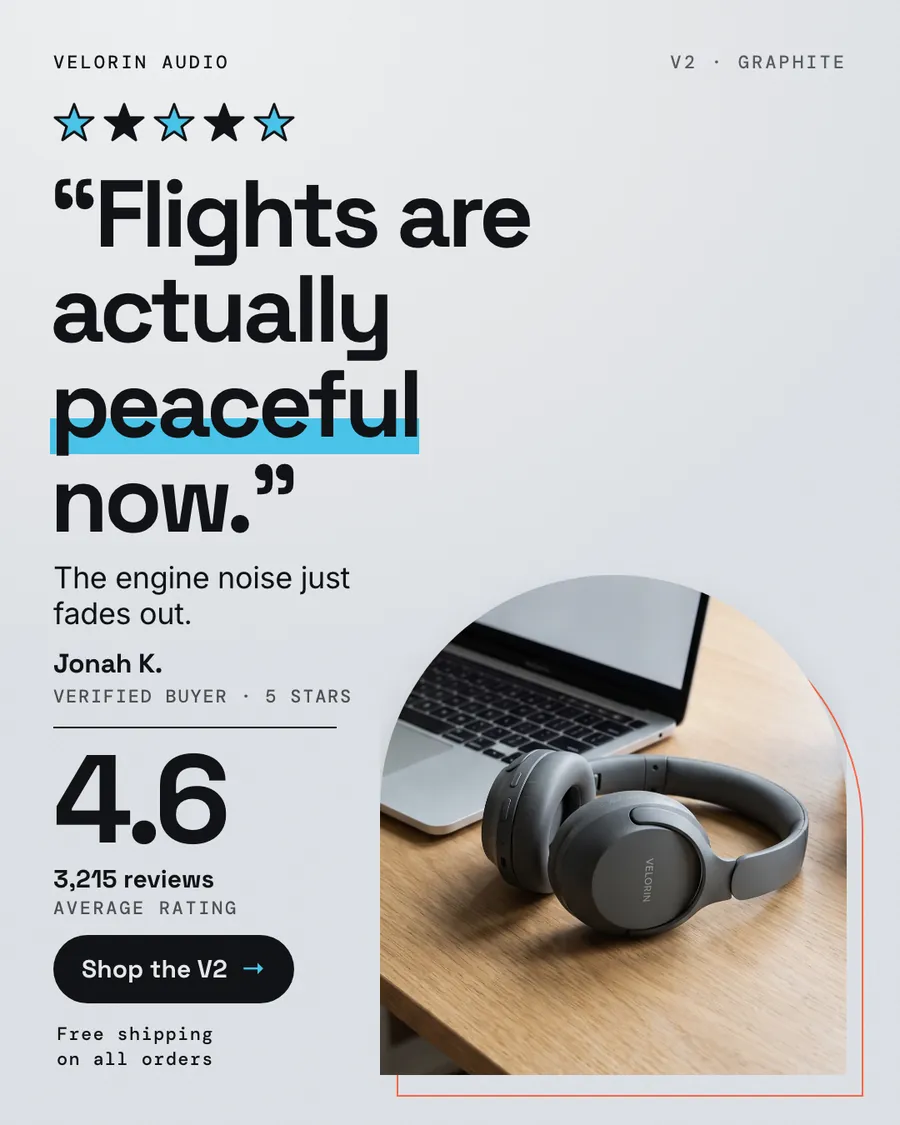
Review cardSocial proof
Velorin Audio: “Flights are actually peaceful now.”
Fictional sample brand · made by our engine
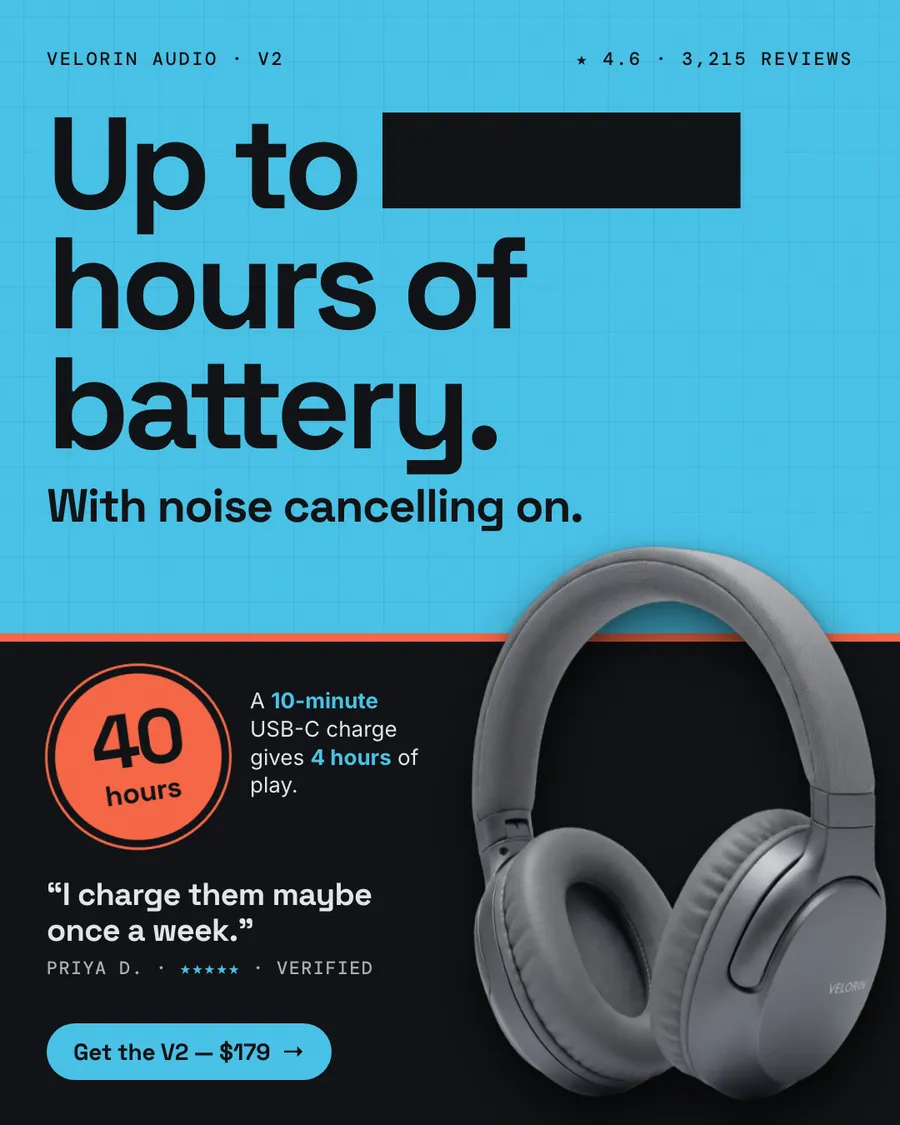
Fill in the blankBenefit
Velorin Audio: Up to ____ hours of battery. With noise cancelling on.
Fictional sample brand · made by our engine
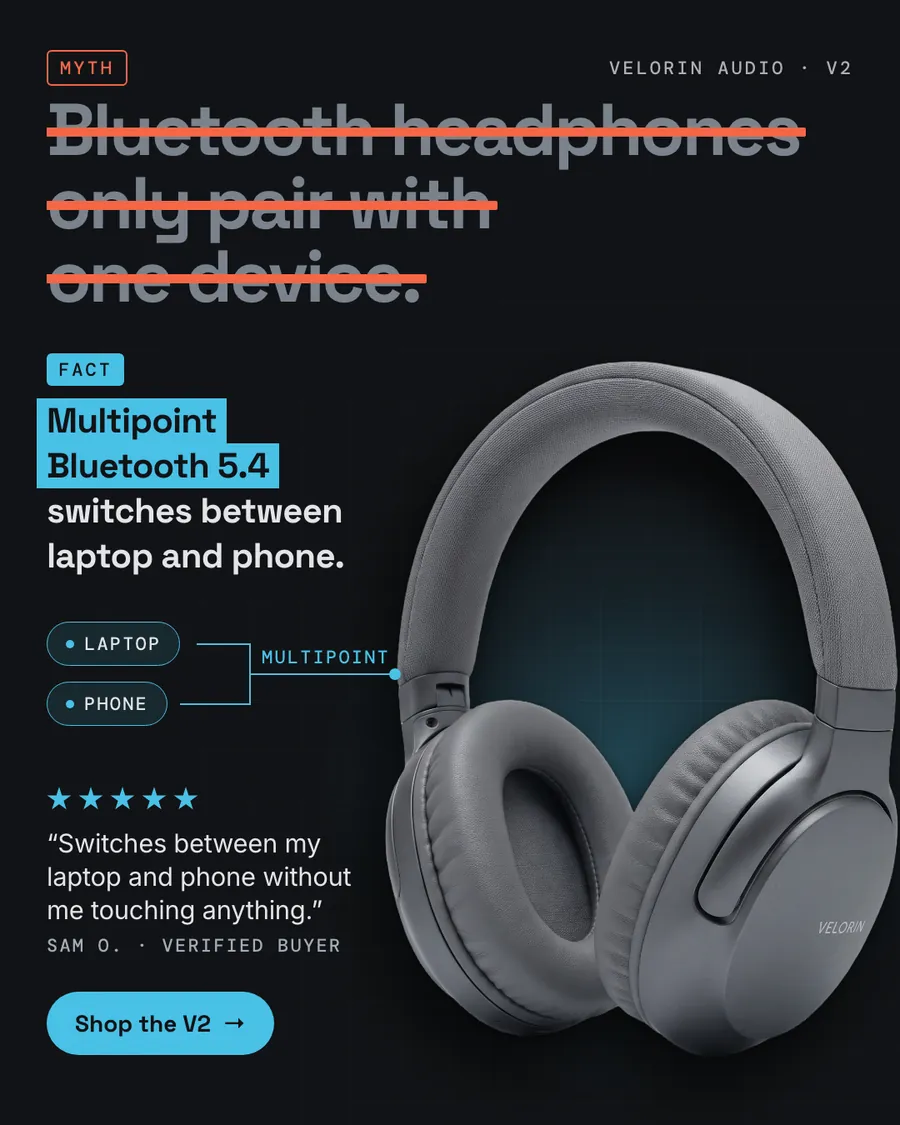
Myth vs factConvenience
Velorin Audio: Bluetooth headphones only pair with one device.
Fictional sample brand · made by our engine
Words to be careful with
Headphones aren't a restricted category on the main ad platforms. The risks are the numbers in the ad, the names of other companies, and the radio inside the product.
Battery hours and noise claims
Before an ad states a measurable fact, the FTC (the US consumer protection agency) expects you to hold a reasonable basis for it. "Up to 40 hours" needs your own test under stated conditions, and a line like "lab tested" means you need at least the testing it describes.
Source: FTC: Policy Statement Regarding Advertising Substantiation
Advertising before FCC authorization
Under 47 CFR 2.803, a radio frequency device can't be marketed, which includes advertising it for sale, until it has a valid FCC equipment authorization. A device shown before then must carry a notice that it hasn't been authorized and can't be sold yet.
Source: 47 CFR 2.803: Marketing of radio frequency devices (Cornell LII)
The Bluetooth name and logo
The Bluetooth SIG says a company may use its trademarks only if it is a member and the product has completed the Bluetooth Qualification Process under that member's account. Check both before the logo goes on an ad.
Warranty lines
When an online ad mentions a warranty, the FTC's guide says to tell shoppers they can get the complete written warranty free from the seller. A link to the terms on the product page does that job.
Source: 16 CFR 239.2: Disclosures in warranty or guarantee advertising (Cornell LII)
Comparisons with famous brands
Meta doesn't allow ads that violate a third party's intellectual property, including trademarks. Leave other brands' names, logos and product photos out, and compare against a feature instead.
Source: Meta Advertising Standards: Third-Party Intellectual Property Infringement
Rules checked . The sources are linked at the end of this page.
How often to refresh headphone ads, and what to measure
Headphone buyers see your ads several times before they decide, so the same image wears out on them faster than the audience size suggests.
On a small budget, add two or three new ads every two to three weeks, each with a different benefit or a new photo setting, such as a train, a desk or a plane. From mid November, plan a fresh batch every week until your last shipping date.
Meta flags an ad as "Creative limited" when its cost per result runs above your past ads, and "Creative fatigue" once it reaches twice as much. Its suggestion is a new ad with a materially different image or video, while keeping the original running.
What to measure
- Cost per add to cart, by benefit
- Tells you whether quiet, battery or switching sells your headphones, long before purchases are many enough to compare.
- Days from first visit to purchase
- If buyers take a week, judge each ad over a week too. Pausing on day three cuts ads that were working.
- Shopping click share on your top feature searches
- Shows whether the feed's titles and price earn a place against bigger brands.
- Return rate and the reason given
- Comfort returns point to the product page, not the ads. Returns that mention battery or noise mean a claim needs softening.
Questions about advertising headphones
How do I market headphones as a small brand?
Choose one benefit you can prove better than most, like battery hours with noise cancelling on, and build your first ads around it. Run them on Meta for discovery, list the product on Google Shopping for people comparing, and get a few honest creator reviews so shoppers can hear what the ads can't show.
How much should I spend on headphone ads at first?
Start from your margin: the price times what's left after parts, shipping, fees and returns is the most a first sale can cost. At a price near $180 that number is high, but sales are slower, so most new brands start well below Meta's learning-phase target and judge results by add to cart.
Are Google Shopping ads worth it for headphones?
Usually yes, because many buyers search by feature and price before they choose. Shopping puts your photo and price in that comparison. Expect to sit next to famous brands, and give your feed exact titles and specs so the right searches find you.
How do I advertise electronics online without a big budget?
Narrow the target. One product, one benefit and one channel tell you more than a little spend spread everywhere. Use static ads with real specs and reviews, which cost little to replace, and save video for when creators have made some you can learn from.
Do I need FCC approval before I advertise wireless headphones?
The FCC's marketing rule says a radio frequency device can't be advertised for sale until it has a valid equipment authorization. Bluetooth headphones contain a radio, so have the authorization in hand before ads go live, and check the details with whoever handled your testing.
Should I send free headphones to reviewers?
It's one of the most useful early steps, as long as each reviewer says they got the pair free. Pick creators whose audience commutes, travels or works at a desk, send no script, and accept that some reviews will be mixed.
Which months matter most for headphone ads?
Gift season is the biggest: Black Friday is November 27, 2026, and December gifting follows. USPS recommends shipping Ground Advantage by December 17 for delivery before Christmas in the lower 48 states, so set your own last order date before that and stop promising delivery after it.
How do I advertise headphones for sale online?
Make the product page carry the proof first: a spec table, the warranty terms, real photos and reviews. Then send traffic to it from Meta and Google Shopping, and show the page again to visitors who didn't buy with a review or warranty ad.
Can I mention a famous brand in my headphone ads?
It's safer not to. Meta doesn't allow ads that violate another company's trademarks, and a comparison with a named brand needs your own fair test. Compare against a feature instead, like hours of battery with noise cancelling on.
Get the ads for this plan
Paste your store link and get 3 free ads of your own headphones: we read your products, prices and reviews, design around your real product photo and check every fact against your store.
Where to go next
- Headphones ad ideasEight sample ads for a wireless headphone brand: each spec said in plain words, the proof it needs, photos and claims.
- HeadphonesHeadphone and earbud ads that lead with one real spec, show the hardware and quote real listeners.
- How to advertise phone casesShort video on TikTok and Meta first, Shopping for exact-model searches, bundles that carry a low price, and the brand-name rules.
- How to advertise watchesA plan for a small watch brand: Meta and Google Shopping first, reviewers next, and a budget that admits a $185 watch sells slowly.
- How to advertise luggageA plan for a small luggage brand: prove size and capacity, give a $245 purchase time, and keep airline and lock claims exact.
- Black Friday ad ideasThe 2026 dates, six Black Friday offers and the products they suit, copy lines, and 16 sample ads for four stores.
- Christmas ad ideasThe 2026 shipping cutoffs that set your ad calendar, six Christmas offers, copy lines and 16 sample ads for four stores.
- Ad creative testing on a small budget: an honest guideOne ad is a bet; fifty ads is a spray. Here is the middle path for small budgets: a few angles that disagree with each other, enough spend to read them, and a weekly loop that builds on what works.
- PricingFree preview, Lite $29/month for 9 designs a month (optional 2 weekly), Starter $49/month for 20. Meta and a 7-day trial from Growth.
Sources
Platform rules on this page were checked on against:
- Meta Business Help Center: About the learning phase
- Meta Business Help Center: About creative fatigue recommendations in Ads Manager
- Meta Advertising Standards: Third-Party Intellectual Property Infringement
- FTC Guides Against Deceptive Pricing, 16 CFR 233.1 (former price comparisons)
- FTC: Policy Statement Regarding Advertising Substantiation
- 47 CFR 2.803: Marketing of radio frequency devices (Cornell LII)
- Bluetooth SIG: Marketing and branding
- 16 CFR 239.2: Disclosures in warranty or guarantee advertising (Cornell LII)
- USPS 2026 Holiday Shipping Deadlines
- 3 free ads, no signup
- Lite $29/month · 9 designs a month · optional 2 weekly
- Starter $49/month · 20 designs
- Growth $99/month, 7-day free trial
- Pro $149 · Scale $199
- 30-day money-back guarantee