how to advertise watches
How to advertise watches as a small brand
Watch buyers do their homework. They check the case size against their wrist, look up the movement, read reviews and often wait a week before paying. That makes a watch slow to sell from a cold ad and quick to sell once someone trusts you. The plan below starts from that, with Fieldmark Watch Co., a fictional field watch brand, as the example.
Updated · Budgets and examples use a fictional brand's numbers. Use yours.
In short
How do you advertise watches as a small brand?
Show the watch on real wrists of different sizes and state the specs buyers check: case size, movement, crystal and water rating. Run Meta for discovery and Google Shopping for spec searches, send review units to honest reviewers, judge early ads on add to carts, and expect each sale to take longer than a cheap product.
StoreToAds makes ready-to-post ads from your product photo, free to try.
At a glance
- The first question
- How big will it look on my wrist?
- Where to start
- Meta (Facebook and Instagram) for discovery, Google Shopping for people searching specs
- What builds trust
- Independent reviews and wrist shots, more than brand claims
- Buying pace
- Slow: judge the first weeks on add to carts, not purchases
- The rule that bites
- Water resistance and origin words must match the spec sheet
Which channels fit watches, in the order to try them
Most people who buy a watch from a small brand either stumbled on it and fell for the dial, or searched for exactly its specs. You need one channel for each, then the reviews that convince both.
- 01
Meta (Facebook and Instagram)
Start hereWhy it fits
Wrist shots and slow dial close-ups stop the scroll for people who didn't know they wanted an automatic. It's also where gift buyers find a watch before Father's Day or the holidays.
The trade-off
At $185, most clicks are browsing. Purchases arrive slowly, which makes Meta's learning phase (Facebook's first days of testing who to show the ad to) hard to finish on sales alone.
- 02
Google Shopping
Start hereWhy it fits
Watch shoppers search in specs: "38mm field watch automatic", "sapphire automatic under 200". Shopping shows your dial and price right on that search.
The trade-off
Search volume for a small brand's exact niche is limited, big brands share the page, and titles that leave out size, movement and crystal get skipped.
- 03
Reviewers and enthusiast communities
Add nextWhy it fits
Watch buyers trust independent reviews on YouTube, blogs and forums more than any ad. One honest review becomes the proof your ads point to.
The trade-off
Slow and out of your control: enthusiasts say what they think, and most forums limit self-promotion, so read the rules before posting.
- 04
Email
Add nextWhy it fits
New dials, strap releases and restocks of a sold-out color give watch buyers reasons to come back, and a waitlist tells you how many to make.
The trade-off
It only reaches people who signed up, so it grows behind your ads and reviews.
- 05
Creators with wrist-shot accounts
Add laterWhy it fits
Accounts that post daily wrist shots show the watch with real clothes and in real light.
The trade-off
Gifted watches are expensive samples, every post needs a disclosure, and running their photo as an ad needs permission.
- 06
Pinterest and TikTok
Skip for nowWhy it fits
Both can work for watches with a strong look or a maker story on camera.
The trade-off
Spec-driven buyers do their research elsewhere, and both channels want a steady supply of new visuals you're better off spending on Meta first.
Working with watch reviewers
For a small watch brand, reviews do the job a big brand's TV budget does: they make the name feel safe. A few rules keep them useful.
- Send review units, ask for honesty. A reviewer who can point out a flaw is believed when they praise the dial. Loaned or gifted watches are a material connection, so their review needs a disclosure under the FTC's Endorsement Guides.
- Give them the specs sheet. Case size, thickness, movement, power reserve, crystal and water rating, so nothing in the review is a guess.
- Quote, don't twist. If you use a line from a review in an ad, keep its meaning, link the review if you can, and ask first when the words are a creator's own content.
- Point ads at the proof. Once a review is live, an ad that leads with the reviewer's honest verdict often answers more doubts than a fifth spec ad.
How to size a starting budget for watch ads
A watch carries plenty of margin per order, so each sale can afford a real ad cost. The catch is volume. With Fieldmark's numbers: one Field 38 at $185, with free shipping and 30-day returns.
| Order value | $185.00 |
|---|---|
| Margin after product cost, shipping and fees | 50% |
| Most a first order can cost to break even | $92.50 |
| 50 purchases a week at that cost | $4,625 a week |
| The same budget per day | about $661 |
Meta says an ad set usually leaves its learning phase after about 50 results in the week after its last significant edit, and recommends a budget large enough to get enough results. Meta Business Help Center: About the learning phase
Fifty watches a week is a serious business, not a starting budget. At this price an ad set optimized for purchases will usually stay in learning for a while, and that is normal for a slow-selling product rather than a sign the ads failed.
- Optimize for add to cart or checkout first. Meta suggests a more frequent event when an ad set can't get about 50 results a week. Watch shoppers add to cart, think, and come back, so the event still points at buyers.
- Judge over two weeks, not two days. Many watch buyers come back days after the first click. Early verdicts kill ads that would have sold.
- Lift the order with a strap. A $45 steel mesh strap offered with the watch raises the order value and makes a ready-made gift set.
Wrist-size returns are the main leak. Every wrist shot that shows the size honestly saves a return, which is worth more than a cheaper click.
Your first 30 days advertising watches
The steps assume one hero watch, a product page with full specs and purchase tracking that works. Because sales come slowly, the plan reads early results from add to carts and checkouts.
Days 1 to 3
Shoot the size honestly
Photograph the watch on a small wrist and a large one, a dial close-up in daylight, the caseback and the lume in the dark. Put case size, thickness, strap width, movement, power reserve, crystal and water rating on the page.
Days 4 to 7
Launch 6 ads, optimized for add to cart
Two wrist-size ads, one spec ad, one durability ad, one caseback ad and one review ad. One campaign, one broad ad set, optimized for add to cart while purchases are few.
Days 8 to 16
Hands off, and send review units
No edits to the ad set, its budget or its ads during learning. Meanwhile, send three to five watches to reviewers whose audience matches yours, with the spec sheet and no script.
Days 17 to 23
Open Google Shopping with spec-rich titles
Start a small Shopping campaign with titles such as "Field 38 automatic, 38 mm, sapphire, 100 m". Open a waitlist email for the next dial or strap.
Days 24 to 30
Decide on purchases, then add the gift angle
If purchases are coming steadily, move the ad set to optimize for them. If not, keep add to cart and test a new angle. Build gift versions three weeks before the next gift date.
Angles to test for watch ads
Each angle settles one doubt a watch buyer researches. The sample ads, spec glossary and copy lines are on Watch ad ideas.
Size on a real wrist
38 mm is perfect on my small wrist.
Specs in one breath
Japanese automatic, sapphire crystal, 100 m.
Tougher than it looks
Hiking and swimming all summer. Not a scratch on the crystal.
The caseback
Turn it over: the movement runs behind glass.
The price, with proof
A sapphire automatic for $185, with a 2-year warranty.
After dark
Lume on every hand and numeral, for the walk home.
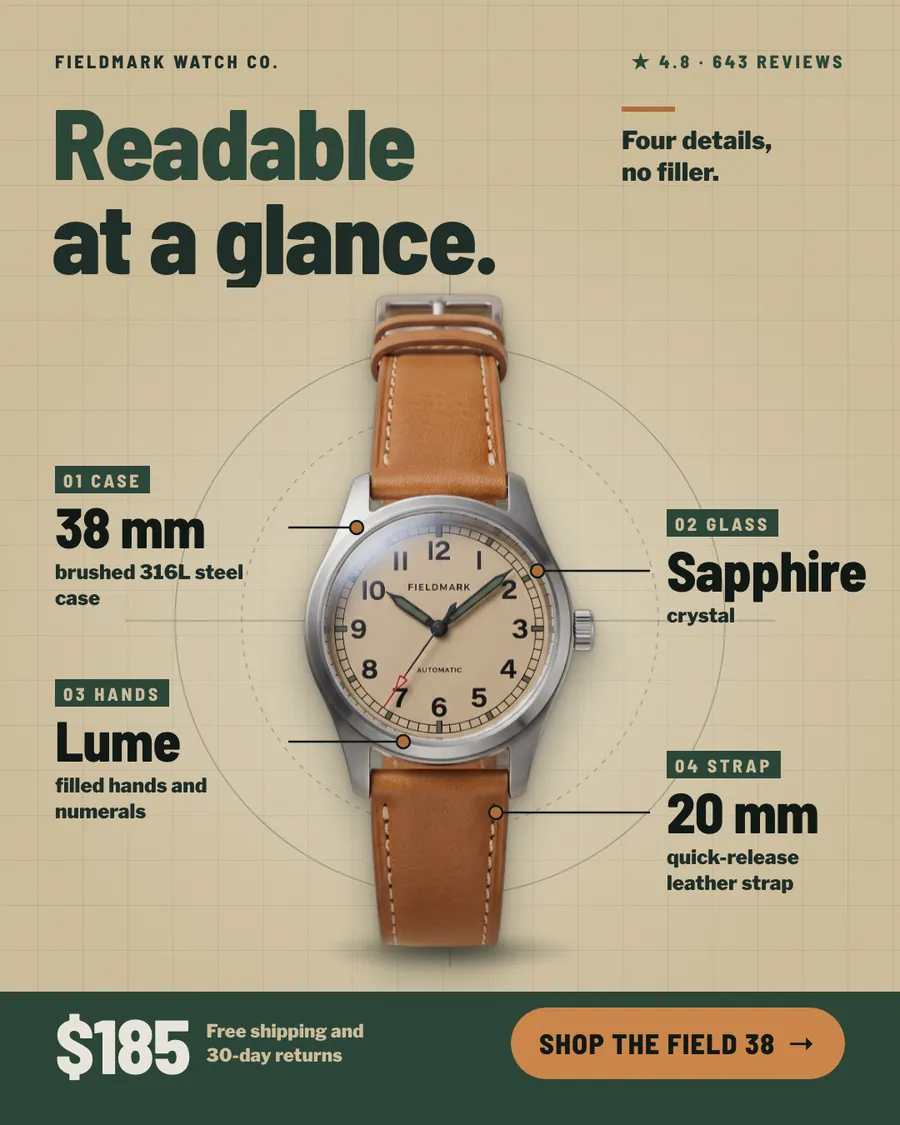
Annotated heroTransparency
Fieldmark Watch Co.: Readable at a glance.
Fictional sample brand · made by our engine

Myth vs factDurability
Fieldmark Watch Co.: MYTH: A MECHANICAL WATCH IS TOO DELICATE FOR THE TRAIL.
Fictional sample brand · made by our engine
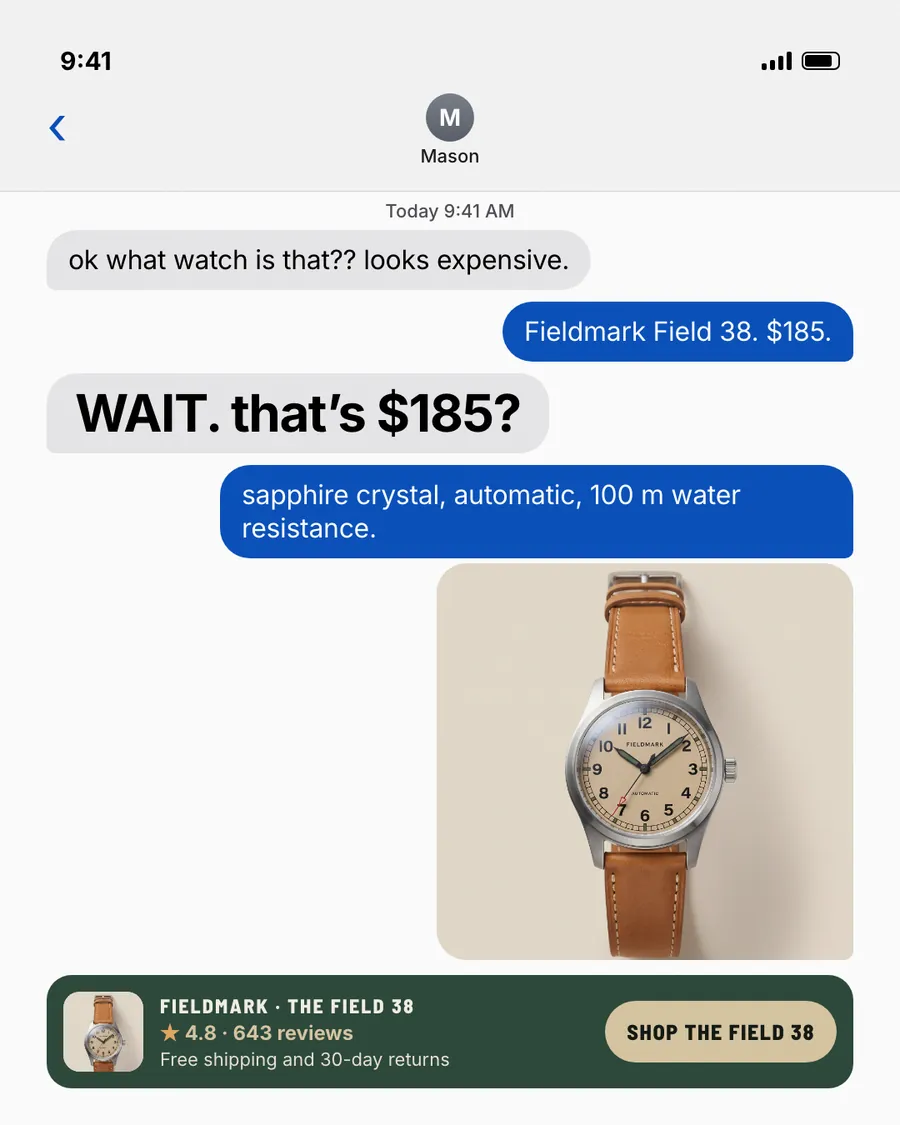
Text threadValue
Fieldmark Watch Co.: WAIT. that's $185?
Fictional sample brand · made by our engine
Offers that work for watches
Watch buyers distrust heavy discounts on a brand they don't know. Offers that take away the risk of buying unseen work better than a lower price.
Free shipping and 30-day returns
The answer to the wrist-size worry. Fieldmark puts it on the ad, because at $185 it removes most of the risk.
A second strap at a bundle price
Raises the order value, gives gift buyers a set, and shows the watch two ways in one ad.
The warranty, stated
A 2-year warranty answers the "automatics are fragile" doubt better than any adjective.
Watch: State the terms on the page; vague coverage reads as none.
Early access for a new dial
Subscribers get first pick of a limited run, which builds the list without cutting the price.
Watch: If you call something a launch price, raise the price afterward as you said you would.
Words to be careful with
Watches aren't a restricted category on Meta or Google. The trouble comes from stretched specs, borrowed designs and reviews that don't say they were paid for.
Water resistance
ISO describes its everyday standard (ISO 22810) as covering daily use and swimming, and a separate standard (ISO 6425) for diving watches. State your rating and the activity it suits; a 100 m watch isn't a dive watch.
Source: ISO: Standard for water-resistant watches (ISO 22810, with ISO 6425 for diving watches)
Homages and lookalikes
Under Meta's standards on third-party intellectual property, a watch that copies a famous brand's marks or distinctive design to pass as the real thing is counterfeit. Naming the famous model your watch resembles is the fastest way to get the ad removed.
Source: Meta Advertising Standards: Third-Party Intellectual Property Infringement
Origin and movement words
"Japanese automatic movement" is precise and checkable. Wording that implies Swiss or European manufacture when the watch isn't made there breaks the FTC's basic rule that ads must be truthful and backed by evidence.
"Comparable value" claims
"Compare at $400" needs essentially similar watches really selling at about that price (16 CFR 233.2). Let a reviewer's verdict carry the value argument instead.
Source: FTC Guides Against Deceptive Pricing, 16 CFR 233.2 (comparable value comparisons)
Reviews from gifted watches
A free or loaned watch is a material connection, so reviews and creator posts about it need a clear disclosure (FTC Endorsement Guides).
Rules checked . The sources are linked at the end of this page.
How often to refresh watch ads, and what to measure
Watch ads can run for weeks on a small budget, because the audience of people interested in a 38 mm field watch is narrow and the product doesn't change. The calendar and new dials are what make an ad look stale.
Add 2 or 3 new ads every 4 to 6 weeks on a small budget, sooner if frequency climbs. A new dial color, a strap change or a new setting gives the ad a genuinely different image. Swap in gift versions for the holidays, Valentine's Day, graduations and Father's Day.
Meta shows "Creative limited" when an ad's cost per result is above your past ads, and "Creative fatigue" at twice their cost. It suggests a materially different image or video while keeping the original running.
What to measure
- Add to cart and checkout rates
- The earliest reliable signal at this price, and the events to optimize for until purchases are steady.
- Cost per purchase over 14 days or more
- Watch buyers often come back days later. Short windows make good ads look bad.
- Returns that mention size
- A sign the wrist shots aren't honest enough yet. Fix them before raising the budget.
- Searches for your brand name
- Google Search Console shows how often your site appears for searches of your brand name. A rising line is a good sign reviews and ads are building trust.
Questions about advertising watches
How do I advertise watches online?
Lead with what watch buyers check: the case size on a real wrist, the movement, the crystal and the water rating. Run Meta ads for discovery and Google Shopping for people searching those specs, add independent reviews, and judge the first weeks on add to carts rather than purchases.
How do I promote a watch brand?
Get the watch into honest reviewers' hands, show it on many real wrists, and keep one product at the center until it sells. Ads then point people at the proof. A waitlist for new dials turns early interest into launch-day buyers.
How do I advertise watches on Instagram?
Instagram ads run from your Meta ad account. Use wrist shots in daylight, a slow dial close-up as a Reel and the caseback for curiosity, in 4:5 and 9:16. State the case size on the ad, since it's the first thing viewers wonder about.
How do I advertise watches on Facebook?
One Sales campaign, one broad ad set and five or six ads on size, specs, durability and reviews. At watch prices, optimize for add to cart until purchases arrive steadily, and give each ad two weeks before you judge it.
What are some popular watch ad slogans?
Big brands sell heritage and achievement with famous lines. A small brand does better with a line that carries a fact, such as Readable at a glance, or a customer's words about how the watch wears. Let the specs and reviews do the persuading.
Should a small watch brand send watches to reviewers?
Yes, if you can spare a few units. Independent reviews carry more weight with watch buyers than any ad. Ask for an honest review, provide the full spec sheet, and make sure the reviewer discloses that the watch was gifted or loaned.
How much should I spend on watch ads?
Your order value times the margin after product cost, shipping and fees is the most a first order can cost. About 50 purchases a week at that cost is what Meta's learning usually needs, which is a lot of watches; most small brands optimize for add to cart first.
Is Google Shopping good for selling watches?
It works well for people searching specific specs, like a case size, movement or crystal. Put those specs in the product title and use a clean dial photo. Volume for a small niche is limited, so it complements Meta rather than replacing it.
When is the best time to advertise watches?
Watches sell all year to people who research, with gift peaks before the holidays, Valentine's Day, graduations and Father's Day. Have your ad sets learning before each peak and put the order-by date in gift ads.
How do I show watch size in an ad?
Photograph the watch on more than one wrist, state the case size in millimeters, and include a customer's comment about fit if you have one. Avoid wide-angle close-ups that make the case look bigger than it is.
Get the ads for this plan
Paste your store link and get 3 free ads of your own watches: we read your products, prices and reviews, design around your real product photo and check every fact against your store.
Where to go next
- Watch ad ideasSeven sample ads for a 38 mm field watch, a plain-English spec glossary, wrist-shot photos and the dates watches sell.
- WatchesWatch ads that keep the dial sharp, name the specs your page lists and show it on the wrist.
- How to advertise jewelryA jewelry ad plan built around the gift calendar: Meta for detail, Pinterest and Shopping before the peaks, and learning done before December.
- How to advertise men's grooming productsA plan for a beard and skin brand: plain Meta ads all year for the user, kit ads for the gift buyer in December and June.
- How to advertise sunglassesTry-on video on Meta and TikTok first, Shopping for style searches, frame measurements in every ad and lens claims you can prove.
- Ad creative testing on a small budget: an honest guideOne ad is a bet; fifty ads is a spray. Here is the middle path for small budgets: a few angles that disagree with each other, enough spend to read them, and a weekly loop that builds on what works.
- PricingFree preview, Starter $49/month, weekly plans from $99/month with a 7-day free trial, 30-day money-back guarantee.
Sources
Platform rules on this page were checked on against:
- 3 free ads when your spot opens
- Starter $49/month
- Growth $99/month, 7-day free trial
- Pro $149 · Scale $199
- 30-day money-back guarantee