how to advertise a book
How to advertise a book, from launch week to the gift season
A book has two problems no other product here has: a thin margin per copy, and buyers who want to know what the story is before they care who published it. So book ads sell the question at the heart of the story, and the plan leans on bigger orders, like book clubs and gifts. Here it is, worked through with Ferrow Press, a fictional small press launching a debut novel.
Updated · Budgets and examples use a fictional brand's numbers. Use yours.
In short
What is the best way to advertise a book?
Run Meta ads that each lead with one hook from the story or one reader's reaction, and Amazon ads on the book's own pages where people already shop for books. Get honest early reviews with every free copy disclosed, sell book club bundles to raise the order, and plan a second push for gift season.
StoreToAds makes ready-to-post ads from your product photo, free to try.
At a glance
- What readers buy on
- A question from the story, and a reader who couldn't put it down
- Where to start
- Meta (Facebook and Instagram) for discovery and Amazon ads where book shoppers already browse
- The margin problem
- A few dollars per copy, so bundles and book clubs carry the budget
- The second season
- Gift buying in November and December, months after launch
- The rule to plan around
- Every free copy behind a review has to be disclosed
Which channels fit a book, in the order to try them
Book readers find new titles while scrolling and while browsing a store's book pages. The order below covers both, then adds the reader communities that turn one sale into a book club's worth.
- 01
Meta (Facebook and Instagram)
Start hereWhy it fits
A cover with a one-line question from the story stops readers who like that kind of book, and Meta finds them without you guessing interests. A reader's reaction, like staying up to finish it, is proof a blurb can't fake.
The trade-off
At around $18 a copy, each sale leaves little to spend on the ad that made it. Meta works best for books when the ad sells a bundle or the order is two copies or more.
- 02
Amazon ads
Start hereWhy it fits
Many readers browse books where they already buy them, and a sponsored listing puts your cover beside similar titles at the moment they're choosing. The click lands where the book is sold.
The trade-off
Amazon's moderation reviews the book, the cover and your custom text, and its guide lists customer reviews and prices among the things to avoid in that text. The customer belongs to the store, not to you.
- 03
Book clubs and newsletters
Add nextWhy it fits
One book club means five or ten copies, and a reading group guide makes the choice easy for whoever picks. Newsletters for readers of a genre reach people who buy books every month.
The trade-off
It takes outreach and patience, and paid newsletter placements vary widely in who they reach.
- 04
Reader creators on Instagram and TikTok
Add nextWhy it fits
Book communities on both apps recommend novels to each other, and a creator holding your book at 2 am says more than your own ad can.
The trade-off
You send copies and can't control the verdict. Every creator who got a free copy has to say so, and results are uneven from one post to the next.
- 05
Email to your own readers
Add laterWhy it fits
Buyers of a press's first book are the warmest audience for its next one, its hardcover or a gift copy in December.
The trade-off
It needs a list, which most debut launches don't have yet. Start collecting from day one.
- 06
Google Shopping
Skip for nowWhy it fits
Some shoppers search a title they've already heard about, and a listing can catch them.
The trade-off
Few people search for a debut by name, and large book retailers fill the results, often with discounts. Come back to it once the title has buzz.
Your first 30 days advertising a book
These 30 days assume the book is out or within a month of release. If you're further ahead, start with the launch calendar further down the page and come back here for launch week.
Days 1 to 4
Make the book's page do the selling
Put the cover, a short pitch, the formats and prices, the page count and a reading group guide on one page. Add reader quotes with their real source, and test a purchase to make sure it reaches Meta Events Manager.
Days 5 to 11
Launch 6 Meta ads on 3 hooks
Two ads each for a question from the story, a reader's reaction and the book club angle. Use the cover in one ad of each pair and a cozy reading scene in the other. Put all six in a single Sales campaign aimed broadly, in 4:5 and 9:16.
Days 12 to 18
Turn on Amazon ads for every format
Advertise the paperback and the ebook, each with custom text that sells the story, not the price or the reviews. Allow up to three business days for moderation, so submit early in the week.
Days 19 to 25
Pitch book clubs and send reader copies
Offer a bundle with the reading guide to book clubs, libraries' reading groups and local stores. Send copies to a few reader creators, ask for an honest post, and remind them to say the copy was free.
Days 26 to 30
Plan the gift season
Books are easy gifts, so a December push can outsell launch month. Set your last order date for Christmas delivery and a gift ad built on the reader who bought three copies for friends.
A launch calendar for a new book
The 30 days above start around release. A launch actually begins weeks earlier, with copies for early readers and a page that takes preorders. A rough calendar for a small press, using Ferrow's debut:
| When | What happens | Ads |
|---|---|---|
| 8 to 12 weeks before release | Early reader copies go out; ask for honest reviews and disclosures | None yet |
| 4 to 6 weeks before | Preorder page live, with a ship date you can keep | A small preorder test on Meta |
| Launch week | Reviews start appearing; book clubs hear about it | Meta and Amazon ads on |
| Weeks 2 to 8 | Clubs pick it; reader creators post | Refresh hooks; push the bundle |
| November and December | Gift buying | Gift ads with your order-by date |
How to size a starting budget for book ads
A paperback leaves a small amount per copy after printing, shipping and fees, so book budgets live or die on order size. Ferrow's numbers: the paperback is $18, and a typical order is two copies at $36, just past free shipping at $35.
| Order value | $36.00 |
|---|---|
| Margin after product cost, shipping and fees | 30% |
| Most a first order can cost to break even | $10.80 |
| 50 purchases a week at that cost | $540 a week |
| The same budget per day | about $77 |
Meta says an ad set usually leaves its learning phase after about 50 results in the week after its last significant edit, and recommends a budget large enough to get enough results. Meta Business Help Center: About the learning phase
Read that as a ceiling, not a target. Very few debut novels can buy dozens of break-even (the point where the ads pay for themselves) sales a week from day one, and a book doesn't need to: its sales build slowly through reviews, clubs and word of mouth.
- Make the bundle the hero. Ferrow's five-paperback book club bundle at $75 is one order that can carry a far higher ad cost than a single copy.
- Optimize for add to cart at first. With few sales a week, compare hooks by cost per add to cart, then move to purchases when volume grows.
- Count the next book only with proof. If your readers buy a second title from the press, a first order can cost more. Until then, assume it can't.
Offers that work for books
Readers rarely need a discount to try a book. They need a reason to read this one now, or a reason to buy more than one copy.
A book club bundle
Five paperbacks for $75, down from $90 bought singly, plus the reading guide, turns one decision into a whole club's copies.
Watch: Compare only against the price the copies really sell for.
Free shipping on two copies
A $35 line just past one $18 paperback nudges a second copy into the order, usually as a gift.
The reading group guide, free
It costs nothing to send and answers the club organizer's main question: will this give us enough to talk about?
A gift copy by a stated date
In December, the date matters more than the price. A clear order-by line sells gift copies all month.
Watch: Work the date back from your carrier and your packing time, and stop promising delivery after it.
Angles to test for book ads
Each angle gives a reader a reason to start the book tonight. The full set of sample ads, cover notes and copy lines is on Book ad ideas; these are the hooks the 30-day plan tests against each other.
The story's question
What did Nell find in the orchard?
The late night
"I stayed up until 2 am to finish it. That ending."
The club's pick
"Our book club's favorite pick this year."
An evening, not a product
Clear your evening.
Debut, with proof
4.6 from 1,784 reviews, for a first novel.
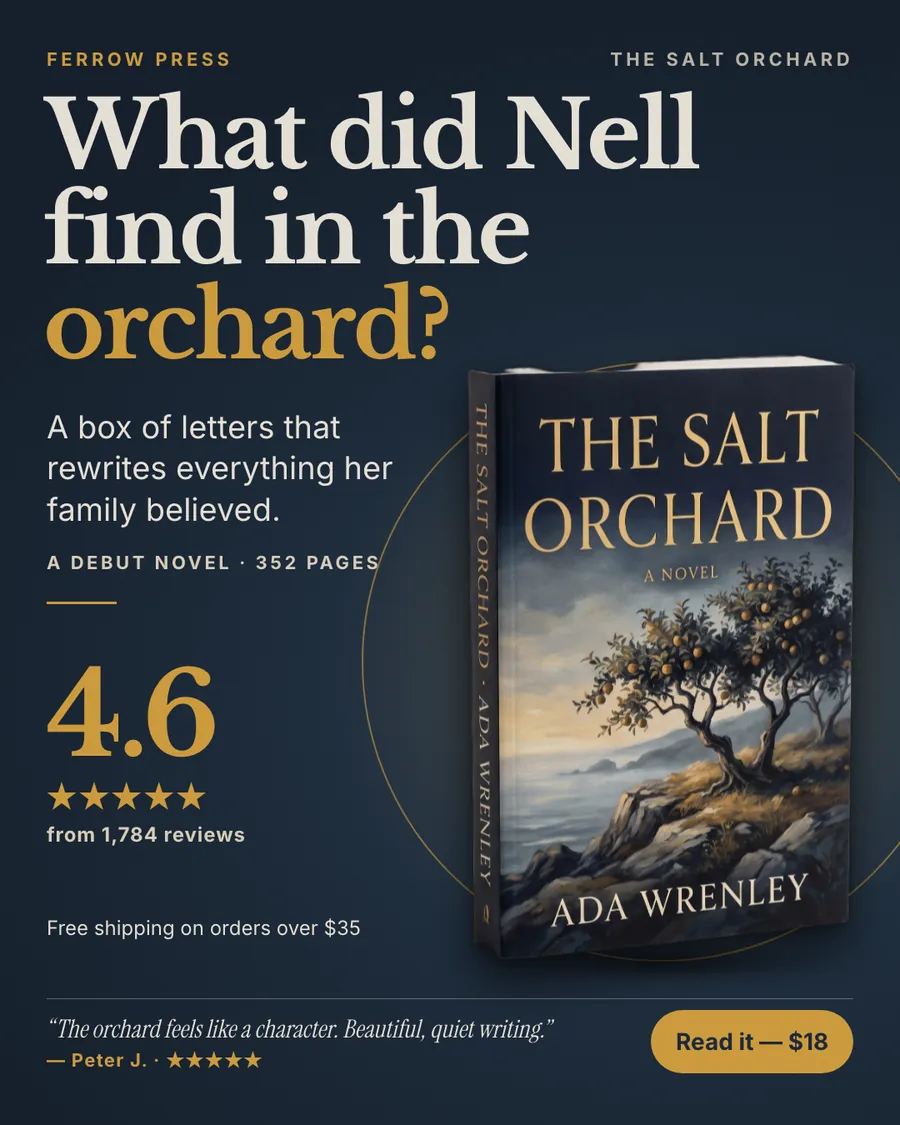
Question hookCuriosity
Ferrow Press: What did Nell find in the orchard?
Fictional sample brand · made by our engine
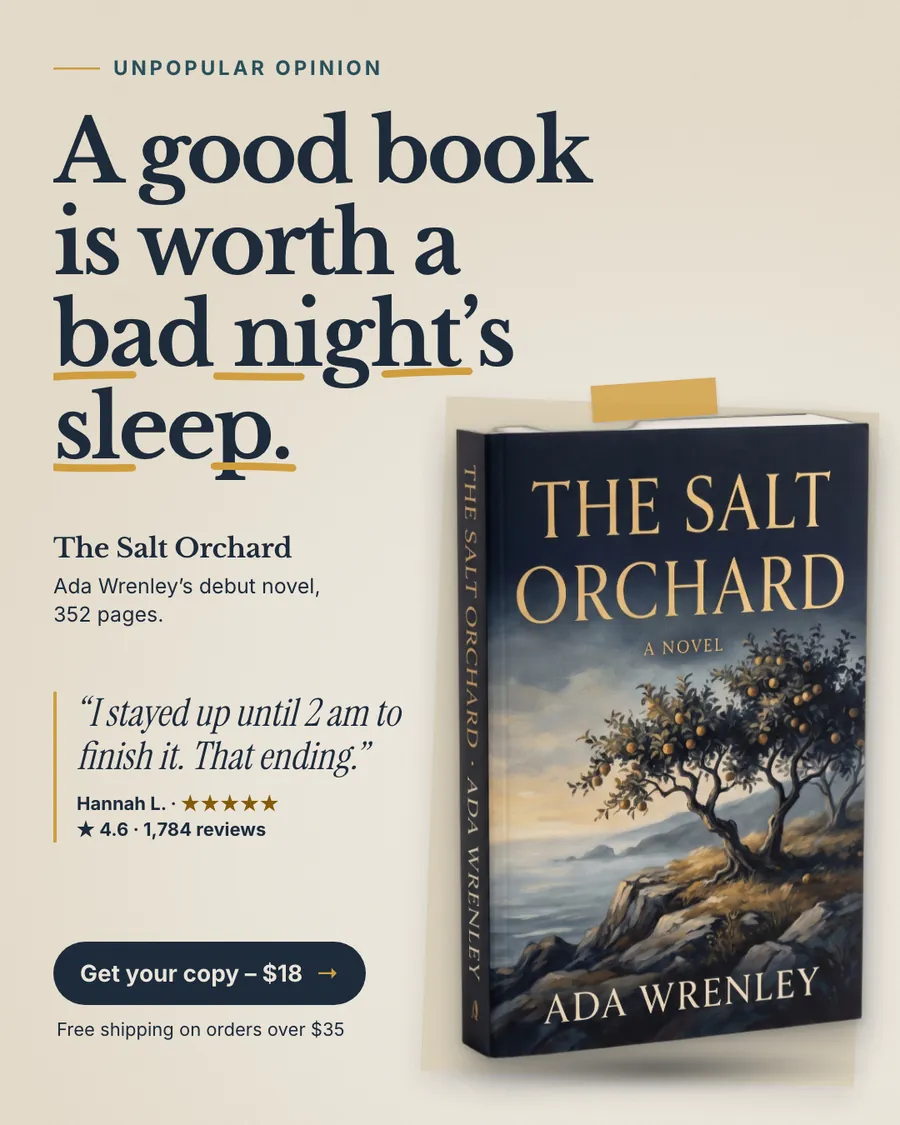
Unpopular opinionSocial proof
Ferrow Press: A good book is worth a bad night's sleep.
Fictional sample brand · made by our engine
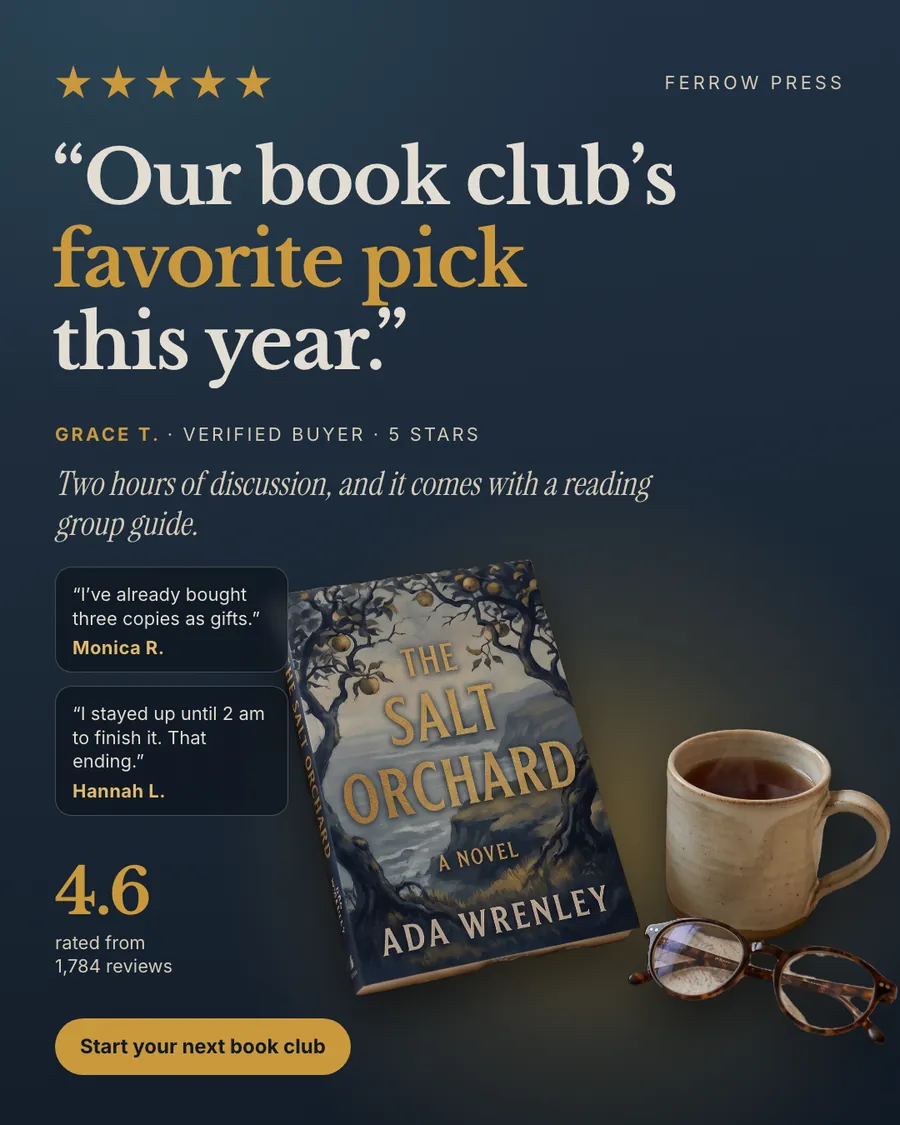
Review cardSocial proof
Ferrow Press: “Our book club’s favorite pick this year.”
Fictional sample brand · made by our engine
Words to be careful with
Books aren't a restricted category on the big ad platforms. The rules that catch book launches are about reviews, claims about sales, and the cover.
Free copies behind reviews
The FTC's endorsement guides treat a free or discounted product as a material connection that must be disclosed clearly and conspicuously, even if no review was required in return. Every early reader and creator who got a free copy should say so.
Source: 16 CFR 255.5: Disclosure of material connections (Cornell LII)
Asking for reviews
The FTC's review rule allows incentives only when there's no requirement, stated or implied, that the review be positive. Don't hint that a free copy depends on stars.
Source: FTC: The Consumer Reviews and Testimonials Rule, questions and answers (16 CFR 465)
"Bestseller"
"Bestseller" is an objective claim, so the FTC expects you to have a reasonable basis for it first: a list or ranking you can name, with its date. Without one, use a reader's words instead.
Source: FTC: Policy Statement Regarding Advertising Substantiation
Cover art on Meta
Meta's ad standards don't allow nudity or near nudity in ads, and imagery focused on individual body parts should target people over 18. A suggestive cover can stop a book ad, so test the cover before planning a launch around it.
Source: Meta Advertising Standards: Adult nudity and sexual activity
Amazon's book ad review
Amazon's guide for book advertisers says moderation looks at the book, the cover and the custom text, and lists customer reviews and prices among the things to avoid in that text. Decisions usually come within a day, but can take up to three business days.
Source: Amazon Ads: Ad moderation and approval, a guide for book advertisers
Preorders
Under the FTC's mail order rule you need a reasonable basis for any ship date you give, or for shipping within 30 days if you give none. If the release slips, ask buyers to accept the delay or refund them.
Source: FTC: Business Guide to the Mail, Internet, or Telephone Order Merchandise Rule
Rules checked . The sources are linked at the end of this page.
How often to refresh book ads, and what to measure
A book's ads tire faster than its readers do. The story has many doors in, so each new batch can lead with a different scene, character or reader instead of a new color.
Around launch, add two or three new ads every two weeks, each built on a different hook or a new reader quote. After the first two months, slow down to a monthly batch until gift season, then refresh weekly until your last shipping date.
Meta flags an ad "Creative limited" when it costs more per result than your past ads, and "Creative fatigue" at twice the cost. Its suggestion is a new ad with a materially different image or video, with the original kept running.
What to measure
- Cost per add to cart, by hook
- Tells you whether the story's question, a reader's reaction or the book club angle sells the book, long before purchases are many enough to compare.
- Copies per order
- The single number that decides whether ads can pay for themselves at book prices. Watch it rise when the bundle ads run.
- Reviews per week after launch
- Reviews keep both Meta and Amazon ads working. A drop is a sign to send more reader copies, with disclosures.
- Gift orders in December
- Shows how much the second season adds, and how early to start it next year.
Questions about advertising a book
How do I advertise a book on Amazon?
Use Amazon's sponsored ads on the book's own listing, for each format you sell. Write custom text that sells the story; Amazon's guide for book advertisers lists customer reviews and prices among things to avoid there. Moderation usually takes about a day and can take up to three business days.
Should a small press advertise on Facebook or Amazon first?
Run both if you can, because they catch readers in different moods. Facebook and Instagram find readers who weren't looking for a book yet; Amazon reaches people already browsing books. If you have to pick one, start where most of your copies are sold today.
How do I promote a book on Instagram and TikTok?
Send copies to a handful of reader creators whose taste matches the book, with no script, and ask each one to say the copy was free. Then use paid ads built on a single hook from the story, and reuse creators' posts only with their permission.
How do I set a budget for a book launch?
Start from what a copy earns after printing, shipping and fees. At paperback prices that is only a few dollars, so the budget depends on bigger orders, like two copies or a book club bundle. Begin small, compare hooks by add to cart, and save a share for gift season.
When should I start advertising a new book?
Paid ads usually start around release, once there are reviews to show. The work starts earlier: early reader copies about two to three months ahead, and a preorder page a month or so before. Plan a second push for November and December, when books become gifts.
Should I advertise the paperback, the ebook or the hardcover?
Advertise the format with the best margin per order and send each ad to that format's page. Ebooks suit readers who want to start tonight, the paperback suits clubs and gifts, and the hardcover suits gift season. Test them as separate ads rather than one ad for all three.
How do I advertise a Kindle ebook?
Amazon's own ads are the most direct route, because the click lands where the ebook is sold. Keep the custom text about the story, without prices or reviews. Outside Amazon, run Meta ads that link to the ebook page for readers who want to start right away.
Do book clubs really help sell a novel?
They can do more than any single ad, because one club's pick means several copies and a conversation that spreads. A free reading group guide and a bundle priced for a club make the organizer's choice easy.
How do I get early reviews without breaking the rules?
Give copies to readers who agree to post an honest review, never only a positive one, and ask each of them to say the copy was free. The FTC (the US consumer protection agency) treats a free product as a connection that must be disclosed, even when no review was required.
How long should a book ad campaign run?
As long as it pays for itself. Books sell over months and years, so a good ad can run well past launch with new creative every few weeks. Pause only what costs more than a copy earns, and keep the hooks that still sell.
Get the ads for this plan
Paste your store link and get 3 free ads of your own books: we read your products, prices and reviews, design around your real product photo and check every fact against your store.
Where to go next
- Book ad ideasSeven sample ads for a debut novel from an indie press: hooks, reader quotes, cover rules and the review rules authors miss.
- BooksBook ads from your book's own page: the real cover, the jacket hook, each format's price and reader reviews.
- How to advertise stationeryFor a small paper brand: bundles first, then Meta, paper reviewers and two seasons a year, with a budget that respects a $24 notebook.
- How to advertise giftsA plan for gift boxes and personalized gifts: ads for the giver, built backwards from each order-by date, with a budget for gift peaks.
- How to advertise an Etsy shopWhen Etsy Ads pay, what Offsite Ads really cost per order, and how Pinterest and video bring outside shoppers to your listings.
- Christmas ad ideasThe 2026 shipping cutoffs that set your ad calendar, six Christmas offers, copy lines and 16 sample ads for four stores.
- Black Friday ad ideasThe 2026 dates, six Black Friday offers and the products they suit, copy lines, and 16 sample ads for four stores.
- Ad creative testing on a small budget: an honest guideOne ad is a bet; fifty ads is a spray. Here is the middle path for small budgets: a few angles that disagree with each other, enough spend to read them, and a weekly loop that builds on what works.
- PricingFree preview, Lite $29/month for 9 designs a month (optional 2 weekly), Starter $49/month for 20. Meta and a 7-day trial from Growth.
Sources
Platform rules on this page were checked on against:
- Meta Business Help Center: About the learning phase
- Meta Business Help Center: About creative fatigue recommendations in Ads Manager
- 16 CFR 255.5: Disclosure of material connections (Cornell LII)
- FTC: The Consumer Reviews and Testimonials Rule, questions and answers (16 CFR 465)
- FTC: Policy Statement Regarding Advertising Substantiation
- Meta Advertising Standards: Adult nudity and sexual activity
- Amazon Ads: Ad moderation and approval, a guide for book advertisers
- FTC: Business Guide to the Mail, Internet, or Telephone Order Merchandise Rule
- 3 free ads, no signup
- Lite $29/month · 9 designs a month · optional 2 weekly
- Starter $49/month · 20 designs
- Growth $99/month, 7-day free trial
- Pro $149 · Scale $199
- 30-day money-back guarantee