how to advertise stationery business
How to advertise a stationery business without losing money on a $24 notebook
Stationery has a loyal, picky audience and a small price tag. Fountain pen users care about paper weight down to the gram, but one notebook leaves very little room for an ad cost. So this plan starts with the offer that makes the order bigger, then finds the paper people who care. It uses Penmoor Paper Co., a fictional notebook brand.
Updated · Budgets and examples use a fictional brand's numbers. Use yours.
In short
How do you advertise a stationery business?
Build an order worth advertising first, like a notebook and pens over your free-shipping line. Then run Meta ads that prove paper quality with ink tests and spec numbers, send samples to pen and paper reviewers, and put most of your budget into the two stationery seasons: planner season before January and back to school.
At a glance
- The hard part
- A low price, so one notebook barely covers an ad
- Fix it first with
- A bundle over the free-shipping line
- Where to start
- Meta, plus notebooks sent to paper reviewers
- The proof people want
- Ink tests, paper weight in gsm, lay-flat photos
- The two seasons
- Planners before January, school supplies before September
Which channels fit stationery, in the order to try them
Stationery buyers are hobbyists more than shoppers: they follow reviewers, compare paper specs and know exactly what bleed-through means. The channels that work reach those communities directly.
- 01
Meta (Instagram first)
Start hereWhy it fits
Journaling, planning and pen accounts are a big part of Instagram, and a close-up of fountain pen ink sitting crisp on the page is an ad that community stops for.
The trade-off
A $24 product makes each sale cheap to lose money on. Without a bundle, the learning phase math rarely works.
- 02
Paper and pen reviewers
Start hereWhy it fits
Notebook buyers trust ink tests by people they follow. Sending a notebook costs you a few dollars of product and postage, far less than a week of ads.
The trade-off
Reviews are honest, so a weak spot will show. Gifted reviews need a clear disclosure, and you need permission to run their photos as ads.
- 03
Pinterest
Add nextWhy it fits
People look for bullet journal spreads and planner setups on Pinterest, and plan the coming year's notebook there before January.
The trade-off
Pins about layouts drive clicks from people who want the idea, not always the notebook. Make the pin show your notebook, not just a pretty spread.
- 04
Etsy
Only if it fitsWhy it fits
Handmade journals, printable planners and custom notebooks have a ready audience searching on Etsy, and Etsy Ads keep spend inside that search.
The trade-off
Etsy's Offsite Ads take 15% of an attributed order (12% for shops past $10,000 a year), which hurts on a $24 item, and buyers stay Etsy's customers.
- 05
Amazon
Only if it fitsWhy it fits
"Dot grid notebook" and "A5 notebook fountain pen" are real searches there, and Sponsored Products put your notebook on them.
The trade-off
Price pressure from large notebook brands is heavy, and fees take a big bite out of a low-price item. You can't email those buyers about your planner.
- 06
Reddit
Add laterWhy it fits
Reddit has dedicated communities for notebooks, fountain pens and planners, and its ads can target people by the communities they're active in.
The trade-off
These communities dislike anything that feels like a pitch. Ads need to read like a fellow enthusiast's note, with specs, not slogans.
Sending notebooks to paper reviewers: a small seeding plan
Seeding is the stationery channel that costs least and teaches most. Keep it simple and honest:
- List 20 to 30 small creators who test paper: fountain pen reviewers, bullet journal accounts, planner YouTubers. Look for comments asking about paper, not just follower counts.
- Send the notebook with a short note on what's different (paper weight, binding, the index) and no script. Say plainly that a post isn't required.
- Ask anyone who posts whether you may reuse their photo or video as an ad, in writing, and for how long.
- Remind them that a gifted product needs a clear disclosure, and keep the disclosure when you run their content.
- Track who posted and what they tested. The details reviewers pick are the ones your ads should lead with.
Offers that work for stationery
On a low-price product, the offer decides whether advertising can pay at all, which is why it comes before the budget here. Aim for offers that raise the order, not ones that cut it.
A bundle over the free-shipping line
A notebook and pens, or a notebook and a pocket 3-pack, turns a $24 order into a $40 one and removes the shipping fee in one move.
A planner-season set
Before January, a planner with a matching notebook sells as a fresh start. Penmoor's undated planner avoids the leftover-stock problem of dated ones.
Student multi-packs
Back to school is about quantity and price per notebook. A multi-pack answers that better than a percentage off one notebook.
A sample page or paper swatch
Fountain pen users want to test before buying a stack. A free paper swatch with a first order, or a tester page on request, wins over the skeptics.
Watch: Make sure the swatch is the same paper as the notebook, or the test proves nothing.
How to size a starting budget for stationery ads
This is where stationery gets honest. Penmoor's notebook is $24; with the pens bundle most orders land at about $40, just over the $35 free-shipping line.
| Order value | $40.00 |
|---|---|
| Margin after product cost, shipping and fees | 50% |
| Most a first order can cost to break even | $20.00 |
| 50 purchases a week at that cost | $1,000 a week |
| The same budget per day | about $143 |
Meta says an ad set usually leaves its learning phase after about 50 results in the week after its last significant edit, and recommends a budget large enough to get enough results. Meta Business Help Center: About the learning phase
Even with the bundle, $20 of margin per order means a first order has to be cheap to win. That's why the offer comes before the budget on this page. A few ways to make the numbers work:
- Spend in the seasons. Planner season and back to school bring buyers who are ready to purchase. A higher budget for those weeks and a low one in between beats an even spread.
- Optimize for add to cart while volume is low. When an ad set can't get about 50 purchases a week, Meta suggests a more frequent optimization event.
- Count the next notebook only with data. Notebooks fill up and planners are yearly. If your own records show buyers come back, a first order can cost more; if not, it can't.
Reviewers are part of the budget too: twenty notebooks sent out is a small, fixed cost that often produces your best ad photos.
Your first 30 days advertising stationery
Start with a bundle, a few ads that prove the paper, and a short list of reviewers. Then put weight behind whatever the community responds to.
Days 1 to 3
Build the bundle and the proof photos
Set up a bundle that clears the free-shipping line (Penmoor: the $24 notebook plus the $14 pens, over $35). Photograph an ink test with three or four common pens, the notebook open flat, and the page number and index. Check a test order reaches Meta.
Days 4 to 8
Send 15 to 20 notebooks to reviewers
Pick small pen, journaling and planner creators whose audiences ask about paper. Send the notebook with a plain note: what makes it different, no script. Ask for permission to reuse photos if they post.
Days 6 to 12
Launch 6 Meta ads on 3 angles
Make two ads each for paper performance (an ink test, the gsm), the details (numbered pages, index, lay-flat binding) and community proof (reviews from paper people). Run them in one ad set, 4:5 and 9:16, pointing to the bundle.
Days 13 to 22
Hold steady and gather reviewer content
Don't touch the ad set while it learns. As reviewer posts arrive, note which pens and which details they picked; those are the questions your buyers care about.
Days 23 to 30
Turn the best review into ads
With permission, make 2 or 3 ads from the strongest reviewer photo or ink test, and pause the weakest original ads. If planner season or back to school is within six weeks, prepare those ads now.
Angles to test for stationery ads
Stationery buyers respond to specifics they can check. Penmoor's annotated sample ads and copy lines are on Stationery ad ideas; these are the angles this plan tests first.
Paper weight as a number
120 gsm. Fountain pens welcome.
The ink test
No bleed-through. Barely any ghosting.
The organized details
192 numbered pages and a 2-page index.
Opens flat
Lay-flat binding, so you write to the edge.
Paper people's words
"Fountain pen heaven."
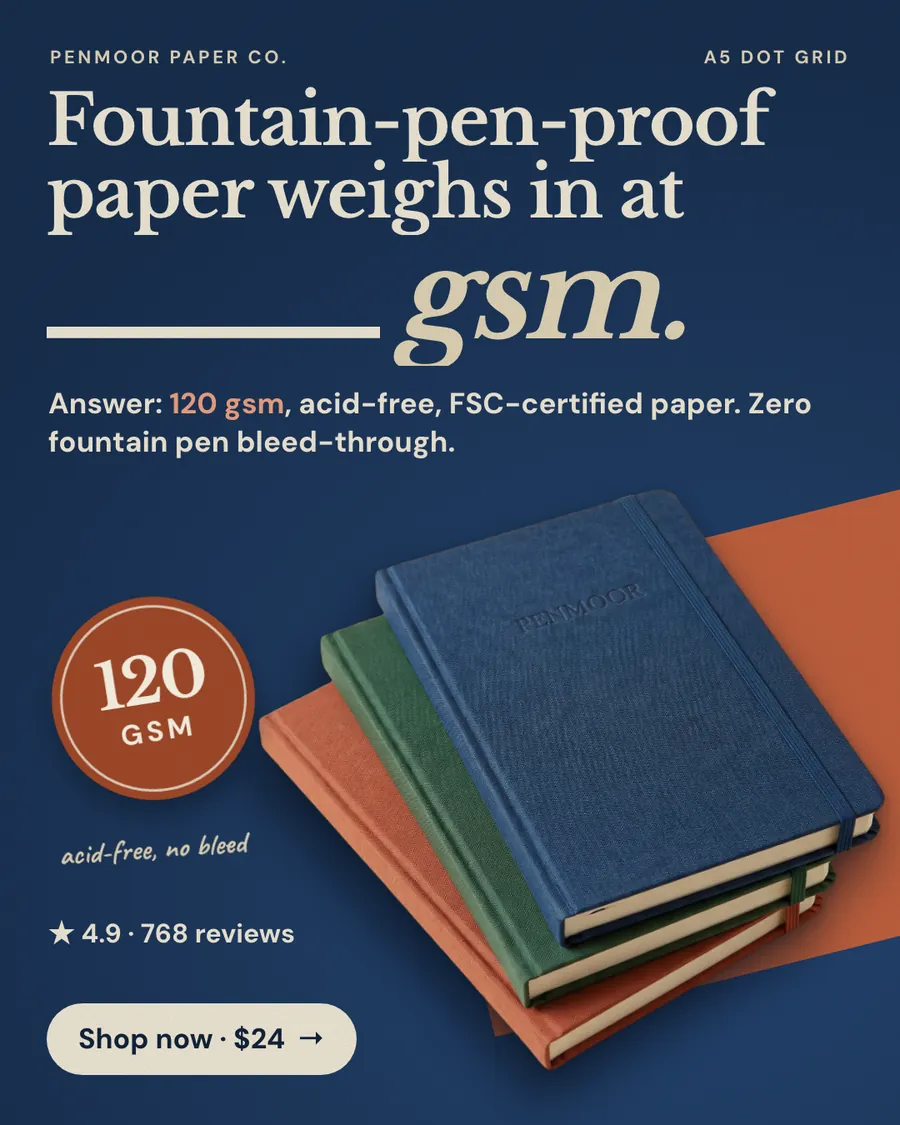
Fill in the blankCuriosity
Penmoor Paper Co.: Fountain-pen-proof paper weighs in at ___ gsm.
Fictional sample brand · made by our engine
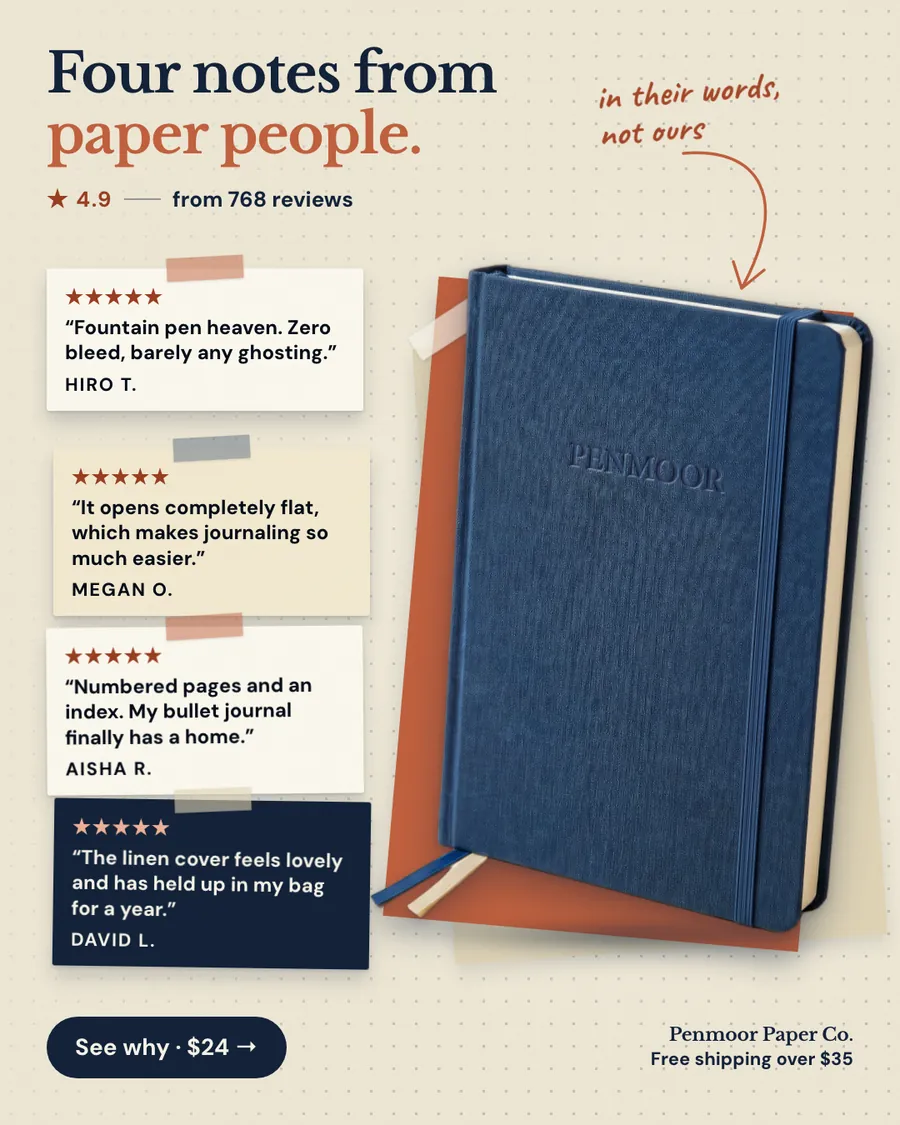
Review wallSocial proof
Penmoor Paper Co.: Four notes from paper people.
Fictional sample brand · made by our engine
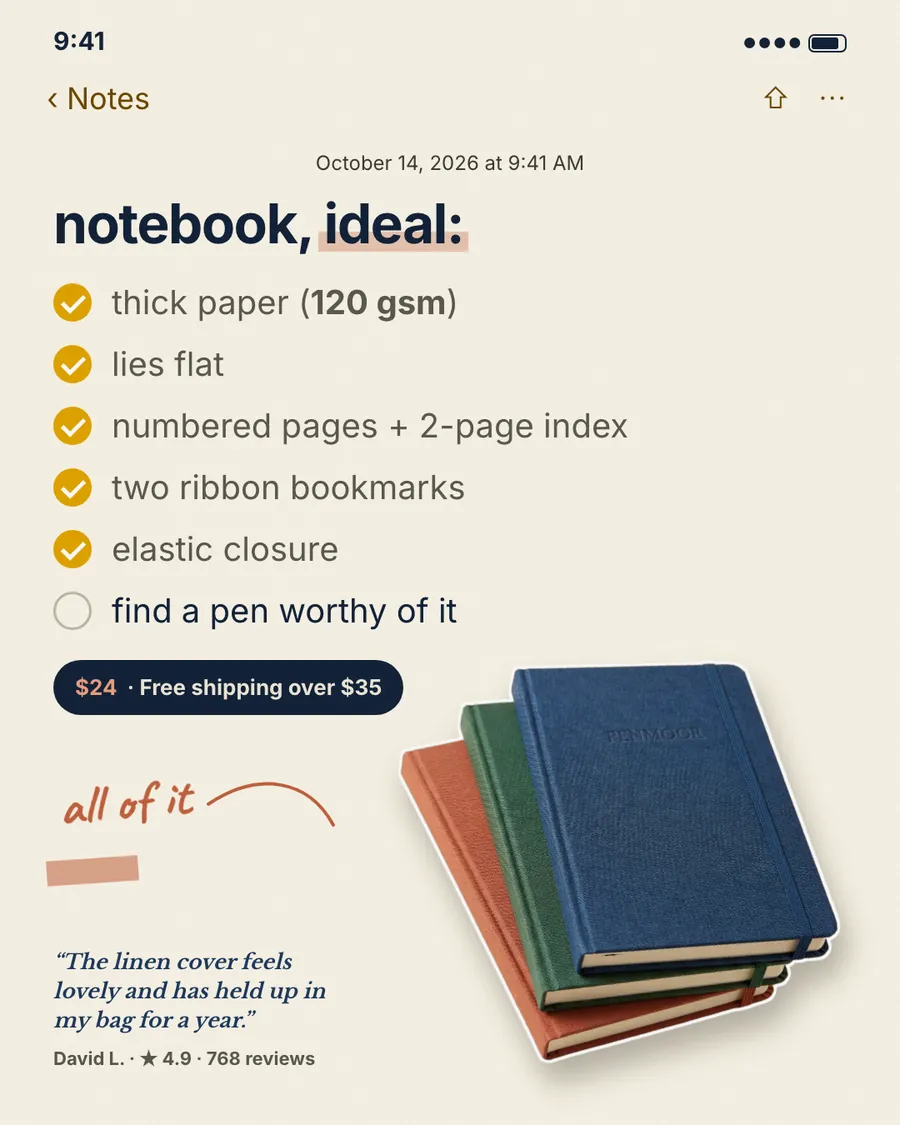
Notes-app listBenefit
Penmoor Paper Co.: notebook, ideal:
Fictional sample brand · made by our engine
Policy flags for stationery ads
Stationery isn't a restricted category on the ad platforms. The claims to watch are performance specs, sustainability words and anything that drifts into wellbeing.
Performance specs
"No bleed-through" and "fountain pen friendly" are factual claims. The FTC expects evidence behind ad claims, so test with the pens your buyers use and keep the test photos.
"Eco-friendly" and "sustainable"
The FTC's Green Guides treat broad green claims as hard to support and recommend naming the specific benefit instead, such as recycled content you can prove.
Source: FTC Green Guides, 16 CFR 260 (environmental marketing claims)
The FSC label
FSC says certified companies must have their FSC label and promotional uses approved by their certifier. If your paper is certified but your business isn't, check before the logo goes in an ad.
Planners for ADHD or anxiety
Meta doesn't allow ads that assert or imply a person's mental health condition, so describe the design (a daily brain-dump page) rather than the reader. Mental health outcomes need evidence under FTC health claim guidance.
Source: Meta Advertising Standards: Privacy Violations and Personal Attributes
Reviewer posts
A creator who got a free notebook has a material connection to you, and their post needs a clear disclosure under the FTC's Endorsement Guides. The same applies if you run their post as an ad.
How often to refresh stationery ads, and what to measure
A small niche sees your ads often, so stationery ads tire faster than the budget suggests. Reviewer content is your cheapest source of fresh creative.
Plan 2 or 3 new ads every two to three weeks, alternating between proof (a new ink test, a new pen) and community (a reviewer's photo, a customer's spread). Swap to seasonal sets about six weeks before January and before school starts.
In Ads Manager, "Creative limited" means an ad is costing more per result than your past ads and "Creative fatigue" means about twice as much. Meta recommends a materially different image; for paper, a new test or a new page layout counts, a new caption doesn't.
What to measure
- Order value and bundle share
- On a low-price product this decides whether ads can pay; watch it before cost per click.
- Cost per purchase in season vs out
- Tells you how much to shift into planner season and back to school next year.
- Reviewer posts per notebook sent
- A cheap channel only if enough reviewers actually post; drop the types of creator who never do.
- Repeat orders at six months
- Notebooks fill up slowly, so measure repeat buying over a longer window than for consumables.
Questions about advertising stationery
How do I advertise a stationery business online?
Make the order worth advertising first, with a bundle over your free-shipping line. Then run a few Meta ads that prove paper quality with ink tests and specs, send notebooks to paper reviewers, and spend most of your budget in planner season and back to school.
How do I advertise stationery on Facebook?
Use one Sales campaign with one ad set and about six ads: ink tests, close-ups of the binding and page numbers, and reviews from paper people. Point the ads at a bundle rather than a single notebook so each order can carry its ad cost, and let the ad set learn for a week before changing it.
How do I advertise notebooks on Amazon?
Start with Sponsored Products on your main notebook, with a title that names the size, ruling, paper weight and page count, and images that show an ink test and the notebook open flat. Expect strong price competition and higher fees, which matter on a low-price item.
How do I advertise stationery on Etsy?
Etsy Ads promote your listings inside Etsy search, which suits handmade journals, printables and custom notebooks. Offsite Ads add a fee of 15% on orders they bring in, or 12% for larger shops, so check that your margin on a low-price item can carry it.
How do I promote a stationery brand on Instagram?
Post the things paper people look for: ink tests, flat lays, page details and real spreads, and send notebooks to creators in the journaling and fountain pen space. When you advertise, reuse the photos that already get saves and comments, with the creator's permission.
How much should a stationery brand spend on ads?
Start from margin per order. With a typical bundle order around $40 and about half left after costs, a first order can cost about $20 before you lose money. That is tight, so most small stationery brands spend lightly between seasons and more in planner season and before school.
When should planner ads start for the new year?
Planner buyers start looking in autumn, so pins can go up in October and feed ads in November, running through the first weeks of January when people restart. Undated planners let you keep advertising after New Year without leftover dated stock.
Are reviews from pen and paper creators worth it?
For stationery, often more than ads at the start, because buyers trust ink tests from people they follow. Sending a notebook costs little. Gifted posts need a clear disclosure, and ask permission before using any creator photo as an ad.
How do I advertise a local stationery store?
Set up a free Google Business Profile with photos, hours and products, and run Meta ads with a radius around the shop showing what's new on the shelves. In-store events like pen testing or journaling nights give people a reason to come in, and a reason to post about you.
Get the ads for this plan
Paste your store link and get 3 free ads of your own stationery: we read your products, prices and reviews, design around your real product photo and check every fact against your store.
Where to go next
- Stationery ad ideasSeven sample ads for a fountain-pen notebook: paper weight, pen tests, layouts, build quality, and planner and school seasons.
- StationeryNotebook and planner ads that sell the inside: spreads, paper weight, format and lay-flat binding.
- How to advertise giftsA plan for gift boxes and personalized gifts: ads for the giver, built backwards from each order-by date, with a budget for gift peaks.
- How to advertise print on demand productsStart from what an order leaves after the supplier's cut, test designs on Meta, push sets over single tees, then add Pinterest and Etsy.
- How to advertise wall artPinterest and Instagram first, retargeting for people who take days to decide, pairs to lift order value, and print and edition rules.
- Ad creative testing on a small budget: an honest guideOne ad is a bet; fifty ads is a spray. Here is the middle path for small budgets: a few angles that disagree with each other, enough spend to read them, and a weekly loop that builds on what works.
- PricingFree preview, Starter $49/month, weekly plans from $99/month with a 7-day free trial, 30-day money-back guarantee.
Sources
Platform rules on this page were checked on against:
- Meta Business Help Center: About the learning phase
- Meta Business Help Center: About learning limited
- Meta Business Help Center: About creative fatigue recommendations in Ads Manager
- Meta Advertising Standards: Privacy Violations and Personal Attributes
- FTC Green Guides, 16 CFR 260 (environmental marketing claims)
- FTC Endorsement Guides, 16 CFR 255
- 3 free ads when your spot opens
- Starter $49/month
- Growth $99/month, 7-day free trial
- Pro $149 · Scale $199
- 30-day money-back guarantee