how to advertise swimwear
How to advertise swimwear: a plan for a small swim brand
Swimwear has a short selling season and a nervous buyer. Trying on a swimsuit is hard enough in a fitting room, let alone through a screen, ad platforms watch swimwear images closely, and most of the buying happens in the warm months. This plan works with all three, using the numbers of Sunmere Swim, a fictional brand making a ribbed one-piece from recycled nylon.
Updated · Budgets and examples use a fictional brand's numbers. Use yours.
In short
How should a small brand advertise swimwear?
Use the quiet months to collect fit proof on several real bodies and to test angles on a small budget, then spend most from spring into early summer. Lead ads with fit, fabric and an easy return, frame every person in a natural pose, and never write copy that judges how someone's body looks.
StoreToAds makes ready-to-post ads from your product photo, free to try.
At a glance
- The buyer's fear
- Will it fit my body, and will it stay put in the water?
- Where to start
- Meta (Facebook and Instagram), with the suit shown on more than one body type
- When to spend
- Most in spring and early summer, a little for winter travel
- The cost people forget
- Returns, which free return policies make more likely
- What gets ads rejected
- Close crops on body parts and copy about bodies
Which channels fit swimwear, in the order to try them
Swimsuits are bought for a moment: a trip, a pool season, a summer of swim lessons with the kids. The channels that work are the ones where buyers plan those moments and can see the suit on people who look like them.
- 01
Meta (Facebook and Instagram)
Start hereWhy it fits
A suit worn at a real pool, in motion, does what a flat lay (a photo taken from above, laid flat) can't. Reels and Stories let you show the fit from three angles in a few seconds, and broad targeting finds swim buyers without you guessing at interests.
The trade-off
Meta's nudity rules reach close crops on body parts, so a swimwear image can be limited where a dress wouldn't be. Natural poses and full-body framing avoid most of that.
- 02
Creators and try-on clips
Add nextWhy it fits
The question every buyer has is how the suit looks on a body like theirs. Five creators in five sizes answer it better than any size chart, and their clips can become your best ads.
The trade-off
Paid or gifted posts need a clear disclosure, and you need the creator's permission to run their video as an ad.
- 03
Pinterest
Add nextWhy it fits
People plan trips, honeymoons and pool seasons on Pinterest weeks ahead, which suits a product bought before the moment, not during it.
The trade-off
Saves turn into orders slowly, so judge it over a season rather than a week.
- 04
Email and SMS
Add nextWhy it fits
A new color, a matching cover-up or a restock in a sold-out size gives you reasons to write, and past buyers already know their size.
The trade-off
Swim buyers are seasonal, so a list that goes quiet from October to February needs a reason to stay subscribed.
- 05
Google Shopping
Add laterWhy it fits
Searches like "ribbed one-piece", "chlorine-resistant swimsuit" or "long torso swimsuit" are specific, and a Shopping ad puts the suit and the price on them.
The trade-off
Every size and color needs to be a clean variant in your product feed, and prices sit next to big retailers.
- 06
Amazon or Etsy
Only if it fitsWhy it fits
Etsy suits handmade or custom swimwear. Amazon reaches shoppers who buy a suit the week before a trip.
The trade-off
Both keep the customer relationship, and Etsy's Offsite Ads fee is 15% of an attributed order (12% from $10,000 of yearly sales). Returns on fit hit just as hard there.
Your first 30 days advertising swimwear
If your 30 days fall in winter, treat them as the test month: a small budget, many angles, and a library of fit proof ready for spring. If they fall in spring, the same steps apply with more budget behind them.
Days 1 to 3
Fix the fit page before any ad
List measurements for every size, the coverage at the seat, whether the cups are removable and what the lining is. Add the model's size and height to every photo, write the return steps in plain words, and check that a test purchase reaches Meta Events Manager.
Days 4 to 10
Shoot one suit on several bodies and launch
Photograph and film the hero suit on at least three people of different sizes, in water and out. Make six ads: two on staying put in motion, two on the fabric, two on fit with a buyer's own words. Keep all six together in a single Sales campaign aimed at a broad audience.
Days 11 to 17
Check what got limited, then hold still
Look at review status first. If an ad was rejected or limited, change the crop or the pose rather than appealing the same image. Then leave the rest alone and watch which angle earns orders.
Days 18 to 24
Read the returns and add Pinterest
Sort the first returns by reason: too small, too big, too much or too little coverage. Each one is a line to add to the page or the ad. Put the best try-on images on Pinterest in 2:3 for trip and pool planners.
Days 25 to 30
Write the season plan
Mark when your buyers start shopping, when new colors launch and when to stop ads for the year. Book creators for the spring push now, and set up a back-in-stock email for sizes that sell out.
How to size a starting budget for swimwear ads
Sunmere's numbers: most orders are one $98 one-piece, sometimes with the $78 cover-up. Free returns within 30 days help buyers commit, and they also mean some of those orders come back.
| Order value | $98.00 |
|---|---|
| Margin after product cost, shipping and fees | 40% |
| Most a first order can cost to break even | $39.20 |
| 50 purchases a week at that cost | $1,960 a week |
| The same budget per day | about $280 |
Meta says an ad set usually leaves its learning phase after about 50 results in the week after its last significant edit, and recommends a budget large enough to get enough results. Meta Business Help Center: About the learning phase
Think of that weekly budget as the spring and summer number. Spending it in December would mostly buy views from people who won't need a swimsuit for months.
- Take returns out of the margin. Each returned suit costs the ad, the shipping both ways and the restocking. Use your real return rate, not a hope.
- Spend in waves. A small steady budget in winter, then the bulk from spring into early summer, then taper. The same ads cost less to run when buyers are actually looking.
- Sell the set. A top and bottom, or a suit and cover-up, lifts the order value and the break-even (the point where the ads pay for themselves) with it.
- Optimize for add to cart if purchases are thin. When an ad set can't reach enough results, Meta suggests a more frequent event until sales build.
A swimwear year, month by month
The break-even above is the ceiling. The calendar decides how close to it you spend. A rough shape for a small swim brand selling in the US:
| When | What buyers are doing | What to run |
|---|---|---|
| November and December | Winter trips, gifts for travelers, Black Friday browsing | A small budget, cover-ups and gift cards, fit tests |
| January and February | Booking spring trips and cruises | New colors, trip-planning ads, Pinterest |
| March to May | Buying for spring break and the pool season | The main push: fit proof and try-on clips |
| June and July | Last-minute trips, a second suit | Sets and second colors for past buyers |
| August and September | Season winding down | Taper, clear old colors, grow the email list |
| October | Mostly travelers to warm places | Lowest spend; plan next year's shoots |
Offers that work for swimwear
The best swimwear offers lower the risk of a bad fit. A discount on a suit that may not fit doesn't fix the reason people hesitate.
Free returns with a clear window
Sunmere's 30-day free returns answer the fit fear in one line, and putting the window in the ad shows it is real.
Watch: Price the returns into your margin before you advertise them as free.
Mix-and-match sets
Selling top and bottom separately lets buyers pick two sizes, which cuts returns. Sunmere's top is $58 and the bottom $52.
Free shipping over a set's price
Sunmere sets its free shipping line at $75, so one suit or a top and bottom clears it.
A matching cover-up
It turns a suit into a trip outfit and raises the order value without any discount.
Angles to test for swimwear ads
Each angle answers one reason people put off buying a swimsuit. The full set of sample ads, copy lines and photo notes is on Swimwear ad ideas; here are the angles this plan tests first.
It stays put
Why does this one-piece stay put mid-cannonball?
Proof from many buyers
4.7 stars from 1,938 reviews, in sizes XS to 3XL.
The fabric survives the pool
Chlorine-resistant color that holds up all summer.
Your usual size
"Ordered my usual size and it fit."
Made for the trip
One suit, one cover-up, packed in a corner of the bag.
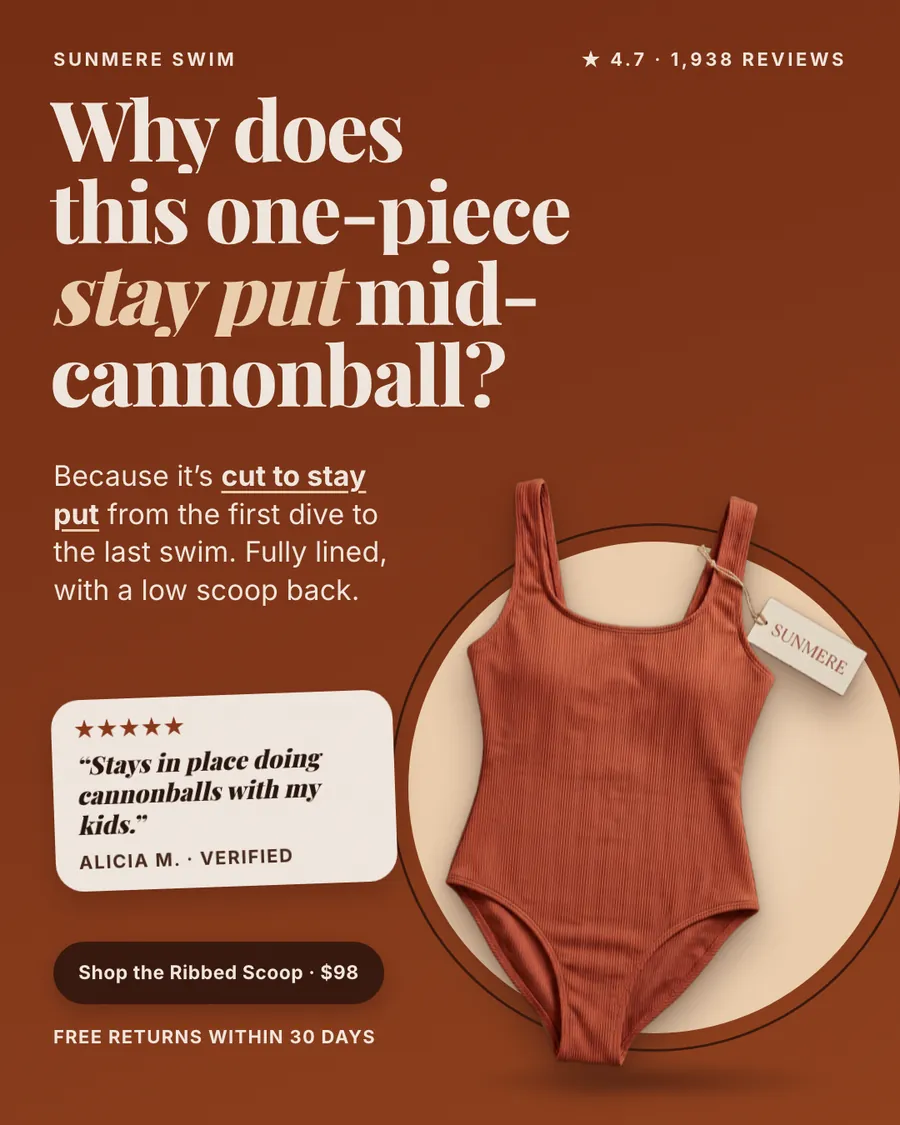
Question hookFit
Sunmere Swim: Why does this one-piece stay put mid-cannonball?
Fictional sample brand · made by our engine
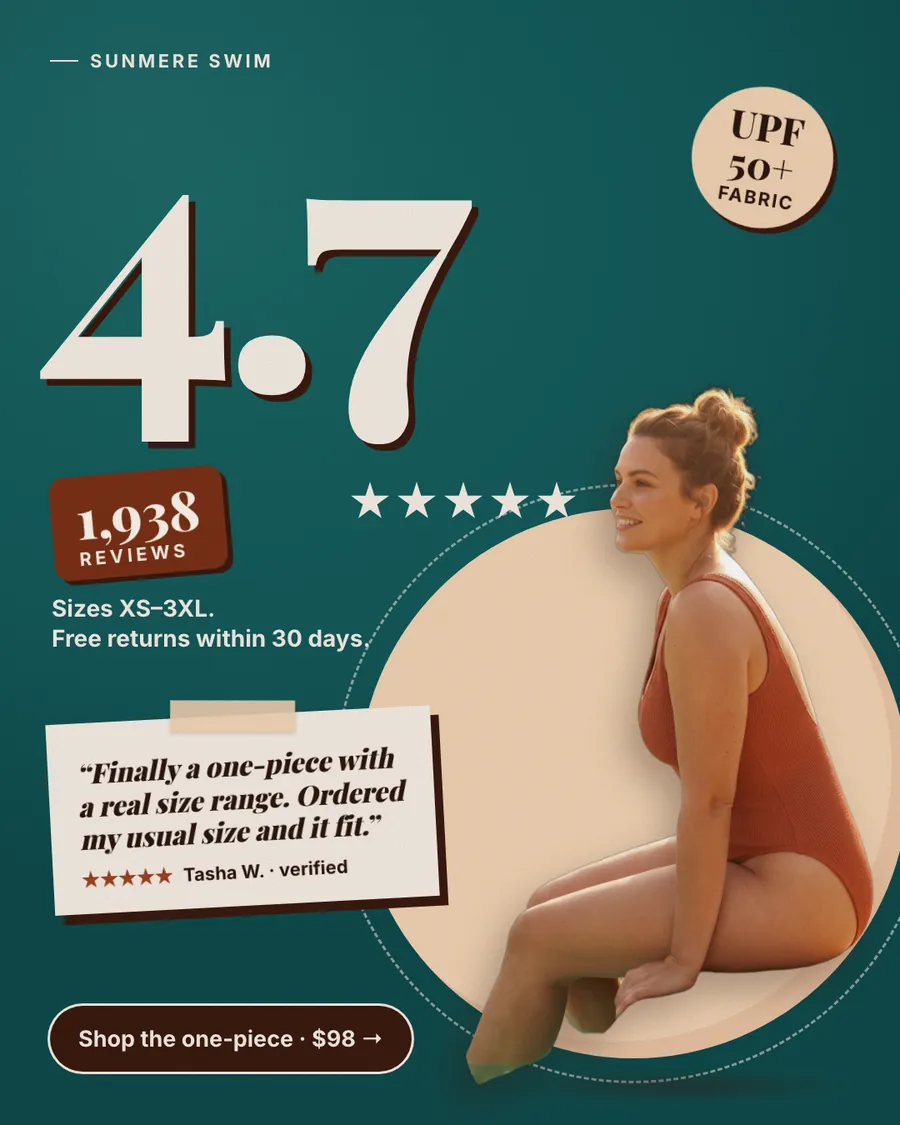
Big numberSocial proof
Sunmere Swim: 4.7 stars. 1,938 reviews.
Fictional sample brand · made by our engine
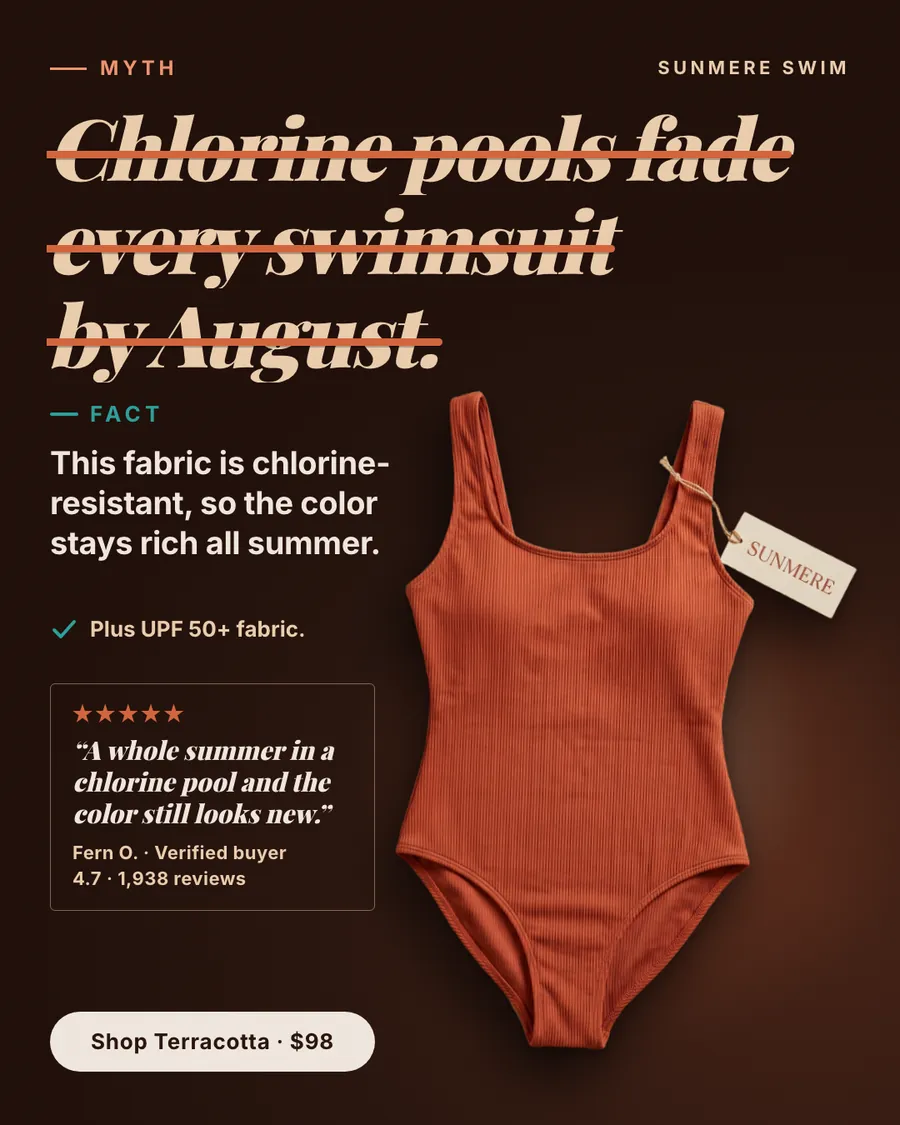
Myth vs factDurability
Sunmere Swim: Chlorine pools fade every swimsuit by August.
Fictional sample brand · made by our engine
Words to be careful with
Swimwear is allowed on the big ad platforms, but it sits close to two sets of rules: what an image may show, and what copy may say about bodies. Material and sun claims need proof too.
Crops that focus on a body part
Meta's ad policy bars nudity and near nudity, and says photorealistic images focused on individual body parts such as the buttocks or breasts should target people over 18. Show the whole suit on a person in a natural pose rather than a tight crop.
Source: Meta Advertising Standards: Adult Nudity and Sexual Activity
Copy that judges bodies
Meta's health and wellness policy doesn't allow statements of inferiority about physical appearance, and its personal attributes rule bars copy that asserts things about the viewer's body or health. "Hide your tummy" and "Not bikini ready?" are out; "Fully lined, with removable cups" is fine.
"Slimming" and "tummy control"
Meta's weight loss rules say ads can't claim results come solely from wearing a product. Describe the construction, like a lined front panel, instead of promising a smaller body.
UPF 50+
ASTM D6603 bases UV-protection labels on test data from instruments, and keeps medical-device sun-protective clothing out of its scope; those follow FDA guidance. Keep the test report for any UPF number, and don't stretch it to "prevents skin cancer".
"Recycled" fabric
The FTC's Green Guides allow an unqualified "recycled" only when the whole product is recycled, apart from minor parts. A suit made from 78% recycled nylon should say 78%, not "made from recycled materials".
Rules checked . The sources are linked at the end of this page.
How often to refresh swimwear ads, and what to measure
Swimwear ads wear out fastest exactly when you need them most: in the spring push, when budgets rise and the same buyers see your ads daily.
In the quiet months, two or three new ads a month is plenty. From spring into early summer, plan a new batch every week or two: a new color, a new creator, a new setting. Have the shoots done before the season starts, not during it.
Two labels in Ads Manager (Facebook's tool for running ads) tell you when: "Creative limited" for an ad whose cost per result has crept above your earlier ads, and "Creative fatigue" once that cost has doubled. Meta's advice is a new ad with a materially different image or video, which for swimwear usually means a new body, place or color.
What to measure
- Cost per purchase after returns
- The only cost per order that counts in swimwear. An ad that sells many suits that come back is weaker than it looks.
- Return reasons by size
- Tells you which size notes, photos or fit lines to fix before the busy months.
- Rejected or limited ads
- A pattern of limits shows which crops or poses the review system reads as too revealing, before it costs the season.
- Sets and add-ons per order
- The easiest way to raise the break-even, and a sign your trip and outfit angles work.
Questions about advertising swimwear
How do I start advertising a swimwear brand?
Start by fixing the fit page: measurements for every size, coverage notes and easy returns. Then shoot your best suit on several body types and run six Meta ads, each with a different reason to buy. Keep the budget small until you know which angle sells, then spend most in spring.
When should a swimwear brand advertise?
Most demand comes from spring into early summer, so that is where most of the budget belongs. Winter is useful for testing angles, reaching people booking warm trips and building fit proof. Use your own sales history to set the dates once you have one.
Why do swimwear ads get rejected on Facebook and Instagram?
Usually because of the image or the copy. Meta's nudity policy covers images focused on individual body parts, and copy that comments on the viewer's body breaks its rules on appearance and personal attributes. Natural poses, full framing and copy about the suit, not the body, avoid most rejections.
How much should a new swimwear brand spend on ads?
Work out what a first order can cost: order value times the margin left after the suit, shipping, returns and fees. Meta says an ad set usually leaves learning after about 50 results in a week. Most small brands spend well below that in winter and closer to it in spring.
Should I sell swimwear on Amazon or my own site?
Your own site keeps the customer and the email address, which matters for a seasonal product you want to sell again next year. Amazon can reach last-minute buyers, but it takes fees, keeps the relationship and still sends back the suits that don't fit.
How do I show plus-size swimwear in ads without problems?
Show the suit on people across your whole size range, in the same natural poses and framing you use for every size. Write copy about the cut, the support and the fabric. Avoid any line that suggests a body needs hiding or fixing.
Do swimwear ads need to target people over 18?
Not by default, but Meta says photorealistic images focused on individual body parts should target people over 18. Full-length images of a suit worn in a natural pose don't fall under that line, which is another reason to avoid tight crops.
Are creators worth it for a small swim brand?
Often, because the main question is how a suit looks on a body like the buyer's, and creators of different sizes answer it. Brief them on the angle your own ads proved, get permission to run their clips as ads, and make sure every paid post is clearly disclosed.
How do I cut swimwear returns with ads?
Answer the return reasons before the order: the model's size on every photo, coverage notes, cup details and a clear note on how the size runs. Selling tops and bottoms separately helps too, since many buyers need two sizes.
Get the ads for this plan
Paste your store link and get 3 free ads of your own swimwear: we read your products, prices and reviews, design around your real product photo and check every fact against your store.
Where to go next
- Swimwear ad ideasSeven sample ads for a ribbed one-piece that sell fit, fabric and size range, plus Meta's image rules for swimwear in plain words.
- ClothingApparel ads that answer the fit question: fabric, size range and on-body photos from your store.
- How to advertise a clothing brandOne hero product, fit proof on real bodies, returns counted before the budget: a first-month ad plan for a small clothing brand.
- How to advertise sunglassesTry-on video on Meta and TikTok first, Shopping for style searches, frame measurements in every ad and lens claims you can prove.
- How to advertise body butter and body careA body butter brand's plan: Meta and TikTok for texture, a duo that clears free shipping, a reorder note at two months, and the itch claims to drop.
- Black Friday ad ideasThe 2026 dates, six Black Friday offers and the products they suit, copy lines, and 16 sample ads for four stores.
- Instagram Story ad examples12 Instagram Story ads at the real 9:16 shape, with Meta's safe zone you can switch on and notes on each.
- Pinterest ad sizePinterest ad sizes, checked November 2026: 2:3 at 1000 x 1500, file limits, titles and carousel specs.
- PricingFree preview, Lite $29/month for 9 designs a month (optional 2 weekly), Starter $49/month for 20. Meta and a 7-day trial from Growth.
Sources
Platform rules on this page were checked on against:
- Meta Business Help Center: About the learning phase
- Meta Business Help Center: About creative fatigue recommendations in Ads Manager
- Meta Advertising Standards: Adult Nudity and Sexual Activity
- Meta Advertising Standards: Health and Wellness
- Meta Advertising Standards: Privacy Violations and Personal Attributes
- ASTM D6603-19: Labeling of UV-Protective Textiles
- 16 CFR 260.13: Recycled content claims
- FTC: Threading Your Way Through the Labeling Requirements Under the Textile and Wool Acts
- Etsy: Fees & Payments Policy
- 3 free ads, no signup
- Lite $29/month · 9 designs a month · optional 2 weekly
- Starter $49/month · 20 designs
- Growth $99/month, 7-day free trial
- Pro $149 · Scale $199
- 30-day money-back guarantee