how to advertise snacks
How to advertise snacks when one bag costs less than the ad
A snack is cheap, eaten in minutes and bought again and again by the people who like it. That makes the first order hard to pay for and the fifth order easy. A snack ad plan is built around that gap. The example throughout is Saltpeak, a fictional brand of crunchy roasted chickpeas.
Updated · Budgets and examples use a fictional brand's numbers. Use yours.
In short
What is the best way to advertise snacks?
Show the snack in a moment people already have, like the desk drawer or the hiking bag, with one fact from the label on the ad. Run a few Meta ads at a multi-pack that clears free shipping, then win the second order with a subscription or email timed to when the bags run out.
StoreToAds makes ready-to-post ads from your product photo, free to try.
At a glance
- The hard part
- A $24 pack leaves little room to pay for a new customer
- Where the profit is
- The second, third and fourth order
- Where to start
- Meta (Facebook and Instagram) ads pointing at a multi-pack that ships free
- Words with rules
- Good source, high, healthy and gluten-free are defined by the FDA
- The reorder clock
- Six 5 oz bags is 30 one-ounce servings: about a month at one a day
Which channels fit snacks, in the order to try them
Snacks are bought on taste, texture and habit. The first channel has to make a stranger curious enough to try a bag; every channel after it should make the second order automatic.
- 01
Meta (Facebook and Instagram)
Start hereWhy it fits
A bag open on a desk, a handful in a lunch box or a pouch in a trail pack shows the moment and the product in one image. Meta finds the snackers; you supply the moment.
The trade-off
A single pack can't carry much ad cost. Without a basket that clears free shipping, even a good ad can lose money on every order.
- 02
Subscriptions and email
Add nextWhy it fits
A snack runs out on a schedule you can calculate. A subscription offer, or an email just before the bags run low, wins the reorder without paying for an ad again.
The trade-off
It only works after the first order, and a subscription needs easy pause and cancel or it creates refunds.
- 03
TikTok
Add nextWhy it fits
Taste tests and first-bite reactions are a natural format there, and a loud crunch carries well in short video.
The trade-off
It needs fresh clips every week, from you or from creators, and paid creator posts need clear disclosure and permission to reuse.
- 04
Amazon
Only if it fitsWhy it fits
Plenty of people buy pantry snacks there out of habit, and a listing catches searches for your kind of snack.
The trade-off
Fees and price comparison squeeze a low-price pack, and those buyers never join your email list, so the reorder belongs to Amazon.
- 05
Google Shopping
Add laterWhy it fits
Some shoppers search by the snack itself, like "roasted chickpeas" or "high protein snack", and a Shopping ad shows your pack and price on that search.
The trade-off
Branded grocery products sell for less, so list the multi-packs, keep shipping costs honest, and judge it by orders, not clicks.
- 06
Offices, gyms and cafes
Only if it fitsWhy it fits
A box on an office shelf or a gym counter puts the snack in front of the same people every day, which ads can't afford to do.
The trade-off
Wholesale prices cut the margin, and it is sales work, not advertising. Do it once the direct orders are steady.
Your first 30 days advertising snacks
Month one should answer two questions: which snacking moment makes strangers buy, and how many first buyers come back on their own.
Days 1 to 3
Put the label facts and the basket on the page
Show the protein, fiber, calories, ingredients and allergen statement as they appear on your label, and make the pack that clears free shipping the first choice. Test a purchase so you know it lands in Meta Events Manager.
Days 4 to 10
Launch 8 ads on four moments
Two ads each for the desk drawer, the trail or gym bag, the after-school kitchen and the crunch itself. Give every ad one label fact. Keep them in a single Sales campaign, broad audience, 4:5 and 9:16, pointing at the multi-pack.
Days 11 to 17
Let it learn, then read by moment
No edits for a week. Then rank the four moments by cost per purchase and note which flavor people pick when they land on the page.
Days 18 to 24
Ask for the reorder before the bags run out
At one serving a day, a 6-pack of 5 oz bags lasts about a month. Email first buyers around week three with the subscription and the flavor they haven't tried. Add two new ads on the winning moment.
Days 25 to 30
Try creators, and plan the next moments
Send packs to a handful of creators who already post about lunch, hiking or the gym, and ask to run their best clip as an ad. Then line up ads for the next snacking moments on your calendar, such as road trips, game days or back to school.
How to size a starting budget for snack ads
Cheap products make expensive customers. Saltpeak's 6-pack is $24 and free shipping starts at $40, so its ads aim at the Variety 12-pack, $45, which clears the line on its own.
| Order value | $45.00 |
|---|---|
| Margin after product cost, shipping and fees | 40% |
| Most a first order can cost to break even | $18.00 |
| 50 purchases a week at that cost | $900 a week |
| The same budget per day | about $129 |
Meta says an ad set usually leaves its learning phase after about 50 results in the week after its last significant edit, and recommends a budget large enough to get enough results. Meta Business Help Center: About the learning phase
Eighteen dollars per new customer is not much, which is why snack brands rarely profit on the first order. The plan works when the first order is big enough to ship and the second one comes without paying for another ad.
- Optimize for add to cart while orders are few. Short of about 50 purchases a week, Meta's advice is to pick an event that happens more often. Move to purchases once orders are steady.
- Let reorders raise the ceiling, with proof. Only let a first order cost more than its margin once your own records show how many buyers come back and when.
- Never send cold ads to a single pack. A $24 order that ships at your cost is where snack budgets disappear.
The serving math behind the reorder
Saltpeak's label serving is 1 oz and its bags hold 5 oz, so each bag is about five servings. That turns every pack into a date you can plan an email around:
| Pack | Price | Servings | Per serving | Clears $40? | Lasts at one a day |
|---|---|---|---|---|---|
| Sea Salt 6-pack | $24 | 30 | $0.80 | No | About a month |
| Two 6-packs | $48 | 60 | $0.80 | Yes | About two months |
| Variety 12-pack | $45 (was $48) | 60 | $0.75 | Yes | About two months |
A household where two people snack daily finishes a 6-pack in about two weeks. Send the reorder email before the last bag, not after it.
Offers that work for snacks
A snack offer should make the first box bigger or the next one automatic. A discount on one pack mostly lowers a margin that was already thin.
A variety pack for first orders
Trying an unknown flavor is the risk; a mix removes it. Saltpeak's Variety 12-pack is $45 against $48 before, and it clears free shipping by itself.
Watch: The earlier price has to be one you really charged, for a real stretch of time.
Free shipping above the multi-pack price
A line just above a single pack pushes people to the basket your ads can afford.
Subscribe for the next delivery
A delivery that arrives as the last bag empties beats any reminder, and it turns a one-time buyer into a steady one.
Watch: Show the price, how often it ships and how to cancel before checkout, and make cancelling simple.
The second flavor at the reorder
Someone who finished the sea salt bags is the right person to try smoky BBQ, at the moment they need more anyway.
Angles to test for snack ads
Every snack ad needs a moment and a fact. Crunch shots, label call-outs and ready lines are collected on Snack ad ideas; the four weeks above pit these angles against each other.
The myth the crunch breaks
MYTH: Chickpeas can't crunch like chips.
A label you can read
Three ingredients: chickpeas, olive oil, sea salt.
The number that answers hunger
6 g of plant protein in a 1 oz serving.
The moment it disappears
Your desk drawer won't stay full.
A customer's use
"Perfect for my hiking bag. The bags reseal really well."
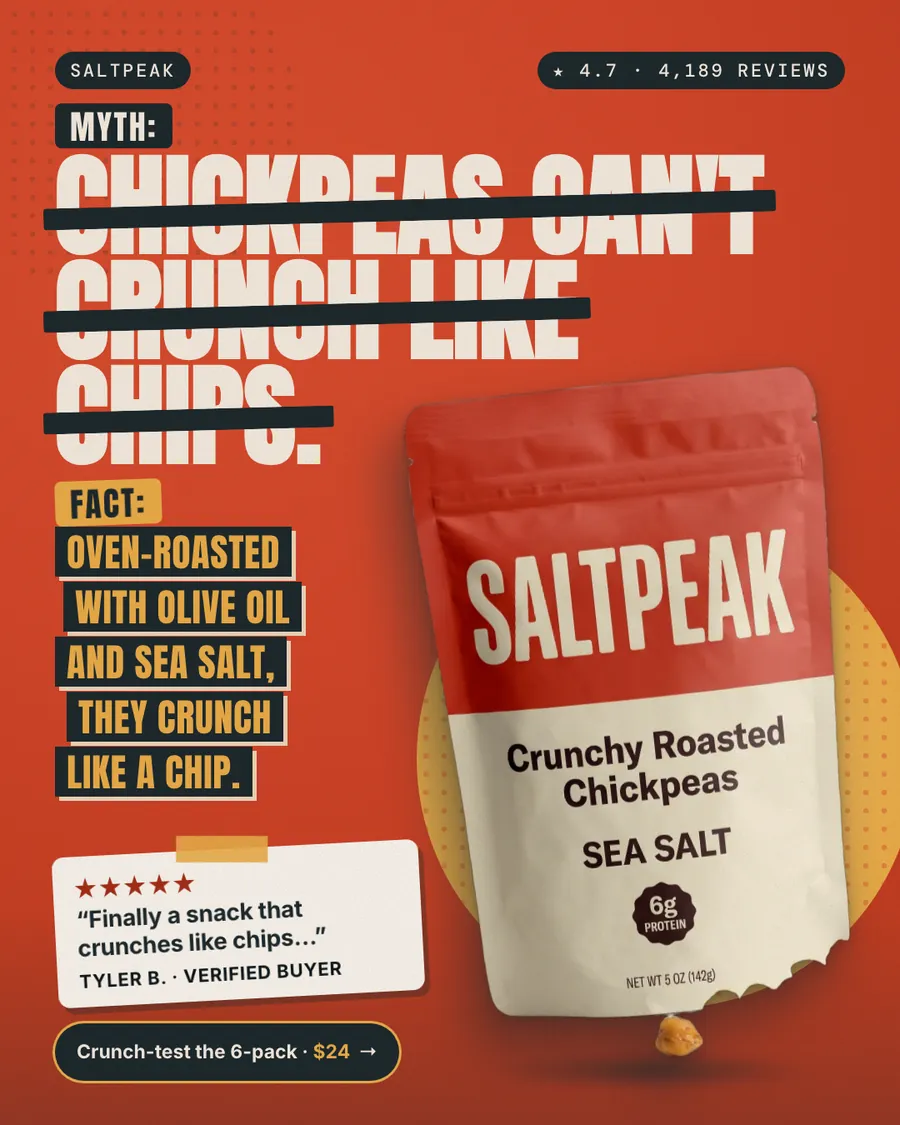
Myth vs factBenefit
Saltpeak: MYTH: Chickpeas can't crunch like chips.
Fictional sample brand · made by our engine
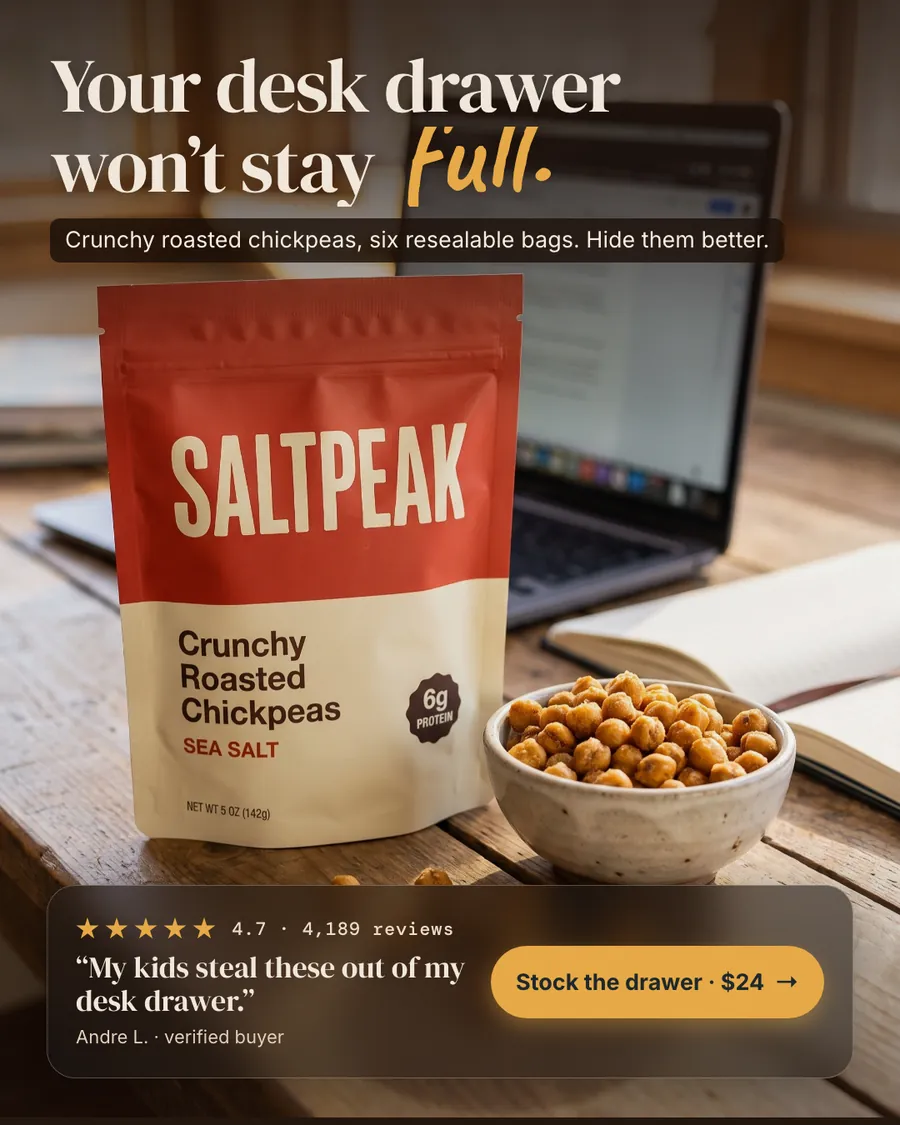
Lifestyle typeRitual
Saltpeak: Your desk drawer won't stay full.
Fictional sample brand · made by our engine
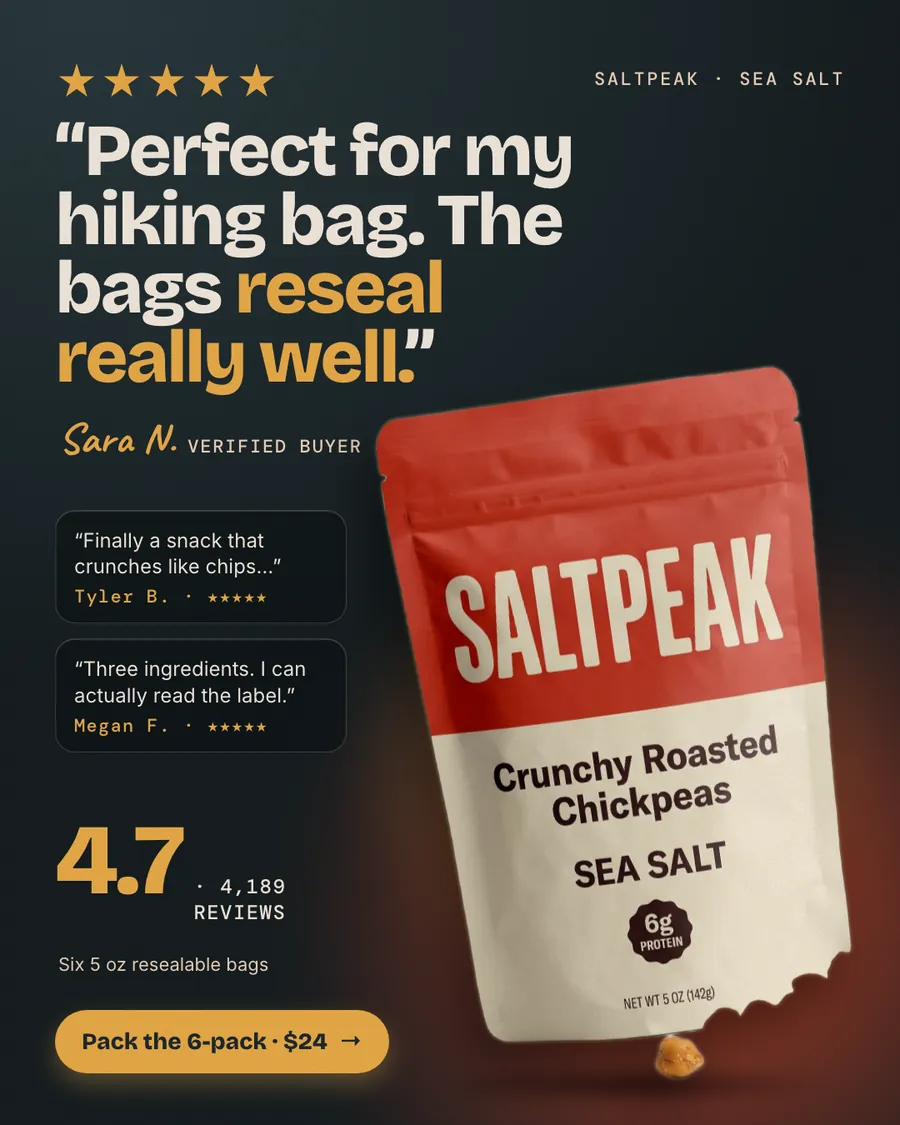
Review cardSocial proof
Saltpeak: "Perfect for my hiking bag. The bags reseal really well."
Fictional sample brand · made by our engine
Words to be careful with
Snacks aren't restricted on Meta or Google. The trouble is the label words: many of the ones snack ads lean on have exact federal definitions, and an ad shouldn't promise more than the label may.
"Good source of protein" and "high fiber"
Under 21 CFR 101.54, "good source" means 10 to 19 percent of the daily value per reference amount, and "high" means 20 percent or more. Work out the percent from your own label before using either phrase; grams alone don't settle it.
Source: 21 CFR 101.54: Nutrient content claims for good source, high and more
"Healthy"
The FDA's updated rule, announced December 19, 2024, requires a minimum from a food group plus limits on added sugars, saturated fat and sodium. For an individual food the sodium limit is 230 mg per reference amount, so a salted snack can miss it.
"Gluten-free"
Food labeled gluten-free, "no gluten", "free of gluten" or "without gluten" must contain less than 20 parts per million of gluten. The ad makes the same promise as the label.
Source: FDA: Gluten and food labeling
"Nut-free" and allergens
The FDA lists nine major allergens, sesame among them. A line like "made in a nut-free facility" must be true of the whole facility, and FDA says may-contain statements are voluntary, not a stand-in for good manufacturing practice.
Source: FDA: Food Allergies
Google Shopping and young audiences
Google's policy for high fat, sugar and salt food applies to Shopping ads only: those ads may not target minors, and nutritional thresholds decide which products count. Check your products against them before aiming Shopping ads at families.
Source: Google Merchant Center: High fat, sugar, salt food and beverage (Shopping)
Rules checked . The sources are linked at the end of this page.
How often to refresh snack ads, and what to measure
Snack ads wear out quickly because the people most likely to buy see them most. Keep the label fact, change the moment around it.
Plan two or three new ads every two to three weeks: a new moment, a new flavor or a new customer line, each with a different photo. Around launches and big eating days, refresh weekly while spend is up.
Meta labels an ad "Creative limited" once it costs more per result than your past ads, and "Creative fatigue" once it costs twice as much. Its advice is a materially different image or video, so swap the scene, not just the headline.
What to measure
- Cost per first purchase, by moment
- Shows which snacking moment to build the next ads around.
- Share of orders that clear free shipping
- If most orders don't, fix the basket before spending more on ads.
- Reorders within 45 days
- A 6-pack lasts about a month at one serving a day, so this is the window that shows whether people come back.
- Subscription cancels in the first two deliveries
- Early cancels mean the offer or the delivery timing is off, not the snack.
Questions about advertising snacks
How do I start advertising a snack brand?
Make the multi-pack that ships free the default on your product page, then run about eight Meta ads in one campaign, each built on one snacking moment and one label fact. Leave them for a week, keep the moment that sells, and email first buyers before their bags run out.
How do I promote a snack business with a small budget?
Spend on the cheapest wins first: a clear label on the product page, a pack that clears free shipping, a reorder email and samples to a few creators. Then run a small Meta test and optimize for add to cart until purchases are frequent enough to learn from.
How much does a snack brand need to spend on ads?
Multiply your usual order by the margin left after ingredients, packaging, shipping and fees. That is your break-even (the point where the ads pay for themselves) cost per new customer. Meta's learning phase (Facebook's first days of testing who to show the ad to) looks for about 50 results a week, which many small brands can't fund at first, so they start on a more frequent event.
Should I sell my snacks on Amazon or on my own site?
Start on your own site, where you keep the customer and can ask for the reorder. Add Amazon later if your buyers expect it, knowing that fees take a big share of a low-price pack and the reorder there belongs to Amazon.
Are TikTok ads good for snacks?
They can be, because taste tests and crunch sounds suit short video. The catch is volume: TikTok needs new clips every week. Many small brands start on Meta with photos, then add TikTok once creators or their own team can keep filming.
How do I get snack customers to order again?
Time a short email to when the bags should be running low, about three weeks after delivery for a daily snacker of a 6-pack, and offer a subscription or a flavor they haven't tried. A reorder that needs no new ad is where snack brands make their money.
Can I advertise snacks to kids?
Aim your ads at the parents who buy, not at children. Google's Shopping policy for high fat, sugar and salt foods bars targeting minors with those ads, and lunch box or after-school moments reach parents without speaking to kids directly.
How do I market a snack bar or plantain chips?
The same plan works for any packaged snack: pick the moment it belongs to, put one label fact on every ad, sell a multi-pack that ships free and follow up before it runs out. Only the moments change, such as a gym bag for a bar or a party bowl for chips.
When is the best time to run snack ads?
Snacks sell all year, so keep a steady budget and lean in around the moments that fit your snack: back to school, road trips, game days or the new year. Build those ads a few weeks early so they finish learning before the rush starts.
Get the ads for this plan
Paste your store link and get 3 free ads of your own snacks: we read your products, prices and reviews, design around your real product photo and check every fact against your store.
Where to go next
- Snack ad ideasEight sample ads for a roasted chickpea snack: crunch, a short label, protein and fiber numbers, and the claim words FDA defines.
- SnacksSnack ads from your page: the real bag, ingredients, protein and fiber per serving, allergen lines and reviews, all checked.
- How to advertise food productsA plan for sauces, snacks and pantry brands: sell the dish, answer how hot or how sweet, and build first orders that clear free shipping.
- How to advertise chocolateA plan for a small chocolate maker: ads timed to gift dates, a sampler as the first order, and a summer plan for the heat.
- How to advertise protein powderA plan for a small protein brand: Meta and short video first, a taste trial to beat the chalky-tub doubt, and the muscle-claim rules.
- Bundle offerBundle and set ads that show what is in the box and the real saving against buying separately.
- Ad creative testing on a small budget: an honest guideOne ad is a bet; fifty ads is a spray. Here is the middle path for small budgets: a few angles that disagree with each other, enough spend to read them, and a weekly loop that builds on what works.
- PricingFree preview, Lite $29/month for 9 designs a month (optional 2 weekly), Starter $49/month for 20. Meta and a 7-day trial from Growth.
Sources
Platform rules on this page were checked on against:
- Meta Business Help Center: About the learning phase
- Meta Business Help Center: About creative fatigue recommendations in Ads Manager
- 21 CFR 101.54: Nutrient content claims for good source, high and more
- FDA: Use of the "healthy" claim on food labeling
- FDA: Gluten and food labeling
- FDA: Food Allergies
- Google Merchant Center: High fat, sugar, salt food and beverage (Shopping)
- FTC Guides Against Deceptive Pricing, 16 CFR 233.1 (former price comparisons)
- 3 free ads, no signup
- Lite $29/month · 9 designs a month · optional 2 weekly
- Starter $49/month · 20 designs
- Growth $99/month, 7-day free trial
- Pro $149 · Scale $199
- 30-day money-back guarantee