how to advertise deodorant
How to advertise deodorant: a plan built on the second stick
A deodorant ad has a hard job: it asks someone to swap a product they've used for years, for something they can't test until the next hot afternoon. And at around $14 a stick, the first order rarely pays for the ad that won it. So the plan is about earning trust once and the refill many times. The numbers are Clovewell's, a fictional aluminum-free stick in a refillable case.
Updated · Budgets and examples use a fictional brand's numbers. Use yours.
In short
What is the best way to advertise deodorant?
Advertise the switch on Meta with ads that answer one doubt each: lasting through the day, marks on clothes, and the scent. Sell a multi-pack or trio that clears free shipping, then earn the margin on refills by email. Keep claims about odor, never sweat, unless your product is an antiperspirant.
StoreToAds makes ready-to-post ads from your product photo, free to try.
At a glance
- The real sale
- The refill, months after the first stick
- Where to start
- Meta (Facebook and Instagram), with one ad per doubt a switcher has
- The order to aim for
- A trio or multi-pack that clears free shipping
- The line that matters most
- Odor is cosmetic; sweat and wetness are drug claims
- Amazon
- Useful for reach, but the reorder belongs to Amazon
Which channels fit deodorant, in the order to try them
Deodorant is a daily habit, so the best channels are the ones that can change a habit once and then keep it. The order below suits a brand selling a stick and refills from its own store.
- 01
Meta (Facebook and Instagram)
Start hereWhy it fits
People switch deodorant after something nudges them: a new ingredient worry, a shirt with white marks, a scent they're tired of. Meta's broad delivery reaches those switchers without you guessing interests, and one doubt per ad keeps the message clear.
The trade-off
Meta's rules bar ads that attack someone's hygiene, so the obvious hook, asking the viewer whether they smell, is the one you can't run. Sales cost the most in that first week, during learning.
- 02
Email and SMS
Start hereWhy it fits
This is where deodorant makes its money. A buyer who got through a hot week on your stick is ready for the refill, and a reminder timed to when it should run low costs almost nothing per order.
The trade-off
It only works once you have buyers. SMS needs explicit permission to text, and refill reminders should be easy to stop.
- 03
TikTok
Add nextWhy it fits
Day-in-the-life videos, gym bags and a stick that glides on clear are natural there, and creators who switched can explain why in their own words.
The trade-off
TikTok bars medical claims and exaggerated promises in cosmetic and beauty ads, and creators tend to say exactly that kind of thing about sweat. Brief them first.
- 04
Google Shopping
Add laterWhy it fits
Searches like "aluminum free deodorant" or "baking soda free deodorant" are people already deciding to switch, and a Shopping ad puts your stick and price beside the query.
The trade-off
Those searches are crowded with drugstore brands at lower prices. Your title needs the free-of facts and the scent to compete.
- 05
Amazon
Only if it fitsWhy it fits
Plenty of people buy deodorant where they buy everything else, and a listing with strong reviews can sell steadily once it ranks.
The trade-off
Deodorant lives on the refill, and on Amazon the buyer's next order is Amazon's to win, not yours. A refillable case also needs a listing for the refill that people can find.
- 06
Pinterest
Skip for nowWhy it fits
Bathroom shelf and travel bag pins exist, and a refillable case photographs well.
The trade-off
Deodorant is rarely planned or saved weeks ahead. Your budget does more on Meta and email.
Your first 30 days advertising deodorant
The plan below tests why people switch to you, not which audience to target. It assumes one hero scent, a refill and a multi-pack.
Days 1 to 3
Write the claims list and fix the page
List what you can back: the free-of facts, the scent, the size, how long odor protection lasts and how you know it. Strike anything about sweat, wetness or health. Then make sure the product page shows the refill price and how the case works, because that's the question switchers ask before buying.
Days 4 to 10
Launch one ad per doubt
Make six ads: two on lasting all day, two on no marks on clothes, two on the scent in plain words. Run them in one Sales campaign with a broad audience, in 4:5 and 9:16, and don't touch the budget for a week.
Days 11 to 17
Find the doubt that sells
Look at cost per purchase by doubt, not by ad. If the marks ads win, your buyers are tired of stained shirts; if the lasting ads win, they've been let down by natural deodorant before. Either answer tells you what the next ads and the page should lead with.
Days 18 to 24
Double the winning doubt, push the trio
Make two or three new versions of the winning doubt and pause the weakest pair. Add the trio or multi-pack to the best ad's copy, since it lifts the first order closer to paying for itself.
Days 25 to 30
Turn on the refill reminder
Set an email for when a stick should be running low, offering the refill and the other scent. Your own order dates will tell you the right timing after a few months; start with a sensible guess and adjust.
How to size a starting budget for deodorant ads
A $14 stick leaves very little after product, case, shipping and fees, which is why deodorant brands lean on bundles and refills. Clovewell's free shipping starts at $30, so its typical first order is the trio at $36.
| Order value | $36.00 |
|---|---|
| Margin after product cost, shipping and fees | 50% |
| Most a first order can cost to break even | $18.00 |
| 50 purchases a week at that cost | $900 a week |
| The same budget per day | about $129 |
Meta says an ad set usually leaves its learning phase after about 50 results in the week after its last significant edit, and recommends a budget large enough to get enough results. Meta Business Help Center: About the learning phase
That is a lot of money for a product that sells for $14. Deodorant brands that make paid ads work usually do it in one of three ways:
- Lead with the trio. A single stick order keeps only a few dollars. Making the three-pack the hero of the best ad raises the break-even (the point where the ads pay for themselves) on the first order without a discount on the stick.
- Let refills carry the cost, once you can measure them. If your data shows buyers come back for a $10 refill every month or two, a first order can cost more than its margin. Use your own repeat numbers, never a guess.
- Optimize for add to cart at first. A small budget may not reach 50 purchases a week, so give the ad set a more frequent event to learn from and switch to purchases as volume grows.
Offers that work for deodorant
Deodorant offers work best when they lock in the habit: a bigger first order, an easy refill, or a way to try a second scent.
A trio or three-pack
Clovewell's trio is $36 against $42 for three sticks, and it clears the $30 free shipping line. Three sticks also last long enough for a switcher to decide they're staying.
Watch: Show the per-item prices you really charge so the saving can be checked.
A refill price stated up front
A refillable case only sells if people know what the next one costs. "Refills are $10" in the ad answers the question before the click.
A refill subscription
A habit product with a schedule suits a standing order. It removes the moment a buyer drifts back to the drugstore.
Watch: Make skipping and cancelling simple, and say so near the button.
A second scent at a small saving
Rotating scents keeps buyers from getting bored, and a second scent is easier to sell to someone who already trusts the formula than a new customer is to find.
Which deodorant ad to show to whom
Retargeting (showing ads again to people who visited your shop) audiences are small for a new brand, so give each row two ads inside the same campaign rather than a campaign of its own.
| Who | What to show | What the ad leads with |
|---|---|---|
| People who've never heard of you | The hero stick | One doubt answered: lasting, marks or scent |
| Visitors who didn't buy | The trio | The doubt they likely had, plus the free shipping line |
| Buyers whose stick should be low | The refill | The price of the refill and how easy the swap is |
| Repeat buyers | A second scent | Something new to try, not a discount |
Angles to test for deodorant ads
Each angle answers one reason people hesitate to switch. The designed versions, with the facts each one uses, are on Deodorant ad ideas; here we only name the angles worth a test budget.
It lasts the workday
Odor protection that makes it to dinner.
No marks on dark clothes
Glides on clear. Your black shirts will thank you.
The scent, named
Cedarwood and sage. Not perfume, not nothing.
Keep the case
Buy the case once. Refills are $10.
What's left out
No aluminum. No baking soda. Here's what's in it instead.
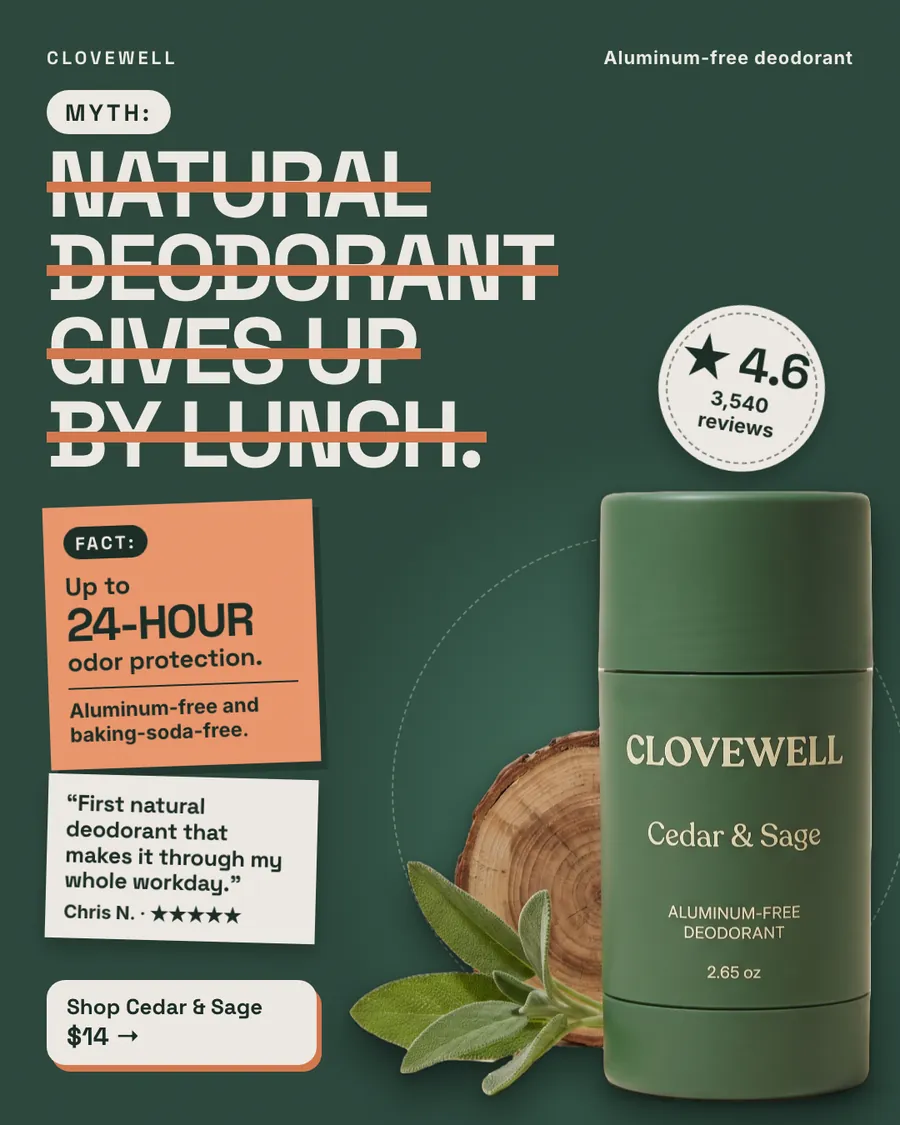
Myth vs factBenefit
Clovewell: MYTH: Natural deodorant gives up by lunch.
Fictional sample brand · made by our engine
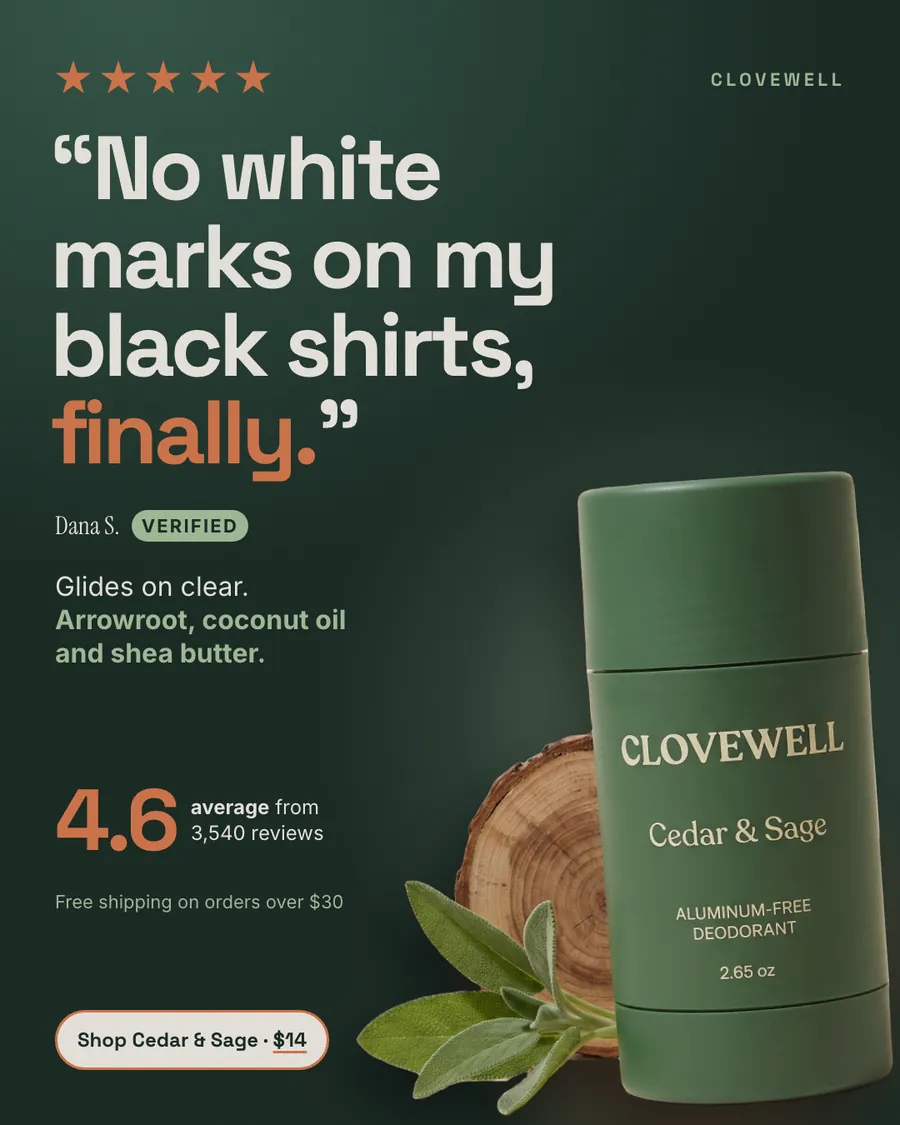
Review cardSocial proof
Clovewell: “No white marks on my black shirts, finally.”
Fictional sample brand · made by our engine
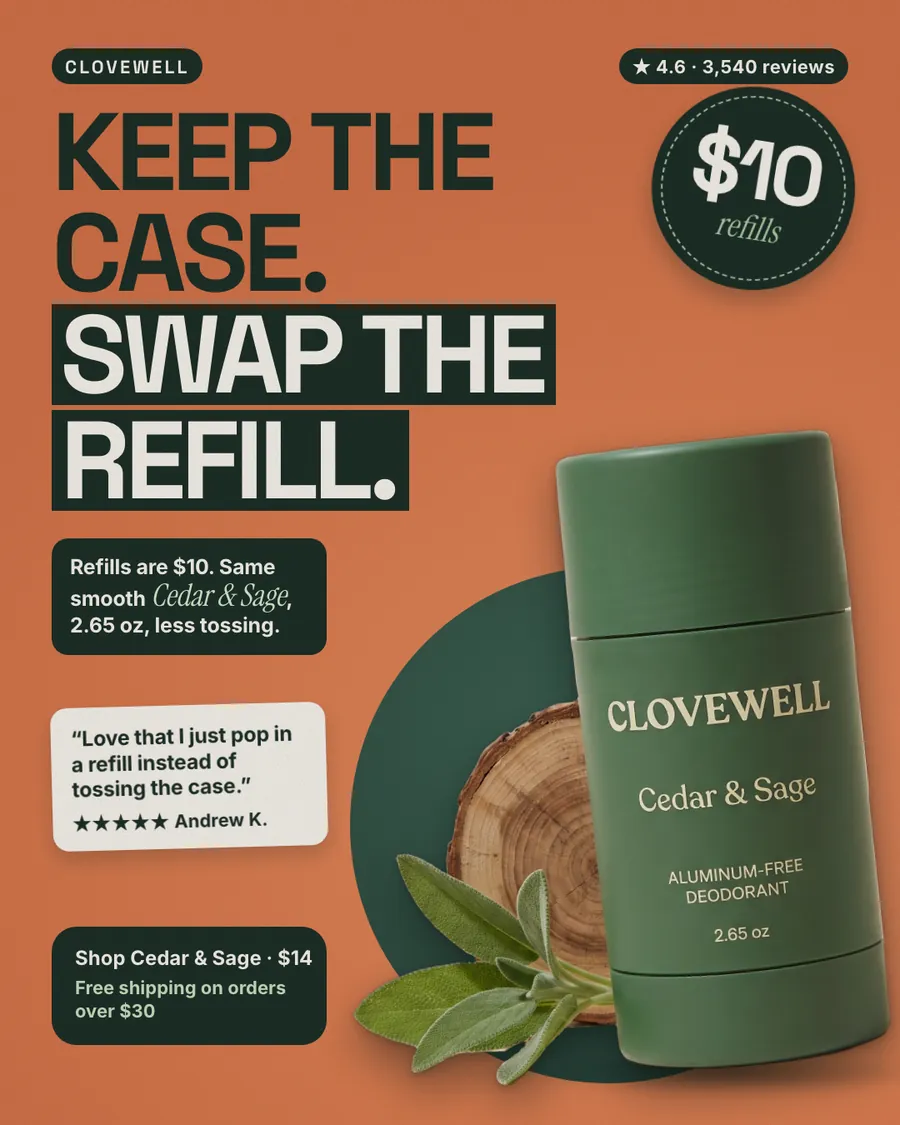
Bold posterValue
Clovewell: Keep the case. Swap the refill.
Fictional sample brand · made by our engine
Words to be careful with
Deodorant is a cosmetic, but the category sits right next to a drug, the antiperspirant. Most rejected or risky deodorant ads cross that line or aim a question at the viewer's body.
Odor is cosmetic, sweat is a drug
The FDA lists deodorants as cosmetics, while deodorants that are also antiperspirants are cosmetic and drug combinations. Antiperspirant labels use "reduces underarm wetness" style wording, so an aluminum-free deodorant ad shouldn't promise dryness or less sweat.
Source: 21 CFR 350.50: Labeling of antiperspirant drug products
"24-hour" and "all day"
For antiperspirants, 21 CFR 350.50 ties claims like "24 hour protection" to sweat-reduction testing. For a deodorant's odor claim, the FTC (the US consumer protection agency) expects a reasonable basis before the ad runs, so keep the test or panel behind the number on file.
Source: FTC Policy Statement Regarding Advertising Substantiation
Aluminum and cancer
The National Cancer Institute's fact sheet says no scientific evidence links these products to breast cancer. An aluminum-free ad can say what it leaves out; it shouldn't imply that other deodorants cause disease.
Source: National Cancer Institute: Antiperspirants/Deodorants and Breast Cancer
Questions about the viewer's hygiene
Meta bars terms, descriptions or questions that attack someone's appearance, body parts or hygiene. "Worried you smell?" is the risky version; "a stick that lasts through a hot commute" is not.
Health conditions
Meta's personal attributes policy rejects ads that assert or imply a person's physical health, including medical conditions, so heavy sweating as a condition is off limits as a hook.
Source: Meta Advertising Standards: Privacy Violations and Personal Attributes
Scent and sensitive skin
The FDA notes that some fragrance components can cause allergic reactions for some people, and that products labeled "unscented" may still contain masking fragrance. Name the oils you use and say exactly what "unscented" means for yours.
Source: FDA: Fragrances in Cosmetics
Rules checked . The sources are linked at the end of this page.
How often to refresh deodorant ads, and what to measure
Deodorant ads wear out slowly, because a switcher's doubts don't change much. What changes is the weather and the season, which give the same doubt a new scene.
On a small budget, two or three new ads every three weeks is usually enough. Refresh the scene, not the doubt: the lasting angle can move from an office to a summer wedding to a gym bag, and each counts as new creative.
Meta shows "Creative limited" when an ad costs more per result than your past ads and "Creative fatigue" when it costs twice as much or more. It recommends a new ad with a materially different image or video, and says keeping the original active may still help results.
What to measure
- Cost per purchase, by doubt
- Tells you which reason to switch your buyers care about, and what the page should answer first.
- Share of first orders that are the trio
- The trio is what makes a first order come close to paying for itself; if it stays low, show it more clearly.
- Refill orders per first-time buyer at 90 days
- The single number that decides how much you can afford to pay for a new customer.
- Rejected ads and the line that caused them
- Keeps the claims list honest. Strike the line from every future ad, not just the one that was rejected.
Questions about advertising deodorant
How do I promote a deodorant brand online?
Start with a small Meta campaign of six ads, each answering one doubt a switcher has: will it last, will it mark clothes, what does it smell like. Send buyers a refill reminder when a stick should be running low, and add TikTok or Shopping once you know which doubt sells.
Should I sell deodorant on Amazon or my own site?
Your own site first, if refills are part of the plan, because the reorder is where deodorant makes money and on Amazon that next order isn't yours to send reminders for. Amazon can add reach later, especially for buyers who never shop small brands directly.
How much should a deodorant brand spend on ads?
Take a typical order and multiply by the margin left after product, shipping and fees. That is the most a first order can cost to break even. About 50 purchases a week is what Meta's learning phase (Facebook's first days of testing who to show the ad to) looks for, so many small brands start lower and count on refills.
How do I advertise deodorant on social media without getting rejected?
Write about the product, not the viewer's body: what's in it, how long odor protection lasts, how it looks on clothes. Avoid questions about smelling, sweating or health conditions, and don't promise dryness unless the product is a labeled antiperspirant.
Is TikTok good for advertising deodorant?
It suits real-life videos of commutes, workouts and long days, which is where deodorant proves itself. Start with creators who actually switched and let them talk about scent and comfort; brief them to avoid medical claims and promises about sweat.
How do I get deodorant customers to reorder?
Make the refill easy to find and fairly priced, state the price in ads and emails, and remind buyers when a stick should be low. A subscription with simple skipping helps people who don't want to think about it.
Can I call my deodorant long-lasting in ads?
Yes, if you can back it. Say what lasts, odor protection, and for how long, and keep the testing behind that number on file. Avoid wetness or sweat claims entirely unless your product is sold and labeled as an antiperspirant.
Do men's and women's deodorants need separate campaigns?
Usually not at first. One campaign with a broad audience lets Meta find buyers for each scent. Make separate ads with scents and scenes that suit each, and split budgets only once one clearly outsells the other.
When should a deodorant brand spend the most on ads?
Warm months bring the lasting doubt to the front, so they suit the switch message, and Black Friday, November 27, 2026, suits trios and refill bundles. Outside those times, steady spend plus refill emails keeps a habit product moving.
What should a deodorant product page include for ad traffic?
The full ingredient list, the free-of facts, the scent notes, the size, how long odor protection lasts, how the case and refills work, the refill price and real reviews about lasting and marks. The ad raises one doubt; the page should answer it near the top.
Get the ads for this plan
Paste your store link and get 3 free ads of your own deodorant: we read your products, prices and reviews, design around your real product photo and check every fact against your store.
Where to go next
- Deodorant ad ideasSeven sample ads for an aluminum-free deodorant, the switch doubts to answer, odor versus sweat claims and refill ideas.
- Beauty productsAds for body care, beauty tools and gift sets that show the product and keep claims to your label.
- How to advertise men's grooming productsA plan for a beard and skin brand: plain Meta ads all year for the user, kit ads for the gift buyer in December and June.
- How to advertise body butter and body careA body butter brand's plan: Meta and TikTok for texture, a duo that clears free shipping, a reorder note at two months, and the itch claims to drop.
- How to advertise soapA handmade soap plan: Meta for the ingredients, bundles to lift a $10 order, stock that matches the ad budget, and the claims that turn soap into a drug.
- Bundle offerBundle and set ads that show what is in the box and the real saving against buying separately.
- Black Friday ad ideasThe 2026 dates, six Black Friday offers and the products they suit, copy lines, and 16 sample ads for four stores.
- Ad creative testing on a small budget: an honest guideOne ad is a bet; fifty ads is a spray. Here is the middle path for small budgets: a few angles that disagree with each other, enough spend to read them, and a weekly loop that builds on what works.
- PricingFree preview, Lite $29/month for 9 designs a month (optional 2 weekly), Starter $49/month for 20. Meta and a 7-day trial from Growth.
Sources
Platform rules on this page were checked on against:
- FDA: Is It a Cosmetic, a Drug, or Both? (Or Is It Soap?)
- 21 CFR 350.50: Labeling of antiperspirant drug products
- National Cancer Institute: Antiperspirants/Deodorants and Breast Cancer
- Meta Advertising Standards: Health and Wellness
- Meta Advertising Standards: Privacy Violations and Personal Attributes
- FTC Policy Statement Regarding Advertising Substantiation
- FDA: Fragrances in Cosmetics
- TikTok Advertising Policies: Healthcare and Pharmaceuticals
- Meta Business Help Center: About the learning phase
- Meta Business Help Center: About creative fatigue recommendations in Ads Manager
- 3 free ads, no signup
- Lite $29/month · 9 designs a month · optional 2 weekly
- Starter $49/month · 20 designs
- Growth $99/month, 7-day free trial
- Pro $149 · Scale $199
- 30-day money-back guarantee