skincare ad prompt

Skincare ad prompts, tested on one vitamin C serum

A serum is an easy object to draw and a hard one to advertise honestly. We ran five common skincare ad prompts for Mira, a fictional brand, in the image models behind ChatGPT and Gemini and in a Midjourney-style keyword prompt. The amber bottle came back in some form every time. What changed was the claims around it, and one run made up a customer's face.

Updated · Every prompt ran once on October 17, 2026, for a fictional brand. Nothing was retried or cherry-picked.

In short

What is a good AI prompt for a skincare ad?

Attach your bottle photo, say the bottle and label must stay as they are, and give the model only claims your product page makes, in quotes. Never ask for a before-and-after or for benefits it should write itself: in our test that produced an invented face and a result the serum doesn't promise.

Run for real

The five prompts, run for real

Mira · Vitamin C Serum 15% · $38 (was $48) · 4.8 from 1,204 reviews · fictional

Mira's product page lists: Vitamin C Serum 15%, a 30 ml amber glass dropper bottle, $38 (was $48); 15% stabilized vitamin C with ferulic acid and vitamin E; fragrance-free and suitable for sensitive skin; brightens dull skin and fades dark spots in 4 weeks; rated 4.8 from 1,204 reviews. Prompts A to C went in without a photo. D and E had the packshot here attached.

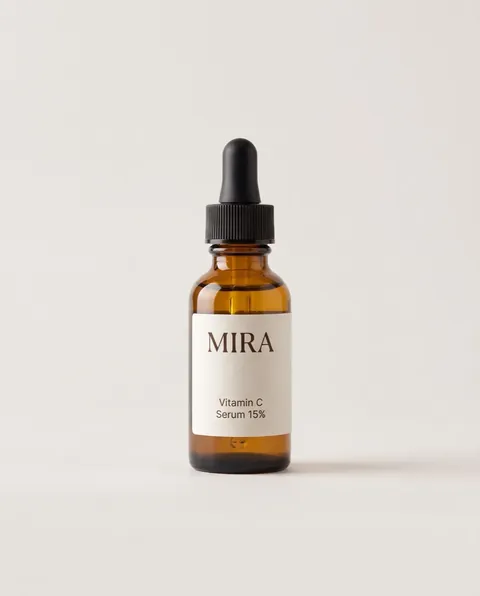
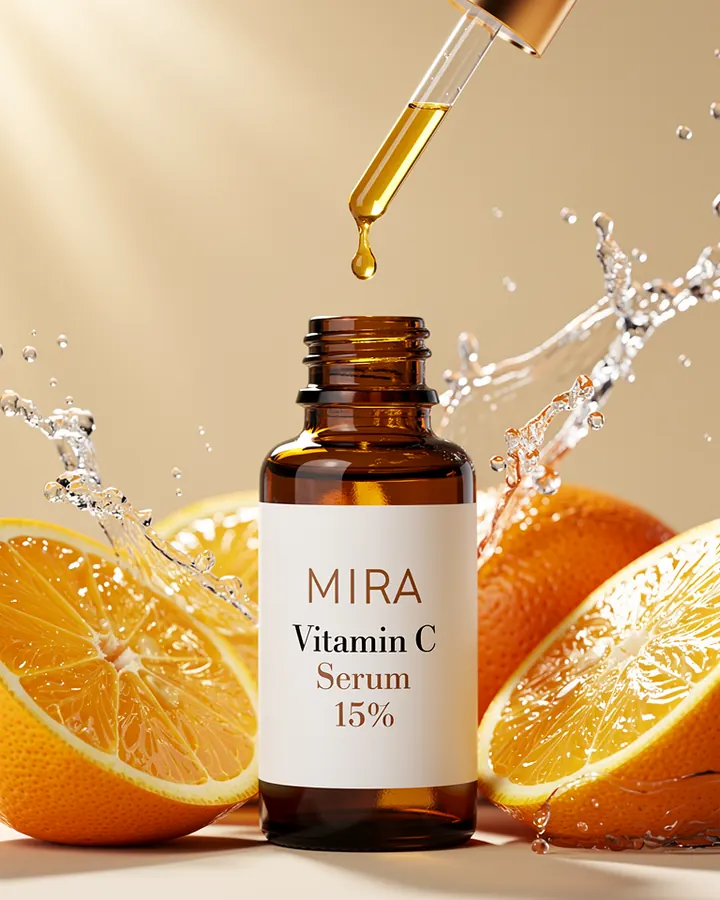
Mira's product photo: Vitamin C Serum 15%, the packshot attached to prompts D and E.
The packshot attached to prompts D and E, and the file our engine places. Mira is a fictional brand; this photo was made once for our sample library.
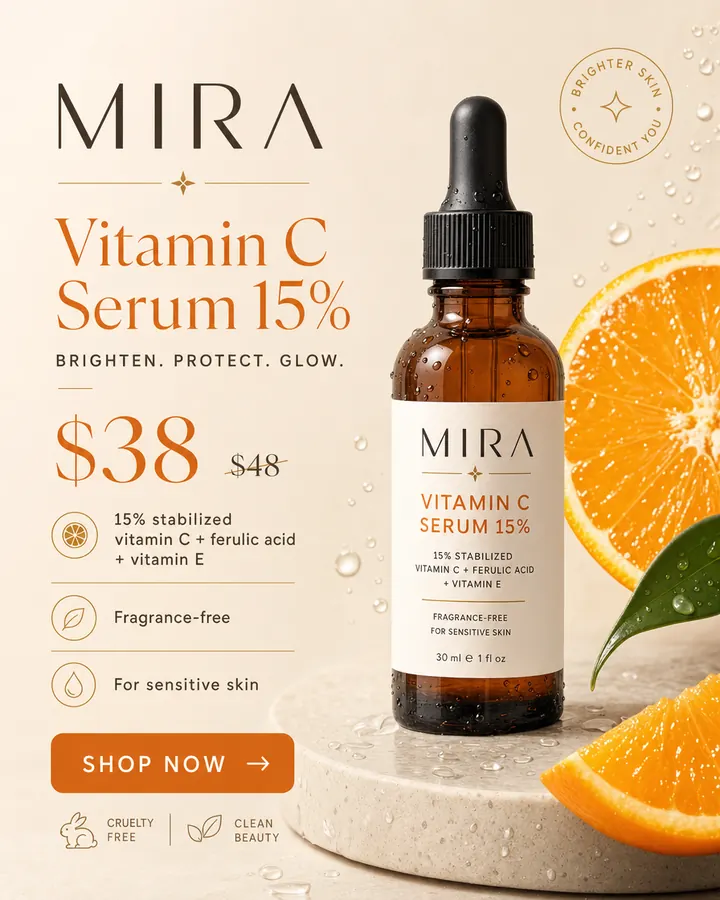
  1. AI output for the first prompt: an amber dropper bottle with a redesigned orange-lettered Mira label on a stone plinth beside orange halves, with $38 and $48 struck through, three feature lines, a Shop now button and Cruelty free and Clean beauty badges.
    Made with GPT-5.4 Image 2 (OpenAI, through the OpenRouter API), October 17, 2026, for a fictional brand.

    Prompt AChatGPT-style prompt, no photo

    The clean-girl ChatGPT prompt

    A minimal beige ad with citrus and droplets is the look most "product ad prompt ChatGPT" examples aim for.

    The prompt, word for word

    Create an Instagram ad for my skincare brand MIRA. Product: Vitamin C Serum 15%, 30 ml amber glass dropper bottle, $38 (was $48). 15% stabilized vitamin C with ferulic acid and vitamin E, fragrance-free, for sensitive skin. Clean, minimal, beige background with orange slices and water droplets. Include the brand name, product name, sale price and a "Shop now" button.
    Product
    Product changed
    Text errors
    0
    Unasked details
    3

    What went right

    • Price, old price and every ingredient line match the brief: $38, $48 struck through, 15% stabilized vitamin C, ferulic acid, vitamin E, fragrance-free.
    • The amber dropper bottle is the right kind of bottle at a believable size.

    What went wrong

    • The label was redesigned: orange lettering, extra lines of small print, and a thin sans-serif MIRA in place of the brand's serif logo.
    • Two badges at the bottom say "Cruelty free" and "Clean beauty". Mira's page claims neither.
    • A round seal adds "Brighter skin, confident you", a result promise nobody wrote.

    Could you run it? Close to usable, which is the risk: the badges look like routine decoration and are claims you'd have to stand behind.
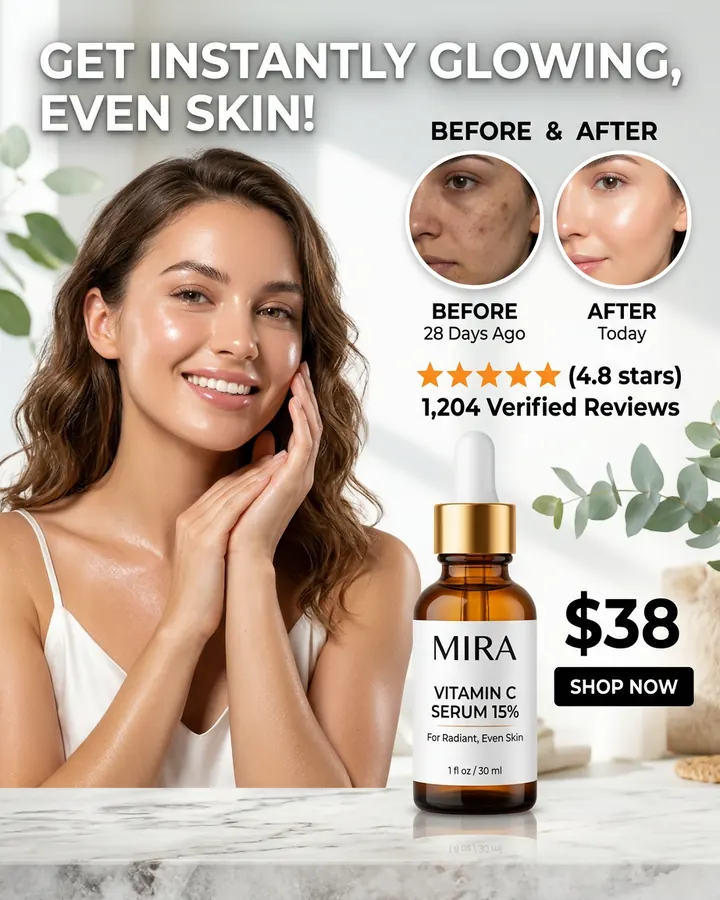
  2. AI output for the second prompt: a smiling model touching her cheek beside a dropper bottle with a gold collar, under the headline Get instantly glowing, even skin!, with two round before and after face crops labelled 28 days ago and today, a rating and $38.
    Made with Nano Banana 2 (Gemini 3.1 Flash Image) (Google, through the OpenRouter API), October 17, 2026, for a fictional brand.

    Prompt BGemini-style prompt, no photo

    The Gemini before-and-after prompt

    "Model with glowing skin" plus "before and after" is a common beauty ai prompt, and the one that breaks ad rules fastest.

    The prompt, word for word

    Generate a high-converting skincare ad for Mira Vitamin C Serum 15%. Show the amber dropper bottle with a white label that says MIRA Vitamin C Serum 15%, next to a model with glowing, radiant skin. Add a bold headline, a before and after comparison, "4.8 stars, 1,204 reviews" and the price $38. Bright, fresh, dewy look.
    Product
    Product changed
    Text errors
    0
    Unasked details
    4

    What went right

    • The rating and review count are the numbers we gave it, and the price is $38.
    • The label reads MIRA and Vitamin C Serum 15%.

    What went wrong

    • The headline promises "instantly" glowing skin. The page says dark spots fade in 4 weeks.
    • It invented the before-and-after: two crops of a face that belongs to nobody, captioned "28 days ago" and "today". A made-up result shown as a real one.
    • The review line became "1,204 Verified Reviews". Nothing says they were verified.
    • The bottle has a gold collar and white bulb instead of Mira's black dropper, and its label adds "For radiant, even skin".

    Could you run it? Don't run this. A fabricated before-and-after is the kind of claim ad platforms and the FTC look for first.

  3. AI output for the third prompt: an open amber bottle with a white Mira Vitamin C Serum 15% label between orange halves and a water splash, with a gold-collared pipette floating above it dripping a single drop.
    Made with FLUX.2 Pro (Black Forest Labs, through Higgsfield), October 17, 2026, for a fictional brand.

    Prompt CMidjourney-style keyword prompt, no photo

    The Midjourney-style serum drop prompt

    The "golden drop falling from the pipette" shot is a staple of AI product photography prompts for serums.

    The prompt, word for word

    vitamin c serum product photography, amber glass dropper bottle, white label that reads "MIRA Vitamin C Serum 15%", golden serum drop falling from the pipette, sliced oranges, water splash, soft morning light, clean beige backdrop, commercial beauty shot, hyper realistic, 8k --ar 4:5 --v 7 --style raw
    Product
    Product changed
    Text errors
    0
    Unasked details
    0

    What went right

    • Every word on the label is right: MIRA, Vitamin C, Serum, 15%.
    • The drop, the citrus and the splash make a striking hero shot.

    What went wrong

    • The bottle has no dropper in it. The pipette floats above with a gold collar, a part Mira's bottle doesn't have.
    • The label type is a light serif, not the brand's.
    • No price, headline or button: a photo to build an ad on, not an ad.

    Could you run it? A good background plate if you swap in your real bottle. As the product shot, it shows a bottle you don't sell.

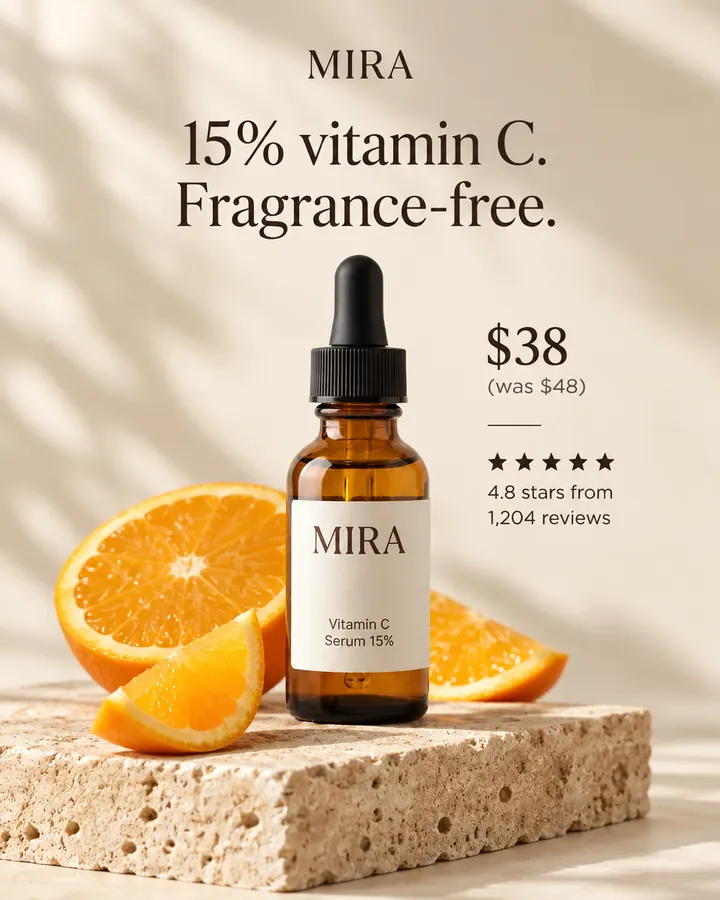
  4. AI output for the fourth prompt: Mira's amber dropper bottle with its cream serif label on travertine beside orange slices, under the headline 15% vitamin C. Fragrance-free., with $38 (was $48) and 4.8 stars from 1,204 reviews.
    Made with GPT Image 2.5 (OpenAI, through Higgsfield), October 17, 2026, for a fictional brand.

    Prompt DChatGPT-style prompt with the product photo

    ChatGPT with the serum photo

    Attaching the packshot and asking for a clean ad is how most owners use ChatGPT for skincare now.

    The prompt, word for word

    Here is my product photo. Make it into a clean Instagram ad for my skincare brand Mira. Place the bottle on a travertine stone with soft morning shadows and a few orange slices. Keep the bottle and label exactly the same. Add the headline "15% vitamin C. Fragrance-free.", the price "$38 (was $48)" and "4.8 stars from 1,204 reviews".
    Product
    Product kept
    Text errors
    0
    Unasked details
    0

    What went right

    • Mira's bottle, black dropper and serif label came through intact.
    • Headline, sale price and rating appear word for word, and nothing was added.
    • Soft shadows and travertine suit the brand's calm look.

    What went wrong

    Nothing we could find.

    Could you run it? Runnable as it stands. It got there because every claim on it was one we typed from the product page.

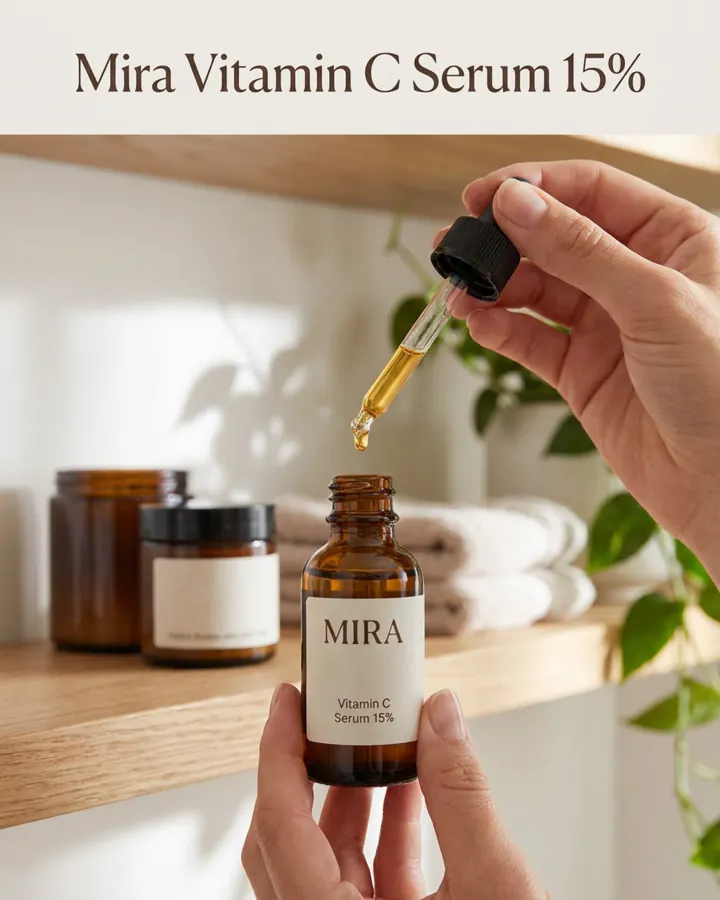
  5. AI output for the fifth prompt: one hand holding Mira's open amber bottle while another lifts the black dropper with a drop of golden serum at its tip, bathroom shelf behind, inside a light frame headed Mira Vitamin C Serum 15%.
    Made with Nano Banana Pro (Gemini 3 Pro Image) (Google, through Higgsfield), October 17, 2026, for a fictional brand.

    Prompt EGemini-style prompt with the product photo

    Gemini with the serum photo

    Hands with a dropper are the classic texture shot; the "product photo nano banana prompt" is how people now make it.

    The prompt, word for word

    Use this exact serum bottle. Show it held between a woman's fingers, with the dropper lifted out and one drop of serum on the tip, bathroom shelf in the background. Do not change the bottle or the label. Add the text "Mira Vitamin C Serum 15%" at the top.
    Product
    Product kept
    Text errors
    0
    Unasked details
    0

    What went right

    • The bottle and label match the photo, and the lifted dropper is Mira's black one.
    • Both hands look natural, with the drop exactly where the prompt asked.

    What went wrong

    • It boxed the scene inside a pale frame with the title above, rather than putting the line over the photo.

    Could you run it? A clean texture shot. Trim the frame and it's ready for a feed.

What the five runs show for skincare

The serum bottle is easy: every run drew an amber dropper bottle. The problem in skincare is what gets written next to it. The two prompts that left room for the model to fill added cruelty-free and clean-beauty badges, an "instantly" the brand never claims, and a before-and-after of a person who doesn't exist.

With the packshot attached and every line spelled out, both models produced ads we'd be comfortable running. That's a fair result, and the reason it worked is that we did the claim checking ourselves before we typed the prompt.

Skincare ads go through stricter review than most categories, and a picture that looks finished invites skipping that step. If you use prompts, treat any claim you didn't write as a claim you now have to prove. For lines that stay within what a page proves, see our skincare ad ideas; for channels and a first budget, the guide to advertising skincare.

Real sample ads

The same serum, made by our engine

These were built from Mira's product page. The engine placed the packshot as it is, used only the claims and numbers the page states, and a fact check matched them before the ads were delivered.

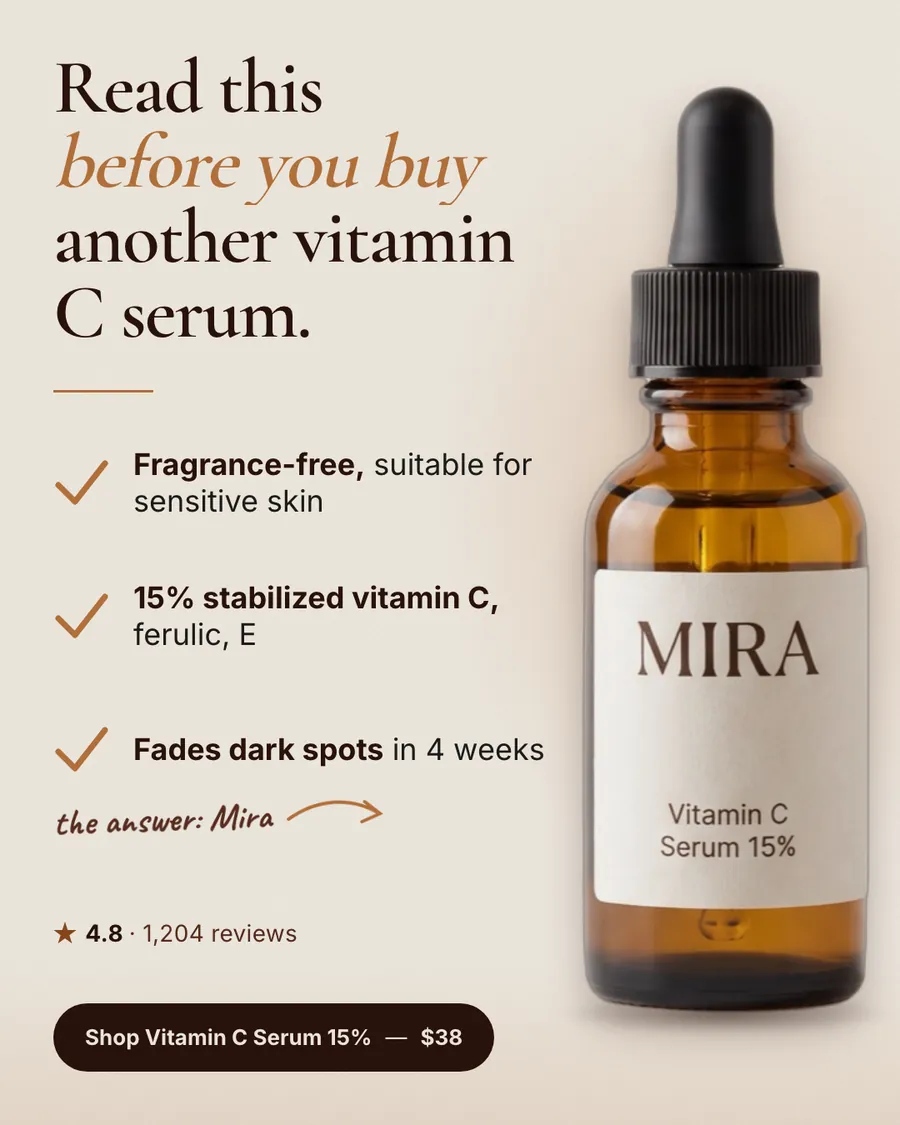
  • Cream Mira ad: 'Read this before you buy another vitamin C serum.' with three checkmark points (fragrance-free, 15% stabilized vitamin C with ferulic and E, fades dark spots in 4 weeks), 4.8 from 1,204 reviews, an amber dropper bottle and a $38 shop button.

    Read this firstIngredients

    Mira: Read this before you buy another vitamin C serum.

    Four claims, all lifted from the product page: fragrance-free, sensitive skin, 15% vitamin C with ferulic and E, and dark spots fading in 4 weeks. No "instantly", no badges the store hasn't earned.

    Store facts used: Fragrance-free, 15% stabilized vitamin C, ferulic, E, fades dark spots in 4 weeks, 4.8 from 1,204 reviews, $38

    Matched by the fact check: $38 · 4.8 rating · 1,204 reviews · 15% · 4 weeks

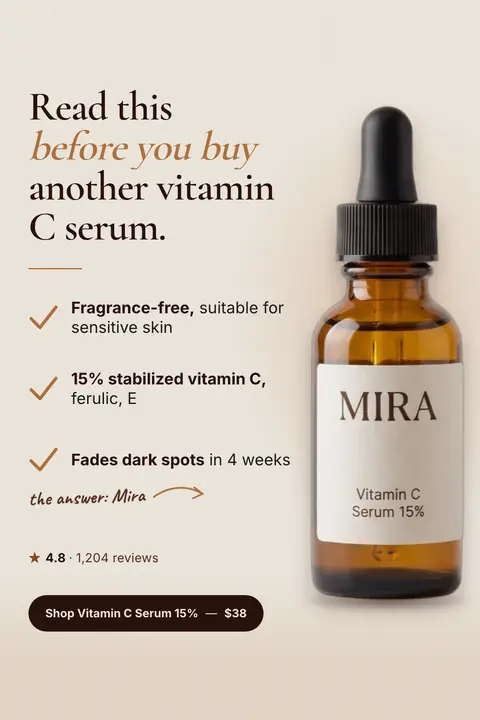
    The 2:3 Pinterest versionCream Mira ad: 'Read this before you buy another vitamin C serum.' with three checkmark points (fragrance-free, 15% stabilized vitamin C with ferulic and E, fades dark spots in 4 weeks), 4.8 from 1,204 reviews, an amber dropper bottle and a $38 shop button. Shown here in the 2:3 Pinterest size.

    Fictional sample brand · made by our engine

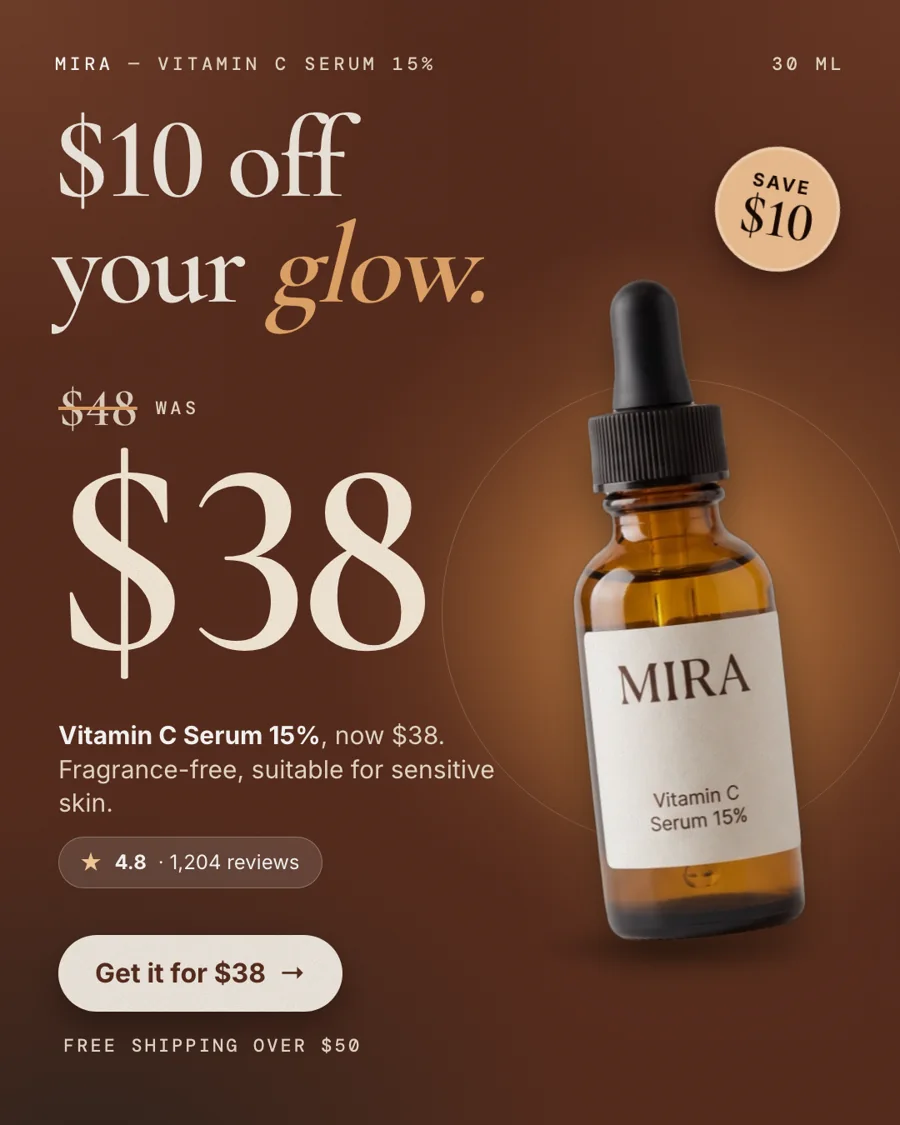
  • Dark brown Mira offer ad: '$10 off your glow.' with the old price $48 crossed out, a huge $38, a 'Save $10' sticker, 4.8 from 1,204 reviews and a 'Get it for $38' button beside the serum bottle.

    Price dropOffer

    Mira: $10 off your glow.

    The sale told straight: $48 struck, $38 large, the $10 saved, the rating and free shipping over $50, each read from the store. The bottle is the photo file, so the black dropper and serif label never change.

    Store facts used: $38, was $48, 4.8 from 1,204 reviews, free shipping over $50

    Fictional sample brand · made by our engine

The difference, side by side

Prompting an image modelOur engine
The bottle and labelRedrawn: a gold collar here, a new label there; close only when the photo is attachedThe packshot itself, placed, so the logo and dropper are the ones you sell
Skin resultsWhatever the prompt invites, including a before-and-after it makes upOnly results your page states, worded the way the page words them
Badges and labelsAdds cruelty-free, clean beauty, verifiedShows a badge only when the store makes that claim
Price and reviewsRight when you type them rightRead from the store and matched before delivery
Feed, Stories, PinterestA new generation for each shape, each one recheckedOne design rendered in five sizes

Copy and paste

A skincare prompt pack that starts from your bottle photo

Attach your own packshot to each of these. Fill the brackets with lines from your product page exactly as written, and leave out anything the page doesn't say: skin results, certifications and badges included.

  1. 01

    The ingredient ad

    When the formula is the reason to buy.

    Keep the attached bottle photo exactly as it is: bottle, dropper or pump, label text and logo. Place it on [SURFACE] with [ONE PROP LINKED TO A LISTED INGREDIENT] in soft daylight. Add only this text: headline "[KEY INGREDIENT AND STRENGTH, as on my page]", line "[TWO MORE FACTS FROM MY PAGE, e.g. Fragrance-free. 30 ml.]", price "[PRICE]". No badges, seals or certification marks. Portrait 4:5.
  2. 02

    The texture shot

    To show what the product feels like, without promising results.

    Use the attached bottle unchanged. Show one hand holding it and the other lifting the [DROPPER / PUMP] with a single drop of [TEXTURE COLOUR] product. Neutral bathroom or vanity background, natural light, real skin texture with no smoothing. Add only "[PRODUCT NAME]" in small type at the top. No faces.
  3. 03

    The review ad

    When customers already say it best.

    Keep the attached bottle exactly as photographed on the right of a [COLOUR] background. On the left, set this review word for word: "[REVIEW TEXT]" with "[FIRST NAME + INITIAL]" under it, then "[RATING] stars from [REVIEW COUNT] reviews". Do not add "verified" or any other label.
  4. 04

    The price drop

    For a real, current sale.

    Use the attached bottle unchanged. Add only: "[SALE PRICE]" large, "[ORIGINAL PRICE]" struck through, and "[OFFER TERMS, word for word from my store]". Plain background in [BRAND COLOUR]. No countdowns, no "today only", no extra discount badges.
  5. 05

    The claim check

    Before you download anything.

    List every word, number, badge and symbol in your image. For each one, tell me whether it appears in the text I gave you. Then make a new version that removes everything I didn't give you and changes nothing else, including the bottle and label.

Tips for each tool, for skincare

ChatGPT

  • With the photo attached and the text in quotes, our run kept Mira's label and added nothing. Without the photo, it redesigned the label and added two badges.
  • Add "no badges, seals or certifications" to every skincare prompt. Models treat them as decoration; shoppers and reviewers read them as claims.
  • Ask for the 9:16 Stories version as a separate image, then check the label and the price again.

Gemini

  • Upload the bottle and describe only the scene. Our Nano Banana Pro run kept the bottle and the black dropper when told not to change them.
  • Never ask for a before-and-after. Asked once, Nano Banana 2 made up a face and a 28-day result.
  • Ask for "text over the photo, no frame". Ours came back boxed inside a border.

Midjourney-style tools

  • The drop-from-the-pipette shot looks great and rarely matches your bottle. Use it as a background, not as the product.
  • Parameters like --ar and --style raw are Midjourney settings, read at the end of the prompt. FLUX skipped them.
  • Keyword prompts give you no copy at all, which for skincare is a safe default: write the claims yourself from your page.

Questions about skincare ad prompts

What are good beauty AI prompts for product ads?

The ones that keep your real bottle and give the model nothing to invent: attach the photo, name what can't change, quote every line of text and ban badges. The pack above follows that pattern for ingredients, texture, reviews and sales.

What should a skincare ad prompt include?

The product photo first, then the setting, then exact text. "Keep the attached bottle exactly as it is. Place it on travertine in soft light. Add only: [headline], [price]." Leave out adjectives like glowing or flawless; in our tests they turned into result claims.

Can ChatGPT make a skincare ad?

Yes. From a description, GPT-5.4 Image 2 made a tidy ad with every number right, a redesigned label and two badges Mira doesn't claim. With the packshot attached, GPT Image 2.5 kept the bottle and added nothing. Check every word before it runs.

Can I use AI to make a before-and-after for my skincare ad?

No. An AI before-and-after shows a result nobody had. Meta's ad standards restrict ads that imply personal attributes or show unrealistic health outcomes, and the FTC treats fabricated results and testimonials as deceptive. Use real, documented customer photos with consent, or skip the format.

What is a catchy slogan for skincare?

One built on a fact the product page proves: "15% vitamin C. Fragrance-free." or the review line customers repeat. Our skincare ad ideas page has lines like these, each tied to a fact, plus the claims to avoid.

Why did the AI add badges like cruelty-free?

Beauty ads in its training data are full of them, so a model treats badges as part of the look. Each one is a claim. Unless your page and your suppliers back it up, remove it, and say "no badges" in the prompt next time.

Is ChatGPT or Gemini better for skincare ads?

With the photo attached, both kept Mira's bottle in our single runs, and neither added a claim. Without a photo, the Gemini prompt that asked for a before-and-after produced the most serious problem. The prompt mattered more than the tool.

What should a skincare product photo look like for AI tools?

One sharp packshot on a plain background, the label facing the camera and readable, the dropper or pump in place. The tools copy what they see, so a blurred or angled label comes back worse.

How do I advertise my skincare product?

Show the texture, name the ingredients and strength, and let real reviews carry the results. Our guide to advertising skincare covers channels, a first budget and the claims reviewers flag.

Do AI-made skincare ads get flagged by Meta?

Ads can be rejected for their claims whoever made them, and Meta says it may add an AI info label when it detects that an outside generative AI tool made or edited the ad. The invented results we saw are a bigger risk than the label.

Skip the prompts for your skincare

Paste your store link and get 3 free ads of your own skincare: we read your products, prices and reviews, design around your real product photo and check every fact against your store.

Launching soon. Early access opens in small batches; we'll email you first.

← All ad prompts, tested

Where to go next

  • 3 free ads when your spot opens
  • Starter $49/month
  • Growth $99/month, 7-day free trial
  • Pro $149 · Scale $199
  • 30-day money-back guarantee
See pricing