how to advertise essential oils
How to advertise essential oils when the easy promise is the one you can't make
Most essential oil marketing leans on what a scent does for you: better sleep, less stress, an easier breath. Those are exactly the lines that turn an oil into a drug in the FDA's eyes and get ads rejected. A brand that advertises the scent itself, the bottle and how far it goes can run steadily for years. The numbers below are Elderhush's, a fictional diffuser blend maker.
Updated · Budgets and examples use a fictional brand's numbers. Use yours.
In short
How do you advertise essential oils as a small brand?
Run Meta ads that describe each blend's notes in plain words, show the real bottle and how many drops it holds, and quote customers on the scent, never on sleep or stress. Sell a set of blends that clears free shipping, email buyers when a bottle should be empty, and keep safety around children and pets visible.
StoreToAds makes ready-to-post ads from your product photo, free to try.
At a glance
- What you can sell
- The scent, the notes and how long a bottle lasts
- Where to start
- Meta (Facebook and Instagram), with two blends whose notes are easy to picture
- The order to aim for
- A set of blends, or a diffuser plus one blend
- The claims to drop
- Sleep, stress, pain and breathing: all drug claims
- What ads must never show
- A child or pet next to an open bottle or a running diffuser
Which channels fit essential oils, in the order to try them
Essential oils are bought by people who already own a diffuser and by people shopping for a small gift. The order below suits a brand selling blends from its own store, with marketplaces as an option rather than the base.
- 01
Meta (Facebook and Instagram)
Start hereWhy it fits
A fir sprig beside an amber bottle and four named notes is enough to make someone imagine the room. Meta finds diffuser owners and gift buyers without interest targeting, and it lets one ad run in feeds and Stories.
The trade-off
Wellness wording draws close review, so ads that hint at sleep or anxiety get rejected or quietly limited. Write the claims list before the first ad, not after the first rejection.
- 02
Email and SMS
Add nextWhy it fits
A 15 ml bottle runs out, and the person who used it up already likes the blend. A note when it should be nearly empty, with a second blend, is the cheapest sale in the category.
The trade-off
It only reaches buyers and subscribers. SMS needs explicit permission to text.
- 03
Pinterest
Add laterWhy it fits
Cozy rooms, reading corners and shelf styling are saved and planned there, and an amber bottle on a styled shelf fits right in, especially before gift season.
The trade-off
Pins pay off slowly: a save in October may become an order in December. Keep the same scent-only wording you use on Meta.
- 04
Google Shopping
Add laterWhy it fits
Searches like "balsam fir essential oil blend" or "diffuser oil set" come from people ready to buy, and a Shopping ad shows the bottle and price on that query.
The trade-off
Those results are crowded with large multi-packs at low prices. Your title needs the notes, the size and the blend name to stand apart.
- 05
Etsy
Only if it fitsWhy it fits
For a maker blending by hand, Etsy search already brings buyers looking for small-batch blends and gift sets, and Etsy Ads only spend there.
The trade-off
Offsite Ads take 15% of an attributed order until a shop passes $10,000 in yearly sales, then 12%. Those buyers stay Etsy's, so your reorder note can't reach them.
- 06
Amazon
Only if it fitsWhy it fits
Many people buy oils where they buy everything else, and a listing with strong reviews can sell steadily.
The trade-off
You sit beside cheap multi-packs on price, and the reorder, which is where oils make money, belongs to Amazon rather than to you.
Your first 30 days advertising essential oils
Start with two blends rather than the whole shelf. A clear test of two scents tells you more than a thin spread across twelve.
Days 1 to 3
Write the scent-only claims list
For each blend, list what you can back: the oils in it, the bottle size, roughly how many drops it holds, how it's meant to be used and how it's made. Cross out every word about sleep, stress, breathing, pain or immunity before anyone designs an ad.
Days 4 to 7
Fix the page and the safety notes
Put the notes, the size, how to use it and the safety line (keep away from children and pets, dilute before skin use if that applies) on each product page. Check that a test order reaches Meta Events Manager.
Days 8 to 14
Launch 6 ads on two blends
For each blend, one ad that names the notes, one that shows how far a bottle goes, and one built on a customer's description of the smell. One Sales campaign, broad audience, 4:5 and 9:16, and no edits for a week.
Days 15 to 22
Find the blend people buy, not the one they like
Comments and saves often go to the prettiest photo. Look at cost per purchase by blend and by angle, pause the weakest pair, and make two new versions of the strongest.
Days 23 to 30
Add the set and the reorder note
Put your multi-blend set into the winning ad's copy, and set an email to go out when a bottle should be running low. If it's autumn, plan gift wording and your last order date.
How to size a starting budget for essential oil ads
A $22 bottle leaves little after the oils, the glass, the dropper and postage. Elderhush's free shipping starts at $40, so its typical first order is the Diffuser Blend Set of 4 at $54.
| Order value | $54.00 |
|---|---|
| Margin after product cost, shipping and fees | 55% |
| Most a first order can cost to break even | $29.70 |
| 50 purchases a week at that cost | $1,485 a week |
| The same budget per day | about $212 |
Meta says an ad set usually leaves its learning phase after about 50 results in the week after its last significant edit, and recommends a budget large enough to get enough results. Meta Business Help Center: About the learning phase
That's a sizeable weekly budget for a small blender. Three ways essential oil brands make it work:
- Lead with the set, sell singles by email. The set lifts the order and lets a buyer find their favorite blend, which they then reorder on its own.
- Offer the diffuser to people who don't own one. A $58 diffuser with a blend makes a much bigger order, and it creates a buyer who will need oils for months. Show it to new visitors, not to past buyers.
- Optimize for add to cart until purchases build. A small budget may never reach 50 purchases a week. A more frequent event gives the ad set something to learn from in the meantime.
Two kinds of essential oil buyer, two different ads
Whether someone already owns a diffuser changes what they need from you. Split the ads, not the audience: Meta will find each group if the ad speaks to it.
| Buyer | What they need | What to advertise |
|---|---|---|
| Owns a diffuser | New scents, and a reason to pick yours | A single blend with its notes, then the set |
| No diffuser yet | A way to start without guessing | The diffuser with one blend, priced together |
| Shopping for a gift | Something that looks finished in a box | The set, gift-ready, with a last order date |
| Past buyer | The next bottle | The same blend or a new one by email, not a cold ad |
Offers that work for essential oils
Oil offers work best when they help someone find a favorite blend or start a habit. Deep discounts on single bottles mostly attract people who were going to buy the cheapest pack anyway.
A set of blends at one price
Elderhush's set of four 10 ml blends is $54, down from $64. It lets a new buyer discover which scent they'll reorder.
Watch: Only show a was-price you really charged, so buyers can check the saving.
A diffuser and blend pair
For someone with no diffuser, one box with both removes the guesswork, and it starts a habit that needs oils every month.
Gift-ready in December
Amber bottles in a box are an easy gift. A gift note, plus a clear last order date in the ad, turns the set into a holiday offer without a discount.
Watch: USPS lists December 17 as the Ground Advantage send-by date for Christmas delivery in the contiguous US in 2026; add your packing time.
First look at a new blend for past buyers
People who emptied a bottle trust your blending. A new seasonal scent sent to them first sells at full price.
Angles to test for essential oil ads
Each angle sells the scent or the value, never an effect on the body. You can see them built into real layouts on Essential oil ad ideas; the plan on this page decides which ones get money first.
The notes, named
Balsam fir, cedarwood, bergamot, a little rosemary.
A room, not a promise
Your living room, after a walk in the woods.
How far a bottle goes
About 300 drops in one small amber bottle.
What it isn't
Not sweet. Not perfume. Just pine and citrus.
A customer's words on the smell
"Smells like a walk in the woods after rain."
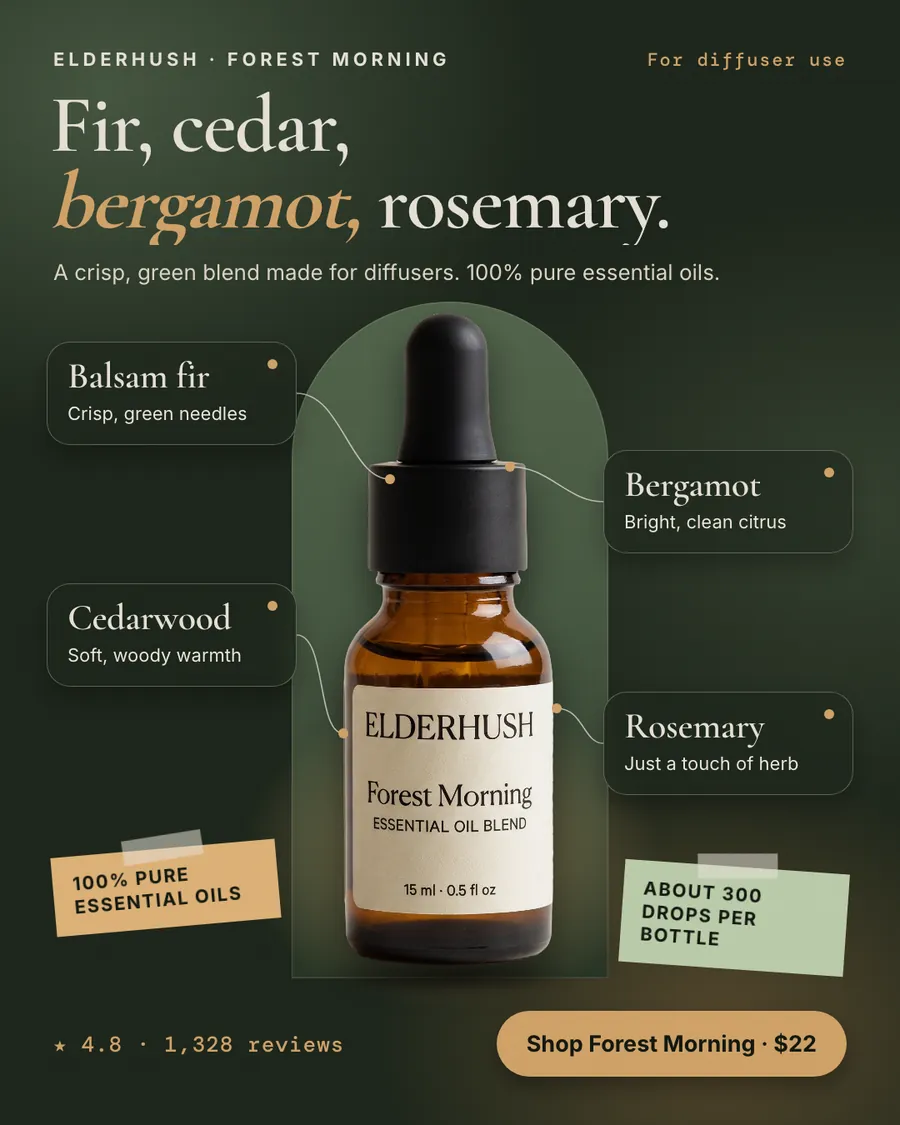
Ingredient spotlightScent
Elderhush: Fir, cedar, bergamot, rosemary.
Fictional sample brand · made by our engine
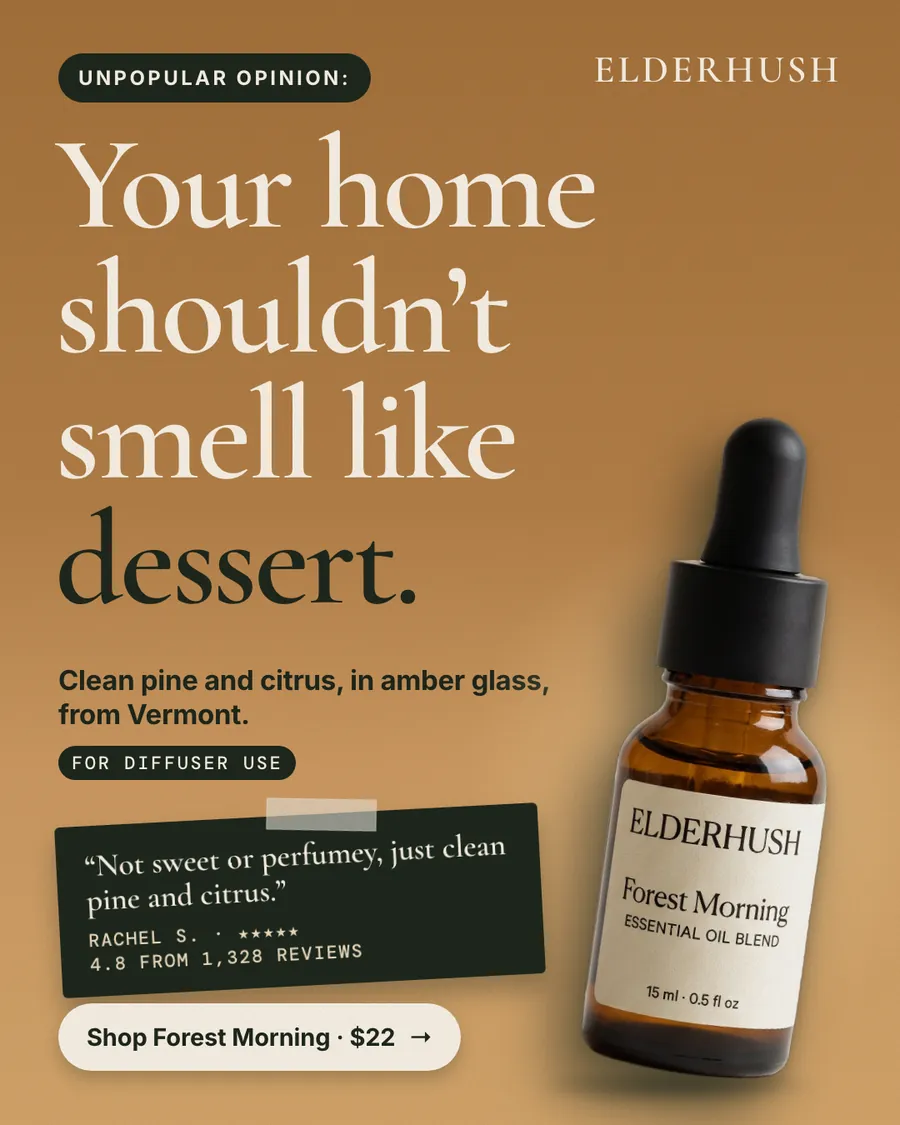
Unpopular opinionPersonality
Elderhush: Your home shouldn't smell like dessert.
Fictional sample brand · made by our engine
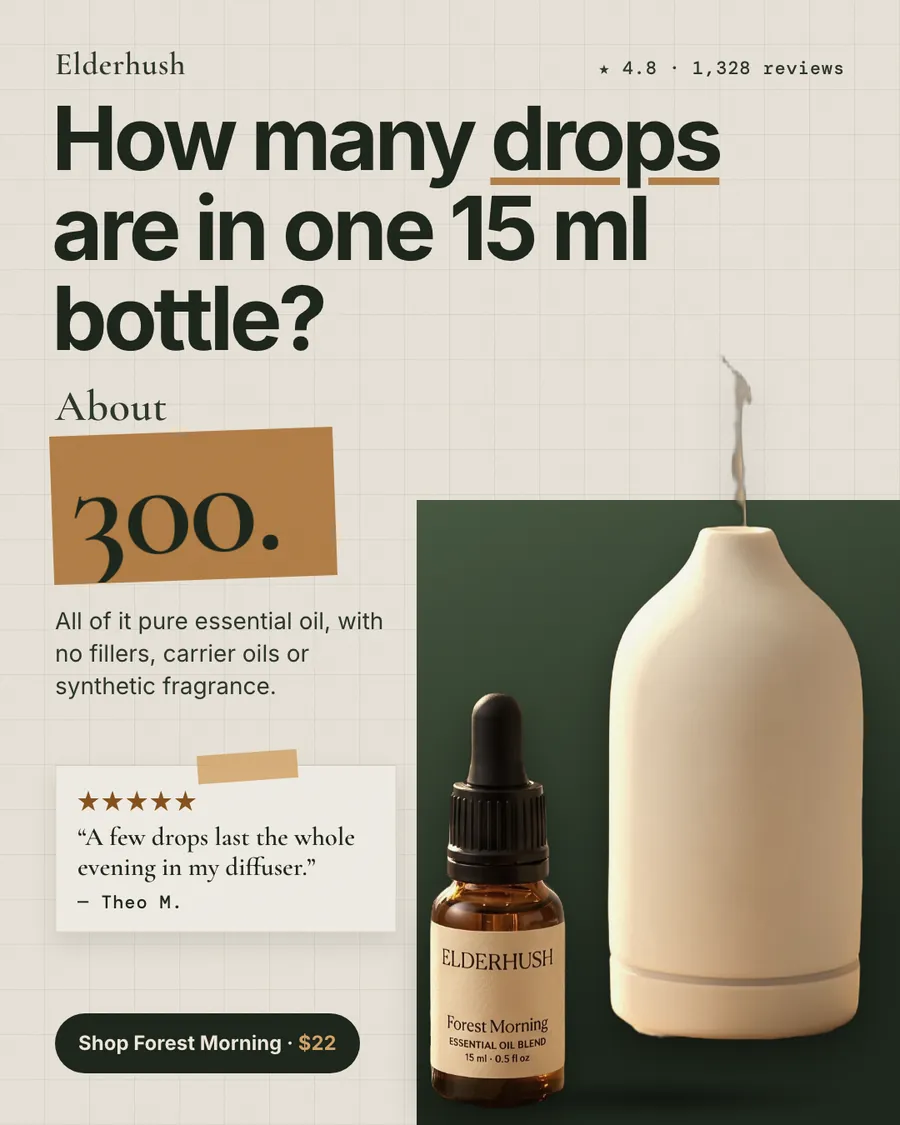
Question hookValue
Elderhush: How many drops are in one 15 ml bottle?
Fictional sample brand · made by our engine
Words to be careful with
Essential oils aren't banned on the big ad platforms. The trouble comes from health promises, from safety, and from purity words nobody defines.
Sleep, stress, pain and breathing
The FDA's aromatherapy page lists claims like helping sleep, easing anxiety or depression, relieving pain or relaxing muscles as drug claims, whatever the source of the ingredients. Products sold only to scent a room, such as air fresheners and scented candles, are the CPSC's area instead.
Source: FDA: Aromatherapy
Questions aimed at the viewer
Meta rejects ads that assert or imply someone's physical or mental health, so "Can't switch off at night?" is a problem where "a quiet green scent for the evening" is not.
Source: Meta Advertising Standards: Privacy Violations and Personal Attributes
Children in the photo
Poison Control warns that some essential oils can be poisonous if swallowed or absorbed through the skin, that children may be more susceptible, and that bottles belong out of the sight and reach of children and pets. Never stage an ad with a child near an open bottle.
Source: Poison Control: Essential oils
Pets and diffusers
The ASPCA says concentrated oils can be dangerous for pets, that a diffuser is best used briefly in an area pets can't reach, and that diffusers should be avoided in homes with birds. Skip the cat-on-the-sofa shot and any "pet safe" line.
"100% pure" and other purity words
The FDA says there is no regulatory definition for "essential oils", so a purity claim is only as strong as your proof. The FTC (the US consumer protection agency) expects a reasonable basis for objective claims before an ad runs, such as a supplier's test report for each batch.
Source: FTC Policy Statement Regarding Advertising Substantiation
Rules checked . The sources are linked at the end of this page.
How often to refresh essential oil ads, and what to measure
Scent ads wear out more slowly than most, because each new blend is a new story. The risk is spreading a small budget across too many blends at once.
Outside gift season, two or three new ads every three weeks is enough for a two-blend test. A seasonal blend counts as fresh creative on its own; give it a week to itself before mixing it into the main ad set.
Keep an eye on the Delivery column: an ad marked "Creative limited" is costing more per result than your earlier ads, and "Creative fatigue" means at least double. Meta's advice is a materially different image or video, so change the room or the light, not just the headline.
What to measure
- Cost per purchase, by blend
- One blend usually carries an oil brand's ads. Find it before spreading the budget across the range.
- Share of first orders that are a set or diffuser bundle
- The bigger first order is what makes paid ads add up. If it stays low, show the set more clearly.
- Second orders at 60 days
- Tells you whether the reorder note works and how much a new customer can cost.
- Rejected or limited ads
- Each one points at a word that sounded like a health claim. Strike it from the list for every ad, not just the rejected one.
Questions about advertising essential oils
How do I start advertising an essential oil business?
Write a claims list that covers scent, size and use only, fix your product pages with notes and safety lines, then run six Meta ads on two blends. Leave them alone for a week, keep the blend that sells, and add a reorder email before you try another paid channel.
Which ad platform is best for essential oils?
Meta is the usual place to start, because it reaches diffuser owners and gift buyers without detailed targeting. Pinterest helps before gift season, and Google Shopping catches people searching for a specific scent. Marketplaces bring buyers but keep the reorder for themselves.
Should I sell essential oils on Amazon or Etsy?
Etsy suits a small maker with handmade blends and gift sets; Amazon suits a brand ready to compete on price and reviews. Both keep the buyer's details, so your reorder emails can't reach them. Many brands use one for reach and send their own ads to their own store.
How much should I spend on essential oil ads?
Multiply a typical order by the margin left after oils, glass, postage and fees. Spend more than that on a first order and you lose money on it. About 50 purchases a week is what Meta's learning phase (Facebook's first days of testing who to show the ad to) looks for, so most small brands start lower and lean on sets and reorders.
How do I market essential oils on Instagram?
Instagram ads come from your Meta ad account, so make each ad in 4:5 for the feed and 9:16 for Stories and Reels. Short clips of a diffuser in a real room, with the notes written on screen, work well there, as long as no child or pet is in the shot.
How do I advertise incense or other home fragrance?
The same plan works: sell the scent in plain words, a set at one price and a reorder note. The FDA notes that products sold only to scent a room, like air fresheners and scented candles, are the CPSC's area, and health claims change that just as they do for oils.
Do I need to sell a diffuser to advertise oils?
No, but it helps. Many buyers already own one and only want blends. For those who don't, a diffuser and blend pair makes a much bigger first order and starts a monthly habit, so it's worth testing as a separate ad.
How do I get essential oil customers to reorder?
Time a short email to when a bottle should be empty, offer the same blend and one new one, and make the reorder take one click. New seasonal blends give you a reason to write without discounting.
Can I advertise oils for use on the skin?
Only with care. Show and describe the dilution your label gives, and never show oil applied neat to skin if your directions say to dilute. Poison Control notes some oils can be harmful when absorbed through the skin, so many diffuser brands keep skin use out of ads entirely.
When do essential oil brands spend the most on ads?
Plan the biggest budget for gift season, from Black Friday, November 27, 2026, to your last order date, when sets and diffuser bundles suit gift buyers. The rest of the year, steady spend on your best blend plus reorder emails is usually enough.
Get the ads for this plan
Paste your store link and get 3 free ads of your own essential oils: we read your products, prices and reviews, design around your real product photo and check every fact against your store.
Where to go next
- Essential oil ad ideasSeven sample ads for a diffuser-blend brand, scent words that replace wellness words, safety lines and a calendar.
- How to advertise candlesA candle brand's ad plan: Meta all year, Pinterest from October, a reorder email timed to the burn, and a budget that peaks for gifts.
- How to advertise soapA handmade soap plan: Meta for the ingredients, bundles to lift a $10 order, stock that matches the ad budget, and the claims that turn soap into a drug.
- How to advertise body butter and body careA body butter brand's plan: Meta and TikTok for texture, a duo that clears free shipping, a reorder note at two months, and the itch claims to drop.
- Christmas gift adsShip-to-them offers, what's-inside ads and last-minute timing for gift boxes, with four ads for Bowfinch.
- Bundle offerBundle and set ads that show what is in the box and the real saving against buying separately.
- Ad creative testing on a small budget: an honest guideOne ad is a bet; fifty ads is a spray. Here is the middle path for small budgets: a few angles that disagree with each other, enough spend to read them, and a weekly loop that builds on what works.
- PricingFree preview, Lite $29/month for 9 designs a month (optional 2 weekly), Starter $49/month for 20. Meta and a 7-day trial from Growth.
Sources
Platform rules on this page were checked on against:
- FDA: Aromatherapy
- FDA: Fragrances in Cosmetics
- Meta Advertising Standards: Privacy Violations and Personal Attributes
- Poison Control: Essential oils
- ASPCA: The essentials of essential oils around pets
- FTC Policy Statement Regarding Advertising Substantiation
- Etsy: Fees & Payments Policy
- Meta Business Help Center: About the learning phase
- Meta Business Help Center: About creative fatigue recommendations in Ads Manager
- USPS 2026 Holiday Shipping Deadlines
- 3 free ads, no signup
- Lite $29/month · 9 designs a month · optional 2 weekly
- Starter $49/month · 20 designs
- Growth $99/month, 7-day free trial
- Pro $149 · Scale $199
- 30-day money-back guarantee